
Run a mobile search for a service in Midtown Manhattan, then walk three blocks south and run the exact same search. The results will change entirely. New York City compresses the spatial mechanics of search engines. In most American cities, local search visibility is measured in miles. In New York, it is measured in avenues, blocks, and sometimes even specific high-rise buildings.
For SaaS founders targeting local businesses, indie hackers building location-based directories, and agencies managing multi-location clients, New York local SEO is the ultimate stress test. You are competing against legacy brands, massive marketing budgets, and the sheer density of a market where tens of thousands of businesses are fighting for the same three spots on a mobile screen.
Winning here requires abandoning generic playbook advice. A baseline Google Business Profile is a prerequisite, not a competitive advantage. To genuinely capture organic traffic in the five boroughs, you need hyper-local content architectures, diversified map optimization, and a system for generating relevant, localized answers at scale.
Here are five tactics that actually work for local SEO in New York.
Why New York Local SEO Breaks Traditional Rules
Before executing tactics, it helps to understand why the algorithmic environment in New York differs from the rest of the country.
The Hyper-Proximity Factor
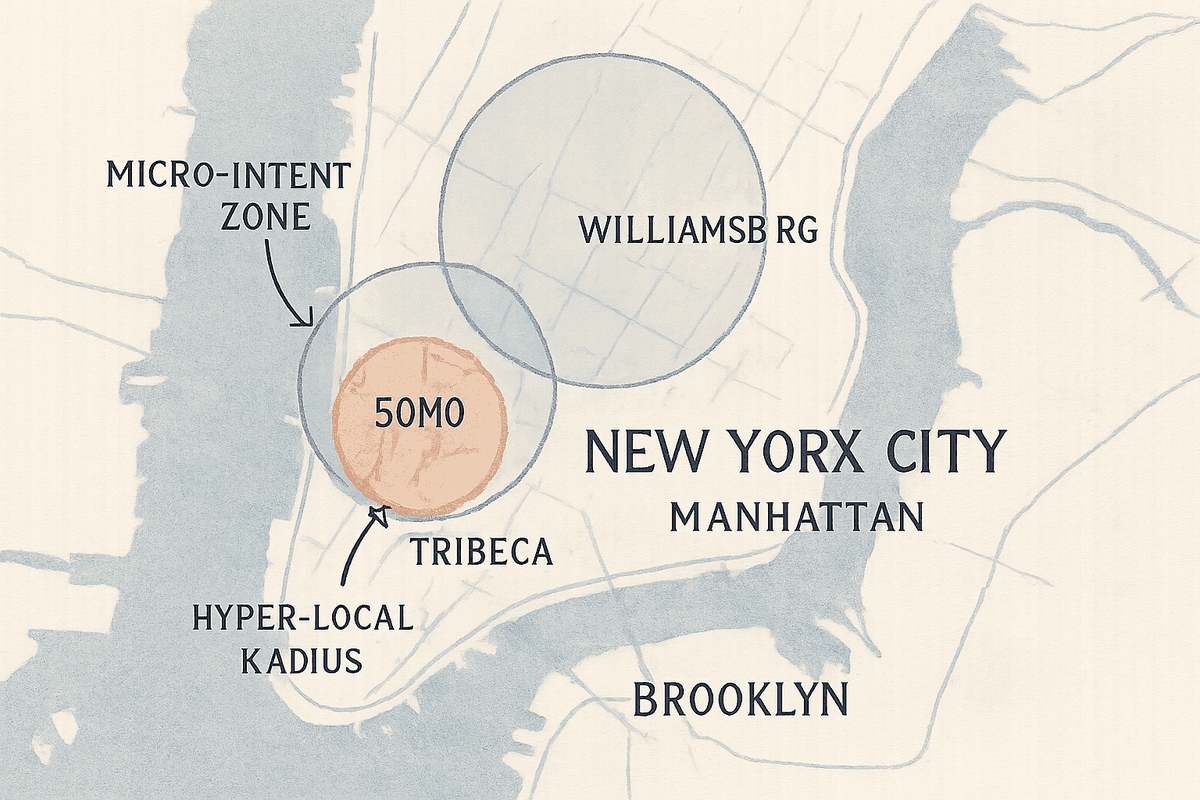
Google's local algorithm relies heavily on proximity to the searcher. Because the density of businesses in New York is astronomically high, Google's acceptable radius for a "near me" search shrinks dramatically. If you are trying to rank a SaaS company's local landing page for "restaurant POS systems Brooklyn," you are not just competing with national software providers; you are competing with localized resellers physically sitting in Williamsburg and Park Slope.
Neighborhood Nomenclature
New Yorkers rarely search by zip code, and they often ignore official borough names in favor of micro-neighborhoods. Searchers do not look for services in "New York, NY 10013." They search for "Tribeca," "SoHo," "DUMBO," or "Astoria." Your content must map to the vernacular of the residents, not just USPS designations.
High Mobile and Transit Search Volume
Search behavior in New York is inherently mobile and transit-oriented. People search while walking or riding the subway. This means navigational intent is exceptionally high. If your mobile site speed is poor, or your structured data fails to explicitly state your service area or physical location, bounce rates will spike, dragging down your rankings.
Tactic 1: Claim Digital Territory Across All Maps (Not Just Google)
Many businesses obsess over their Google Business Profile (GBP) and ignore the rest of the ecosystem. While Google holds the lion's share of search volume, neglecting alternative map platforms is a massive mistake in a market where every percentage point of market share matters.
Google Maps Optimization
The foundation of local SEO remains your Google Business Profile. For New York, you must move beyond basic setup:
- Primary Category Selection: Be ruthlessly specific. "Software Company" is too broad. "B2B SaaS Provider" or "Point of Sale Software Provider" narrows the competitive field.
- Service Areas: If you do not have a physical storefront but serve local clients, define your service areas by specific NYC neighborhoods, not just "New York State."
- Geotagged Updates: Post weekly updates featuring local context. If your agency helped a client in Long Island City, mention Long Island City in the update text.
Apple Business Connect
New York has a massive iOS user base. When someone uses an iPhone to ask Siri for a recommendation or opens Apple Maps directly, Google is completely bypassed. Apple Business Connect allows you to claim your location cards, update imagery, and inject keywords into your business description. For businesses relying on foot traffic or local brand awareness, optimizing for Apple Maps is non-negotiable.
Bing Maps Optimization
Do not ignore Bing. Many corporate offices in Manhattan operate on locked-down Windows machines where Microsoft Edge and Bing are the default browser and search engine. B2B SaaS companies and service providers often find highly qualified, high-intent enterprise traffic coming through Bing Maps. As noted by specialized practitioners like TM Blast, optimizing across all secondary platforms establishes the local citations required to build geographic authority.
Tactic 2: Build Hyper-Local Page Architectures
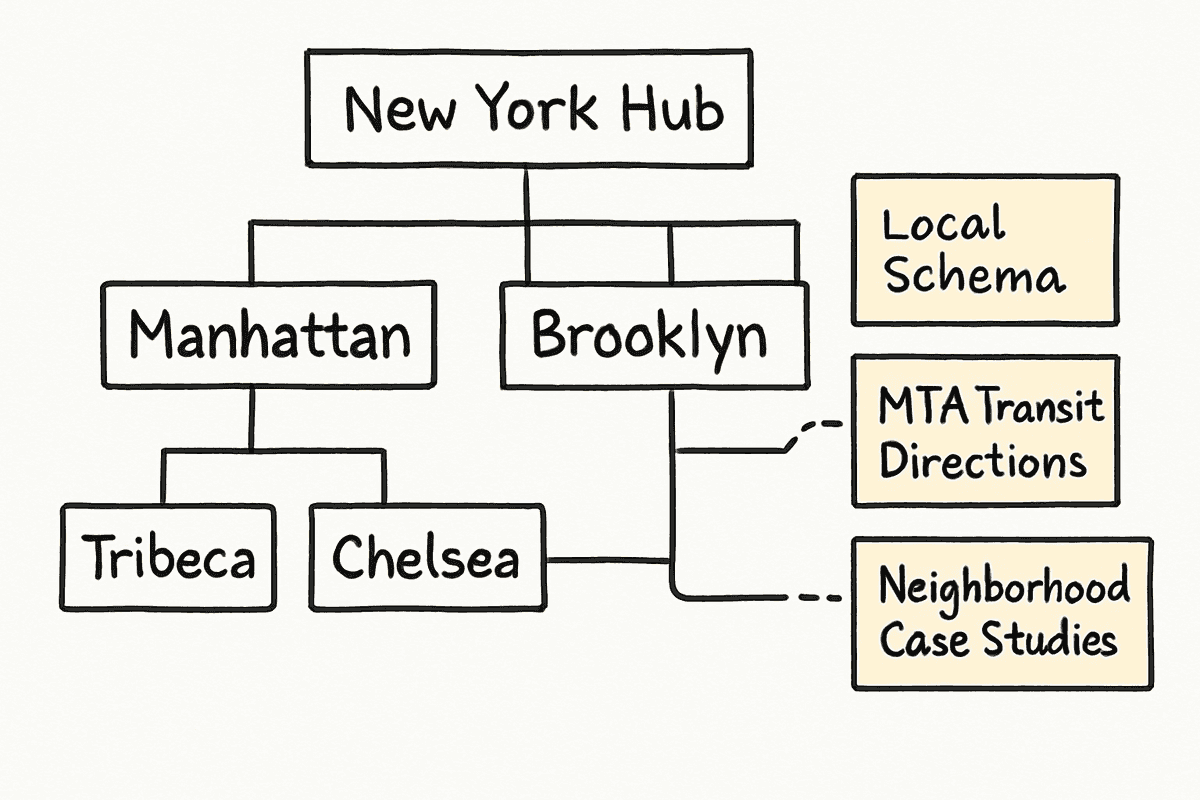
Attempting to rank a single page for "New York SEO Services" or "New York Restaurant Software" is an uphill battle. The search intent is too broad, and the competition is too fierce. You need a hub-and-spoke model of location pages.
If you want to understand the mechanics of these pages in depth, read How to Build an SEO Landing Page (7-Step Guide). For New York specifically, your architecture should look like this:
The Borough Hubs
Create a parent page for the primary market (e.g., /new-york/). Beneath this, create hub pages for the boroughs you actually serve:
/new-york/manhattan//new-york/brooklyn//new-york/queens/
The Neighborhood Spokes
Beneath the borough hubs, build out neighborhood-specific pages targeting long-tail intent. These pages must contain unique, hyper-local content. Do not just swap out the city name on a boilerplate template.
/new-york/manhattan/chelsea//new-york/brooklyn/williamsburg/
What Goes on a Hyper-Local NYC Page?
To prevent these pages from being flagged as thin content or doorway pages, they must offer genuine localized value:
- Neighborhood-Specific Case Studies: Detail how your SaaS product or service solved a problem for a specific client in that exact neighborhood.
- Transit Directions: Explain how to reach your office via the MTA (e.g., "Take the N or W train to Astoria Blvd"). This provides strong local semantic signals.
- Local Schema Markup: Inject LocalBusiness schema that explicitly lists cross streets, local neighborhood names, and exact coordinates.
Tactic 3: Automate Local Content Velocity
Search engines reward domains that consistently publish highly relevant, localized answers. However, maintaining content velocity—writing 20 to 30 neighborhood-specific articles a month—requires massive resources. Hiring freelance writers to produce this volume can drain a marketing budget instantly.
This is the exact friction point BeVisible solves for SaaS founders, indie hackers, and localized service businesses. BeVisible is an automated SEO content generation platform that transforms websites into daily sources of ranked answers.
Instead of paying steep New York agency retainers or managing a team of writers, you can automate your local content production entirely:
- Automated Keyword Mapping: Connect your site URL and define your niche. BeVisible conducts competitor analysis and builds a 30-day content map targeting specific NYC long-tail queries (e.g., "best inventory software for Brooklyn bodegas" or "how to handle local SEO for Manhattan real estate").
- Daily Publishing: The platform automatically writes, polishes, and publishes an article every 24 hours directly to your CMS (WordPress, Webflow, Notion, Ghost, or Shopify).
- Built-In SEO Optimization: Every article features answer-first structures, local schema markup, internal links, and metadata optimized for both traditional Google search and AI engines like ChatGPT.
For businesses comparing the cost of manual production against automated systems, review SEO Charges UK: Agency Rates vs Automation (2026) to understand the financial leverage of a system like BeVisible, which offers a Professional plan with 30 articles a month for $79 on its launch discount.
Tactic 4: Cultivate Hyper-Local Digital PR
Backlinks are still the currency of trust in organic search. For local SEO, relevance matters more than raw domain rating. A link from a local Brooklyn community blog carries more geographic weight than a link from a massive, generalized national publication.
Strategies for NYC Local Links
- Sponsor Local Events and Meetups: New York has thousands of active tech, SaaS, and industry-specific meetups. Sponsoring a local chapter often results in a permanent link from their localized event page.
- Hyper-Local Publications: Pitch stories to neighborhood blogs (like West Side Rag or Greenpointers). If you are a SaaS company that just released data on retail trends in Brooklyn, localized press will cover it.
- Block Associations and Chambers of Commerce: Joining local business groups provides highly trusted, geographically specific citation links.
If you are managing the SEO strategy yourself, staying educated on shifting link-building tactics is critical. Keep up with the 11 Best SEO Blogs Every SaaS Founder Needs (2026) to track algorithm updates affecting link valuation.
Tactic 5: Engineer Review Velocity and Semantic Relevance
Total review count is a vanity metric. What search engines actually measure is review velocity (how consistently you get new reviews) and semantic relevance (what words customers use in those reviews).
The Power of Semantic Reviews
If you run an IT consulting firm in the Financial District, a review saying "Great service!" is helpful for conversions. A review saying "They set up the entire IT infrastructure for our new office in the Financial District and handled all the local networking" is algorithmic gold.
Google parses the text of reviews to understand the context of your business.
How to Drive Review Velocity
- Automate Requests: Integrate your CRM with review generation software to request a review exactly 24 hours after a successful client interaction.
- Prompt for Specificity: When asking for a review, gently guide the client. Ask them to mention what specific service you provided and what neighborhood they are located in.
- Respond with Keywords: When you reply to reviews, reinforce the local signals. (e.g., "Thanks, Sarah! We loved helping your team upgrade their software stack in your new Midtown location.")
Evaluating Agencies vs. Building In-House
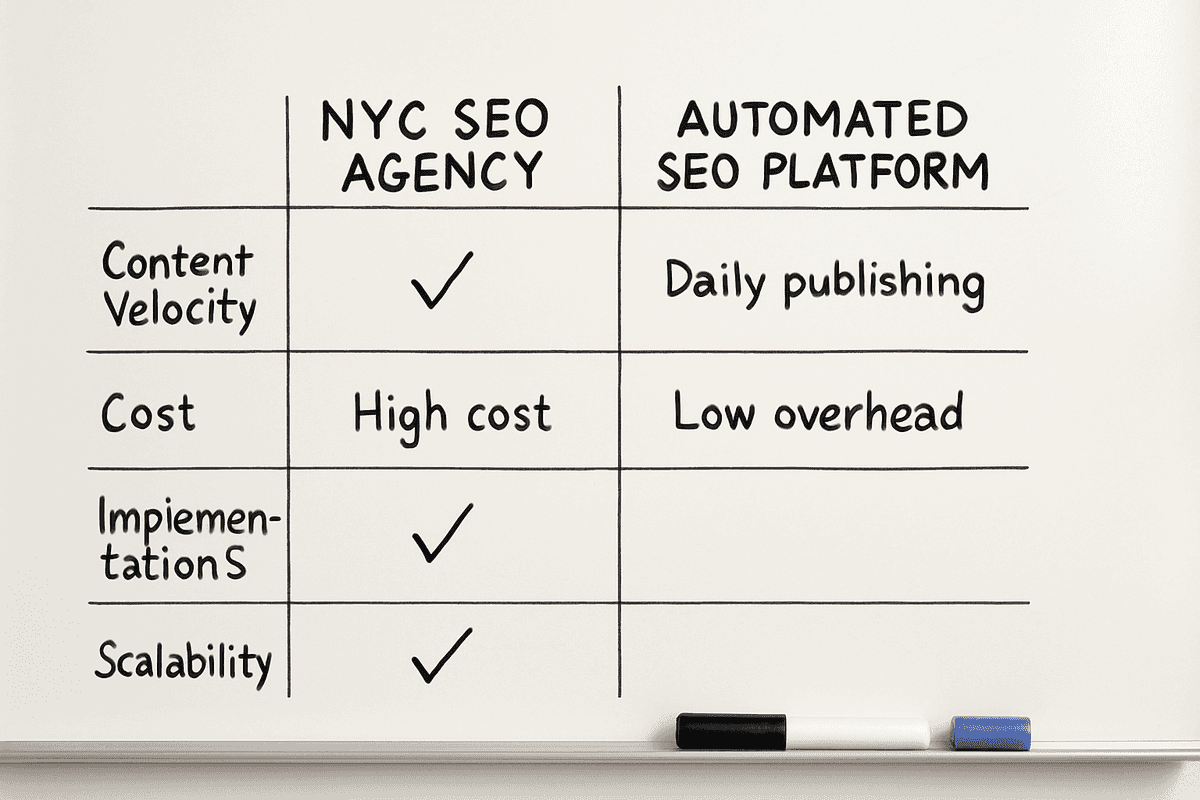
Eventually, every growing company in New York faces a choice: hire a local SEO agency or build an automated in-house machine.
When evaluating high-end agencies featured on lists like Semrush, you will find that New York SEO firms charge a premium simply for their zip code. Retainers often start at $3,000 to $5,000 a month just for local maps management and a few blog posts.
If you are vetting these firms, you must know what red flags to look for. Read Hiring SEO Services in Phoenix? 5 Red Flags (2026) to understand the warning signs of bad agency contracts—the exact same rules apply in New York.
The Alternative: Technical Excellence + Automation
For many SaaS founders and indie hackers, the better path is ensuring technical excellence and automating the content layer.
If your SaaS platform relies heavily on modern JavaScript frameworks, your first step isn't local content—it's making sure Google can actually render your site. Review the SEO for Single Page Applications: A 5-Step Guide (2026) to ensure your technical foundation is solid.
Once the technical layer is secure, deploying an automated solution like BeVisible allows you to match the content output of a top-tier New York agency at a fraction of the cost. By mapping the right local keywords and committing to a daily publishing schedule, you build the geographic authority necessary to rank, even in the most crowded digital territory in the world.
Frequently Asked Questions (NYC Local SEO)
Does a Manhattan address rank better than a Brooklyn address?
It depends entirely on the searcher's location. If the searcher is in Manhattan, the Manhattan address has the proximity advantage. There is no inherent "domain authority" granted just for being in Manhattan. Google prioritizes user proximity above prestige.
Can I rank in New York without a physical office?
Yes, but it requires a strict Service Area Business (SAB) strategy. You must hide your physical address if it is residential or out-of-state, and rely heavily on hyper-local landing pages, localized schema markup, and localized digital PR to prove your relevance to the specific boroughs you serve.
How long does it take to see local SEO results in NYC?
Because the market is saturated, moving the needle takes longer than in tier-two cities. Expect a timeline of 4 to 6 months of consistent map optimization, technical improvements, and daily localized content publishing before seeing significant shifts in competitive "near me" queries.