
You search for your core service and city, and there it is: a competitor with an inferior product, half your experience, and a terrible website sitting comfortably at the top of the Google Map Pack. Meanwhile, your business is buried on page two.
It is a frustrating realization, and it usually leads to one immediate thought: "I need to hire a local SEO expert."
But hiring a local SEO specialist is a minefield. The barrier to entry in the SEO industry is notoriously low. For every seasoned practitioner who actually understands the nuances of local search algorithms, there are ten self-proclaimed "gurus" whose entire strategy consists of spinning spammy city pages and buying low-quality directory links.
Whether you are an agency owner looking to outsource client work, a local service provider, or a SaaS founder building hyper-localized landing pages, understanding what a legitimate local SEO specialist does—and what you should automate instead—will save you thousands of dollars and months of lost time.
Here is what you need to know before you sign a retainer, approve an hourly rate, or hand over the keys to your Google Business Profile.
What Does a Local SEO Specialist Actually Do?
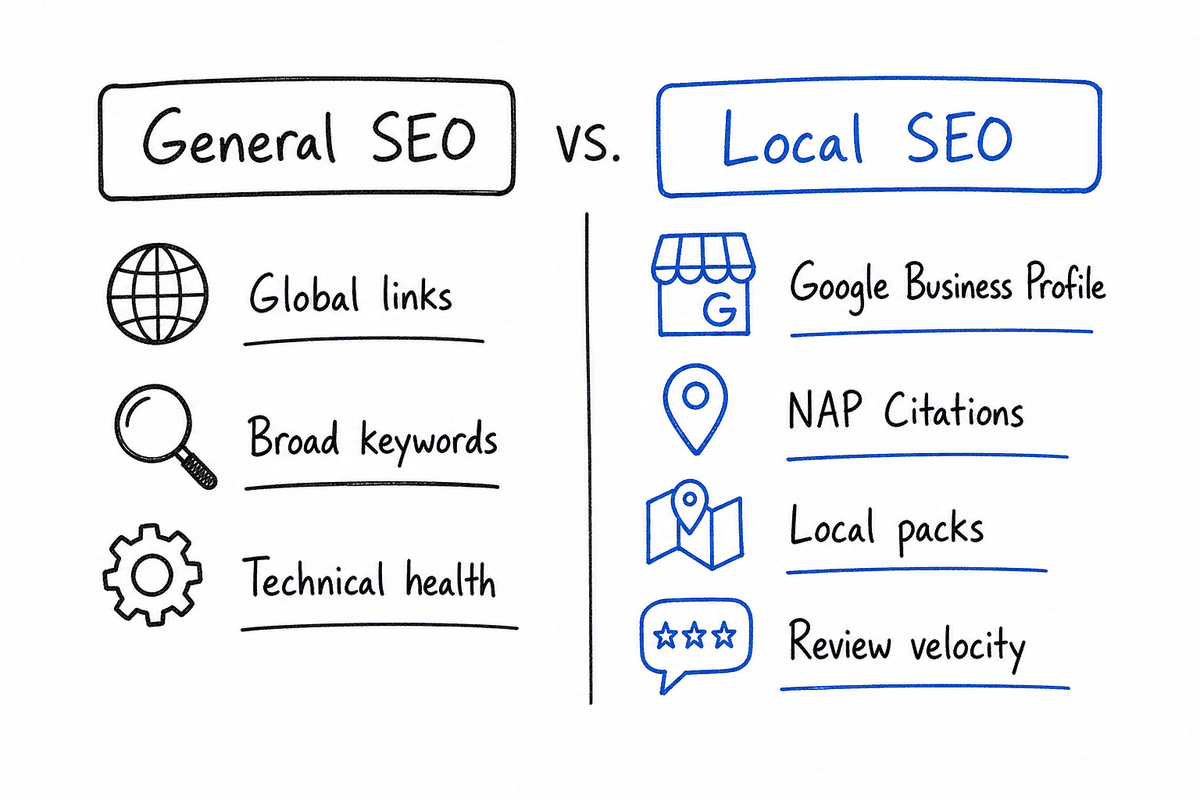
General SEO focuses on ranking a website globally or nationally. Local SEO is an entirely different beast. It is specifically designed to maximize visibility for geographic-specific queries (e.g., "inventory management software in chicago" or "best local marketing agency").
The deliverables look fundamentally different. If you hire a local SEO specialist, their daily workflow should revolve around three distinct pillars: Google Business Profile optimization, local citation management, and localized content strategy.
1. Google Business Profile (GBP) Mastery
Your Google Business Profile is the lifeblood of local search. It dictates whether you appear in the coveted "Map Pack" (the top three local results shown above organic web listings). A true specialist doesn't just "set up" your profile; they actively manage it.
This involves categorized service structures, weekly optimized GBP posts, Q&A seeding, and image geotagging. More importantly, they handle review velocity—strategizing how to consistently generate positive reviews to signal trust and freshness to Google.
2. The NAP Ecosystem and Citations
NAP stands for Name, Address, and Phone number. Google uses external directories (Yelp, YellowPages, industry-specific aggregators) to verify that your business is legitimate.
If your address is formatted as "Suite 100" on your site, "Ste 100" on Yelp, and omitted entirely on an industry directory, Google’s confidence in your business drops. A specialist audits this entire ecosystem, standardizing your NAP data across hundreds of data aggregators using manual outreach or tools like Yext and BrightLocal.
3. Hyper-Local Content and On-Page Strategy
Ranking in the Map Pack is only half the battle. You also need to dominate the traditional organic results beneath it. This requires building dedicated, localized service pages.
Historically, agencies would charge a premium to manually write 50 different pages targeting 50 different cities. Today, this is exactly the kind of manual grind that smart businesses avoid by using automation, reserving their human specialist's hours for high-level strategy and link building.
The SaaS & Agency Dilemma: Do You Even Need Local SEO?
It is a common misconception that local SEO is only for plumbers, dentists, and brick-and-mortar retail stores. In reality, local SEO is one of the most underutilized growth levers for vertical SaaS platforms and B2B agencies.
Consider an indie hacker who built a lightweight CRM for chiropractors. Attempting to rank for "chiropractor CRM" pits them against massive, venture-backed companies. However, creating programmatic local pages targeting "chiropractor CRM software in Denver" or "patient management software Austin" taps into high-intent, low-competition searches.
Agencies face a similar challenge. If you are struggling to stand out nationally, dominating your backyard is the fastest path to cash flow. In fact, reviewing local agency landscapes—like checking the top competitors for seo in durham—reveals that agencies who aggressively target their own local markets establish a baseline of inbound leads that sustains them while they build national authority.
Freelancer vs. Agency vs. Automation: Who Should You Hire?
When you are ready to pull the trigger, you have three primary routes. The right choice depends on your budget, your timeline, and whether you need technical strategy or just pure content execution.
The Freelance Specialist
Hiring a freelancer is often the most flexible route. Marketplaces like Upwork and Fiverr are filled with specialists. If you want vetted talent without the traditional marketplace sift, platforms like Toptal curate top-tier freelance marketers.
- Pros: Lower overhead costs compared to an agency. Direct communication with the person actually doing the work. Highly specialized (you can hire someone who only does GBP optimization).
- Cons: Reliability can be an issue. They often lack the enterprise tools an agency possesses. You must project-manage the engagement yourself.
The Dedicated Local SEO Agency
If you have a larger budget and want a "done-for-you" service, hiring a dedicated agency is the traditional path. Established players like Logical Position offer structured, tiered packages focusing specifically on local visibility.
- Pros: Deep bench of talent (copywriters, technical SEOs, link builders). Access to expensive enterprise software. Proven processes and reporting dashboards.
- Cons: Expensive monthly retainers. You are often assigned a junior account manager rather than a seasoned specialist. Slower execution due to internal red tape.

The Automation Route (Replacing the Content Grind)
A massive chunk of what you pay a local SEO specialist for is simply content creation—writing city-specific service pages, building seo landing pages, and publishing blog posts to build topical authority.
This is where the industry has shifted. Instead of paying an agency $2,000 a month to manually write these pages, smart founders use platforms like BeVisible. By connecting to your site URL, BeVisible analyzes your niche and competitors, builds a 30-day content map, and automatically writes, polishes, and publishes an article every 24 hours.
Because the articles feature answer-first structures, schema markup, and internal links optimized for both traditional search and AI engines (like ChatGPT and Perplexity), you get the localized content footprint of a massive agency for $79 a month. You can then take the remaining budget and hire a specialized freelancer purely for high-level technical tasks, like acquiring local backlinks.
5 Red Flags When Interviewing a Local SEO Expert
The local SEO industry has a reputation problem. If you are evaluating a candidate or an agency, listen closely during the discovery call. If you hear any of these red flags, walk away.
1. The "Guaranteed #1 Ranking" Promise
No one controls Google. The algorithm factors in user proximity, search history, and real-time behavioral data. If a specialist guarantees that you will rank #1 in the Map Pack within 30 days, they are either lying or planning to use black-hat tactics (like keyword-stuffing your business name) that will eventually get your profile suspended.
2. They Don't Ask About Your Offline Business
A true local SEO specialist knows that local rankings are deeply tied to real-world operations. If they don't ask about your service radius, your physical office setup (co-working space vs. dedicated storefront), or how you currently collect customer reviews, they don't understand local search.
3. Ignoring Schema Markup
LocalBusiness schema is code injected into your website that speaks directly to search engines. It explicitly tells Google your business name, coordinates, opening hours, and accepted payment methods. If their technical audit ignores schema markup, their technical foundation is weak.
4. Relying on Spammy PBNs for Local Links
Link building is hard. Local link building is even harder. Bad agencies take shortcuts by pointing Private Blog Networks (PBNs) at your site. A legitimate specialist will talk about local PR, sponsoring local little league teams, joining the regional Chamber of Commerce, or acquiring links from local news outlets. If you are hiring SEO services in Phoenix, you want links from Phoenix-based businesses, not a generic blog farm in Eastern Europe.
5. Their Entire Strategy is "Spinning" Content
If their master plan is to take one piece of content, swap out the city name 100 times, and publish it across your site, they are living in 2015. Google’s "Helpful Content" system aggressively demotes low-effort, mass-produced doorway pages. Every local page must provide unique, localized value.
How Much Should You Pay for Local SEO Services?
Pricing in local SEO is notoriously opaque. A quick glance at industry discussions, like this Reddit thread on local SEO pricing, shows wild variations in what small businesses and founders are quoted.
Generally, local SEO pricing falls into three buckets:
Be highly skeptical of the "$149/month" packages advertised online. At that price point, the agency cannot afford to allocate human hours to your campaign. They are simply plugging your business into an automated citation tool like Yext and pocketing the margin.
If you are comparing seo charges UK or US rates, always ask for a line-item breakdown of deliverables. You are paying for labor, strategy, and asset creation—not just "optimizations."
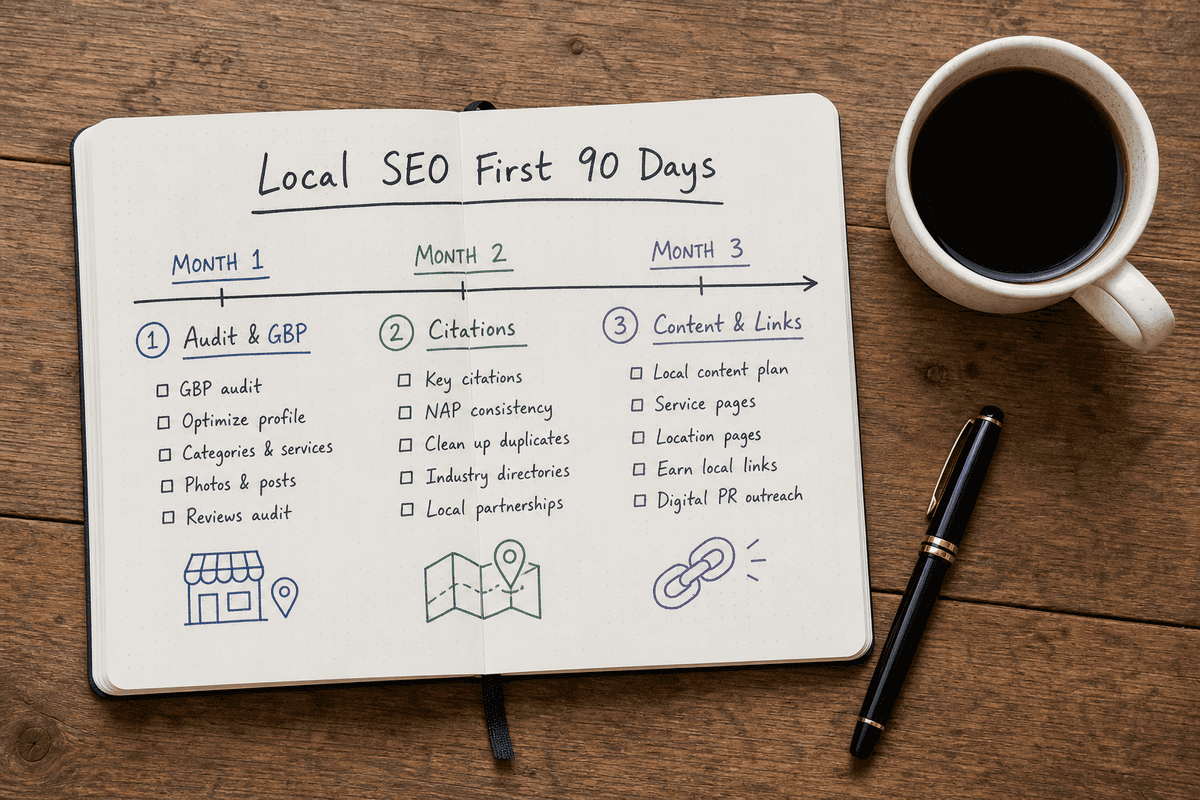
The Local SEO Deliverables Checklist (First 90 Days)
If you hire a competent professional (or a vetted expert from lists like OneLittleWeb's top experts), their first 90 days should look highly structured.
Use this timeline as a benchmark to hold your hire accountable.
Month 1: Audit, Cleanup, and Foundation
- GBP Audit: Claiming the profile, resolving duplicate listings, and optimizing categories and attributes.
- Technical Site Audit: Fixing broken links, improving mobile page speed, and implementing LocalBusiness schema markup.
- Baseline Reporting: Setting up Google Search Console and local rank tracking software (like GeoGrid trackers) to establish current visibility.
Month 2: The Citation Campaign
- NAP Consistency Check: Identifying discrepancies across the web where your business name or phone number is wrong.
- Data Aggregator Submission: Pushing correct data to primary aggregators (Data Axle, Foursquare, Neustar Localeze).
- Hyper-Local Directory Outreach: Getting listed in highly specific regional directories (local business associations, city portals).
Month 3: Content and Review Velocity
- Review Strategy Rollout: Implementing an automated or manual system to request reviews from satisfied customers via SMS or email.
- Localized Content Generation: Publishing high-quality pages targeting specific services within specific neighborhoods.
- Local Link Outreach: Pitching local journalists, podcasts, or complementary businesses for backlink opportunities.
Stop Paying Humans for Robotic Work
The most successful modern SEO strategies combine elite human strategy with relentless machine execution.
Hiring a local SEO specialist is a smart move if you need someone to un-suspend a Google Business Profile, negotiate a link placement with a local newspaper, or architect a complex multi-location site structure. Those are high-leverage, human-required tasks.
But paying an agency retainer to write, format, and publish localized blog content or service answers is an outdated model.
For content marketers, e-commerce owners, and SaaS founders building organic traffic, platforms like BeVisible handle the entire production pipeline. By automating keyword research, building a 30-day content map, and auto-publishing daily optimized articles tailored for both Google and AI search engines, you secure the organic footprint you need.
Outsource the high-level relationship building to a specialized freelancer. Automate the daily content engine. That is how you dominate local search without bloated agency retainers.
Frequently Asked Questions
How long does local SEO take to show results? Unlike national SEO, which can take 6-12 months, local SEO can show movement much faster. If your issue is simply a poorly optimized Google Business Profile or conflicting NAP data, you can see Map Pack movement in as little as 30 to 60 days. Building organic authority for competitive local keywords, however, still follows a 3-6 month timeline.
Is local SEO worth it for vertical SaaS companies? Absolutely. If your SaaS caters to a physical business model (e.g., inventory software for auto shops), local decision-makers often search locally. Creating automated programmatic pages for "auto shop software in [City]" captures extremely high-intent, low-cost organic traffic that competitors ignore.
Can I do local SEO myself without hiring a specialist? Yes, the foundational steps are highly accessible. Claiming your GBP, filling out every field accurately, adding high-quality photos, and consistently gathering reviews will put you ahead of 70% of local businesses. You only need to hire a specialist when you hit a plateau, face aggressive competition, or encounter technical penalties.