
Most SaaS founders hit a wall when their daily growth flatlines. They check their analytics dashboards, stare at flat traffic graphs, and wonder which of their fifty backlog ideas will actually move the needle. The problem is rarely a lack of data. The problem is a lack of prioritization and visibility.
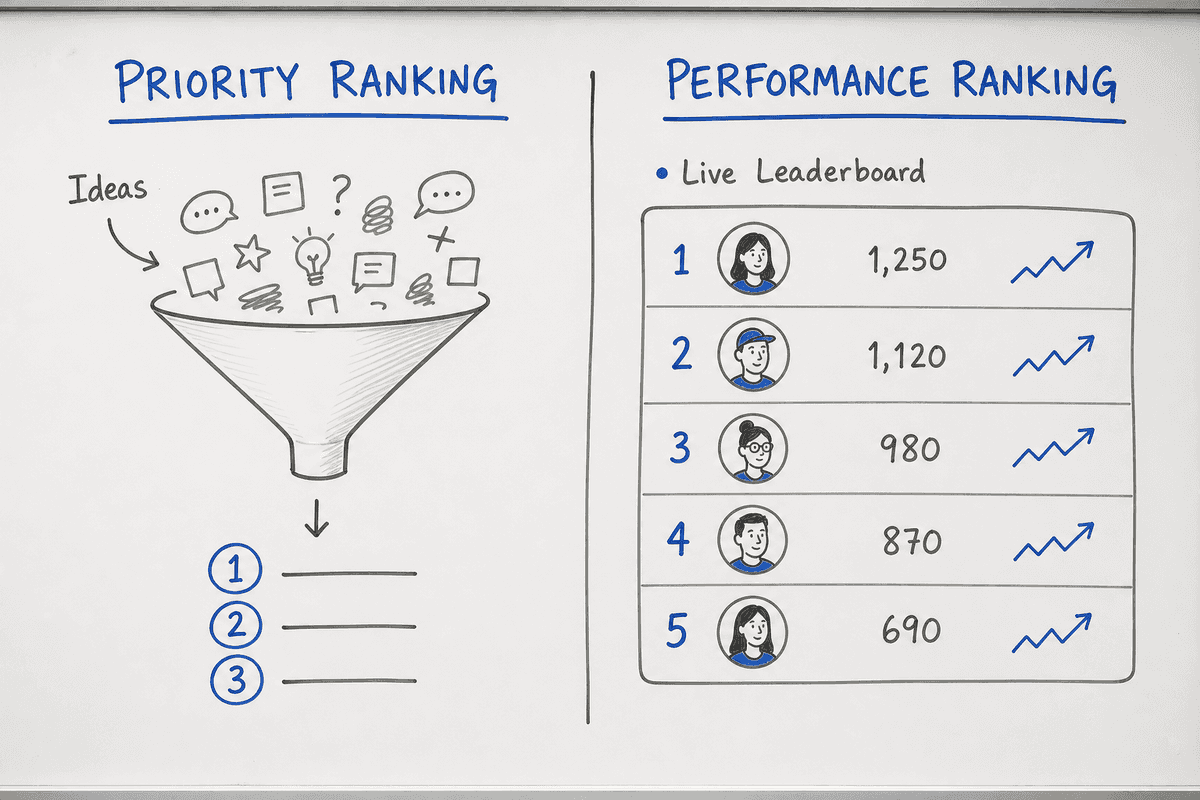
When you search for an "online ranking tool," you are usually looking to solve one of two distinct growth bottlenecks. You either need to force-rank your team's competing priorities to figure out what to build next, or you need a live leaderboard to track daily performance—whether that is your sales team's outreach or your website's search engine visibility.
Growth in 2026 requires mastering both sides of this equation. You have to rank your inputs to know what matters, and you have to rank your outputs to see if it worked.
This guide breaks down exactly how to use modern online ranking tools to force-rank your roadmap, build real-time leaderboards, and track your daily organic growth.
The Dual Nature of Ranking Tools in Growth Operations
Tracking daily growth is not a passive activity. It requires actively sorting your initiatives and gamifying your results. To do this, growth teams rely on two distinct categories of ranking software.
1. Decision and Priority Ranking
These tools help you figure out what to execute today. When a product team has twenty feature requests or a marketing team has thirty content ideas, a traditional 1-10 rating scale fails. Everything gets scored an 8, and you are left with no clear starting point.
Priority ranking tools force a strict 1-to-N list. They use algorithms to pit items against each other, ensuring that your team agrees on the absolute most critical task for the day.
2. Performance and Leaderboard Ranking
Once you execute your priorities, you need to track the results. Performance ranking tools ingest data and output live, ranked lists. This might be a sales team leaderboard that updates in real-time on a monitor in the office, or an SEO rank tracker monitoring your daily keyword growth on Google and AI search engines.
Top Online Ranking Tools for Team Prioritization
If you want to track daily growth, you first need to ensure you are growing the right things. Using an online ranking tool to build custom ranking lists for any purpose keeps your team aligned. Here are the standout tools for prioritization in 2026.
OpinionX: Stack Ranking for User Research
OpinionX is a powerful free online ranking tool designed specifically for product and growth teams. Instead of sending out standard surveys where users check boxes, OpinionX forces respondents to make trade-offs.
By using stack ranking and pairwise comparison, OpinionX tells you exactly which features or content topics your audience values most. If you are a SaaS founder trying to decide between building an integration or improving your dashboard, putting those options into OpinionX removes the guesswork. You get a definitive, ranked list based on actual user consensus.
ForceRank: Agile Team Alignment
When your internal team cannot agree on the next sprint, ForceRank provides a rapid solution. It is an online ranking tool for team prioritization that asks each stakeholder to drag and drop items into a strict ranked list.
ForceRank then aggregates these individual lists to highlight consensus and surface disagreements. If your lead developer ranks a technical debt task at #1, but your head of growth ranks it at #10, the tool flags that discrepancy immediately. Resolving these misalignments is crucial for maintaining daily momentum.
Pairwise Sorting Engines
Sometimes you just need a barebones logic engine to sort a massive list of ideas. Tools like Priority Sort and PubMeeple's Ranking Engine excel here.
They use pairwise comparison—showing you two items at a time and asking, "Which is more important?" By cycling through your options, the underlying algorithm (often an Elo rating system similar to chess rankings) generates a mathematically sound ranked list from your subjective choices.
Top Tools for Tracking Live Performance and Leaderboards
Once your tasks are prioritized and executed, the focus shifts to tracking the outcomes. Real-time feedback loops are the engine of daily growth.
Leaderboarded: Live Gamification
If you manage a sales team, a community, or a tournament, Leaderboarded functions as a live ranking tool built for real-time updates.
Gamification works because it creates visible stakes. When sales reps can see their names moving up and down a custom ranking list throughout the day, activity levels spike. Leaderboarded allows you to connect data sources via API and embed the resulting leaderboard on any website or internal dashboard. The psychological impact of seeing a live score change cannot be overstated.
Tracking Organic SEO Growth
For content marketers and indie hackers, daily growth is often measured by search engine rankings. Tracking how your pages rank across thousands of queries requires specialized automated software.
This is where the execution and tracking overlap. If you are manually writing content, building an SEO landing page piece by piece, and manually checking your keyword positions, you will quickly burn out.
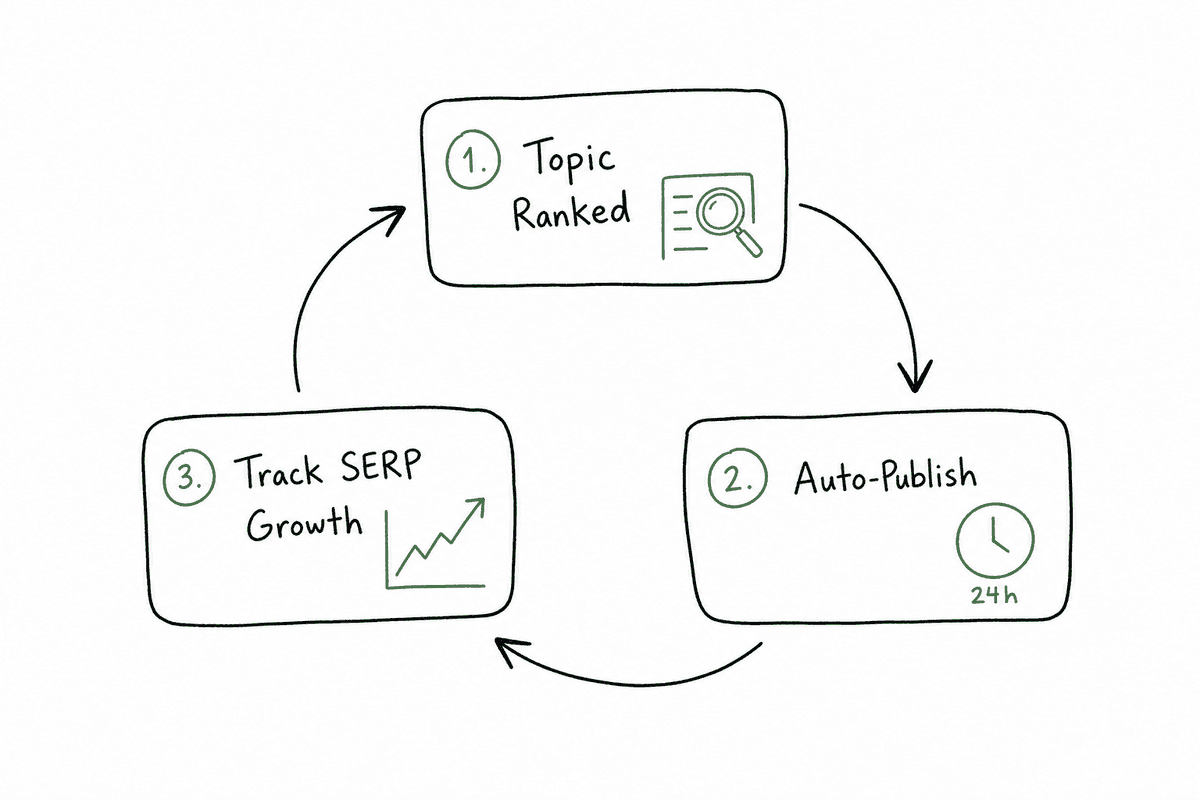
Platforms like BeVisible handle this entire loop automatically. BeVisible is an automated SEO content generation and publishing platform that transforms your site into a daily source of ranked answers for Google and AI engines like ChatGPT. It connects to your URL, builds a 30-day content map, and automatically writes, polishes, and publishes articles every 24 hours.
Because the platform integrates directly with Google Search Console analytics, it effectively acts as your internal organic ranking tool, showing you exactly how those daily auto-published articles are climbing the SERPs.
5 Core Features of a Modern Online Ranking Tool
Whether you are building classroom rankings for teachers, competition and tournament rankings, or tracking SaaS metrics, the best ranking tools share a few foundational features.
1. Real-Time Updates
Static spreadsheets are dead. If your ranking tool requires manual refreshing or batch processing overnight, it fails the daily growth test. A live ranking tool must process inputs instantly. When a user votes on an OpinionX poll or a sales rep closes a deal, the leaderboard should reflect that change within seconds.
2. Embed on Any Website
Rankings only drive behavior if people see them. The ability to embed a leaderboard or a voting interface directly into your own app, Notion workspace, or WordPress site is critical. Frictionless visibility ensures your team and users interact with the rankings continuously.
3. Custom Ranking Lists for Any Purpose
Flexibility is non-negotiable. You might need to rank marketing channels by ROI on Monday, and then rank software bugs by severity on Tuesday. Look for tools that allow custom fields, weighted variables, and flexible data ingestion.
4. Transparent Algorithms
If a tool spits out a ranked list, you need to know how it arrived at that conclusion. Does it use simple average scoring? A weighted Borda count? An Elo rating system? Understanding the underlying math helps you trust the output, especially when making high-stakes product decisions.
5. Seamless API Integration
Modern growth stacks are interconnected. Your ranking tool should pull data from your CRM, product analytics, or CMS without manual CSV uploads.
This is particularly relevant for modern web architectures. For instance, if you are running a single-page application, tracking user events and SEO metrics can be complex. You need tools that interface cleanly with your frontend. To understand how to structure your site to capture these growth metrics effectively, check out this guide on Single-Page Application SEO: What Works in 2026?.
The Framework: Building a Daily Growth Routine
Software alone does not create growth. You need an operational framework to tie your prioritization tools and performance trackers together. Here is a battle-tested daily routine for SaaS founders and content teams.
Step 1: Capture the Inputs
Throughout the week, collect ideas, feature requests, and target keywords. Store these in a central repository. Do not evaluate them immediately; just capture them.
Step 2: Force-Rank the Backlog
At the start of your sprint (or daily, if you move fast), run your unprioritized list through an online ranking tool like ForceRank. Have your core team spend five minutes doing pairwise comparisons.
This brief exercise eliminates endless debate meetings. You emerge with a strict, mathematically verified 1-to-N list of what needs to happen today.
Step 3: Execute with Automation
Take the number one priority and execute it. If your priority is organic traffic growth, lean on automation to do the heavy lifting.
Instead of hiring expensive agencies—which often come with hefty price tags, as noted in discussions about SEO charges UK—you can use BeVisible to handle the daily execution. By generating and publishing highly optimized, schema-rich content every 24 hours, you guarantee that your daily growth inputs are consistently being met.
Step 4: Monitor the Leaderboard
Watch the results flow in. If you are tracking sales, keep your Leaderboarded dashboard visible to the team. If you are tracking organic growth, monitor your daily impressions and rank changes in Google Search Console.

Common Pitfalls When Ranking Growth Initiatives
Even with the best tools, teams frequently sabotage their own growth through poor ranking practices.
Falling Back on "Gut Feel"
The most common failure mode is using a ranking tool, getting a result you dislike, and ignoring it. If your OpinionX poll clearly shows that users care more about export functionality than a new dashboard UI, but you build the UI anyway, you are wasting your growth potential. Trust the data you collect.
Allowing Ties
Never allow items to tie for the number one spot. If you have two "Priority 1" tasks, you actually have zero priorities. The primary value of an online ranking tool is forcing a decision. Embrace the friction of choosing.
Tracking Vanity Metrics
When building a live leaderboard, ensure you are tracking metrics that actually matter. Ranking your team by "emails sent" instead of "meetings booked" will lead to a massive spike in low-quality emails. Gamification is powerful; be very careful about what behavior you are incentivizing.
Scaling Your Growth Stack
As your SaaS or agency grows, the volume of data you need to rank will multiply. You will transition from ranking a few blog ideas to managing massive content clusters, and from tracking a single sales rep to managing entire regional teams.
To keep up, you must continuously refine the tools you use. Staying informed about the latest software and strategies is essential. Curating a list of the 11 Best SEO Blogs Every SaaS Founder Needs is a great way to ensure you are always aware of the cutting edge in growth and ranking technology.
Frequently Asked Questions
What is the best free online ranking tool? For user feedback and polling, OpinionX offers a highly robust free tier that includes stack ranking and pairwise comparison. If you just need to quickly sort a personal list of items, PubMeeple's Ranking Engine is entirely free and incredibly fast.
How does pairwise comparison work in ranking tools? Pairwise comparison breaks down a long list by showing you only two items at a time. You choose the winner between the two. The algorithm repeats this process across different combinations, assigning a score to each item based on its win/loss record against the others, ultimately generating a fully ranked list.
Can I embed live rankings on my website? Yes. Tools like Leaderboarded provide simple iframe or API integrations that allow you to display real-time custom ranking lists on nearly any platform, including WordPress, Notion, Webflow, and custom React applications.
How often should I review my prioritized ranking lists? For fast-moving SaaS teams, backlog priorities should be force-ranked weekly. Live performance dashboards and SEO rankings, however, should be monitored daily to spot immediate growth trends or traffic drops.
Tracking daily growth requires discipline. By combining the decisive power of prioritization tools with the real-time visibility of live leaderboards, you eliminate the guesswork from your daily operations. You know exactly what to do next, and you can see exactly how well it is working.