
When a prospective buyer asks ChatGPT, Perplexity, or Gemini to compare B2B software solutions, your search visibility is no longer determined solely by blue links. AI engines synthesize dynamic answers, recommend two or three primary tools, and ground their choices in specific web citations.
If your SaaS platform is omitted, miscategorized, or cited using outdated pricing data, you lose pipeline before the prospect ever visits your website.
Tools like Otterly.ai emerged early to give marketers a basic window into brand mentions across AI assistants. However, as AI search has matured, many SaaS growth teams, founders, and content leads have run into a clear bottleneck: tracking passive mentions in a dashboard does not fix visibility gaps. Knowing that Perplexity cited a competitor's blog post or that Gemini recommended a rival product does not automatically create the content, documentation, or review presence needed to win those citations back.
Evaluating the top Otterly.ai alternatives for SaaS websites requires looking closely at how modern AI citation monitoring works, where simple trackers fall short, and how workflow-driven execution turns missing mentions into published assets that win AI recommendation share.
Why SaaS Teams Are Moving Beyond Basic AI Citation Monitoring
Early AI monitoring platforms focused primarily on surface-level tracking. They queried language models with static brand prompts and returned basic charts showing whether your company name appeared in the output. While this provided an initial benchmark, SaaS marketing teams quickly encountered structural limitations.
+-------------------------------------------------------------------------------+
|                       TRADITIONAL MONITORS (e.g., Otterly)                    |
|                                                                               |
|  [ Prompt Query ] ---> [ LLM Output ] ---> [ Brand Mention Alert (Yes/No) ]   |
|                                                                               |
|  Problem: Leaves a manual gap between detecting missing citations and fixing  |
|  the underlying web sources that feed the LLM's RAG pipeline.                 |

+-------------------------------------------------------------------------------+
                                       |
                                       v
+-------------------------------------------------------------------------------+
|                   WORKFLOW-DRIVEN AI ENGINE (e.g., BeVisible)                 |
|                                                                               |
|  [ Prompt Matrix ] -> [ LLM Citation ] -> [ Root Source Analysis ]            |
|                              |                                                |
|                              +-------------> [ Automated Content Workflow ]   |
|                                              * GAP Identification             |
|                                              * Content Generation             |
|                                              * Review & Scheduling            |
|                                              * Publishing & Verification      |

+-------------------------------------------------------------------------------+
 The core issue stems from how AI assistants generate answers. Systems like Perplexity, Google AI Overviews, Gemini, and ChatGPT Search rely on Retrieval-Augmented Generation (RAG) and real-time web scraping. They do not just pull from fixed training data; they query live web indexes, extract snippets from high-authority sources, and synthesize an answer with footnoted citations.
Tracking these outputs requires measuring specific metrics:
- Page-Level Citation Tracking: Knowing that Perplexity cited
g2.comis vague. Knowing that it cited a specific review page or a competitor's comparative article gives you an actionable target. - Recommendation Share: A brand can be mentioned negatively or framed as an outdated alternative. Tracking whether your SaaS tool is recommended as a top choice versus merely named in a list is critical for measuring commercial impact.
- Prompt Drift: AI assistants update their underlying models and search indexes constantly. A prompt that returned your product on Monday might favor a competitor by Thursday due to a new industry roundup or press release.
- Actionable Remediation: Identifying a missing citation is only ten percent of the job. The remaining ninety percent involves creating, updating, and publishing content that influences the vector search space and forces the AI engine to re-evaluate your domain.
As noted in industry research on AI citation tracking tools from HubSpot, modern growth strategies require cross-model monitoring across multiple AI engines in parallel. Furthermore, analysis on AI citation tracking for SaaS marketing from OnlyAEO emphasizes that tracking intent-based metrics like citation rate and recommendation share provides a far accurate picture of pipeline potential than simple brand mentions.
SaaS companies need platforms that connect citation discovery directly to content production and publication workflows.
Key Evaluation Criteria for SaaS AI Citation Tools
Before selecting an Otterly.ai alternative, evaluate how well each platform handles the unique demands of software buyer journeys. SaaS buyers perform highly specific research queries, ranging from technical feature queries to direct vendor comparisons.
Use these criteria when evaluating citation monitoring tools for your SaaS team:
1. Cross-Model Search Coverage
Your prospects do not use a single AI assistant. A software architect might search Perplexity for technical documentation, while a VP of Sales asks ChatGPT Search for CRM recommendations, and a founder relies on Google AI Overviews while browsing search results. Your monitoring stack must cover all major engines under identical query parameters to maintain data integrity.
2. Page-Level Grounding Intelligence
Domain-level tracking creates an optical illusion. If a tool reports that ChatGPT cited your site, but the source was a buried, unindexed privacy policy rather than a core product feature page, your visibility metric is false. Effective tools isolate the exact target URLs cited by the LLM, revealing which blog posts, documentation pages, or review sites are driving the AI's recommendations.
3. Recommendation Share vs. Passive Mentions
In B2B SaaS, being listed fifth in a bulleted list of ten tools produces minimal conversion. Being highlighted in the top two recommended solutions with explicit feature endorsements drives qualified demo requests. Look for tools that quantify recommendation share alongside raw citation counts.
4. Integrated Content Execution
The primary point of failure for legacy citation monitors is the handoff between analytics and execution. When an alert signals that a competitor has taken over the top recommendation spot for "best SOC2 compliance software for startups," your content team needs an immediate path to publish counter-evidence, update target pages, and recover that share of voice.
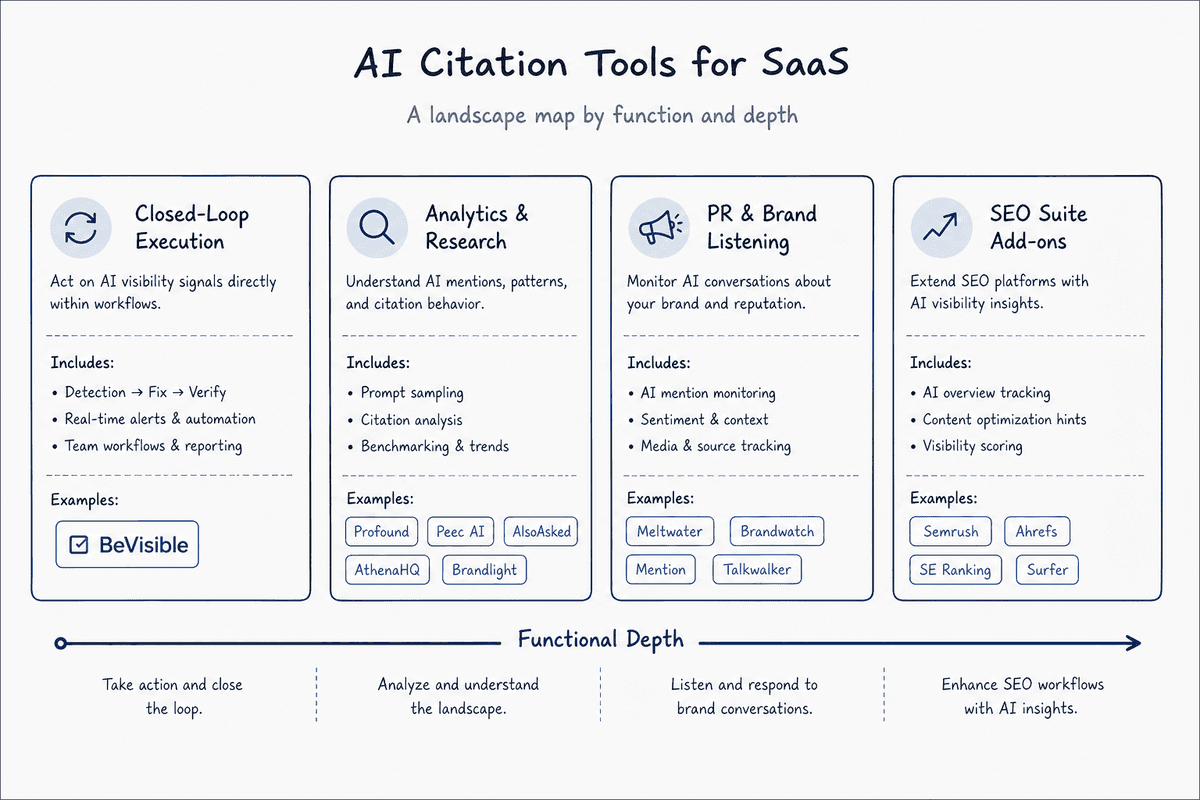
Top 5 Otterly.ai Alternatives for SaaS Websites
Below is a detailed breakdown of the leading alternatives to Otterly.ai, evaluated specifically on their feature set, citation tracking depth, and execution capabilities for software platforms.
+-------------------------------------------------------------------------------+
|                      AI CITATION TOOL LANDSCAPE FOR SAAS                      |
|                                                                               |
|  [ Closed-Loop Execution ]                                                    |
|  * BeVisible -------------------> Integrates discovery, gap analysis,         |
|                                   content creation, and direct publishing.    |
|                                                                               |
|  [ Analytics & Research ]                                                     |
|  * PeepMatrix / AI Trackers ----> High-volume prompt sampling & research.     |
|  * Ahrefs / Semrush Add-ons ----> Hybrid traditional SEO + LLM features.      |
|                                                                               |
|  [ PR & Brand Listening ]                                                     |
|  * Brand24 / Mention ------------> Web mentions + surface-level LLM alerts.   |
|                                                                               |
|  [ Developer Customization ]                                                  |
|  * Custom Python / LLM Stacks -> High maintenance, full raw API control.     |

+-------------------------------------------------------------------------------+
1. BeVisible
Best for: SaaS founders, growth teams, and B2B marketers who want to turn AI visibility gaps into published, revenue-generating content.
BeVisible is an end-to-end AI visibility monitoring and execution platform. While standalone monitors stop at reporting, BeVisible helps teams monitor how AI assistants answer buyer questions, which brands they recommend, and which sources they cite, then turns those visibility gaps into evidence-backed opportunities, articles, review, scheduling, and publishing work.
Key Features:
- Comprehensive Model Tracking: Monitors ChatGPT, Gemini, Perplexity, AI Mode, and Google AI Overviews simultaneously across multi-tiered buyer prompt sets.
- Granular Citation Analysis: Maps exact page-level citations, identifying the specific blog posts, documentation, comparison pages, and third-party review sites AI engines use to answer buyer prompts.
- Gap-to-Publish Workflow: Automatically converts missing mentions and weak citations into concrete content briefs, evidence-backed articles, structural site updates, and scheduled publishing workflows.
- Competitor Recommendation Auditing: Tracks when competitors are recommended over your product and identifies the underlying web sources giving them the advantage.
Pros:
- Bridges the gap between tracking data and content production.
- Designed specifically for B2B SaaS buyer journeys and high-intent software queries.
- Reduces team overhead by automating gap identification and draft creation in one interface.
Cons:
- Focused primarily on AI engine visibility and web execution rather than social media listening.
2. PeepMatrix & Dedicated AI Trackers
Best for: Enterprise research teams requiring raw API-level prompt sampling across thousands of programmatic variations.
Dedicated prompt analytics tools cater to enterprise research teams looking to measure LLM behavior at scale. These platforms run daily prompt batches across various system instructions to measure model drift and raw token distributions.
Key Features:
- Large-scale prompt matrix testing across developer APIs.
- Historical tracking of temperature and system prompt variations.
- Raw data exports for in-house data science teams.
Pros:
- High data volume for enterprise statistical analysis.
- Useful for testing how custom GPTs or fine-tuned models handle brand prompts.
Cons:
- No built-in workflow engine to produce or publish content when gaps are discovered.
- Requires significant manual data manipulation by marketing teams.
- Higher cost structure suited primarily for enterprise research budgets.
3. Brand24 & Modern Social Listening Hybrids
Best for: Brand PR managers monitoring overall web sentiment, social mentions, and general AI references.
Traditional web listening tools like Brand24 have expanded their scrapers to capture AI-generated summaries and public forum citations. They excel at alerting PR teams when a brand name appears across news sites, social media, and web scrapers.
Key Features:
- Unified dashboard combining social media, news, blogs, and basic LLM outputs.
- Sentiment scoring across general web commentary.
- Real-time email and Slack notifications for brand spikes.
Pros:
- Excellent for overall brand protection and corporate PR tracking.
- Broad web coverage beyond pure AI assistants.
Cons:
- Lacks page-level RAG citation analysis specific to B2B software queries.
- Does not analyze structured buyer prompts or competitive recommendation share.
- Provides no tools for content creation, optimization, or direct website publishing.
4. SEO Suite Add-ons (Ahrefs & Semrush AI Features)
Best for: Traditional SEO specialists who want to monitor AI search features alongside classic organic keyword rankings.
Major SEO suites have begun incorporating Google AI Overview tracking and experimental LLM search metrics into their existing keyword rank tracking dashboards.
Key Features:
- Integration with established domain authority and backlink metrics.
- Tracking SERP features including Google AI Overviews alongside organic positions.
- Keyword volume and traditional search intent estimation.
Pros:
- Single tool interface for legacy SEO teams already using these platforms.
- Strong underlying domain authority and backlink data databases.
Cons:
- LLM citation tracking is treated as an add-on rather than a core focus.
- Limited insight into chat-native platforms like Perplexity, custom Claude artifacts, or standalone ChatGPT Search.
- Focuses heavily on traditional keyword metrics rather than conversational buyer prompts.
5. Custom Internal Scraping Pipelines
Best for: Engineering-led SaaS companies with dedicated data teams and custom infrastructure.
Some technical SaaS startups elect to build internal citation monitoring using Python scripts, headless browsers, and direct LLM API calls.
Key Features:
- Complete control over prompt parameters, frequency, and custom databases.
- Direct integration with internal data warehouses (e.g., Snowflake, BigQuery).
Pros:
- Tailored precisely to internal developer specifications.
- No recurring software subscription costs beyond direct API consumption.
Cons:
- High internal engineering overhead to maintain scrapers against constant UI changes.
- Scrapers frequently get blocked by anti-bot measures on AI interfaces.
- Lacks user-friendly editorial interfaces for non-technical marketing teams to act on findings.
Comparative Matrix: Otterly.ai vs. Alternatives
To assist your software evaluation, the matrix below details how these top solutions compare across key capabilities:
How AI Citation Monitoring Actually Works for B2B SaaS
Understanding how to choose an Otterly.ai alternative requires understanding the underlying mechanics of Generative Search engines. Unlike traditional search engines that crawl pages, build an inverted index, and rank documents based on algorithms like PageRank, modern AI search engines operate through a multi-stage retrieval and synthesis framework.
+-------------------------------------------------------------------------------+
|                        HOW LLMs RETRIEVE AND CITE SAAS SOURCES                 |
|                                                                               |
|  1. Buyer Prompt      "What are the best billing tools for SaaS?"             |
|                              |                                                |
|  2. Query Vector      [ Conversational Intent & Entity Extraction ]           |
|                              |                                                |
|  3. Real-Time RAG     [ Search Web Index ] -> Fetches top 10-20 relevant pages |
|                              |                                                |
|  4. Grounding Parse   [ Extract Key Text Snippets & Data Points ]             |
|                              |                                                |
|  5. LLM Synthesis     Synthesizes final answer, selects top recommendations,   |
|                       and footnotes cited target URLs.                        |

+-------------------------------------------------------------------------------+
 When a buyer submits a prompt like "What are the best billing automation platforms for multi-tenant SaaS?", the engine completes five distinct steps:
- Intent Parsing & Query Expansion: The AI decomposes the prompt into sub-queries, identifying key entities like "billing automation," "multi-tenant," and "SaaS."
- Vector Search & Grounding Retrieval: The system queries its search index or partner engines (such as Bing or Google) to retrieve real-time web results.
- Source Parsing & Filtering: The RAG system reads the top search snippets, evaluating structural clarity, domain trust, technical specifics, and recency.
- Synthesis & Ranking: The LLM generates a comparative text response. It selects two to four platforms as primary recommendations based on consensus across the retrieved sources.
- Citation Footnoting: The model attaches precise URLs to validate its statements, grounding its output in external evidence.
If your website lacks structured, easily parsed technical content, or if third-party web pages present conflicting information about your product, the RAG parser discards your domain. Insights highlighted by Stackmatix on AI citation tools demonstrate that winning citations requires optimizing both your owned domain assets and external authoritative platforms.
This makes single-page applications and JavaScript-heavy SaaS marketing sites particularly vulnerable if they are not structured properly for search engines and scrapers. Ensuring your site architecture is accessible is a critical precursor to AI visibility; teams optimizing SPA frameworks often consult guides on SEO for Single Page Applications: A 5-Step Guide (2026) and reviews of Single-Page Application SEO: What Works in 2026? to prevent rendering failures from blocking AI crawlers.
Deep-Dive: A Real-World SaaS Citation Recovery Scenario
To understand the difference between passive monitoring and workflow execution, consider how a mid-sized B2B SaaS company manages a visibility drop.
The Scenario
- Company: CloudMetric (a hypothetical B2B SaaS platform providing infrastructure cost analytics).
- Problem: CloudMetric previously appeared as the top recommended tool when buyers asked ChatGPT or Perplexity, "How do I track AWS cost spikes automatically?"
- The Drop: In March, CloudMetric's growth team noticed a 25% drop in direct trial signups.
Step 1: Detection via Citation Tracking
Using an advanced citation engine, CloudMetric audited the exact prompts driving target buyer traffic. The monitoring dashboard revealed that while CloudMetric was still mentioned in standard web search, Perplexity and Google AI Overviews had shifted their top recommendation to a newer competitor, ScaleCost.
Step 2: Grounding Analysis & Root Cause Discovery
Instead of merely reporting a "lost mention," the citation tool performed a page-level grounding audit on the retrieved sources.
The audit revealed the following root cause:
- ScaleCost had recently published a detailed, benchmark-rich guide titled "2026 AWS FinOps Engineering Benchmarks."
- Perplexity’s RAG pipeline extracted raw data tables directly from ScaleCost’s new article.
- ChatGPT Search cited a popular Reddit thread and a G2 comparison matrix where ScaleCost’s recent updates were heavily discussed.
- CloudMetric's primary landing page lacked structured tabular data and had not updated its AWS pricing metrics in twelve months.
+-------------------------------------------------------------------------------+
|                      CITATION RECOVERY WORKFLOW IN ACTION                      |
|                                                                               |
|  [ AUDIT ] ------------> Identifies lost recommendation for core prompt.      |
|  [ GROUNDING ANALYSIS ] -> Finds competitor cited via detailed benchmark table. |
|  [ CONTENT GAP ] ------> Discovers owned product page lacks structured data.  |
|  [ EXECUTION ] --------> Generates evidence-rich benchmark comparison page.   |
|  [ PUBLISHING ] -------> Publishes directly to CMS; verifies indexation.      |
|  [ RESULT ] -----------> Recovers top recommendation spot in AI outputs.     |

+-------------------------------------------------------------------------------+
Step 3: Workflow Execution and Remediation
Because CloudMetric used a platform built for execution, the team moved straight from gap analysis into production:
- Content Brief Generation: The system generated an evidence-backed article brief designed to fill the exact data gaps identified by the AI engines.
- Structural Optimization: The content team created a high-converting comparison asset featuring structured tables, technical schema, and clear feature contrast. SaaS teams mastering this structure often adapt frameworks from guides on How to Build an SEO Landing Page (7-Step Guide).
- Direct CMS Publishing: The article was reviewed, scheduled, and published directly to CloudMetric’s blog and documentation hub.
- Verification: Within two weeks, as search crawlers indexed the new structured content, Perplexity updated its vector grounding. CloudMetric reclaimed the primary recommended position across 80% of target prompt variations.
Without an integrated workflow, CloudMetric's marketing team would have received a static email alert from a passive monitoring tool, spent weeks analyzing spreadsheets, and lost thousands of dollars in prospective pipeline while manual content briefs bounced between teams.
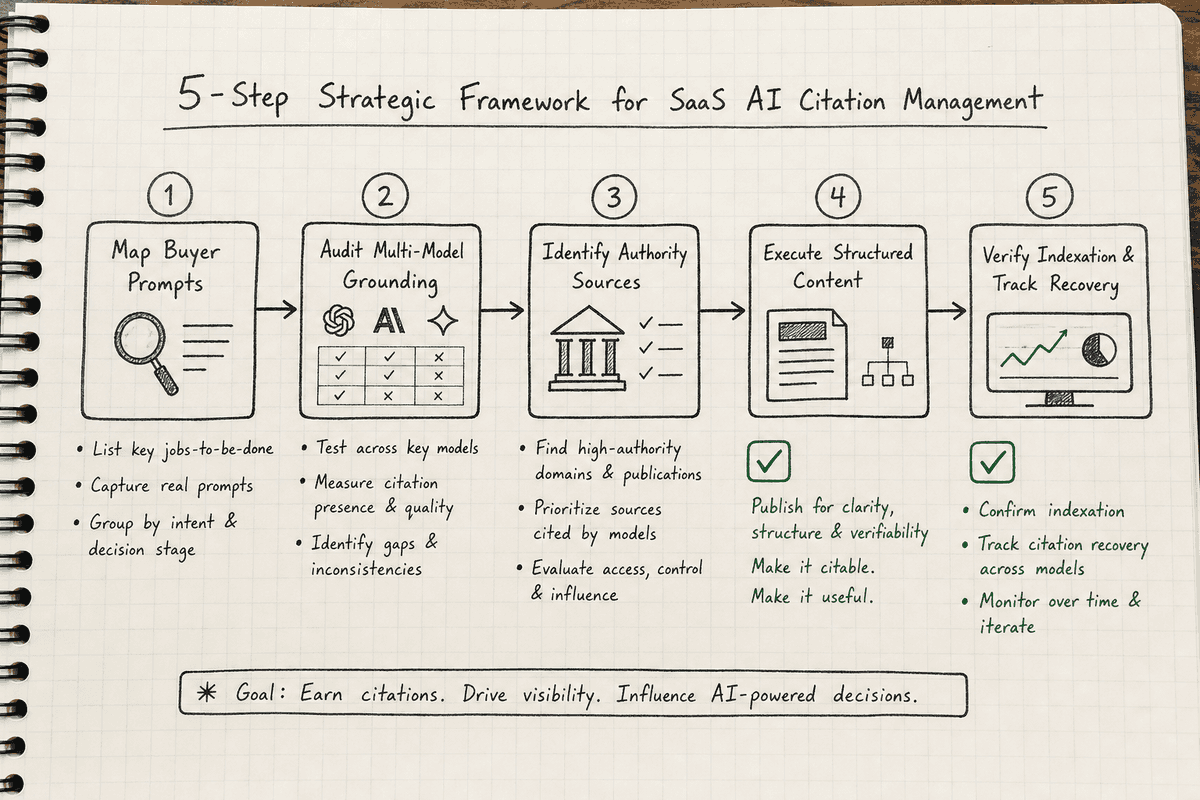
Step-by-Step Framework: Building an AI Citation Strategy
Implementing a citation monitoring and execution framework requires a systematic approach. Follow this five-step strategy to establish control over your brand's presence in AI search outputs:
+-------------------------------------------------------------------------------+
|                     5-STEP SAAS AI CITATION FRAMEWORK                         |
|                                                                               |
|  [ Step 1: Prompt Mapping ] ---> Cluster intent across buyer journeys.        |
|  [ Step 2: Citation Audit ] ---> Run multi-model grounding audits.            |
|  [ Step 3: Source Identification ] -> Locate primary cited web pages.         |
|  [ Step 4: Content Execution ] -> Publish structured counter-assets.         |
|  [ Step 5: Indexing & Re-Audit ] -> Confirm vector score recovery.            |

+-------------------------------------------------------------------------------+
Step 1: Map Buyer Prompt Clusters
Do not rely on single brand queries. Group your target prompts into four commercial categories:
- Category Queries: "Best customer success platform for enterprise B2B SaaS."
- Comparison Queries: "Brand A vs. Brand B for automated billing."
- Feature/Use-Case Queries: "How to export churn telemetry to Snowflake automatically."
- Migration Queries: "Alternatives to Brand C with better API rate limits."
Step 2: Audit Multi-Model Grounding
Run your prompt matrix across ChatGPT, Perplexity, Gemini, and Google AI Overviews. Record three metrics for each query:
- Inclusion Rate: Is your brand mentioned?
- Recommendation Position: Are you ranked #1, #2, or buried in a list?
- Cited Grounding URLs: Which exact web pages are listed in the footnotes?
Step 3: Identify High-Authority Grounding Sources
Categorize the cited URLs into owned assets and third-party platforms:
- Owned Assets: Product pages, technical docs, feature blogs, pricing tables.
- Third-Party Assets: G2, TrustRadius, GitHub repositories, Reddit threads, tech industry blogs.
As noted in research from ABA Growth Co on AI citation tracking platforms, third-party aggregators and industry reviews represent over 40% of the citations used by LLMs to form software recommendations.
Step 4: Execute Structured Counter-Content
When a gap is identified, publish structured content designed for RAG ingestion:
- Use clear header hierarchies (
H2,H3) that directly mirror buyer prompt phrasing. - Include markdown comparison tables with explicit feature comparisons, pros, and cons.
- Provide concise summary paragraphs at the top of key sections to facilitate AI snippet extraction.
For teams building modern single-page web apps, ensuring that technical rendering doesn't block crawler access is critical. Technical resources like Implementing SEO in Single Page Applications (3 Ways) and SEO for Single Page Applications: The Technical Checklist outline how to serve clean, crawlable HTML to search bots.
Step 5: Verify Indexation and Track Recommendation Recovery
Monitor your prompt clusters weekly. LLM citations update dynamically as search bots recrawl updated pages and refresh vector caches. Track the correlation between publishing new structured assets and updates in your AI recommendation share.
Common Pitfalls in SaaS AI Citation Tracking
Avoiding common strategic errors saves time and prevents wasted marketing budget.
Pitfall 1: Focusing Exclusively on Direct Brand Prompts
Asking an AI assistant "What is [Your Company Name]?" will almost always produce a positive answer because the query heavily biases the model toward your domain. However, buyers rarely search this way. They ask unbranded category queries. Tracking unbranded buyer intent reveals your true market share of voice.
Pitfall 2: Treating Domain Authority as the Only Ranking Factor
In traditional SEO, high domain authority (DA) often guarantees page-one placement. In AI search, context relevance and data density frequently override domain authority. A clear, highly structured article from a niche blog can easily out-cite a generic article on a high-DA news publication if the niche article provides clean, tabular answers that match the RAG query.
Pitfall 3: Ignoring Negative Sentiment and Outdated Citations
AI engines often cite old documentation, legacy pricing pages, or outdated reviews. As documented in research on AI citation alert tools for SaaS brand protection, unmonitored outdated citations can quietly direct buyers toward competitors by stating your software lacks features you shipped months ago.
Pitfall 4: Relying on Manual Copy-Pasting to Fix Content Gaps
When a team discovers twenty missing citations across various buyer prompts, assigning team members to manually draft, format, review, and publish twenty individual blog posts creates operational bottlenecks. Scalable execution requires an automated workflow that connects citation gaps directly to content generation and CMS publishing tools.
Frequently Asked Questions About AI Citation Monitoring
How frequently do AI models refresh their citation sources?
Unlike standard search engines that re-rank pages in real time, AI engines refresh citations based on their search grounding layer. For tools connected to live search indexes (like Perplexity or ChatGPT Search), citations can update within hours or days of a new web page being indexed. For static base models, updates occur during model retraining or fine-tuning cycles.
What is the difference between AI Citation Rate and Recommendation Share?
AI Citation Rate measures the percentage of times your domain or brand is footnoted across a set of prompts. Recommendation Share measures how often your product is explicitly listed as a recommended top-tier solution for a buyer query. A high citation rate with low recommendation share means the AI is referencing your site but recommending your competitors.
Can AI citation monitoring replace traditional rank tracking tools?
No. AI citation monitoring complements traditional rank tracking. Traditional SEO tools monitor your rankings on search engine results pages (SERPs), while AI citation tools monitor conversational search engines and LLM answers. SaaS growth teams need both to maintain complete search visibility.
How do custom single-page applications (SPAs) impact AI citation rates?
If an AI search engine's headless crawler cannot render your single-page application's client-side JavaScript, it cannot read your page content. This leads to missing citations regardless of your content quality. Implementing server-side rendering (SSR) or pre-rendering ensures search scrapers access clean HTML. SaaS engineering teams can review best practices in 11 Best SEO Blogs Every SaaS Founder Needs (2026) to stay informed on modern technical standards.
Choosing the Right Citation Engine for Your SaaS Pipeline
As AI search becomes a primary channel for B2B software discovery, monitoring passive brand mentions in a dashboard is no longer enough to maintain market leadership. SaaS growth teams require tools that connect analytics directly to workflow execution.
When selecting an Otterly.ai alternative:
- Choose tools that provide page-level grounding analytics rather than domain summaries.
- Prioritize platforms that measure Recommendation Share across conversational buyer prompt matrices.
- Ensure the tool includes an integrated content execution workflow that converts visibility gaps into published assets.
By moving from passive monitoring to structured, workflow-driven content execution, your team can systematically win citations, dominate AI recommendations, and turn AI search visibility into a consistent driver of software pipeline growth.