
Most growth teams tracking their presence in AI search engines end up hitting a wall. You set up prompts in an analytics platform, monitor where your brand appears across LLMs, and watch weekly visibility scores fluctuate. Then comes the bottleneck: turning those dashboard charts into actual articles, citations, and published assets that convince ChatGPT, Perplexity, and Gemini to mention your software.
Otterly.ai has gained traction as an analytics platform for monitoring brand mentions, sentiment, and sources across large language models. However, monitoring tells you only where you are losing ground. It leaves the heavy lifting—writing articles, optimizing content structure for AI retrieval, scheduling updates, and publishing—entirely to manual workflows.
If your marketing team spends hours copying prompt gap data into spreadsheet briefs, drafting articles in Google Docs, and waiting weeks for production, passive tracking tools slow down your growth. To maintain market share in AI search, you need platforms that bridge the gap between AI visibility monitoring and content execution.
This guide breaks down the leading Otterly.ai alternatives that combine real-time AI search tracking with direct content execution capabilities.
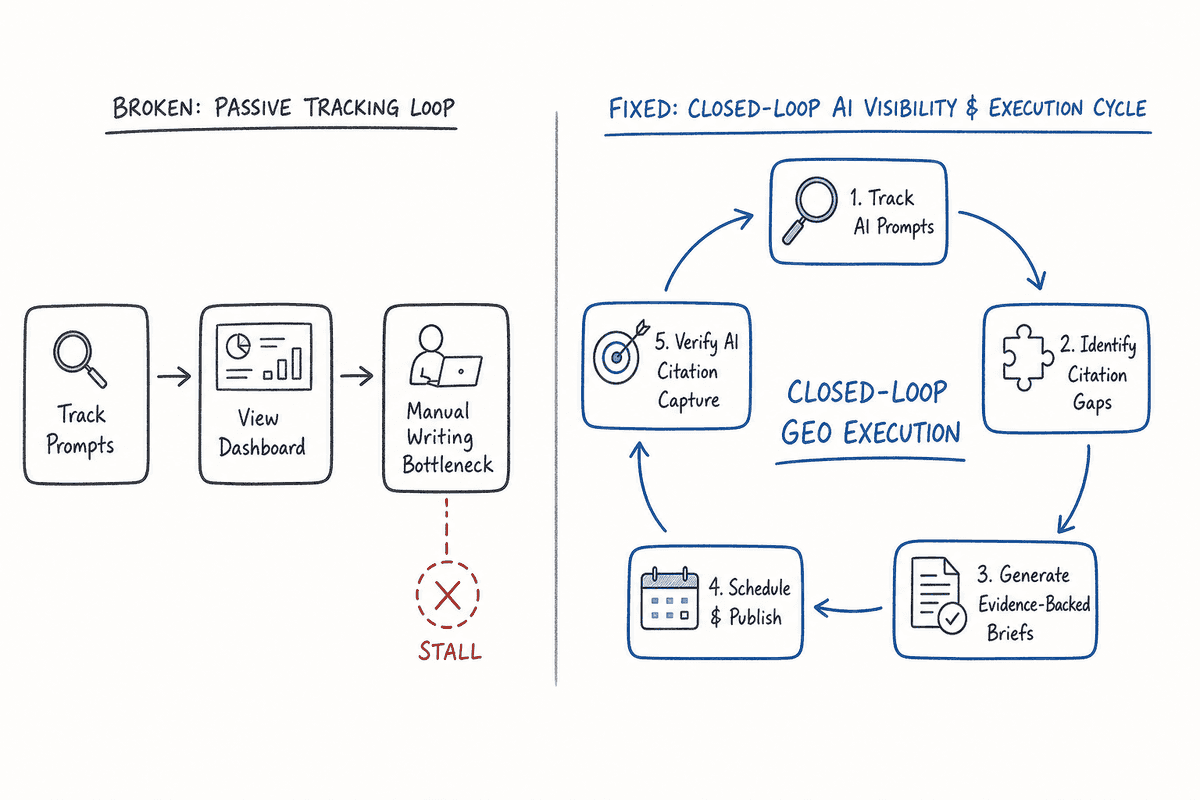
The Analytics Bottleneck: Why Tracking Without Execution Fails
Traditional search engine optimization relied on rank tracking tools that updated once a day. Generative Engine Optimization (GEO) operates on a continuous retrieval cycle. Large language models (LLMs) refresh their knowledge using real-time search APIs, index updates, and third-party web citations. When a competitor launches a targeted comparison page or captures a fresh mention on an industry source, AI assistants can shift their recommendations within hours.
Passive monitoring platforms leave growth teams trapped in an operational gap:
- Data Disconnection: Insights sit inside an isolated analytics dashboard separate from your content management system (CMS) and writing tools.
- Manual Brief Creation: Content managers must manually analyze which source domains Perplexity or ChatGPT cited, then translate those sources into structured brief instructions.
- Production Latency: By the time a freelance writer or internal team completes an article three weeks later, the AI assistant's underlying citation graph has already shifted.
- Lack of Closed-Loop Verification: After publishing new content, you must manually track whether the updated page caused AI models to cite your brand or adjust their answer sentiment.
Moving from passive tracking to active execution changes how your marketing team operates. Instead of viewing AI search visibility as an abstract score, an integrated pipeline treats every missing brand mention, weak citation, or competitor win as a trigger for automated content generation and publishing.
What Distinguishes Content Execution Platforms from Pure Trackers?
When evaluating Otterly.ai alternatives, it helps to distinguish between platforms that function strictly as monitoring dashboards and those designed as complete execution engines.
Platforms that incorporate content execution reduce friction by converting visibility data into published content without requiring five separate software tools.
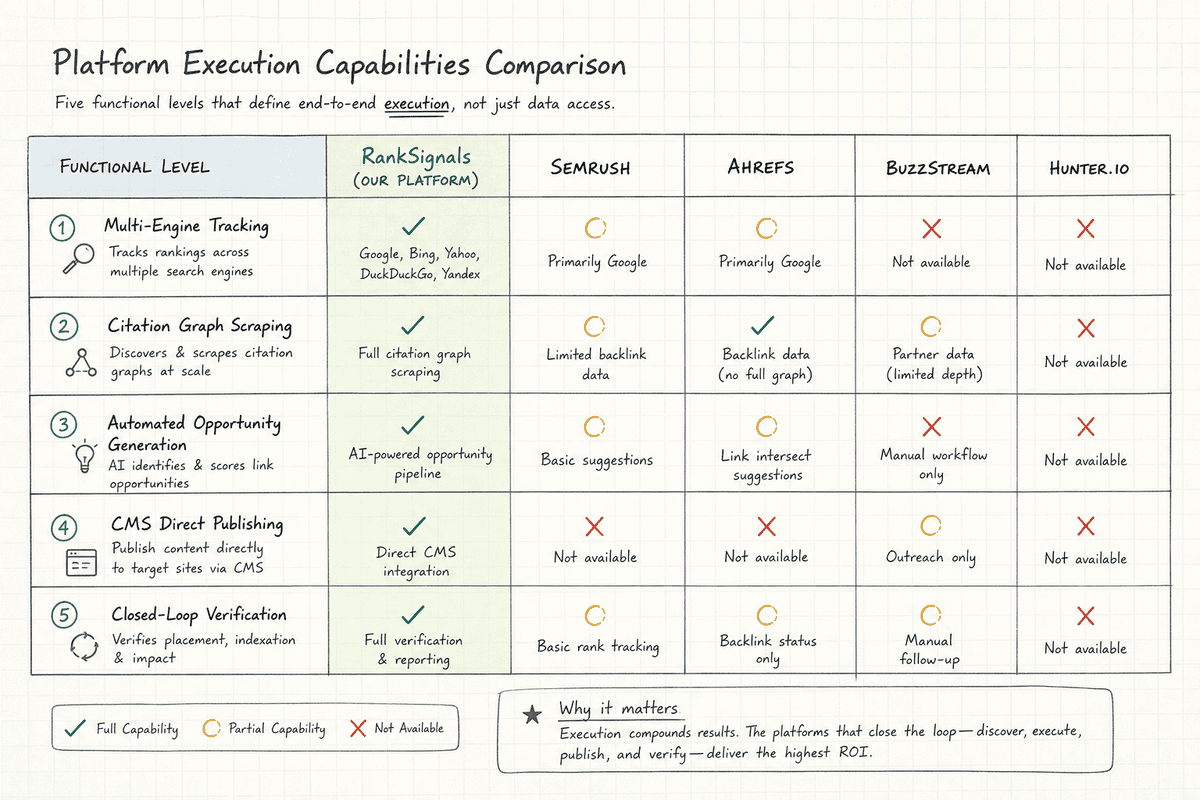
Key Criteria for Choosing an Otterly.ai Alternative
To select a tool that fits your growth stack, evaluate platforms against five functional criteria:
1. Multi-Engine Prompt Tracking
AI search landscape fragmentation means buyers consult different tools depending on their workflow. B2B decision-makers use Perplexity for rapid research, ChatGPT for comparative analysis, Gemini inside Google Workspace, and AI Overviews during standard web searches. Your monitoring setup must support custom buyer prompt sets across ChatGPT, Gemini, Perplexity, AI Mode, and AI Overviews.
2. Deep Citation and Retrieval Scraping
AI engines rely heavily on web retrieval to answer commercial buyer questions. A platform must show not just whether your brand was mentioned, but exact citation sources—identifying which blog posts, review sites, and technical pages provided the facts used by the LLM.
3. Automated Gap-to-Content Pipeline
When an AI engine recommends a competitor over your brand, the platform should immediately generate an actionable output. Look for systems that convert prompt failures directly into article outlines, comparison guides, or technical landing pages designed for LLM indexers.
4. Direct Publishing and Workflow Control
Generating text is only half the battle. Teams need workflow controls to review, edit, schedule, and push content directly to platforms like WordPress, Webflow, or custom CMS setups. Without built-in review and scheduling, generated drafts stall in content backlogs.
5. Automated Citation Verification
After publishing an optimized piece, the platform should track the updated URL to verify whether target AI assistants begin citing it. Closed-loop verification shows you which content structures deliver measurable gains in brand mentions.
Top 4 Otterly.ai Alternatives with Content Execution Capabilities
Here is how the leading platforms compare for teams seeking to combine AI visibility monitoring with direct content execution.
1. BeVisible
BeVisible is designed specifically for SaaS founders, growth teams, and B2B marketing organizations that need to monitor AI search presence and translate visibility gaps directly into published content.
How Monitoring Works
BeVisible tracks how major AI assistants—including ChatGPT, Gemini, Perplexity, AI Mode, and Google AI Overviews—answer high-intent buyer prompts. The platform monitors whether your brand is mentioned, evaluates answer sentiment, and identifies every underlying web source cited by the LLMs.
How Content Execution Works
Rather than stopping at dashboard charts, BeVisible turns missing mentions, weak citations, and competitor wins into evidence-backed opportunities. The built-in execution pipeline lets teams turn visibility gap insights into fully drafted articles, review work, scheduling, and direct publishing. This removes the manual step of building writer briefs and transferring content across multiple tools.
Key Capabilities
- Comprehensive Engine Coverage: Tracks buyer prompts across ChatGPT, Gemini, Perplexity, AI Mode, and AI Overviews.
- Evidence-Backed Opportunity Generation: Converts citation gaps directly into structured, publication-ready content.
- Integrated Workflow: Includes content review, scheduling, and direct publishing capabilities.
- Closed-Loop Verification: Automatically re-evaluates target buyer prompts after content goes live to measure citation acquisition.
Best For
SaaS companies, B2B agencies, and growth teams that want a single platform to track AI visibility and publish content that captures citations in AI search engines.
2. Profound
Profound focuses on enterprise AI Engine Optimization (AEO), offering deep visibility analytics alongside automated workflows designed to manage digital presence across conversational engines Profound.
How Monitoring Works
Profound analyzes how AI search engines represent enterprise brands across commercial prompts. It tracks share of voice, sentiment metrics, and citation frequency across major generative tools.
How Content Execution Works
Profound uses dedicated AI agents to assist enterprise teams with content creation and demand generation workflows Profound vs Pixis. Its AEO template libraries leverage dataset insights from heavily cited web pages to help teams structure optimized pages.
Key Capabilities
- Agent-Driven Insights: Uses specialized AI agents to help analyze enterprise prompt trends.
- AEO Content Frameworks: Provides templates structured around web content patterns favored by LLM web retrievers.
- Enterprise Brand Tracking: Monitors share of voice across multi-product portfolios.
Best For
Enterprise marketing departments requiring corporate-level brand sentiment tracking and specialized agent workflows.
3. Writesonic
Writesonic started as a generative writing tool and has expanded into Generative Engine Optimization (GEO) tracking, connecting prompt insights directly to its generative engine Writesonic GEO Alternatives.
How Monitoring Works
Writesonic offers GEO tracking tools that measure brand visibility across conversational assistants, highlighting prompt terms where competitors rank ahead.
How Content Execution Works
Writesonic excels at rapid generative drafting. Once a visibility gap is identified, users can send prompt data directly into Writesonic's article generator to draft blog posts, web pages, and marketing copy.
Key Capabilities
- Rapid Generative Writing: Drafts articles quickly using its core generative content engine.
- GEO Keyword Analysis: Pinpoints search prompts where brand mentions are missing.
- Multi-Format Content Generation: Generates social copy, ad variations, and long-form posts from a single prompt.
Best For
Content creators and freelance marketers looking for a lightweight tracking layer attached to a high-speed generative writing assistant.
4. Pixis Visibility
Pixis Visibility focuses on performance-driven AI tracking, targeting growth teams that evaluate AI search visibility alongside digital ad channels Profound vs Pixis.
How Monitoring Works
Pixis continuously scans AI assistant outputs for target buyer prompts, quantifying competitor visibility and sentiment trends.
How Content Execution Works
Pixis connects visibility analytics to marketing execution middleware, helping growth teams build campaign assets and landing pages aimed at shifting brand sentiment.
Key Capabilities
- Performance-Focused Analytics: Aligns AI search share of voice with broader campaign performance metrics.
- Competitor Sentiment Tracking: Monitors comparative positioning across generative engines.
- Campaign Middleware: Connects AI search insights to multi-channel execution workflows.
Best For
Performance marketing teams looking to integrate AI search monitoring into a broader paid and organic acquisition framework.
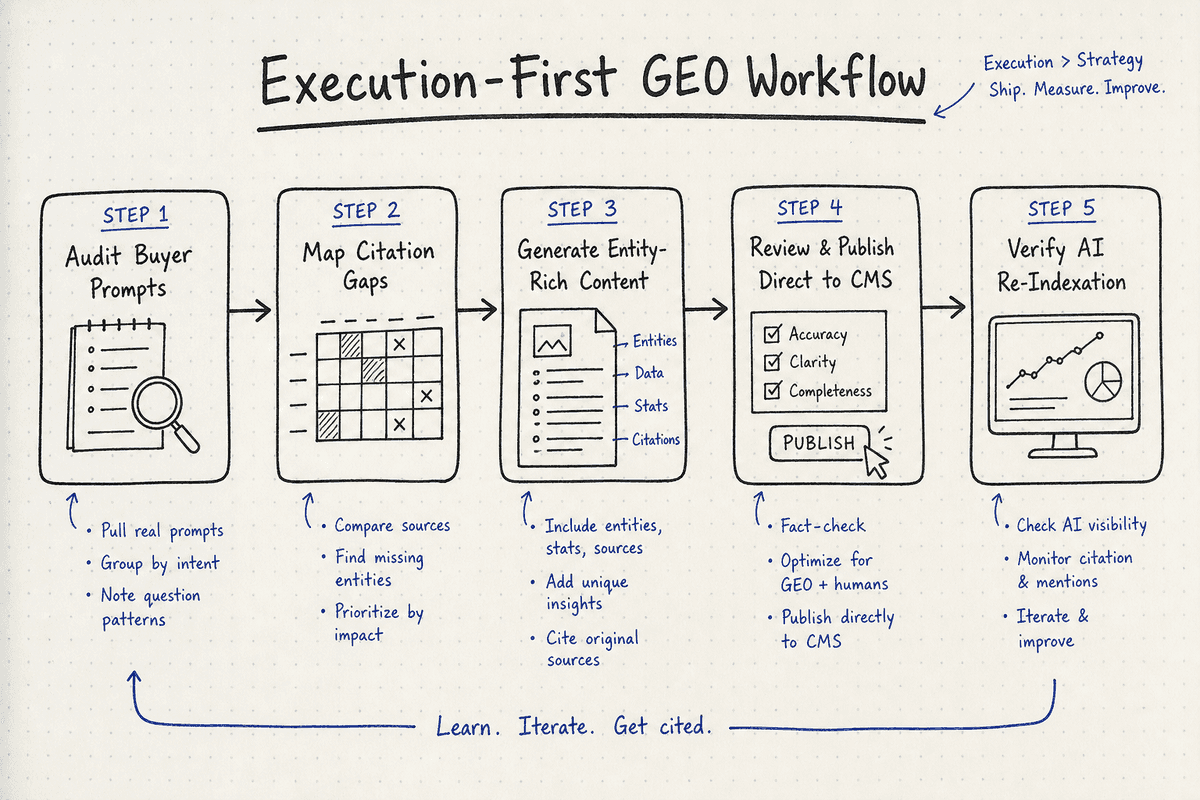
Step-by-Step: Implementing an Execution-First GEO Strategy
Switching from passive monitoring to an execution-led model requires setting up a repeatable content workflow. Here is how leading growth teams structure their process.
+-----------------------------------------------------------------------------------+
|                        EXECUTION-FIRST GEO WORKFLOW                               |
+-----------------------------------------------------------------------------------+
|  1. AUDIT BUYER PROMPTS                                                           |
|     Identify high-intent prompts in ChatGPT, Gemini, Perplexity, & AI Overviews.  |

+-----------------------------------------------------------------------------------+
                                          |
                                          v
+-----------------------------------------------------------------------------------+
|  2. MAP CITATION GAPS                                                             |
|     Pinpoint missing mentions and collect cited web sources.                      |

+-----------------------------------------------------------------------------------+
                                          |
                                          v
+-----------------------------------------------------------------------------------+
|  3. GENERATE EVIDENCE-BACKED CONTENT                                              |
|     Build structured content with explicit definitions, tables, and entities.    |

+-----------------------------------------------------------------------------------+
                                          |
                                          v
+-----------------------------------------------------------------------------------+
|  4. REVIEW, SCHEDULE & PUBLISH                                                    |
|     Approve content, apply schema markup, and publish directly to CMS.            |

+-----------------------------------------------------------------------------------+
                                          |
                                          v
+-----------------------------------------------------------------------------------+
|  5. VERIFY RE-INDEXATION & CITATIONS                                              |
|     Track prompt responses to confirm new citations and mention acquisition.      |

+-----------------------------------------------------------------------------------+
Step 1: Map High-Intent Buyer Prompts
Avoid tracking vague, top-of-funnel keywords. Instead, configure your tracking platform around exact buyer prompts used during procurement:
- "What are the top enterprise alternatives to [Competitor]?"
- "Which software offers the best integrations for [Use Case]?"
- "Compare [Brand A] vs [Brand B] on pricing, compliance, and security."
Step 2: Extract the Underpinning Citation Graph
When an AI assistant omits your brand, inspect the web pages it cited to build its answer. Look for common patterns across cited sources:
- Are the cited pages structured comparison tables?
- Do they feature expert quotes or original statistical data?
- Are they third-party review platforms or authoritative tech blogs?
Step 3: Produce Entity-Rich, Structured Content
Large language models favor content that provides concise facts, clear structure, and unambiguous entity relationships. To learn more about structuring web assets for search engines, explore our guide on how to build an SEO landing page.
Key structural elements that increase AI retrieval odds include:
- Direct Answer Declarations: Clear definition sentences located immediately beneath subheadings.
- Markdown Comparison Tables: Unambiguous side-by-side matrices comparing product features, pricing, and integrations.
- Schema Markup: FAQ, Article, and Product JSON-LD markup that helps web crawlers digest facts cleanly.
If you build applications using client-side frameworks, technical indexing details become critical. Check out our detailed guide on SEO for single page applications to ensure LLM web scrapers can parse your dynamic pages.
Step 4: Schedule, Review, and Publish Direct to CMS
Content generation without workflow management leads to publishing bottlenecks. Use an execution-focused tool to review generated drafts, verify citations, set target publishing dates, and push approved articles directly to your CMS.
Step 5: Verify Citation Capture
After content goes live, monitor target buyer prompts over a 14-to-30-day window. Track whether PerplexityBot or GPTBot re-indexed your domain and whether AI assistant responses updated to cite your new pages.
Real-World Scenario: Shifting from Tracking to Execution
To understand the practical impact of an execution-led approach, consider a mid-market B2B SaaS company that spent six months using a passive AI tracking tool.
The Passive Tracking Era
The company monitored 120 buyer prompts across ChatGPT and Perplexity. Every week, their analytics dashboard showed that competitors were cited in 68% of commercial prompts, while their own brand appeared in only 14%.
Their workflow involved sending monthly PDF exports to an external freelance agency. The agency took three weeks to deliver drafted blog posts, which then sat in WordPress draft status for another two weeks awaiting internal review. Over six months, they published only eight articles, and their AI visibility score remained flat.
The Execution-Led Switch
The company migrated to an integrated visibility and execution platform. The new workflow operated automatically:
- Gap Detection: The platform identified 25 high-intent comparison prompts where Perplexity cited outdated forum threads.
- Automated Content Briefs: The platform converted those prompt gaps into structured article drafts containing missing feature matrices and source citations.
- Streamlined Review & Publishing: The internal content manager reviewed drafts directly in the tool, approved updates, and published 20 articles in 30 days.
- Results: Within 45 days, Perplexity and ChatGPT re-indexed the newly published pages. The brand's citation frequency grew from 14% to 42% across target prompts, driving a measurable increase in organic referral sign-ups.
Content Structures That AI Assistants Prefer to Cite
LLM web retrievers do not parse content the same way human readers or legacy keyword search engines do. To win citations across conversational engines, your published content must use structures designed for machine extraction.
1. The Short Answer + Fact Block
Place a direct, self-contained answer immediately under your H2 headings. AI crawlers frequently extract these 20-to-40-word summaries directly into conversational answer cards.
2. Tabular Comparison Data
When answering competitive queries, LLMs rely heavily on tables. Clean Markdown or HTML tables with clear headers allow models to parse structural comparisons without misinterpreting features.
3. Clear Entity Definitions
Avoid ambiguous pronouns like "our platform" or "this tool." Use clear brand names, technical terms, and product categories explicitly throughout your text to make entity disambiguation easy for NLP models.
For teams curating broader marketing strategies, keeping up with changing distribution formats is essential. See our list of the best SEO blogs to stay informed on search industry changes.
Common Pitfalls When Scaling AI Content Execution
When accelerating content execution, avoid these common mistakes:
Pitfall 1: Publishing Generic AI Text Without Citation Verification
Generating dozens of low-quality articles without original data or cited web sources will not earn mentions in conversational search engines. LLMs seek authoritative data sources; publishing generic filler text dilutes your domain's authority.
Pitfall 2: Blocking LLM Web Crawlers
Ensure your robots.txt file and web firewall do not unintentionally block user agents like PerplexityBot, GPTBot, or ClaudeBot. If generative crawlers cannot fetch your pages, your updated content will never appear in live citation feeds.
Pitfall 3: Ignoring Technical Site Performance
Slow page load times or JavaScript rendering issues can prevent LLM scrapers from reading your content. If you operate dynamic web apps, review technical strategies in our guide on single-page application SEO to keep your pages indexable.
Pitfall 4: Treating GEO as a One-Time Task
AI search engine databases shift continuously as competitors publish new content and models update their underlying training sets. Continuous monitoring coupled with scheduled content updates is required to maintain top AI search visibility.
Frequently Asked Questions
What is the main difference between Otterly.ai and execution-focused alternatives?
Otterly.ai focuses primarily on tracking brand mentions, sentiment, and sources across AI search engines. Execution-focused alternatives go further by converting those visibility insights directly into content production, review, scheduling, and direct CMS publishing workflows.
How fast do AI search engines pick up newly published content?
Engines with real-time web retrieval (such as Perplexity, ChatGPT Search, and Google AI Overviews) can cite newly published content within days if the site is indexed cleanly and provides high-authority answers. Static LLM model updates may take longer.
Can I automate content execution without sacrificing editorial quality?
Yes. Modern AI visibility and execution platforms generate structured, evidence-backed drafts based on verified web sources. Human-in-the-loop review features allow teams to edit, refine, and approve content before it goes live.
Which AI assistants should SaaS brands prioritize for prompt tracking?
SaaS growth teams should prioritize ChatGPT, Perplexity, Google AI Overviews, and Gemini, as these platforms handle the vast majority of commercial software research and comparison queries.
Making the Decision: Tracking vs. Execution
If your marketing team only needs executive dashboards to report on brand sentiment once a quarter, a pure tracking tool like Otterly.ai may meet your basic reporting requirements.
However, if your goal is to grow market share, capture buyer intent, and convert visibility gaps into live citations, passive tracking is only half a solution. Choosing an Otterly.ai alternative with integrated content execution allows you to identify missing mentions and publish citation-winning content in a single continuous workflow.