
Content teams are entirely familiar with the Monday morning analytics panic. For years, it was tied to a sudden drop in traditional organic traffic. Today, the panic sounds different: a major client or executive searches for the industry’s best software on ChatGPT, Perplexity, or Google’s AI Overviews, and your brand is nowhere to be found.
When you lose visibility in AI answers, you lose the highest-intent buyers on the internet.
The immediate reaction is usually to look for a monitoring tool. Otterly.ai has made a name for itself by tracking these brand mentions. But knowing you have a visibility problem doesn't fix the visibility problem. If you want to actually capture the traffic, you need more than a dashboard that says, "ChatGPT didn't mention you." You need to understand exactly what the AI did say, identify the weak citations it relied on, and execute a content strategy to replace those citations with your own assets.
This requires a fundamental shift in how SaaS founders, B2B marketing teams, and growth agencies approach content strategy. Finding content gaps in AI answers—the missing, weak, or inaccurate information—requires a mix of analytical, user-centric, and automated techniques. As AI systems become the primary information source for complex B2B purchases, identifying where they fail to provide comprehensive answers is the most lucrative SEO opportunity available.
Here is how to find content gaps in AI answers, move beyond basic tracking, and explore the tools and workflows necessary to turn those missing mentions into published, revenue-generating content.
The New Definition of a Content Gap in 2026
If you run a traditional content gap analysis, you compare your domain against three competitors. You look at the keywords they rank for that you don't. You export a spreadsheet, sort by search volume, and hand it to a writer.
This model is broken in an AI-first search environment.
Generative AI models do not care about your keyword density. They operate on Retrieval-Augmented Generation (RAG). When a user prompts ChatGPT or Perplexity, the system queries a search index, retrieves context, and synthesizes an answer based on the semantic relevance, authority, and specificity of the retrieved documents.
An AI content gap occurs when the model attempts to answer a user's prompt but lacks the high-quality, authoritative source material needed to provide a definitive, accurate, and brand-inclusive response.
 These gaps manifest in four distinct ways:
- The Hallucination Gap: The AI model makes up a feature for your competitor because neither your site nor your competitor's site clearly documents how a specific process works.
- The Outdated Source Gap: Perplexity cites a forum post from 2021 to answer a technical question about your product because you haven't published a definitive guide on the topic recently.
- The Low-Confidence Gap: The AI explicitly states, "I couldn't find specific pricing information for this tier," or provides a generic, surface-level answer.
- The Missing Entity Gap: A prompt asks for "top AI visibility tools," and the model lists three legacy SEO tools while entirely omitting your purpose-built software.
To find these gaps before your competitors do, you must stop looking at search volume and start looking at content-level AI visibility gaps such as missing topics, weak answer optimization, and outdated resources that AI models are forced to rely on simply because nothing better exists.
Core Capabilities Required to Expose AI Answer Gaps
If you are evaluating Otterly.ai alternatives to find content gaps in AI answers, you need to understand the technical requirements of the job. Tracking brand mentions is the baseline. True visibility execution requires a deeper feature set.
To systematically uncover and fill AI knowledge gaps, a tool or methodology must provide:
1. Multi-Model Prompt Tracking
B2B buyers do not use a single AI tool. Developers might lean toward Perplexity for technical research, marketers might use ChatGPT for vendor comparisons, and executives might rely on Google's AI Overviews for rapid summaries. Your gap analysis must span ChatGPT, Gemini, Perplexity, AI Mode, and AI Overviews. A gap in ChatGPT might not exist in Gemini, and treating them as a monolith leads to wasted content production.
2. Citation Mapping and Sentiment Analysis
It is not enough to know if you were mentioned. You must know why you were mentioned and what was cited. If Gemini recommends your software but cites a negative third-party review from two years ago, that is a massive content gap. You have a gap in controlled, positive narrative. You need a system that maps exactly which URLs the AI uses to formulate its answer.
3. Execution Integration
Content strategists frequently ask, "What should we write next?" and often answer with a very confident shrug when looking at traditional data. An AI visibility tool must bridge the gap between monitoring and doing. Once a missing mention is found, the system should seamlessly turn that vulnerability into an evidence-backed opportunity, creating a brief for an article, a review campaign, or a scheduling task.
4. Low-Confidence Detection
Advanced AI platforms can identify when they provide a response with low confidence or fail to answer a highly specific long-tail query. Actively monitoring these instances is crucial because they represent direct, identified gaps in the knowledge base. If an AI says "It is unclear if Software X integrates with System Y," your immediate next step is to publish an integration guide.
Top Otterly.ai Alternatives for Find Content Gaps in AI Answers
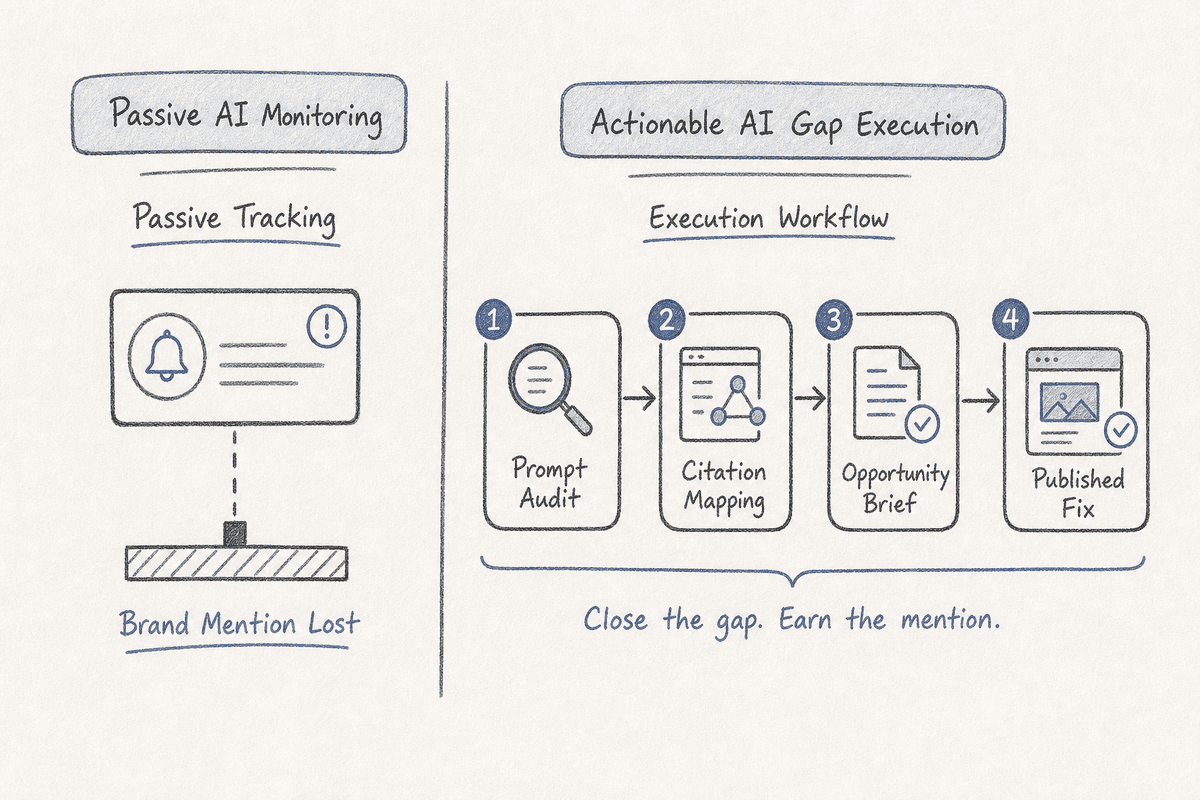
The market for AI visibility is bifurcating. On one side are passive listening tools that alert you when brand sentiment drops. On the other side are execution engines built for marketing and SEO teams who actually have to do the work.
Here are the primary methodologies and platforms serving as alternatives to basic AI brand monitoring.
BeVisible: The Execution-Focused Alternative
For SaaS founders, B2B marketing teams, and growth agencies, passive monitoring is a waste of budget. BeVisible is built specifically for teams that need to measure AI-search visibility and turn those insights into published work.
Instead of just reporting that your brand lost a mention in Perplexity, BeVisible tracks ChatGPT, Gemini, Perplexity, AI Mode, and AI Overviews across the specific buyer prompts that matter to your bottom line. It monitors how these assistants answer buyer questions, which competitors they recommend, and critically, which sources they cite to justify those recommendations.
The true differentiator is the execution layer. BeVisible turns these visibility gaps into evidence-backed opportunities. If it detects that ChatGPT is citing a weak, outdated competitor blog post to answer a high-intent prompt, BeVisible flags this as a content gap and pipelines it into your article scheduling and publishing workflow. It closes the loop from "we are missing here" to "we published the definitive answer that the AI will cite next week."
Conductor & Enterprise SEO Platforms
For large, multi-national corporations with massive websites, enterprise SEO platforms like Conductor are adapting to AI search. These platforms are excellent at monitoring broad market share and integrating traditional search data with emerging AI trends. They help content teams move past the "confident shrug" by layering AI visibility metrics over massive existing keyword databases. However, for agile SaaS teams and agencies, these platforms can be heavy, requiring significant configuration to track highly specific, conversational B2B prompts effectively.
Semrush and Traditional SEO Bridges
Many teams rely on familiar tools like Semrush to run hybrid gap analyses. By utilizing traditional content gap analysis methodologies, teams can look at their audience's interests, pain points, and social listening data to predict what users are asking AI. While Semrush is a powerhouse for traditional organic search and backlink data, predicting AI responses based on traditional index data requires a logical leap. A competitor might rank #1 on Google for a term, but ChatGPT might prefer to cite a highly structured, dense technical PDF from a lesser-known site.
Heretto and Knowledge Base Systems
Sometimes the gap isn't in your marketing content; it's in your technical documentation. Systems like Heretto emphasize building topical authority by aligning your content with how machines and search engines prioritize structured data. If you are a complex SaaS product, AI models frequently scrape your help center and knowledge base to answer user prompts. Ensuring your technical documentation is gap-free is a highly effective, often overlooked alternative to chasing marketing blog gaps.
Step-by-Step: How to Find Content Gaps in AI Answers
If you are ready to move past basic monitoring and start executing, you need a repeatable framework. Finding AI visibility gaps is a forensic process. You are reverse-engineering the output of a black box.
Here is the exact methodology B2B growth teams use to identify where they are losing to competitors in generative AI search.
Step 1: Map the Buyer Prompt Journey
Traditional SEO starts with a seed keyword. AI visibility starts with a buyer scenario.
Generative AI users rarely type two-word queries like "CRM software." They type paragraphs: "I run a 50-person marketing agency. We need a CRM that integrates natively with Slack, handles project-based billing, and costs under $100 per user. Compare the top three options and list their pros and cons."
To find gaps, you must document these conversational prompts. Interview your sales team. Look at the exact questions prospects ask on discovery calls. Pull transcripts from customer support. Map these into a master list of 50 to 100 high-intent buyer prompts. Group them into categories:
- Discovery Prompts: "What are the best tools for..."
- Comparison Prompts: "Tool A vs. Tool B for enterprise teams..."
- Feature Prompts: "Which software offers automated compliance tracking for..."
- Integration Prompts: "How to connect X to Y without Zapier..."
Step 2: Audit the AI Baselines Across Models
Feed your documented prompts into the major LLMs: ChatGPT (GPT-4o), Perplexity (Pro search), Google Gemini, and trigger Google AI Overviews if applicable.
Do not rely on memory or scattered spreadsheets. Use a platform like BeVisible to automate this tracking so you have a consistent baseline. You need to record exactly how each model answers the prompt today.
As you review the answers, look for the following failure modes:
- Complete Omission: Your brand is not mentioned at all.
- Inaccurate Categorization: You are mentioned, but as a "budget alternative" when you are actually an enterprise solution.
- Feature Hallucination: The AI claims your software lacks a feature that you actually launched six months ago.
- Weak Recommendation: The AI mentions you but adds a caveat like, "However, user reviews suggest the interface is clunky."
Step 3: Analyze "Low Confidence" and Unanswered Queries
One of the easiest ways to find a highly lucrative content gap is to look for moments where the AI essentially gives up.
Identify "No Result" or low-confidence areas in the generated text. The AI might output phrases like:
- "Information on specific integration capabilities is limited."
- "Pricing is not publicly available for this tier."
- "There is debate in the industry regarding..."
When an AI system provides a response with low confidence or fails to answer a specific angle entirely, it is waving a massive red flag that a content gap exists. The training data and the retrieved search results simply do not contain a clear, structured, authoritative answer.
If you identify a prompt where ChatGPT gives a vague, low-confidence answer, and you publish a comprehensive, data-backed article answering that exact prompt, you have an incredibly high chance of becoming the primary citation the next time the model processes that query.
Step 4: Map Brand Mentions and Isolate Weak Citations
When an AI does provide a good answer, it relies on citations. This is where you find the tactical gaps you can exploit.
Look at the footnotes or linked sources in Perplexity and Gemini. If a competitor is recommended, click the citation to see why.
You will often find that the AI is citing remarkably weak content. It might be citing a competitor's blog post that is three years old, thin on details, and lacking any real expert insight. The AI cited it only because nothing better was available in the retrieval index.
This is your gap. You do not need to invent a new topic; you just need to write a drastically better version of the cited source.
Step 5: Evaluate Local and Niche Nuances
AI models struggle heavily with hyper-local or highly specialized B2B queries. For example, if you are looking into Hiring SEO Services in Phoenix? 5 Red Flags (2026), you'll notice that generic AI prompts often return generic, national-level advice.
If your target audience is localized or exists within a micro-niche, testing these specific constraints in your prompts will reveal massive gaps. The AI will likely resort to citing broad directories (like Yelp or Clutch) because it lacks highly specific, locally contextualized expert content. Creating this content gives you an immediate edge in localized AI visibility.
Turning AI Visibility Gaps Into Published Work
Monitoring the gaps is the easy part. The reason Otterly.ai alternatives like BeVisible focus so heavily on execution is that an unfixed gap holds zero financial value.
Once you have identified that ChatGPT is failing to recommend your software for a specific buyer prompt, and you've identified the weak citations it currently relies on, you must build content specifically engineered to be read, understood, and cited by machines.
1. Build the Evidence-Backed Opportunity Brief
Do not just tell your writer to "write about CRM integrations." Create a brief based entirely on the AI gap analysis.
- The Target Prompt: What exactly is the user asking the AI?
- The Current AI Answer: What is the AI currently saying?
- The Missing Information: What feature, statistic, or integration is the AI failing to understand?
- The Target Citation: Which weak competitor URL are we trying to replace in the AI's retrieval context?
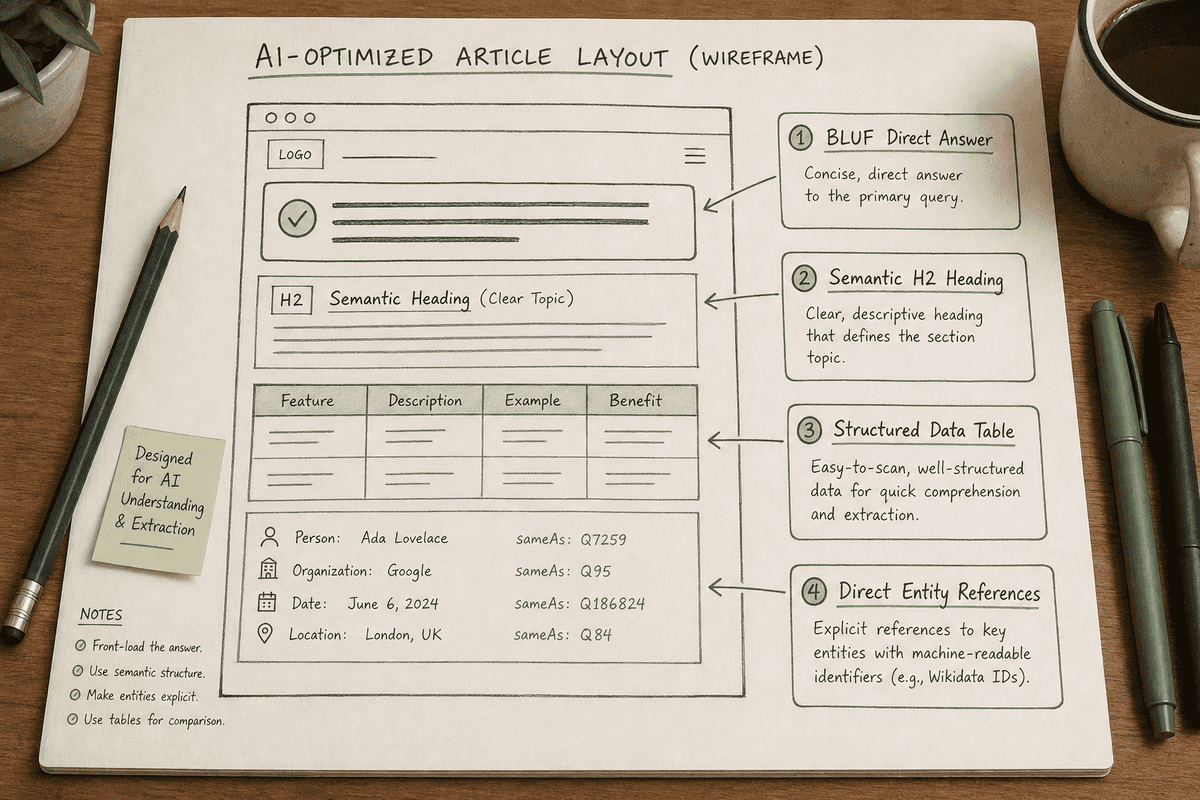
2. Format for Machine Readability
AI models are incredibly smart, but they are also lazy readers. If you bury the answer to a buyer prompt in the seventh paragraph of a rambling narrative, the retrieval engine will likely skip it.
If you are writing a guide on how to build a specific type of page—for instance, How to Build an SEO Landing Page (7-Step Guide)—you must structure the content logically.
- Direct Answers (BLUF): Put the "Bottom Line Up Front." Answer the core prompt immediately beneath the heading.
- Semantic Structure: Use descriptive H2s and H3s. Do not use clever or vague headings. If the section is about pricing, the heading should be "Enterprise Pricing for [Product Name]."
- Tables and Lists: LLMs excel at parsing structured data. If you are comparing features, put them in a standard markdown table. If you are listing steps, use numbered lists.
- Entity Density: Ensure you are using the correct industry terminology, brand names, and technical terms. If the AI is looking for connections between specific entities, your text needs to provide those explicit connections.
3. Address the Technical Foundation
Your content cannot be cited if the search crawler feeding the AI's index cannot render your page. This is particularly critical for modern web apps.
If your marketing site is a Single Page Application (SPA) built on React or Vue, traditional crawlers and AI retrieval bots often struggle to execute the JavaScript and see your content. You can write the best gap-filling content in the world, but if the bot sees a blank page, the gap remains.
Ensure your technical SEO foundation is flawless. Reviewing guides on Single-Page Application SEO: What Works in 2026? and following a strict SEO for Single Page Applications: The Technical Checklist is mandatory. If you fail to implement server-side rendering (SSR) or dynamic rendering, your execution pipeline will fail before it even begins.
4. Inject Original Data and Expert Perspectives
To guarantee that an AI model cites your new content over the older competitor piece, you must provide a higher "information gain."
Information gain is a concept utilized by search engines to measure how much new, valuable information a document adds to the overall corpus of knowledge. If you just rewrite the competitor's post, your information gain is zero.
To increase it:
- Include proprietary data from your platform.
- Quote your internal subject matter experts.
- Include unique frameworks or methodologies.
- Directly address the low-confidence gaps you identified during your audit.
When an AI engine processes your new page and realizes it contains hard statistics and expert quotes that do not exist anywhere else on the web, it is heavily incentivized to use your page as the primary citation for related prompts.
The Trap of "AI Optimization" Without Execution
The biggest mistake growth teams make when transitioning to AI visibility is treating it like a reporting exercise. They buy a tool, set up brand tracking, and have a weekly meeting to look at a dashboard that says, "Our Share of Model in ChatGPT dropped by 4%."
They treat it like traditional PR monitoring.
AI visibility is not passive; it is a highly aggressive, iterative execution game. The models are constantly updating their training weights and refreshing their retrieval indexes. If you find a gap on Tuesday, your competitor might find it on Wednesday.
This is why modern teams are abandoning passive alerts for integrated workflows. Finding the gap is simply the trigger. The real work is in the automated brief creation, the assignment to a subject matter expert, the publishing of the gap-filling asset, and the subsequent re-testing of the prompt a week later to verify that the AI is now citing your brand.
If your team is looking to stay updated on the shifting strategies around this, monitoring the 11 Best SEO Blogs Every SaaS Founder Needs (2026) can help keep your execution tactics sharp as the algorithms evolve. But ultimately, execution beats reading about execution every single time.
FAQs about AI Content Gap Analysis
How quickly do AI models update their answers after I publish new content?
It depends entirely on the model and the retrieval system it uses. Perplexity Pro and Google AI Overviews pull data from live search indexes. If your new page is crawled and indexed by Google or Bing, it can potentially be cited by these AI tools within hours. ChatGPT's base model relies on its training data cutoff, but its browsing feature (which it uses for most B2B research prompts) will fetch live data. Fast indexing is critical.
Are traditional SEO metrics like Domain Authority relevant in AI search?
Yes, but indirectly. AI models using RAG (Retrieval-Augmented Generation) still rely on traditional search indexes to find the documents they read to formulate an answer. A highly authoritative domain is more likely to rank high in those underlying search results, meaning the AI is more likely to retrieve and read it. However, if a high-authority site has a weak answer, and a lower-authority site provides a highly structured, perfectly matched answer, the AI will frequently cite the better answer.
Why is an AI model hallucinating features my competitor doesn't have?
Hallucinations often occur when there is a massive content gap across an entire industry. If buyers frequently ask, "Which CRM has native VR integration?" and no CRM explicitly states they don't have it, the LLM might stitch together unrelated context and assume a leading brand offers it. You can exploit this by publishing content that explicitly clarifies the industry standard, essentially correcting the AI's hallucination and capturing the citation.
Can I just use ChatGPT to find my own gaps?
You can use it for manual, prompt-by-prompt testing, but it does not scale. You cannot ask ChatGPT, "What are my content gaps?" because it lacks the self-awareness to know what it doesn't know in relation to your specific business goals. You must manually feed it buyer prompts, record the outputs, and analyze the citations. This is why automated tracking and execution platforms are necessary for serious B2B growth teams.
Final Thoughts on Visibility
The transition from keyword-based search to generative AI answers is the most significant disruption in digital marketing in two decades. Buyers are asking complex questions, and machines are deciding which brands are worthy of the answer.
Finding content gaps in AI answers is no longer a theoretical exercise for data scientists. It is a daily operational requirement for marketing teams. By moving past basic monitoring tools and adopting an execution-first approach—tracking the prompts, mapping the citations, writing the structured content, and publishing relentlessly—you stop hoping the AI mentions you, and you start giving it no other choice.