
Small marketing teams face a distinct operational headache in 2026. While potential buyers increasingly use AI assistants like ChatGPT, Gemini, Perplexity, and Google AI Overviews to evaluate software, tracking your brand's presence across these platforms is remarkably tedious. Manual prompt testing eats up hours every week, leaving lean teams with spreadsheets full of prompt screenshots and very little idea of how to actually fix missing mentions or incorrect citations.
Otterly.ai gained early popularity among solo marketers and small growth teams because it automated basic prompt testing in ChatGPT. Instead of manually typing "best CRM for real estate agents" into an AI window five times a week, Otterly provided automated mention checks.
However, many small teams quickly hit a ceiling with basic prompt monitoring. Knowing that ChatGPT left your software off a top-five list is only 20% of the battle. If your tool doesn't reveal which sources the AI cited, which competitors were recommended, or how to turn those visibility gaps into published articles that alter future AI outputs, your team ends up with an endless list of problems and no workflow to solve them.
This guide evaluates the top Otterly.ai alternatives for small marketing teams, looking closely at platform coverage, citation tracking, execution features, and overall cost efficiency.
The AI Search Dilemma for Small Teams: Monitoring vs. Execution
When a small marketing team starts tracking Generative Engine Optimization (GEO) or Answer Engine Optimization (AEO), they usually pass through three distinct operational stages.
+-------------------------------------------------------------------------------+
|                       THE AI VISIBILITY MATURITY STAGES                       |
+-------------------------------------------------------------------------------+
| STAGE 1: Manual Prompting                                                     |
| • Marketers copy-paste 20 prompts into ChatGPT & Perplexity.                  |
| • Data gets stale immediately; no source citation context.                    |

+-------------------------------------------------------------------------------+
| STAGE 2: Passive Monitoring (e.g., Early Otterly.ai setup)                    |
| • Automated prompt checks alert you when brand mentions drop.                  |
| • Team sees visibility drop from 60% to 30%, but lacks workflow to fix it.    |

+-------------------------------------------------------------------------------+
| STAGE 3: Closed-Loop AI Visibility & Execution                                |
| • System tracks mentions across ChatGPT, Gemini, Perplexity, AI Mode, AIO.     |
| • Identifies missing citations, sentiment drift, and competitor wins.         |
| • Converts gaps directly into researched, evidence-backed published work.      |

+-------------------------------------------------------------------------------+
The fundamental problem with passive monitoring is that small teams rarely have spare bandwidth to analyze raw data. If a tool tells you that Perplexity failed to cite your platform across 15 buyer queries, someone still has to investigate the cited URLs, spot the missing evidence, write fresh content, and publish it.
Without an integrated workflow that bridges visibility monitoring with content execution, tracking software quickly turns into an anxiety generator rather than a growth driver.
 An effective AI visibility engine needs to complete the full loop:
- Prompt Tracking: Testing varied buyer prompts across multiple generative engines.
- Citation Source Extraction: Mapping exactly which third-party blogs, review sites, Reddit threads, or documentation pages the LLMs draw from.
- Gap Detection: Spotting where competitors are winning mentions and what context is missing.
- Evidence-Backed Creation: Turning those exact gaps into structured articles, documentation, or reviews.
- Publishing & Indexing: Getting updated content live and indexed so AI crawlers pick up the fresh data during their next retrieval cycle.
Key Criteria for Evaluating AI Visibility Tools
To choose the right alternative to Otterly.ai, small teams should assess platforms against five practical criteria rather than long feature wishlists.
1. Multi-Engine Coverage
Buyers rarely stick to a single AI assistant. A B2B buyer might research product categories on Perplexity, draft operational workflows in ChatGPT, and double-check vendor credibility via Google AI Overviews or AI Mode. Tracking only ChatGPT leaves major visibility blind spots. Look for tools that monitor ChatGPT, Perplexity, Gemini, AI Mode, and Google AI Overviews simultaneously.
2. Prompt Intent & Variance Testing
LLMs generate answers probabilistically. Asking "what is the best email marketing tool for SaaS?" at 9 AM might yield a slightly different answer than asking the same prompt at 2 PM. High-performing visibility tools run prompt variations across different user locations and persona contexts to deliver an accurate visibility score rather than a single static snapshot.
3. Citation and Source Breakdown
AI answers are generated from retrieval sources. If Perplexity recommends three of your competitors, it is pulling that recommendation from specific web sources, user reviews, or comparison pages. Understanding where the AI gets its facts is the only way to influence what it says next.
4. Direct Bridge to Content Execution
This is where traditional SEO trackers and light AI monitors fall short. Once a gap is detected, can your team quickly turn that insight into published content? Tools that provide integrated opportunity feeds, outline generation, scheduling, and direct publishing dramatically shorten the time between finding a visibility gap and closing it.
5. Pricing and Resource Fit
Small teams cannot justify enterprise contracts costing $1,500 to $3,000 per month just to track a few dozen core prompt clusters. The ideal tool offers transparent pricing scaled to prompt volume and content outputs, allowing growth teams to expand usage as revenue grows.
Summary Comparison: Otterly.ai vs. Top Alternatives
Detailed Analysis of the Top Otterly.ai Alternatives
1. BeVisible (Best Overall for Closed-Loop AI Visibility and Publishing)
BeVisible is designed specifically for SaaS founders, B2B marketing teams, and growth agencies that need to convert missing AI mentions into published work without jumping between multiple tools.
+---------------------------------------------------------------------------------+
|                       BEVISIBLE WORKFLOW ARCHITECTURE                           |
+---------------------------------------------------------------------------------+
| [PROMPT MONITORING]                                                             |
| Tracks ChatGPT, Gemini, Perplexity, AI Mode, & AI Overviews across buyer intent |
|                                       |                                         |
|                                       v                                         |
| [EVIDENCE & GAP ANALYSIS]                                                       |
| Identifies missing recommendations, unmentioned features, and weak citations    |
|                                       |                                         |
|                                       v                                         |
| [PUBLISHING & EXECUTION ENGINE]                                                 |
| Generates evidence-backed articles, manages reviews, schedules, and publishes  |

+---------------------------------------------------------------------------------+
Key Capabilities
- Full Multi-Engine Tracking: Monitors how your brand and competitors appear across ChatGPT, Gemini, Perplexity, AI Mode, and Google AI Overviews.
- Citation & Source Attribution: Pinpoints the exact web pages, forums, and articles AI models cite when answering buyer queries in your market niche.
- Evidence-Backed Execution: Automatically converts detected visibility gaps into tailored article briefs, evidence-backed drafts, review steps, scheduling, and direct web publishing.
- Competitor Intelligence: Measures competitor recommendation frequencies across high-intent buyer prompts, giving your team clear target queries to win back.
Why It Beats Otterly.ai for Small Teams
Otterly.ai shows you whether your brand appeared in a prompt output, but leaves you stranded when deciding what to do next. BeVisible bridges the gap between analytics and action. When BeVisible flags a query where your brand is missing, it immediately presents the evidence context and lets your team generate, review, schedule, and publish an optimized response page directly to your site.
Ideal For
Growth teams and B2B marketers who want a single platform to track AI search presence and immediately publish content that fixes their visibility deficits.
2. Profound (Best for Enterprise Sentiment Tracking)
Profound has positioned itself as an enterprise-grade intelligence platform for Generative Engine Optimization. It offers deep analytics into how large brands are portrayed across generative AI ecosystems.
Key Capabilities
- Comprehensive Share of Voice Metrics: Tracks brand visibility across multiple LLMs, giving granular sentiment breakdown scores.
- Prompt Persona Modeling: Simulates queries coming from varied demographic, enterprise, or regional personas.
- Historical Trend Analysis: Shows how brand sentiment shifts over long timelines across enterprise product lines.
Strengths & Weaknesses
As highlighted in detailed head-to-head reviews like the Ahrefs vs Profound breakdown on YouTube, Profound excels at deep, high-level brand sentiment tracking for enterprise clients. However, for a small marketing team, its higher pricing tier and heavy reporting focus can be overwhelming. It tells you everything about your brand's sentiment, but requires a separate editorial team to execute content strategies to address those findings.
Ideal For
Mid-market to enterprise companies with dedicated research teams that need deep sentiment analytics and formal share-of-voice reporting.
3. Frase.io (Best for SEO-First Teams Adding AI Research)
Frase has long been a staple in content creation workflows, focusing on SERP analysis and outline generation. More recently, content platforms have expanded toward tracking how AI tools retrieve search information.
Key Capabilities
- SERP and Search Intent Analysis: Summarizes top Google results to build structured content briefs.
- AI Content Drafting: Helps writers outline and draft articles targeted at specific search queries.
- Visibility Insights: Outlines how structured content can capture top featured spots in search summaries, as discussed in Frase's AI visibility roundup.
Strengths & Weaknesses
Frase is an effective tool for drafting search-optimized content. However, it is not a dedicated AI prompt tracker. If your main goal is monitoring whether ChatGPT or Perplexity recommends your software over three specific competitors when buyers type real-world prompts, Frase won't provide automated daily prompt tracking across models like dedicated platforms do.
Ideal For
Content teams that prioritize standard search engine content creation and want basic AI writing assistance without dedicated multi-LLM monitoring.
4. Am I On AI / UseOmnia (Best for Basic Entry-Level Audits)
Tools like Am I On AI and UseOmnia serve small businesses and freelance consultants looking for simple, accessible ways to check brand visibility across standard AI prompts.
Key Capabilities
- Quick Brand Audits: Type in a company name or prompt category to check if standard AI engines recognize the business.
- Entry-Level Dashboards: Simple scores indicating basic brand inclusion across prompt sets.
- Low Setup Complexity: Minimal configuration required to run initial brand presence checks.
Strengths & Weaknesses
According to broader industry reviews like UseOmnia's platform comparison guide, entry-level audit platforms are helpful for quick checkups. However, they lack the multi-prompt depth, citation tracking, and automated publishing workflows required by growing SaaS brands operating in competitive niches.
Ideal For
Local businesses, solo consultants, or pre-launch startups looking for quick, occasional visibility checks.
5. Perplexity Pro + Manual Prompt Auditing (Best for Zero-Budget Teams)
For bootstrap startups with zero budget for marketing software, a manual tracking workflow using Perplexity Pro or ChatGPT Plus remains a common starting point.
Key Capabilities
- Direct Citation Verification: Perplexity displays exact source links inline for every statement, making manual source audits straightforward.
- Deep Research Threading: Marketing teams can interrogate the model directly on why it chose one vendor over another, as noted in research on AI tools for consulting teams by Noloco.
Strengths & Weaknesses
Manual auditing costs almost nothing, but it fails to scale. Prompts must be run manually every week, output data must be logged into spreadsheets, and intent variations are rarely tested thoroughly. It quickly becomes an unsustainable time sync for small teams with competing priorities.
Ideal For
Bootstrap founders validating initial messaging before investing in an automated AI visibility stack.
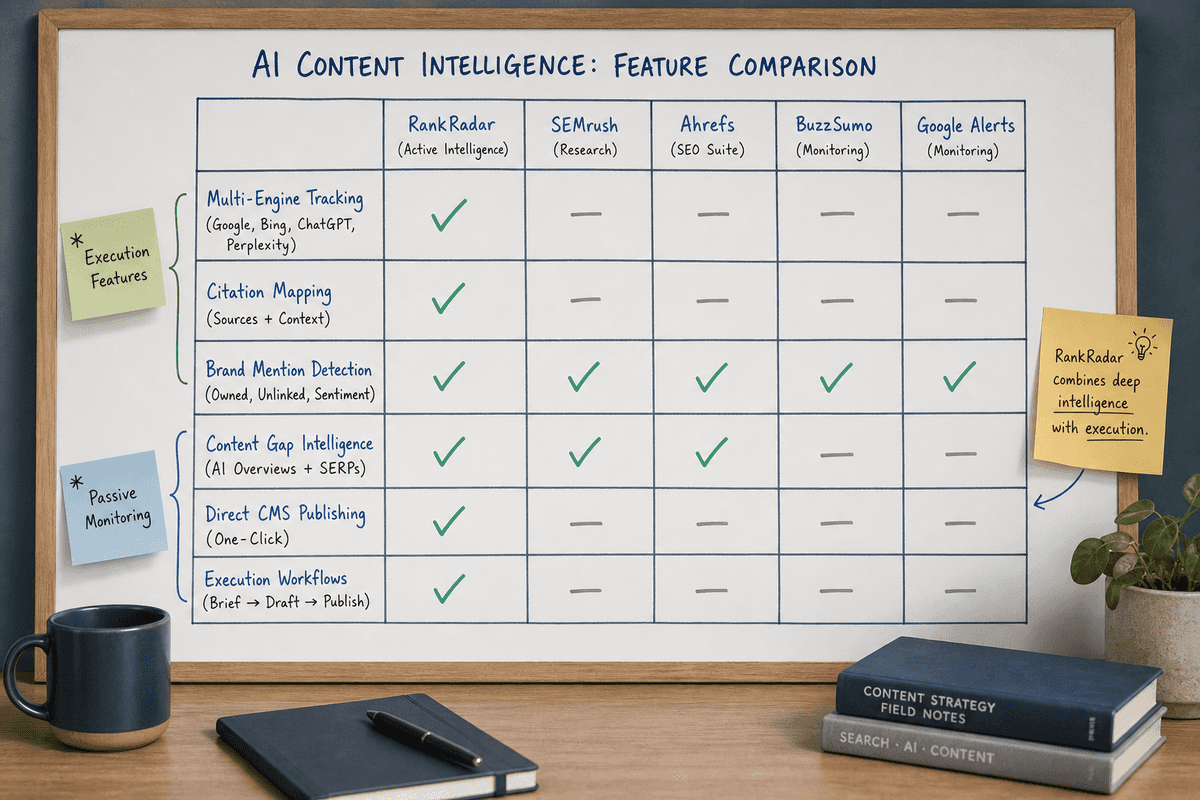
Head-to-Head Feature Comparison
To help your team evaluate which tool matches your day-to-day workflow, this matrix maps key features across common small-team use cases.
Case Scenario: How a 3-Person SaaS Team Won Back AI Search Mentions
To see how an action-oriented visibility tool operates in practice, consider this real-world scenario involving a 3-person marketing team at a B2B SaaS company.
The Problem
The team built a project management tool tailored for remote software agencies. When potential buyers asked Perplexity and ChatGPT, "What are the best agile project management tools for remote software teams?", the AI assistants consistently recommended three competing platforms. The client's brand was completely absent from the top five responses across 12 high-intent buyer prompts.
+---------------------------------------------------------------------------------+
|                        THE RECOVERY WORKFLOW IN PRACTICE                        |
+---------------------------------------------------------------------------------+
| PROMPT AUDIT                                                                    |
| Perplexity & ChatGPT fail to mention Client Brand across 12 high-intent prompts |
|                                       |                                         |
|                                       v                                         |
| CITATION AUDIT                                                                  |
| AI models cite 3 specific software roundups and 2 Reddit community discussions  |
|                                       |                                         |
|                                       v                                         |
| CONTENT GAP IDENTIFICATION                                                      |
| Competitors have detailed feature comparison tables; Client lacks modern spec   |
| sheets and structured comparison pages                                          |
|                                       |                                         |
|                                       v                                         |
| EXECUTION VIA BEVISIBLE                                                         |
| Generates evidence-backed comparison articles & feature breakdowns; publishes  |
| directly to the company blog                                                    |
|                                       |                                         |
|                                       v                                         |
| RESULT AFTER 30 DAYS                                                            |
| Brand included in top 3 recommendations across 9 of 12 target prompts           |

+---------------------------------------------------------------------------------+
The Strategy & Execution
- Citation Audit: Using multi-engine tracking, the team discovered that Perplexity was pulling data primarily from three third-party software roundup articles and two active Reddit threads.
- Gap Analysis: The AI models preferred competitors because those brands had dedicated, highly structured comparison pages with clear data tables outlining remote integrations, pricing tiers, and API capabilities.
- Targeted Publishing: Instead of manually writing content from scratch, the team used BeVisible to generate an evidence-backed comparison article addressing the exact missing parameters identified by the LLM gap analysis.
- Publishing & Indexing: The article was reviewed, scheduled, and published directly to their blog, featuring schema markup and clear structured comparison tables.
The Result
Within 30 days of indexing, fresh web crawls by AI indexers updated the prompt outputs. The brand began appearing in the top three recommendations across 9 of the 12 target prompts on Perplexity and ChatGPT, directly driving qualified referral traffic back to their site.
Generative Engine Optimization (GEO) vs. Traditional SEO
Small marketing teams transitioning from traditional SEO to AI visibility tracking must adjust their strategies. Optimizing for LLM retrieval differs significantly from ranking on standard Google blue links.
+---------------------------------------------------------------------------------+
|                       TRADITIONAL SEO vs. AI VISIBILITY (GEO)                   |
+---------------------------------------------------------------------------------+
| TRADITIONAL SEO                                                                 |
| • Focus: Keywords, backlink quantity, title tag optimization                    |
| • Metric: Organic rank position (e.g., Position #2)                             |
| • Goal: Drive direct clicks to specific landing pages                           |

+---------------------------------------------------------------------------------+
| GENERATIVE ENGINE OPTIMIZATION (GEO)                                           |
| • Focus: Consensus statements, clear entity definitions, structured data tables |
| • Metric: Recommendation inclusion & positive citation presence                 |
| • Goal: Ensure brand is suggested as a solution during buyer research           |

+---------------------------------------------------------------------------------+
Key Differences Every Small Team Must Know
1. Consensus over Single Backlinks
Standard SEO relies heavily on building domain authority through backlink acquisition. AI engines, however, rely on entity consensus. If multiple reputable sources, technical documentation pages, and review platforms state that your software excels at API integrations, the LLM treats that assertion as a reliable fact.
2. Structured Data and Tabular Formatting
LLM context windows prioritize clear information architecture. Articles containing Markdown comparison tables, explicit bulleted specs, and clear schema markup are far easier for AI crawlers to parse and synthesize into buyer recommendations. Teams looking to structure high-performing assets should review our guide on how to build an SEO landing page to ensure proper structural formatting.
3. Shift from Clicks to Answer Citations
In traditional search, ranking position #1 guarantees high click-through rates. In AI search, the AI assistant summarizes the answer directly in the chat interface. Your primary objective shifts from securing a blue link click to ensuring your brand is recommended as the solution within the generated response. To keep up with changing strategies, review our selection of the best SEO blogs every SaaS founder needs.
How to Migrate from Otterly.ai to an Action-Oriented AI Visibility Stack
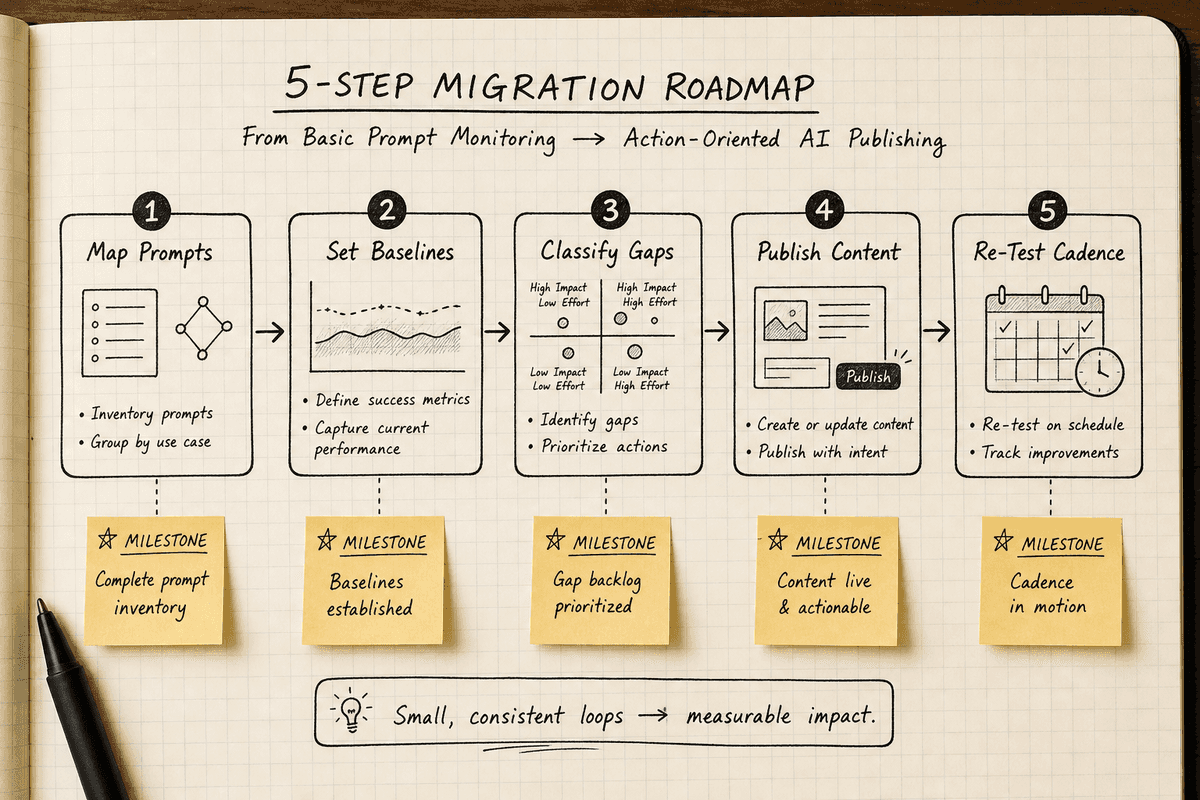
If your team is ready to move beyond simple prompt monitoring and build an end-to-end AI visibility workflow, follow this 5-step implementation process.
Step 1: Map High-Intent Buyer Prompts
Avoid tracking broad, generic head terms like "marketing software." Focus instead on commercial intent queries that active buyers ask when making purchasing decisions:
- "What are the best alternatives to [Competitor X] for small teams?"
- "Top SOC2-compliant email tools for healthcare startups"
- "Compare [Your Product] vs [Competitor Y] pricing and features"
Step 2: Establish Multi-Engine Baselines
Run your prompt matrix across ChatGPT, Gemini, Perplexity, AI Mode, and Google AI Overviews. Record three baseline metrics:
- Inclusion Rate: Percentage of prompts where your brand is mentioned.
- Recommendation Rate: Percentage of prompts where your brand is explicitly recommended as a top solution.
- Citation Share: How often your domain is linked as a primary source.
Step 3: Classify Your Visibility Gaps
Group your prompt results into three actionable gap categories:
- Complete Absence: Your brand is not mentioned at all.
- Hallucination or Outdated Info: The AI mentions your brand but cites incorrect pricing, discontinued features, or legacy positioning.
- Uncited Mention: The AI lists your brand but links exclusively to third-party review sites or competitor blogs rather than your domain.
Step 4: Execute Evidence-Backed Content Updates
For every identified gap, publish structured, authoritative content designed to address the missing information. Ensure your articles feature clear headings, structured data tables, concise technical summaries, and verified facts that AI crawlers can digest easily.
Step 5: Implement a 30-Day Prompt Re-Test Cadence
LLM search indexes do not update instantaneously. Establish a regular 30-day monitoring cycle to track how fresh content publishing impacts AI prompt outputs over time.
Common Pitfalls Small Teams Make with AI Visibility Software
Pitfall 1: Treating Prompts Like Static Keywords
Traditional search keywords yield deterministic results. AI prompts yield probabilistic responses. Expecting an AI engine to return the exact same output for every single user query is a mistake. Focus on overall recommendation trends and citation shares across prompt variations rather than worrying about individual output fluctuations.
Pitfall 2: Ignoring Third-Party Source Citations
Many small teams focus entirely on their owned website, forgetting that LLMs gather information across the broader web. If Reddit discussions, G2 reviews, or independent roundup posts describe your product inaccurately, LLMs will repeat those errors. Effective AI visibility management requires tracking both owned pages and external citation sources.
Pitfall 3: Collecting Data Without an Execution Pipeline
The biggest waste of marketing resources is paying for a tracking software dashboard that nobody acts on. If your team lacks the bandwidth to turn tracking insights into published articles, reviews, or documentation updates, fix your publishing workflow before scaling up your monitoring toolset.
Frequently Asked Questions
How often do AI engines refresh their knowledge sources for brand mentions?
Refresh rates vary by platform. Search-connected AI engines like Perplexity, Google AI Overviews, and ChatGPT with Web Search access real-time web indexes continuously. Live content changes can reflect in search-assisted prompt answers within days or weeks. Base model training weights, by contrast, update on longer multi-month or annual retrain schedules.
Can small marketing teams rely on free AI tools for visibility tracking?
Free tools or manual prompting can work for occasional sanity checks across 5 to 10 core prompts. However, manual checks fail to capture prompt variations, lack automated competitor tracking, and do not scale once your team needs to track dozens of commercial buyer queries across multiple generative engines.
How does AI visibility software account for personalized prompt outputs?
Leading AI visibility tools test prompts using clean, unpersonalized instances across varied user contexts, simulated locations, and query structures. This provides an unbiased baseline score representing what an unauthenticated buyer sees during research.
What is the practical difference between AEO, GEO, and traditional SEO?
Traditional SEO focuses on optimizing web pages to rank in search engine results pages (SERPs). Answer Engine Optimization (AEO) and Generative Engine Optimization (GEO) focus on structuring online information so LLMs and AI search assistants summarize, cite, and recommend your brand when answering complex conversational queries.
Choosing the Right Tool for Your Team
Choosing an alternative to Otterly.ai comes down to your team's primary goal:
- If you only need light automated prompt checks in ChatGPT on a tight budget, Otterly.ai or Am I On AI offer simple entry points.
- If you are an enterprise brand requiring deep sentiment scoring and high-level share of voice reporting, platforms like Profound provide rich corporate intelligence.
- If you are a SaaS founder, B2B marketing team, or growth agency that needs to track ChatGPT, Gemini, Perplexity, AI Mode, and AI Overviews and immediately turn visibility gaps into published work, BeVisible provides the complete end-to-end monitoring and publishing workflow your team needs.