
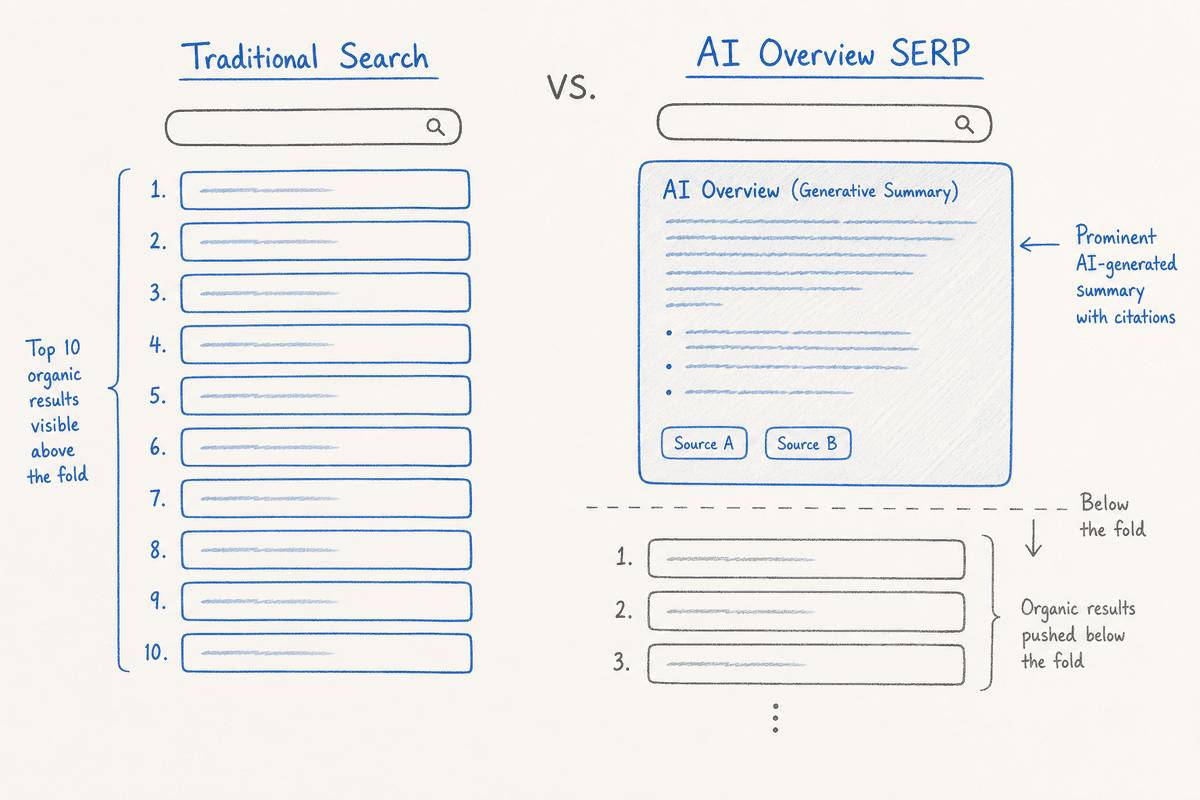
Traffic drops 30% overnight. You check your rank tracker, and your core SaaS landing page is still sitting comfortably at position two. No algorithm update has been announced. No competitors have out-linked you. But when you physically search your target keyword, the problem becomes obvious: a massive, screen-dominating AI Overview has pushed your organic link entirely out of view. Worse, the AI is summarizing your competitor’s article to answer the user’s question.
For the first two decades of SEO, visibility meant ranking in the ten blue links. Today, visibility means being the source material that Large Language Models (LLMs) trust enough to cite in their generated answers. If you aren't being cited by Google's AI Overviews, ChatGPT, Gemini, or Perplexity, you are effectively invisible to a growing segment of high-intent buyers.
Early generative engine optimization (GEO) tools like Otterly.ai emerged to help marketers monitor these specific AI citations. But as search behavior matures, simply knowing you are missing from an AI summary isn't enough. Growth teams, SaaS founders, and agencies are realizing that tracking is only the first half of the equation. The second half is execution—turning those missing mentions and weak citations into a concrete pipeline of published articles, technical updates, and review campaigns.
If you are looking to move beyond passive monitoring, this guide breaks down the most effective Otterly.ai alternatives and methodologies for tracking AI Overview citations in 2026, and more importantly, how to turn those insights into evidence-backed SEO work.
The Reality of AI Overview Tracking in 2026
Traditional rank trackers rely on scraping HTML structure to find where a specific domain sits in a standardized list. AI Overviews (AIOs) break this model completely.
First, AIOs are deeply personalized and highly volatile. An AI Overview might trigger for a user in New York but not for a user in London. It might appear for a query on Tuesday, but disappear by Thursday as Google adjusts its confidence thresholds for that specific topic.
Second, the relationship between traditional ranking and AI citations is complex. While studies show a strong correlation between ranking in the top 10 and being cited in an AIO, it is not a 1:1 rule. A page ranking #8 might be cited as the primary source in an AIO because its content is structured in a highly extractable way—think clean markdown tables, strict H2/H3 hierarchies, and concise entity definitions—while the #1 ranking page is ignored because it’s a rambling wall of text.
Third, citations in AI search take different forms:
- Direct Citations: The AI explicitly names your brand or links to your URL as the source of a specific claim.
- Brand Recommendations: The AI includes your product in a generated list (e.g., "Top CRM tools for small business") without necessarily linking to your site.
- Synthesized Mentions: The AI uses your unique data or framework, but strips the attribution, blending it with other sources.
Understanding these distinctions is critical. When SEO professionals mention that they are starting to track AI Overview citations, they are usually building frameworks to capture not just the presence of a link, but the context of the recommendation. Is the AI positioning your software as the premium choice, or the budget alternative? Tracking tools must evolve to capture sentiment and context, not just raw link counts.
4 Proven Methods to Track AI Citations Without Otterly
While dedicated platforms exist, many marketing teams prefer to integrate AI citation tracking into their existing tech stacks or utilize highly specific workarounds. Here are the four primary methods teams are using to monitor AI Overviews right now.
Method 1: Ahrefs Site Explorer and Brand Radar
If your team is already invested in enterprise SEO software, you likely have access to AIO tracking without needing a standalone subscription. Ahrefs has integrated AI tracking into its core suite, making it one of the most powerful Otterly alternatives for pure data aggregation.
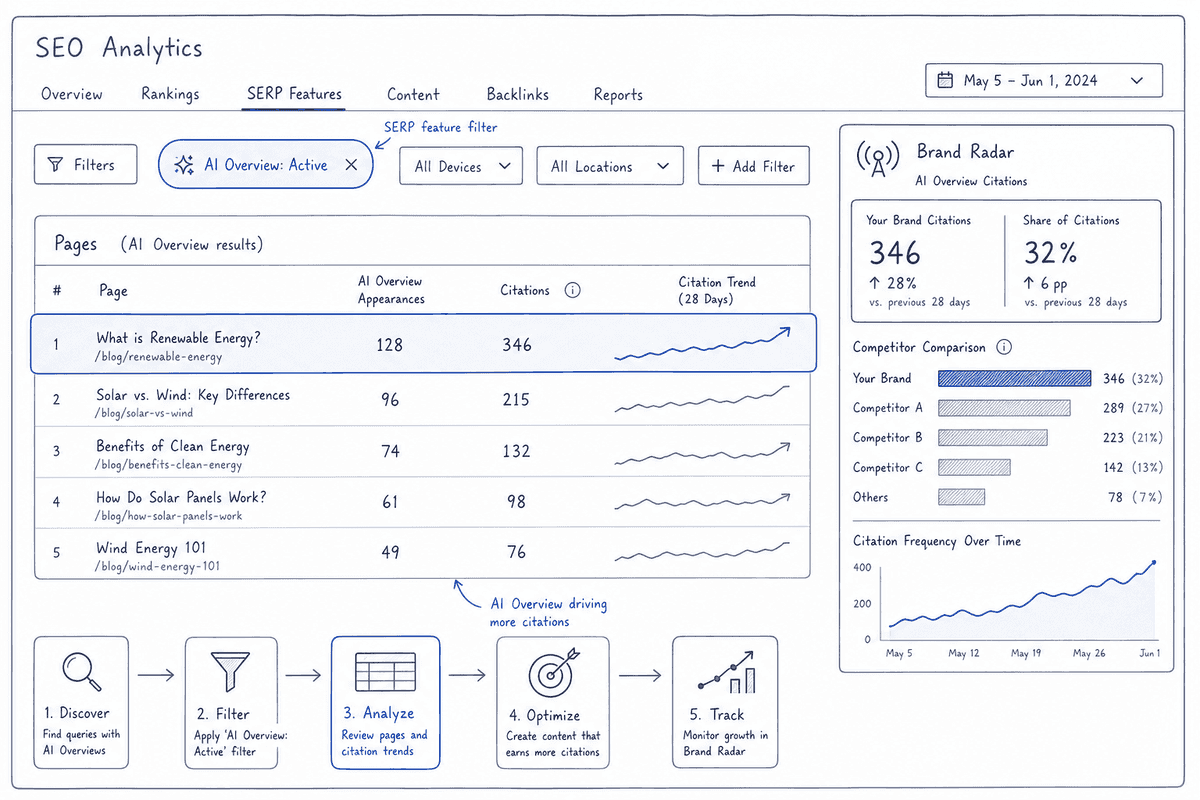
To track your citations, you can use Ahrefs Site Explorer. By entering your domain and navigating to the Organic Keywords report, you can filter the SERP features specifically for "AI Overview." This instantly reveals which of your ranking keywords currently trigger an AI-generated answer.
More importantly, Ahrefs allows you to see if your specific URL is included in the citation carousel. The real power here is the historical data. Because AIO volatility is so high, checking a single day’s snapshot is dangerous. Ahrefs allows you to view performance trends over time, letting you see if an algorithm update suddenly dropped your citations across a whole cluster of keywords.
Additionally, their Brand Radar functionality offers detailed reporting on specific prompts and competitor citations. If you want to know every time a competitor is mentioned alongside your brand in a generative response, this level of enterprise tracking is highly effective.
Method 2: SE Ranking API Paired with Python
For agencies and technical SEO teams that want complete control over their data, pre-packaged SaaS dashboards can sometimes feel restrictive. If you are managing dozens of clients and need to combine AI citation data with internal CRM metrics, API extraction is the logical path.
You can leverage the SE Ranking API paired with Python to build customized tracking environments. By writing a Python script (often run in a simple Google Colab notebook), you can ping the API for thousands of keywords simultaneously, specifically parsing the SERP feature data for AI Overviews.
This method allows for immense flexibility. You can write custom logic to track brand mentions within the text of the AIO itself, not just the citation links. You can cross-reference the presence of an AIO against potential search volumes and your client's current traditional ranking.
While this requires a data analyst or technical SEO to maintain the scripts, it eliminates the per-seat or per-keyword markup typical of specialized AI tracking software. It allows you to build proprietary reporting dashboards that treat AIO citations just like any other data input in your warehouse.
Method 3: Browser Extensions for Real-Time Analysis
Sometimes, aggregate data hides the nuance of the actual buyer experience. When you need to understand exactly how an AI Overview is constructing its argument, real-time manual analysis is necessary.
There are several specialized Chrome Extensions for AIO analysis that operate directly in your browser. When you execute a search query, these extensions scrape the generated AI Overview, extract the SER (Search Engine Results) summary, and build a domain presence report on the fly.
These extensions typically generate a clean table showing exactly which sites were cited, how many times, and where in the text the citation occurred. Most offer a one-click export to Google Sheets or Excel.
This method is highly tactical. It is less about tracking 10,000 keywords and more about dissecting the 10 most critical, high-intent buyer queries for your business. By exporting the citation structure of the pages Google’s AI trusts most, your content team can reverse-engineer the formatting, entity density, and informational hierarchies required to steal that citation spot.
Method 4: The Hidden Bing Webmaster Tools Report
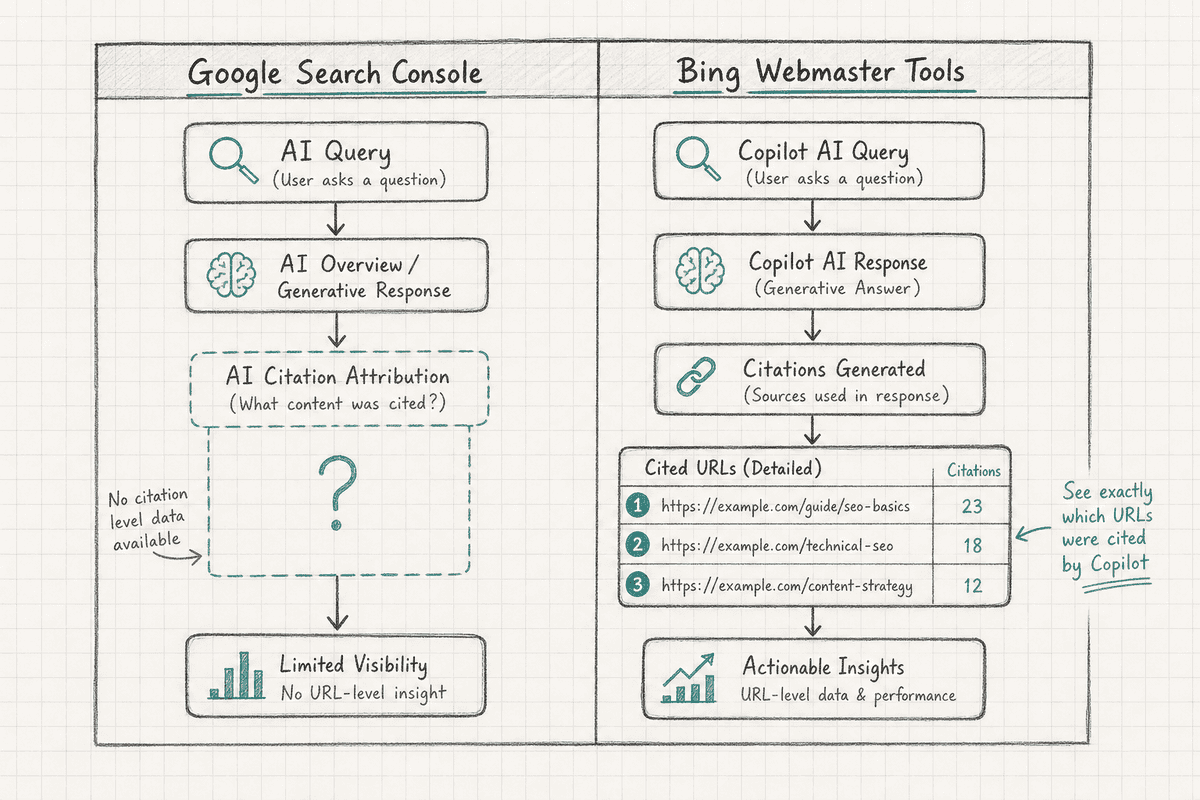
While the SEO industry obsessively focuses on Google, Bing has been quietly integrating generative AI into its search results much longer via Copilot. Because of this deeper integration, Bing actually provides native transparency that Google Search Console currently lacks.
There is a highly useful, built-in report within Bing Webmaster Tools that is entirely free. This report explicitly identifies which of your web pages are being cited by Bing's AI, and specifically lists the queries that triggered those citations.
While optimizing for Bing might seem secondary, the underlying mechanics of Retrieval-Augmented Generation (RAG) are similar across all major search engines. If Bing’s LLM finds your content structured and authoritative enough to cite, Google’s systems are likely evaluating it similarly. Using this free tool provides a fantastic baseline for understanding how machines parse your site's architecture without needing to invest in expensive third-party tools right away.
Beyond Tracking: Turning AI Visibility into Revenue
The fundamental flaw with many Otterly.ai alternatives is that they treat AI citation tracking as a reporting exercise. They send you an alert that you lost a citation to a competitor, and then leave you to figure out what to do about it.
In the fast-paced B2B SaaS environment, a dashboard full of red arrows isn't helpful unless it comes with a clear execution path. This is where BeVisible alters the workflow. BeVisible isn't just about monitoring how AI assistants answer buyer questions—though it tracks ChatGPT, Gemini, Perplexity, AI Mode, and Google AI Overviews rigorously. The core differentiation is how it turns those visibility gaps into evidence-backed opportunities.
Consider a typical scenario. You are a SaaS founder monitoring the query "best inventory management software for Shopify."
A standard tracking tool tells you: Your domain is not cited in the AI Overview. Your competitor, InventoryPlus, is cited 3 times.
What do you do with that information? Do you rewrite your homepage? Do you build a new landing page? Do you buy more backlinks?
BeVisible bridges the gap between monitoring and execution. Instead of just highlighting the missing mention, it turns that data into a specific workflow. If the AI is citing InventoryPlus because of a specific integration they mention on their features page, BeVisible helps you turn that gap into a scheduled publishing task. It highlights the exact entities and subtopics the AI is looking for, allowing your content teams to update your articles, build out better comparison pages, or launch targeted review campaigns to build the authority signals the LLMs are actively searching for.
The Mini-Story: Tracking Everything, Changing Nothing
Consider a mid-sized B2B growth agency that brought on a client in the highly competitive project management space. The agency bought a dedicated AI tracking tool and set up beautiful, automated reports. Every Monday, the client received a PDF showing their "AI Share of Voice."
For three months, the Share of Voice slowly ticked downward. The client was losing citations to a newer, more agile competitor. The agency’s response was to point to the dashboard and say, "See? Google is testing new AI layouts, things are volatile."
The problem wasn't volatility. The problem was that the tracking tool provided no execution layer. The competitor wasn't winning because of a random algorithm test; they were winning because they had restructured their documentation into clean, crawlable markdown tables that the AI could easily ingest and cite.
The agency eventually shifted their approach. They stopped relying purely on a passive dashboard and built an execution workflow. When they saw a citation drop, they immediately triggered a content review. They compared their client's page structure against the cited competitor's page structure. They found the missing entities, updated the content, and forced a recrawl. Within two weeks, the citations returned.
Tracking without an execution framework is just expensive anxiety.
Contrarian Take: You're Tracking the Wrong AI Citations
There is a dangerous trend emerging in the GEO space: optimizing for vanity AI Overviews.
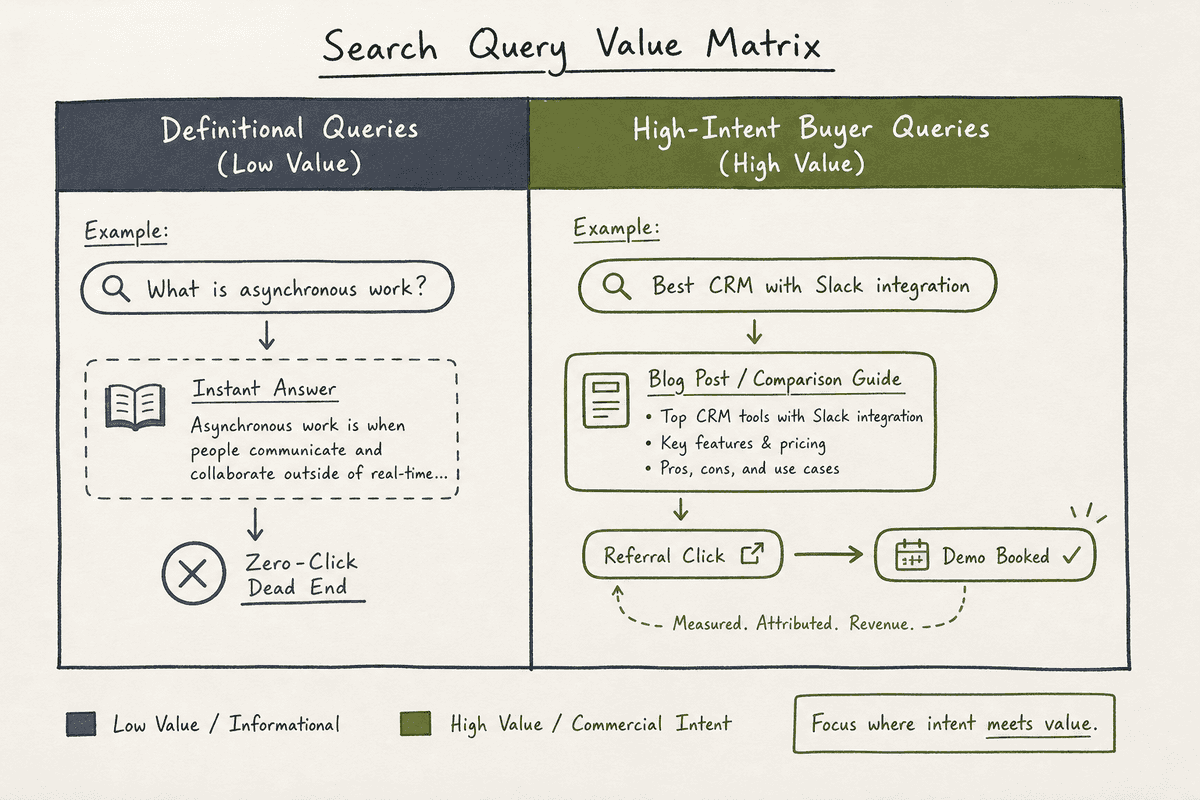
Many marketing teams are obsessed with getting cited for high-volume, top-of-funnel definitional queries. They want their brand cited when someone asks, "What is asynchronous communication?" or "How does machine learning work?"
Here is the uncomfortable truth: being cited in an AI Overview for a definitional query drives almost zero pipeline.
When a user asks an LLM a basic "what is" question, they want the answer right there on the screen. They have absolutely no incentive to click the tiny citation link to visit your website. The AI has fully satisfied their search intent. You might get a vanity impression on your tracking dashboard, but you will not get a click, a lead, or a sale.
Instead of tracking broad industry terms, your focus should be exclusively on high-intent buyer questions. You need to track prompts like:
- "What are the best alternatives to [Competitor]?"
- "Which CRM integrates best with Slack and QuickBooks?"
- "Pricing comparison between Tool A and Tool B."
These are queries where the AI's answer serves as a starting point, not the final destination. The user needs to click through to evaluate the software, read the reviews, or book the demo. The citation here acts as a powerful third-party endorsement from the AI itself.
If you are evaluating the 11 Best SEO Blogs Every SaaS Founder Needs (2026), you will notice that the most successful SEO practitioners are heavily shifting their focus toward this lower-funnel intent mapping. Stop celebrating citations that don't generate revenue.
Structuring Content for Better AI Overview Visibility
Once you use your chosen alternative to identify a visibility gap, how do you actually win the citation back? The process is fundamentally different from traditional SEO link building or keyword stuffing.
Large Language Models parse the web differently than traditional indexers. They are looking for high-density information structured in predictable, easily extractable ways.
1. Optimize for Entity Extraction
LLMs build relationships between concepts (entities). If you want to be cited for "enterprise SEO tools," your page needs to densely and naturally interlink related entities like "crawler limits," "log file analysis," "API access," and "custom reporting."
Do not bury definitions in long, flowing paragraphs. Use bolded text to highlight core concepts immediately followed by a concise, one-sentence definition. This mimics a dictionary structure, which LLMs heavily favor for extraction.
2. Utilize Strict Formatting Hierarchies
If you are writing a guide on How to Build an SEO Landing Page (7-Step Guide), your HTML must reflect that exact structure.
- Your H1 is the overarching topic.
- Your H2s must be the distinct, sequential steps.
- Your H3s should break down the specific tools or nuances within those steps.
AI models use heading hierarchy to understand context. If your H2s are clever puns instead of descriptive steps, the AI will struggle to extract your page as a definitive source.
3. Leverage Markdown-Style Tables for Comparisons
When a user asks an AI to compare two products, the AI looks for sources that have already done the hard work of data organization. If you present pricing, feature sets, or technical specifications in a clean, standardized table, your chances of being cited skyrocket. The AI can pull the data directly from your table cells with high confidence, leading to a direct citation of your page as the data source.
4. Ensure Technical Accessibility
You cannot be cited if the crawler cannot access or render your content. This is especially critical for modern web applications built on React, Vue, or Angular. If you are relying heavily on client-side rendering, AI crawlers (which are often more resource-constrained than standard Googlebot) might see a blank page.
Mastering Single-Page Application SEO: What Works in 2026? is non-negotiable. Ensure you have dynamic rendering or server-side rendering (SSR) in place. If the bot only sees a loading spinner in its initial DOM snapshot, your brilliant content will never make it into the LLM's vector database.
Measuring Click Loss and Search Sentiment
One of the most complex aspects of replacing Otterly.ai is figuring out how to measure the impact of an AI Overview, not just its existence.
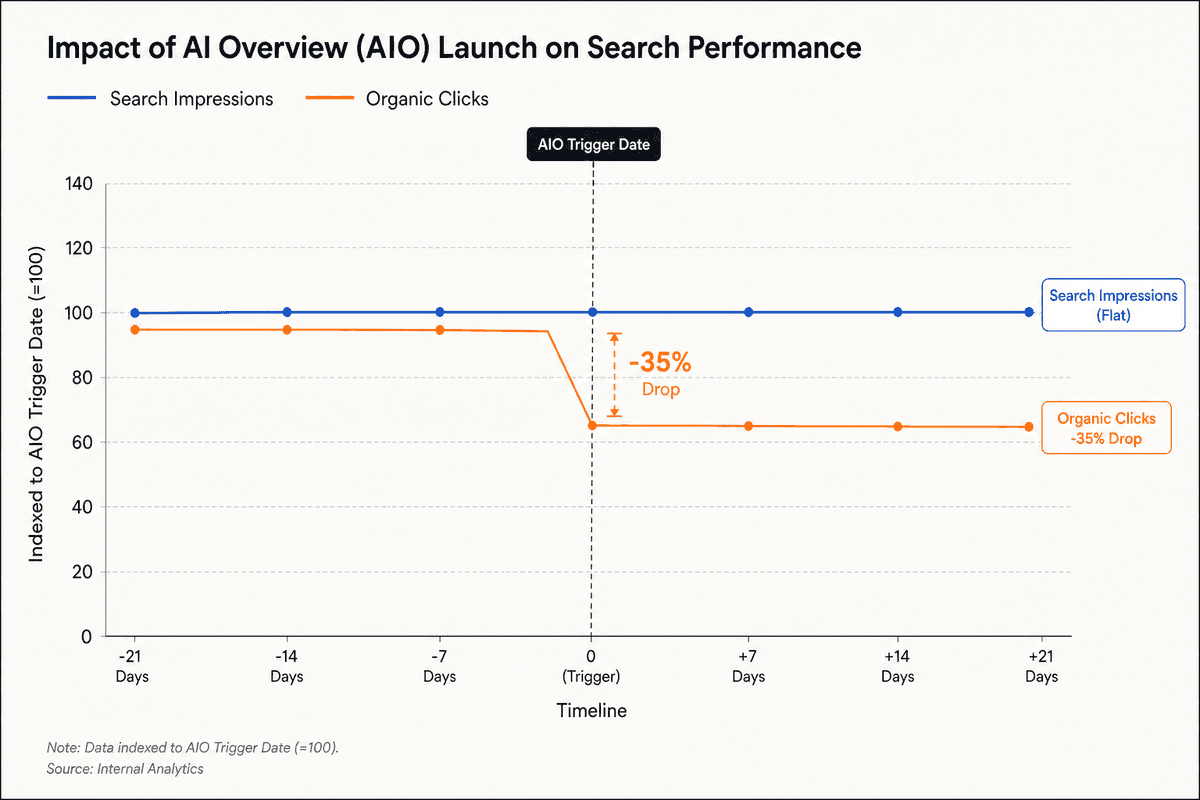
When an AIO appears on a SERP, it pushes organic results down. Even if you maintain your #1 ranking, your Click-Through Rate (CTR) will likely plummet because the AIO answers the user's question immediately.
To measure this effectively, you must correlate your AI citation tracking data with your Google Search Console click data.
- Identify the Trigger Date: Use Ahrefs or your Python scripts to identify exactly when an AI Overview began consistently appearing for your target keyword.
- Isolate the CTR Drop: Look at your Search Console data for that specific query. You will often see impressions remain steady while clicks drop sharply on the trigger date.
- Evaluate the Citation: Are you cited in the AIO?
- If yes, but clicks are still down, the search intent is likely definitional. The AI answered the question, and the user left.
- If no, you have a dual problem: you lost the organic CTR, and you aren't capturing any of the AI citation traffic.
This analysis is crucial when justifying SEO Charges UK: Agency Rates vs Automation (2026). When clients ask why traffic is down despite rankings holding steady, you need the data to prove that the SERP real estate fundamentally changed, and that the new strategy requires investing in GEO rather than just traditional link building.
Building an AI Visibility Execution Workflow
To truly leverage the BeVisible philosophy of turning visibility gaps into action, you need an internal workflow that dictates exactly what happens when a tracking tool alerts you to a missing citation.
Here is a 5-step execution framework you can implement immediately:
Step 1: The Alert Triage
When your tracking system flags a dropped or missing citation for a priority keyword, do not immediately rewrite your content. First, manually verify the AIO. Search the prompt in an incognito window or use an AI Mode extension. Verify the intent of the AIO. Is it recommending tools? Is it summarizing a process?
Step 2: The Source Analysis
Look at the domains the AI did cite. Extract their content. What do they have that you don't?
- Do they include proprietary data or statistics?
- Do they have a stronger backlink profile specifically from industry-relevant domains?
- Is their page structured with bullet points or tables that directly match the AI's output format?
Step 3: The Gap Bridging (Content Execution)
Once you identify the gap, schedule the publishing work. If the AI cited three competitors because they all included a "Pricing Breakdown" section and you didn't, assign a writer to build that section. Write it concisely, use a table, and ensure your H2 explicitly says "Pricing Breakdown for [Software Name]."
Step 4: The Authority Signal Update (Off-Page Execution)
AI models heavily weigh external consensus. If ChatGPT or Gemini is recommending a competitor, it is often because that competitor is frequently mentioned on high-authority aggregator sites, Reddit, or G2. If your page is technically perfect but still isn't cited, your execution step must shift to off-page signals. Schedule a review generation campaign or launch digital PR efforts to ensure your brand is mentioned in the same context as your top competitors across the wider web.
Step 5: Force Indexing and Monitor
Once the on-page or off-page work is complete, use Google Search Console to request indexing. Log the date of the change in your tracking tool, and monitor the keyword over the next 14 to 30 days to see if the AI updates its vector retrieval to include your newly optimized page.
Frequently Asked Questions (FAQ)
Can you track Google AI Overviews for free?
Yes, but with limitations. The Bing Webmaster Tools report provides free, explicit data on AI citations within the Bing/Copilot ecosystem. For Google, you can manually use free Chrome extensions to analyze real-time AIO citations on a query-by-query basis. However, tracking thousands of keywords automatically across Google requires paid APIs or enterprise tools like Ahrefs.
Is Otterly.ai the only tool for generative engine optimization?
No. While it was an early entrant in the dedicated GEO space, many teams are finding success using existing SEO platforms (like Ahrefs Brand Radar), custom Python scripts connected to the SE Ranking API, or comprehensive workflow tools like BeVisible. BeVisible specifically differentiates itself by focusing on the execution side—turning the tracked data into actionable publishing and review strategies.
How long does it take to appear in an AI overview after updating content?
The timeline is highly variable. Because LLMs rely on indexers to feed them data, your changes must first be crawled and indexed by standard bots (like Googlebot). Once indexed, the search engine's RAG system must evaluate the new content against existing sources. This can take anywhere from a few days to several weeks. Furthermore, AI Overviews are highly dynamic; they may test citing your updated page for a few days before reverting to older sources if user interaction signals are poor.
Does technical SEO still matter for AI citations?
Absolutely. If your site is built on complex JavaScript that crawlers struggle to render, your content will not be parsed for AI citations. Ensuring your technical fundamentals are solid—as outlined in guides regarding SEO for Single Page Applications: The Technical Checklist—is a prerequisite for GEO. The smartest content in the world cannot be cited if the bot cannot read it.
Moving from Passive Monitoring to Active Growth
The era of setting up a rank tracker and checking it once a month is definitively over. As AI Overviews, ChatGPT, and Perplexity increasingly intercept the buyer journey, visibility has become fragmented, dynamic, and highly complex to measure.
Tools that simply tell you where you are missing are no longer sufficient. To maintain and grow market share, marketing teams must adopt a methodology that instantly translates visibility gaps into execution. Whether you build this internally using APIs and Python, leverage enterprise tools like Ahrefs, or adopt platforms like BeVisible to automate the workflow from monitoring directly to publishing, the goal remains the same.
You must optimize for the machine's extraction while fundamentally satisfying the buyer's intent. Track meticulously, but more importantly, build the systems required to act on the data before your competitors do.