
You check your inbound analytics. Traffic is largely flat, maybe even down a few percentage points year-over-year. Yet, lead velocity is accelerating, and the quality of inbound inquiries is suspiciously high. When you ask these new prospects how they found you, the answer is increasingly identical: "I asked ChatGPT for the best solution, and it recommended you."
This is the new reality of B2B discovery. Buyers are bypassing traditional search engines, actively ignoring ten blue links and sponsored ads, and opting for conversational AI assistants to short-circuit their research process.
For growth teams and SaaS founders, this creates a massive blind spot. Traditional SEO tools measure keyword volume, backlink profiles, and SERP positions. They cannot tell you if ChatGPT hallucinated a competitor's feature, if Perplexity dropped your brand from a vendor roundup, or if Gemini thinks your product is too expensive based on an outdated Reddit thread.
To track whether ChatGPT mentions your brand, competitors, products, or executives, a new category of "AI visibility" and "LLM monitoring" tools has emerged. While Otterly.ai has built early mindshare in this space, growth teams are increasingly searching for alternatives that go beyond simple monitoring to offer deeper workflow integration, broader engine coverage, and actionable execution.
Here is a comprehensive breakdown of the best Otterly.ai alternatives for tracking ChatGPT brand mentions, and how to use them to engineer your AI visibility.
The Shift from Rank Tracking to AI Visibility Monitoring
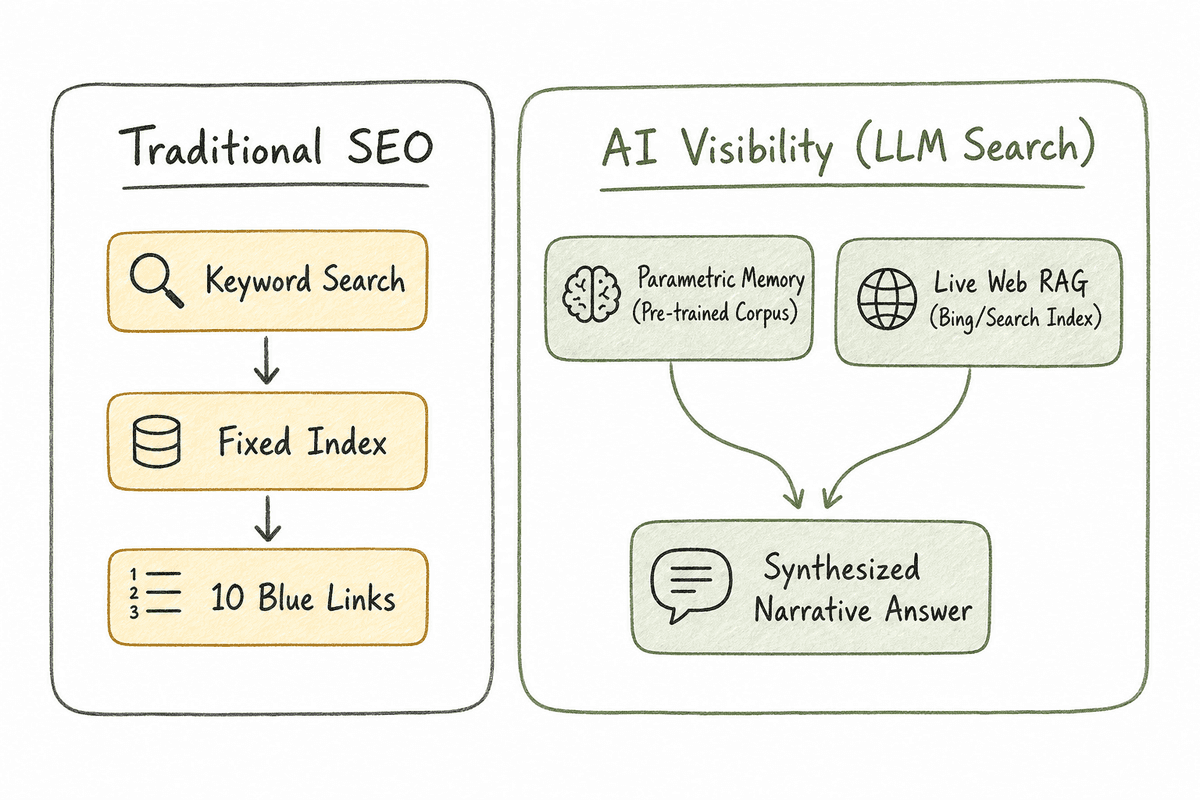
Before evaluating specific tools, you need to understand why tracking ChatGPT mentions is fundamentally different from tracking Google rankings.
When you track a keyword in traditional search, the output is deterministic. If a user searches for "best CRM for manufacturing," Google retrieves an indexed list of URLs. Your page is either ranked number three, or it isn’t.
AI assistants operate differently. They do not rank URLs; they synthesize answers dynamically. When a buyer prompts ChatGPT with, "What is the best CRM for a mid-sized manufacturing company with long sales cycles?", the AI relies on two distinct mechanisms:
- Parametric Memory (Pre-training): The vast corpus of data the model was trained on. If your brand was heavily discussed in authoritative spaces prior to the model's knowledge cutoff, the AI is likely to recommend you based on its internal weights.
- Retrieval-Augmented Generation (RAG): The model's ability to browse the live internet. If ChatGPT uses Bing to search for current context, it reads top-ranking articles, extracts entities, and synthesizes a response on the fly.
Tracking AI brand mentions means you must track both the model's inherent biases and its real-time retrieval habits across thousands of buyer persona prompts.
A standard visibility tool must simulate the buyer journey. It needs to feed hundreds of varied prompts into ChatGPT, Gemini, Perplexity, and AI Overviews, parse the narrative responses, identify whether your brand was mentioned, evaluate the sentiment (positive, neutral, or negative), and pinpoint exactly which sources the AI cited to form its opinion.
Why Teams Outgrow Basic AI Monitoring
Otterly.ai has served as an accessible entry point for many teams looking to track mentions across ChatGPT, Gemini, Claude, and Perplexity. It offers competitor benchmarking and citation tracking, which are table stakes for AI search engine optimization (AEO).
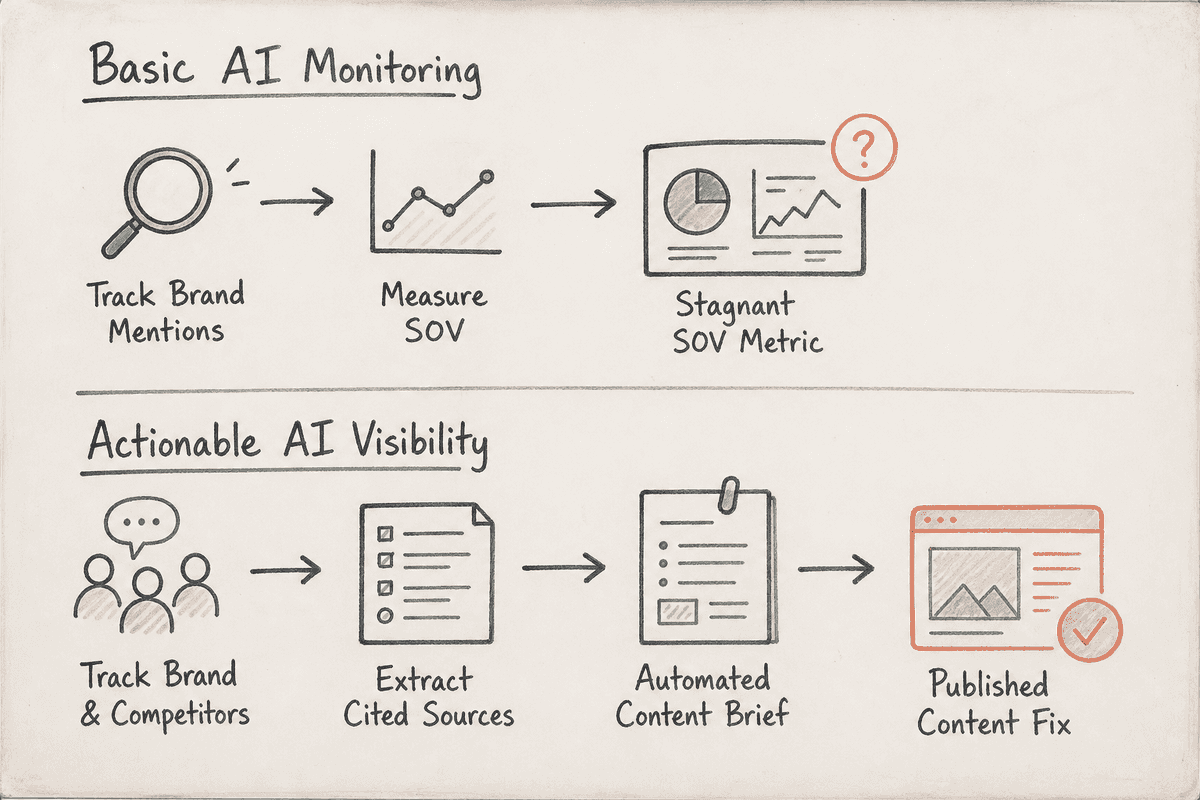
However, monitoring alone rarely moves the needle. Knowing that ChatGPT recommends a competitor over you is only useful if you have a system to diagnose why it happened and how to fix it.
Teams typically look for Otterly.ai alternatives when they hit one of three failure modes:
- The "So What?" Problem: The tool delivers a dashboard showing a 15% drop in Share of Voice (SOV), but provides no actionable content brief or workflow to regain that visibility.
- The Citation Gap: The tool tells you ChatGPT cited a source, but doesn't integrate with your publishing or outreach workflows to help you secure a mention on that specific source.
- Enterprise Reporting Needs: Larger organizations need to slice sentiment data by executive name, specific product lines, and complex geographic segments, requiring deeper data manipulation than standard monitoring platforms allow.
Let’s look at the top alternatives that solve these specific challenges.
1. BeVisible: Best for Turning Visibility Gaps into Executed Work
If your primary frustration with AI monitoring is that it creates passive dashboards rather than active workflows, BeVisible is built for your team.
While traditional tools focus strictly on data extraction, BeVisible is designed around the execution phase of AI visibility. It tracks how AI assistants answer buyer questions, which brands they recommend, and which sources they cite across ChatGPT, Gemini, Perplexity, AI Mode, and Google's AI Overviews.
The differentiator is what happens after the data is collected.
When BeVisible identifies a visibility gap—for instance, ChatGPT consistently recommending a competitor because they are cited in a specific G2 roundup that your brand is missing from—it doesn't just report the gap. It turns that missing mention into an evidence-backed opportunity. BeVisible connects the diagnostic data directly into article creation, review generation, scheduling, and publishing workflows.
Key Capabilities:
- Buyer Prompt Tracking: Simulates complex, multi-variable buyer questions rather than just raw keywords.
- Citation Engineering Workflows: Identifies the exact domains the LLMs are reading to form their answers, allowing your content and PR teams to prioritize outreach and placement.
- Action-Driven Architecture: Maps weak citations and competitor wins directly into your content roadmap. If ChatGPT complains about your pricing because of an outdated blog post, BeVisible highlights the exact asset you need to update or counteract.
For SaaS founders and growth teams who need to measure AI-search visibility and immediately turn missing mentions into published work, BeVisible acts as both the monitor and the execution engine.
2. Profound: Best for Enterprise Executive Reporting
When tracking AI visibility scales up to the enterprise level, the requirements shift. You aren't just tracking a single product; you are tracking multiple product lines, regional brand reputation, and the public perception of the C-suite.
Profound is frequently cited as an enterprise leader in this space, heavily catering to large-scale communications and corporate marketing teams. According to industry analyses of top tools, Profound focuses deeply on share of voice, sentiment analysis, citation intelligence, and executive reporting.
Key Capabilities:
- Executive Reputation Tracking: If an enterprise CEO is mentioned in ChatGPT prompts related to industry leadership or recent news, Profound tracks the sentiment of those specific narratives.
- Granular Sentiment Analysis: Breaks down AI responses to determine not just if a brand was mentioned, but whether the LLM positioned the brand as a premium solution, a budget alternative, or a legacy player losing market share.
- Market Share Benchmarking: Provides high-level Share of Voice metrics that translate well into board-level presentations.
The tradeoff with enterprise tools like Profound is often agility. They are phenomenal at providing deep, customized reporting layers, but may require heavier lifting to translate those reports into day-to-day content marketing tasks compared to execution-focused platforms.
3. Semrush AI Visibility Toolkit: Best for Consolidated Stacks
For teams already heavily invested in traditional search engine optimization, bridging the gap between Google SERPs and ChatGPT responses can be jarring. You have one tool for keyword tracking and an entirely separate platform for AI mention tracking.
The Semrush AI Visibility Toolkit is designed specifically to solve this consolidation problem. For existing Semrush users, this toolkit integrates AI mention tracking directly into familiar SEO workflows and prompt databases.
Key Capabilities:
- Unified Dashboarding: Allows SEO teams to view traditional Google ranking data alongside AI visibility metrics, providing a holistic view of organic discovery.
- Prompt Databases: Leverages Semrush's massive keyword infrastructure to help teams reverse-engineer the prompts buyers are likely to use in ChatGPT based on historical search data.
- Familiar Interface: Reduces the learning curve for teams that already spend hours a week inside the Semrush ecosystem.
This integration makes Semrush a highly practical choice for agencies. If you are already managing multiple client accounts—perhaps figuring out the best SEO Charges UK: Agency Rates vs Automation (2026) to scale your services—adding the AI visibility toolkit allows you to upsell AEO services without onboarding a completely isolated software vendor.
4. AskLab: Best for Specialized Search Tracking
As the AI search landscape fragments, different models develop distinct personalities and retrieval habits. Claude tends to be more cautious and analytical, Perplexity is highly citation-driven and research-focused, while ChatGPT balances conversational tone with Bing's live search index.
AskLab is built for AI-search-focused teams that need to understand these nuances. It explicitly tracks rankings, citations, sentiment, and share of voice across ChatGPT, Gemini, Claude, and Perplexity.
Key Capabilities:
- Multi-Model Precision: AskLab excels at showing the delta between how Perplexity views your brand versus how Gemini views it. This is critical because a strategy that works for Perplexity (optimizing for academic or deep-research citations) might not move the needle for ChatGPT.
- Citation Tracking: Heavily indexes the underlying URLs that the LLMs are surfacing in their footnotes.
- Sentiment Comparison: Allows you to see if a specific AI model has developed a negative bias against your product due to its specific training data mix.
External industry reviews highlight AskLab as a robust, specialized AI Search Tool for Brands that gives technical marketers the exact data points they need to reverse-engineer model behavior.
5. GrackerAI, Workduo, and Siftly: Niche Contenders
Beyond the major players, several other tools have emerged to tackle specific slices of the AI visibility pie.
- GrackerAI: Focuses heavily on the intersection of AEO (Answer Engine Optimization) and GEO (Generative Engine Optimization). According to their insights on the 10 Best Tools to Check if ChatGPT Mentions Your Brand 2026, they prioritize helping brands understand how content structure influences LLM ingestion.
- Workduo.ai: Offers streamlined monitoring for mid-market teams. Their breakdown of the 7 Best Tools to Monitor ChatGPT Brand Mentions in 2026 emphasizes ease of use and rapid deployment for teams that need baseline visibility without enterprise bloat.
- Siftly: Positions itself as a comprehensive comparison tool for brand monitoring, focusing on comparing AI outputs over time to detect shifts in brand narrative, as detailed in their 10 Best AI Brand Monitoring Tools (2026, Compared) report.
And for those heavily researching the category, comprehensive roundups from aggregators like Superframeworks provide ongoing analysis of how these tools evolve month-over-month.
The Core Features of a Modern AI Brand Mention Tool
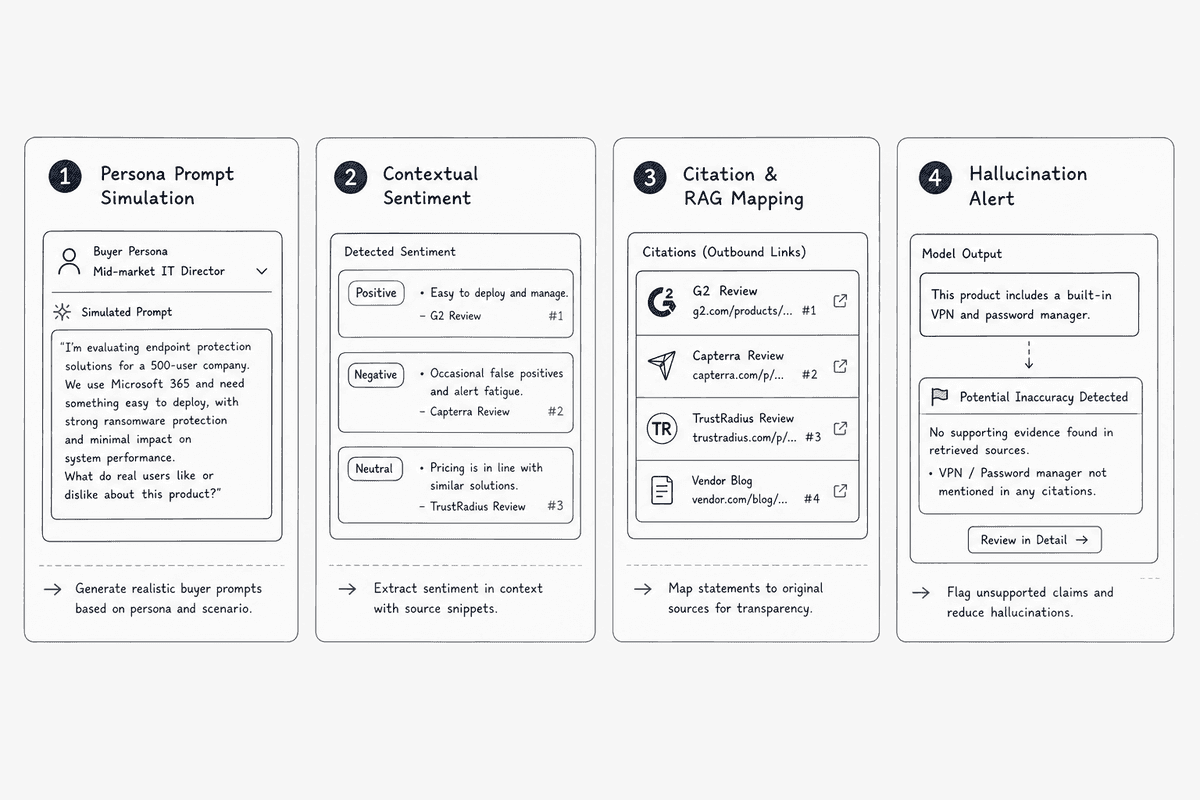
When evaluating an Otterly.ai alternative, a simple feature matrix isn't enough. You need to understand how these features practically apply to a growth team's daily workflow. If you are comparing BeVisible, AskLab, and Profound, evaluate them against these four core capabilities.
1. Persona-Driven Prompt Simulation
The days of tracking a two-word keyword are over. Nobody asks ChatGPT for "CRM software." They prompt it with paragraphs: "Act as a fractional CMO. I need a CRM for a B2B SaaS startup with 50 employees. We currently use HubSpot for marketing but need something with better outbound sales sequencing. What are the top 3 tools, and what are their pros and cons?"
Your tracking tool must be capable of ingesting complex, multi-variable prompts. It should allow you to define buyer personas, constraints, and intent levels, and then run those prompts at scale across the AI models to see how the recommendations change based on the persona's context.
2. Contextual Sentiment Analysis
Binary "mentioned / not mentioned" data is dangerous in AI tracking.
ChatGPT might mention your brand in 100% of the prompts you track, giving you a falsely inflated Share of Voice. However, if you read the actual outputs, the AI might be saying: "While [Your Brand] is a well-known legacy option, users frequently complain about its slow interface and high cost. You should consider [Competitor] instead."
A modern tool must parse the contextual sentiment. Is the AI positioning you as the winner, a runner-up, a budget alternative, or explicitly advising against you?
3. Citation Mapping and RAG Diagnostics
This is the most critical feature for execution. When an LLM recommends a competitor, you must know where it got that idea.
Did it pull from an outdated Reddit thread? Did it read a recent review on G2? Did it cite a competitor's own blog post? If your tool cannot map the AI's output back to the specific source URLs it retrieved via RAG, you cannot fix the visibility gap. You need to know exactly which domains hold influence over the AI's answers so your PR and content teams can target those specific sites for inclusion.
4. Hallucination Detection
LLMs lie. They confidently invent features, pricing tiers, and integration capabilities that do not exist.
A failure mode many brands experience is discovering that ChatGPT is telling enterprise buyers their software lacks SOC-2 compliance, simply because the model hallucinated the gap. Your monitoring tool should flag factual anomalies regarding your brand so you can launch rapid content corrections on your owned domains to retrain the model's retrieval mechanisms.
Building an Actionable AI Visibility Strategy
Tooling is only half the battle. Once you select an alternative to Otterly.ai, you have to operationalize it. The teams that win in AI search do not just stare at dashboards; they execute highly specific campaigns to manipulate the information ecosystem the LLMs rely on.
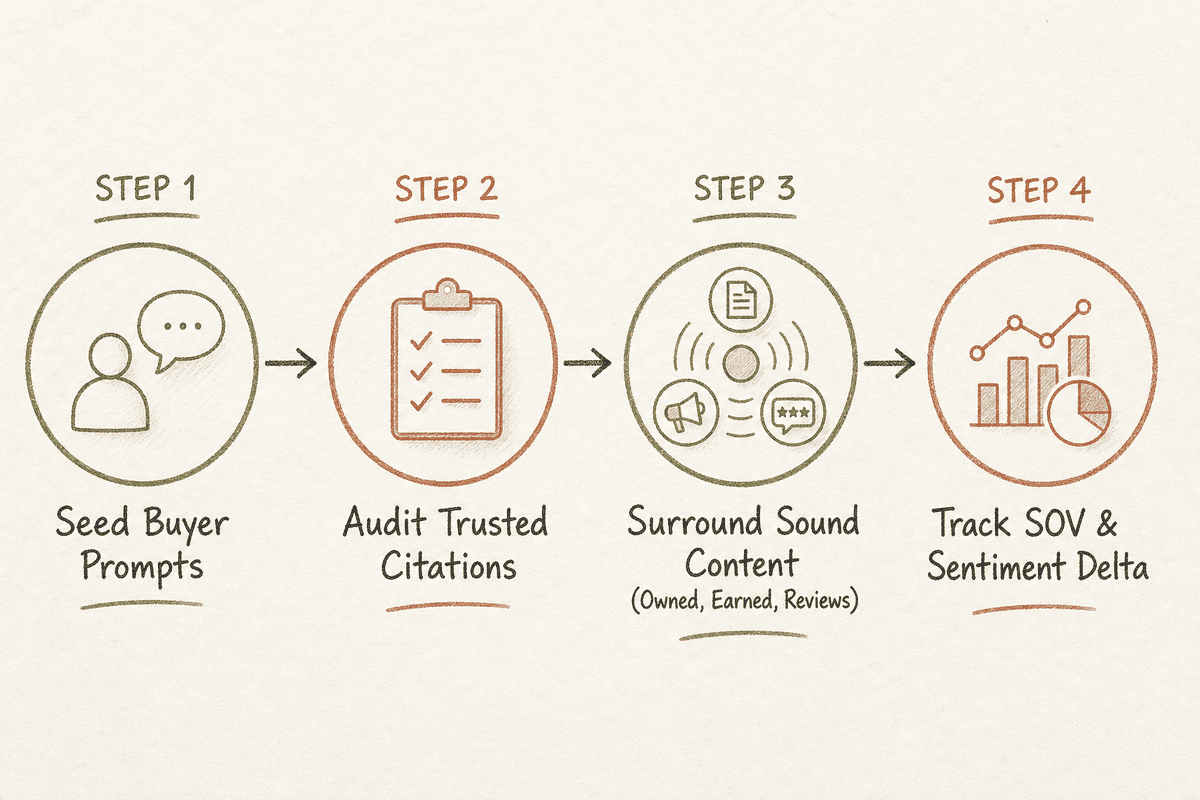
Here is a step-by-step framework for turning ChatGPT mention tracking into measurable growth.
Phase 1: Define Your Seed Prompts and Buyer Scenarios
Start by throwing out your traditional keyword lists. Instead, sit down with your sales and customer success teams. What are the exact questions buyers ask on demo calls? What specific use cases are they trying to solve?
Translate these into 20-50 highly detailed seed prompts. Group these prompts by intent:
- Discovery Prompts: "What are the best tools for..."
- Comparison Prompts: "[Brand A] vs [Brand B] for [Specific Use Case]"
- Diagnostic Prompts: "How do I solve [Specific Problem] using software?"
Load these into your monitoring tool (like BeVisible) and run the baseline audit across ChatGPT, Gemini, and Perplexity.
Phase 2: Audit the Citation Landscape
Once the data returns, ignore your own brand for a moment. Look at the brands the AIs are recommending most frequently. More importantly, look at the citations the AIs are using to justify those recommendations.
You will likely find a pattern. Perhaps ChatGPT consistently cites a specific industry blog, a particular LinkedIn influencer's newsletter, or a niche review site. These are your target domains.
In traditional SEO, you might spend resources figuring out How to Build an SEO Landing Page (7-Step Guide) to capture direct traffic. In AEO, you use that same content creation energy to get featured on the third-party domains the LLM already trusts.
Phase 3: Execute the "Surround Sound" Content Strategy
If ChatGPT is not mentioning your brand, it is because you are missing from its favored retrieval sources. You must engineer a "surround sound" effect.
- Owned Media Correction: Ensure your own website clearly, technically, and explicitly answers the prompts you want to be recommended for. Use structured data, clear semantic HTML, and definitive statements. (For technical teams, ensuring your site architecture is easily crawlable by AI bots is crucial—similar to the principles outlined in Single-Page Application SEO: What Works in 2026?).
- Earned Media Placements: Launch PR and outreach campaigns specifically targeting the URLs and domains you identified in Phase 2. If Perplexity loves citing a specific digital agency's blog regarding 11 Best SEO Blogs Every SaaS Founder Needs (2026), you need to get your brand inserted into that existing article.
- Review Ecosystem Management: LLMs heavily weight user-generated content from platforms like Reddit, Quora, G2, and Capterra. Actively prompt your happiest customers to leave detailed, use-case-specific reviews on these platforms.
Phase 4: Monitor the Delta
Run your prompts again next month. Look for the delta. Has your sentiment shifted from neutral to positive? Has your competitor's Share of Voice dropped? Has ChatGPT stopped hallucinating that false pricing tier?
This is where a tool like BeVisible shines, as it tracks these shifts and immediately suggests the next piece of content required to close any remaining gaps.
Technical Considerations for AI Visibility
It is worth noting that tracking AI mentions can sometimes intersect with deep technical SEO. AI crawlers (like OpenAI's OAI-Bot or Perplexity's crawler) interact with your website differently than Googlebot.
They are often less patient with heavy JavaScript and less capable of executing complex user interactions to find content. If your brand relies heavily on dynamic web apps, you must ensure your content is pre-rendered or easily accessible.
Teams that struggle with AI visibility often find that the models simply cannot read their sites. If this sounds familiar, reviewing technical guides like SEO for Single Page Applications: A 5-Step Guide (2026) or exploring Implementing SEO in Single Page Applications (3 Ways) can ensure your technical foundation isn't actively blocking ChatGPT from learning about your brand. Furthermore, a thorough run-through of an SEO for Single Page Applications: The Technical Checklist ensures that when AI bots arrive, they extract the exact entities and facts you want them to.
Local and Niche AI Brand Tracking
A common misconception is that AI visibility only matters for massive, global enterprise software. In reality, LLMs are increasingly being used for localized and hyper-niche vendor selection.
Buyers routinely prompt ChatGPT with requests like, "Find me a digital marketing firm in North Carolina specializing in technical site migrations." If you are an agency in that region, you need to know if ChatGPT is recommending you or your competitor down the street.
Tracking these localized prompts requires tools that can inject geographic context into their API calls. You need to ensure that the content you are publishing on your owned channels establishes strong local relevance, much like traditional local SEO. If you want ChatGPT to recommend you as one of the Top 7 Agencies for SEO in Durham (Ranked 2026), your owned media and third-party citations must aggressively associate your brand entity with that specific location and service.
The same applies to niche e-commerce and productized services. A seller optimizing their storefront needs to track if AI assistants are recommending their products when users ask for the 7 Best Etsy SEO Tools to Boost Sales in 2026. The fundamental mechanics of tracking the mention remain the same; only the persona and the intent of the prompt change.
Hiring Help vs. Automating the Process
As the necessity of tracking ChatGPT mentions becomes apparent, many founders face a build-vs-buy-vs-hire dilemma. Do you purchase a specialized tool like BeVisible or AskLab? Do you attempt to build a custom API script in-house? Or do you hire an agency to manage your entire AI visibility presence?
Building an in-house tracker is usually a trap. The rate at which OpenAI, Google, and Anthropic change their models, adjust their retrieval behaviors, and update their API endpoints means an internal engineering team will spend entirely too much time maintaining the script rather than building your actual product.
Hiring an agency is a viable path, provided they actually understand AEO and aren't just selling rebranded traditional SEO reports. If an agency claims they can "guarantee" ChatGPT recommendations, that is a massive red flag—similar to the warnings you'd look for when Hiring SEO Services in Phoenix? 5 Red Flags (2026). No one controls the LLM's output deterministically.
The most efficient path for most B2B and SaaS teams is to adopt an automation and execution platform. By using a tool that tracks the mentions and provides the exact content briefs needed to influence the AI, your existing marketing team can absorb AEO into their standard publishing cadence without dramatically increasing headcount.
Comparing Tool Architectures: A Quick Reference
To synthesize the alternatives, here is how the primary approaches to ChatGPT brand mention tracking stack up:
Frequently Asked Questions
How often should I monitor ChatGPT mentions?
For fast-moving SaaS categories, weekly monitoring is recommended. LLMs update their retrieval indices constantly. A competitor publishing a new feature announcement can shift ChatGPT's recommendations within days if that announcement is picked up by high-authority news sites. For slower-moving industries, monthly benchmarking is usually sufficient to track macro trends in brand sentiment.
Can I track competitor mentions even if my brand isn't mentioned?
Yes. Every tool on this list allows you to track competitor entities. This is often more valuable than tracking your own brand. Finding the prompts where a competitor is recommended—and reverse-engineering the citations the AI used to make that recommendation—gives you a precise roadmap for where you need to publish your next piece of content.
Is tracking ChatGPT different from tracking Perplexity or Google's AI Overviews?
Mechanically, yes. ChatGPT relies on a mix of its pre-trained memory and live Bing searches. Perplexity is almost entirely a retrieval engine, heavily citing its sources and prioritizing recent, authoritative publications. Google's AI Overviews are deeply tied to Google's traditional Knowledge Graph and core search index. A robust visibility tool tracks all of them because a buyer might use any of the three, and winning in one does not guarantee visibility in the others.
Making Your Decision
The era of hoping for the best in organic search is over. Buyers are using AI to bypass your marketing funnel, and if you are not tracking what those models are saying about your brand, you are surrendering your narrative to your competitors.
While Otterly.ai helped define the category of AI brand monitoring, growth teams today require more than passive dashboards. They need execution.
Whether you choose Profound for enterprise reporting, AskLab for deep technical tracking, or BeVisible to actively turn visibility gaps into published work, the imperative is the same. You must map the prompts your buyers are using, audit the citations the AIs trust, and aggressively publish content to surround those sources. The tools you choose should make that workflow faster, clearer, and more actionable.