
Ranking on page one of Google used to mean you had won the search battle. In Google AI Mode, that equation no longer holds. A 40,000-keyword analysis published on Reddit revealed that organic position one shares only a 12% URL overlap with the citations featured in Google AI Mode responses.
Traditional rank trackers that scrape the top ten blue links tell you almost nothing about whether Google’s generative interface recommends your software, names your service, or cites your technical documentation. This disconnect has driven marketing teams, growth leads, and SEO specialists to adopt Generative Engine Optimization (GEO) monitoring tools like Otterly.ai.
As AI search matures, tracking alone is no longer enough. Teams need platforms that capture the probabilistic nature of AI Mode, track multi-turn buyer prompts across all major models, and directly bridge the gap between spotting a missing citation and publishing content that fixes it.
Here is a detailed guide on how to track Google AI Mode visibility, why teams look for alternatives to Otterly.ai, and the best platforms available to monitor and win generative search share in 2026.
How Google AI Mode Changes Search Tracking
Google AI Mode operates differently from traditional organic search and standard AI Overviews. While classic search matches user queries to indexed web pages based on PageRank, anchor text, and keyword relevance, AI Mode synthesizes multi-source answers on the fly.
 When a user submits a prompt, the underlying model breaks the query into multiple sub-intents (query fan-out), queries Google’s retrieval indices, reads dozens of source fragments, and generates a structured, conversational response complete with inline citation chips and recommended next steps.
Traditional Search: Query -> Index Lookup -> Ranked 10 Blue Links
AI Mode Search:     Prompt -> Intent Fan-Out -> Multi-Source Extraction -> Generative Synthesis + Citations
Because of this architectural difference, tracking visibility in Google AI Mode presents four unique challenges:
1. Probabilistic vs. Deterministic Results
Traditional rankings are relatively deterministic: position three usually remains position three across multiple visits within the same day. Generative models are inherently probabilistic. According to a research paper on arXiv, measuring visibility in AI search requires statistical sampling across multiple runs rather than a single daily scrape. An AI model might cite your brand in four out of ten query runs, depending on prompt phrasing, temperature settings, and conversational context.
2. Citations Without High Organic Rankings
Google AI Mode frequently pulls citations from niche community forums, specialized blogs, technical comparison tables, and long-tail articles that sit on page three or four of standard organic search. If your visibility tracking only monitors your top-ten organic keywords, you will miss the URLs that actually supply AI Mode with facts and recommendations.
3. Entity Mentions vs. Hyperlinked URLs
In organic search, you either have a ranked URL or you do not. In AI Mode, your brand can be recommended as a top solution without a direct link, or your website can be hyperlinked in a citation card without your brand name appearing in the synthesized summary text. Effective tracking must differentiate between linked citations, unlinked brand mentions, and negative brand positioning.
4. Conversational and Multi-Turn Query Logic
Buyers rarely use single keywords inside AI Mode. They type complex, multi-clause prompts such as: "We are a 50-person B2B fintech company switching from HubSpot to an open-source CRM. What are our top three options under $500/month with SOC2 compliance?" Tracking short-tail keywords like "best B2B CRM" fails to capture where your brand appears during realistic buyer evaluations.
The 5 Core Metrics for Tracking Google AI Mode Visibility
To build an accurate picture of your presence in Google AI Mode, you must replace rank-tracking metrics with visibility dimensions designed for generative engines.
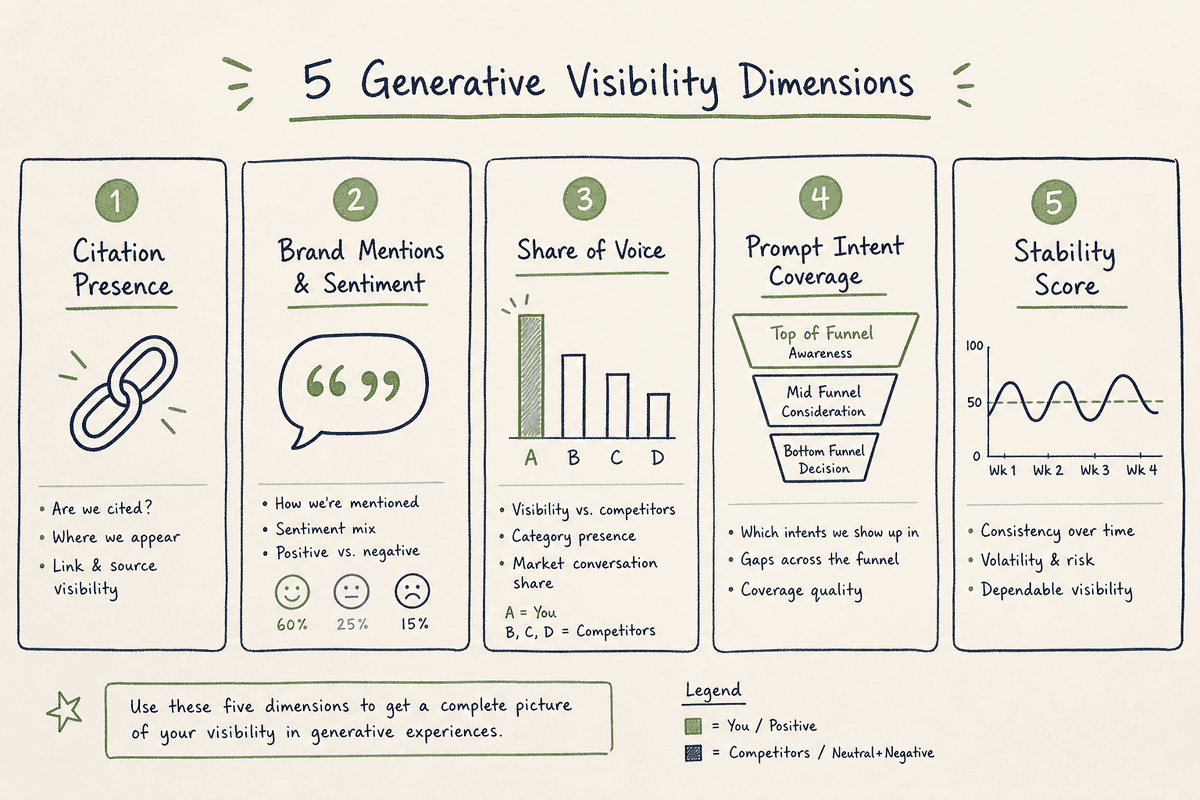
1. Citation Presence and Source Placement
Citation presence measures whether your domain's URLs appear as clickable source chips, footnotes, or referenced carousel cards in the AI response. Tracking tools should record the exact URL cited, the anchor context, and whether your link appears in the primary synthesis paragraph or an auxiliary accordion.
2. Unlinked Brand Mentions and Sentiment Context
Generative engines often list recommendations in bulleted lists without hyperlinking every brand name. You need to track:
- Mention frequency: How many times your company or product is named across target prompt sets.
- Position in recommendation lists: Being listed first versus fifth carries massive downstream conversion differences.
- Sentiment and accuracy: Whether the AI describes your product attributes, pricing, and capabilities accurately or hallucinated outdated limitations.
3. Share of Voice (SOV) Against Direct Competitors
Share of Voice in AI Mode is calculated by evaluating how often your brand appears in head-to-head comparisons, category roundups, and "alternative to" queries relative to your primary competitors. If a competitor appears in 85% of generative answers for your category while your brand appears in 20%, you have an immediate visibility deficit.
4. Prompt Intent Coverage
A comprehensive tracking matrix monitors visibility across five distinct query categories:
- Informational/How-to: High-funnel educational topics.
- Commercial Investigation: "Best [category] software for [industry]."
- Direct Comparisons: "[Brand A] vs [Brand B]."
- Alternative Searches: "Alternatives to [Market Leader]."
- Troubleshooting and Integration: How specific tools work with existing tech stacks.
5. Response Stability and Variance Score
A variance score tracks how consistently your brand appears over repeated queries. A score of 90% stability indicates that your brand is a fixed entity in Google's retrieval memory for that topic, while a 20% stability score means your mention is fragile and easily displaced by competitors.
How to Track Google AI Mode for Free (Manual & Search Console)
Before investing in automated enterprise tooling, marketing teams can set up baseline tracking using Google Search Console and structured manual audit sheets, as highlighted by ekamoira.com.
Step 1: Filter Conversational Queries in Google Search Console
Google Search Console provides query and landing page data that includes traffic routed from AI interactions. While GSC does not yet offer a dedicated "AI Mode Only" toggle, you can isolate AI-heavy queries by applying regex filters:
- Navigate to Performance > Search Results.
- Click + New > Query... > Custom (regex).
- Apply a filter for conversational query patterns:
^(who|what|where|when|why|how|best|top|compare|vs|alternative|is it worth) - Set a secondary filter for long-tail queries containing six or more words.
Compare impressions and CTR shifts on these conversational queries against standard short-tail keywords. AI Mode interactions often show higher impression counts with lower initial CTRs on broad queries, but deliver highly qualified traffic on specific technical queries.
Step 2: Build a Multi-Run Probabilistic Audit Sheet
Because single queries give misleading snapshots, build a tracking spreadsheet using the following framework:
The Limits of Manual Tracking
Manual tracking works well for 10 to 20 core brand terms, but quickly breaks down for scaling SaaS businesses. Testing 200 buyer prompts five times per week to account for probabilistic variance requires 1,000 manual searches weekly. Furthermore, manual queries performed in your personal browser are influenced by your geographic location, browser history, and logged-in account status, skewing the results.
Why Teams Seek Otterly.ai Alternatives
Otterly.ai emerged as an early monitoring tool for AI search platforms. However, as marketing teams integrate AI visibility tracking into their daily content production pipelines, several operational limitations have led them to evaluate alternatives.
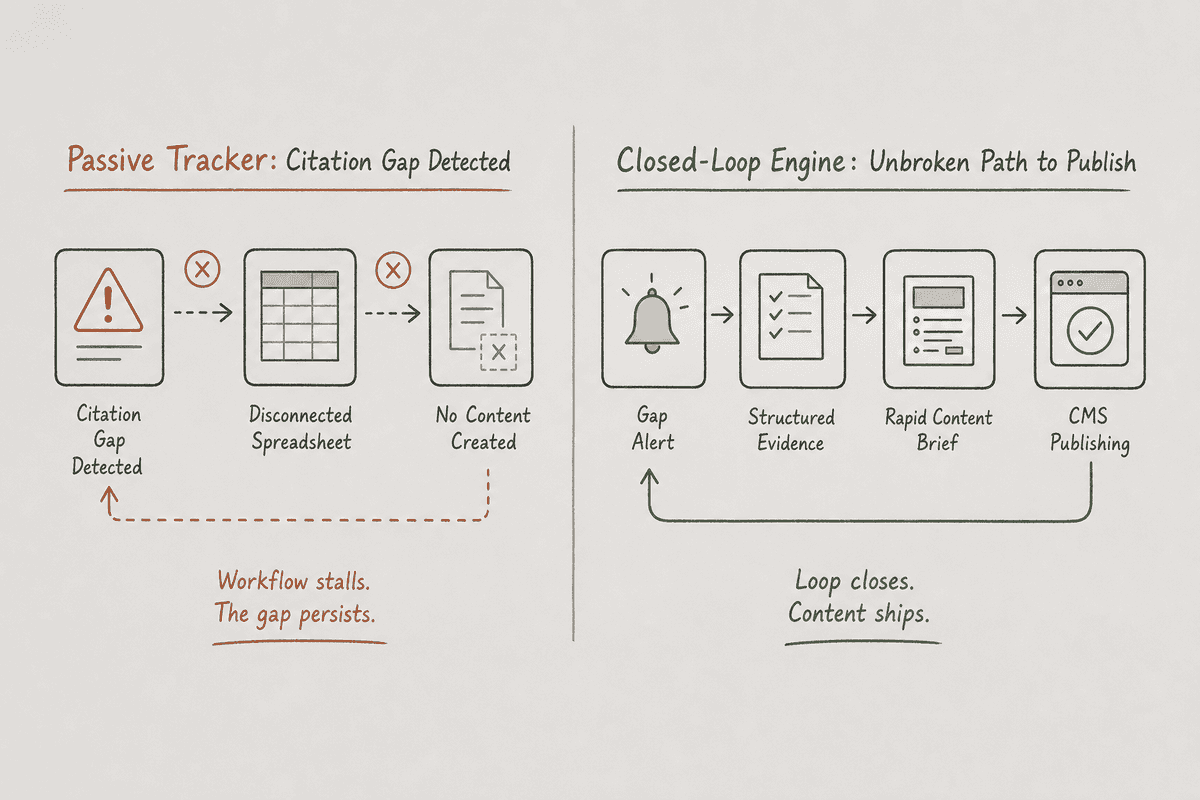
1. The Monitoring-to-Action Execution Gap
The biggest pain point with standalone trackers is the gap between insight and execution. A monitoring tool might alert you that your competitor is cited in 90% of AI answers for "best enterprise data pipelines" while your brand is missing. Knowing you are missing does not solve the problem. Marketing teams need workflows that turn that visibility gap into concrete content briefs, source citation targets, and publishable articles designed to win AI citations.
2. Multi-Engine Depth Across the Full AI Ecosystem
While Google AI Mode is critical, enterprise buyers switch between ChatGPT Search, Perplexity Pro, Google Gemini, and standard Google AI Overviews throughout their buying journey. Teams need unified visibility scoring that measures citation distribution across all these engines simultaneously without paying fragmented per-model add-on fees.
3. Granular Source Archetype and Citation Decomposition
When an AI engine answers a prompt, it relies on specific source archetypes: industry forums, third-party software reviews, direct vendor documentation, and independent editorial comparisons. Basic tracking tools report whether you were cited; advanced alternatives analyze why a competitor was cited, highlighting the exact third-party pages (e.g., Reddit threads, comparison directories) you need to influence.
4. Workflow Integration and Publishing Velocity
Growth teams operate in rapid sprints. When tracking reveals that a competitor recently captured visibility for an emerging feature prompt, the marketing team must create, review, schedule, and publish counter-content immediately. Monitoring tools disconnected from content publishing systems create friction and delay.
Top Otterly.ai Alternatives for Tracking Google AI Mode Visibility
Here is an analysis of the leading alternatives to Otterly.ai for tracking Google AI Mode and multi-engine generative search visibility in 2026, synthesized from industry benchmarks and research on Crawloria and Reddit discussions.
1. BeVisible: Closed-Loop AI Visibility Tracking and Content Execution
BeVisible takes a closed-loop approach to AI search visibility. Rather than acting as a passive dashboard that merely reports missing citations, BeVisible combines comprehensive multi-model monitoring with direct content execution workflows.
[ Monitor AI Mode & LLMs ]
          │
          ▼
[ Identify Citation & Brand Gaps ]
          │
          ▼
[ Evidence-Backed Strategy & Briefs ]
          │
          ▼
[ Drafting, Review & Publishing ]
- Core Platform Coverage: Tracks how AI assistants answer buyer questions, which brands they recommend, and which sources they cite across Google AI Mode, Google AI Overviews, ChatGPT, Gemini, and Perplexity.
- Actionable Gap Resolution: Converts identified visibility gaps and competitor wins into evidence-backed content opportunities, article generation, editorial review, scheduling, and direct CMS publishing.
- Buyer Prompt Tracking: Evaluates deep, multi-stage commercial prompts that real buyers use when evaluating software and services, rather than relying solely on generic short keywords.
- Source Citation Intelligence: Deconstructs the exact external resources and references that generative engines use to build their answers, allowing marketing teams to target the specific citation ecosystems driving AI recommendations.
- Best Suited For: SaaS founders, growth teams, content marketers, and agencies that need to monitor their AI search footprint and immediately publish optimized content to capture missing market share.
If you are exploring broader strategic resources for scaling organic search alongside AI engines, check out our guide to the best SEO blogs.
2. Crawloria: Specialized GEO Intelligence and Deep Scraping
Crawloria focuses heavily on the technical data-scraping layer of generative engine optimization. It provides detailed diagnostic logs of how Google AI Mode crawlers interact with web pages and how citations shift over time.
- Strengths: Excellent raw data extraction for large-scale enterprise websites; granular tracking of citation volatility across geographic regions; detailed API access for custom internal dashboard builds.
- Limitations: Crawloria functions primarily as a technical data feed. It does not provide built-in content generation, editorial review pipelines, or direct publishing integrations to help teams act on the data.
- Best Suited For: Technical SEO consultants and enterprise data teams that want raw scraping feeds to plug into internal business intelligence data warehouses.
3. Ekamoira: Probabilistic Sampling and Share of Voice Analytics
Ekamoira is designed specifically to tackle the statistical instability of generative AI responses. It runs multi-pass query sampling to provide confidence scores for every tracked keyword.
- Strengths: Robust statistical modeling that accounts for AI response variance; detailed sentiment analysis that flags when a model generates inaccurate product limitations; clear competitor side-by-side comparison matrices.
- Limitations: Pricing can scale rapidly due to high-frequency multi-run sampling; limited workflow features for content creation or automated remediation.
- Best Suited For: Mid-market to enterprise brands that need board-level reporting on AI brand sentiment and statistical share of voice across major LLMs.
4. Enterprise Brand Intelligence Platforms (General Brand Monitors)
Broad digital intelligence suites have recently added AI overview modules to their existing social listening and PR tracking toolkits.
- Strengths: Unified interface for PR, social listening, traditional SEO, and AI mentions; strong historical brand health metrics.
- Limitations: AI search tracking is often an afterthought built on top of legacy web-scraping infrastructure; lacks prompt-level granularity, citation source archetype breakdown, and GEO-specific optimization workflows.
- Best Suited For: Large conglomerates that prioritize overall PR and brand sentiment monitoring across all digital channels in a single vendor contract.
Comparison Matrix: Google AI Mode Tracking Platforms
Step-by-Step: How to Turn AI Mode Tracking Data into Citations
Monitoring your Google AI Mode visibility is only step one. The real ROI comes from establishing a repeatable operational loop that converts detected visibility gaps into published, citation-winning assets.
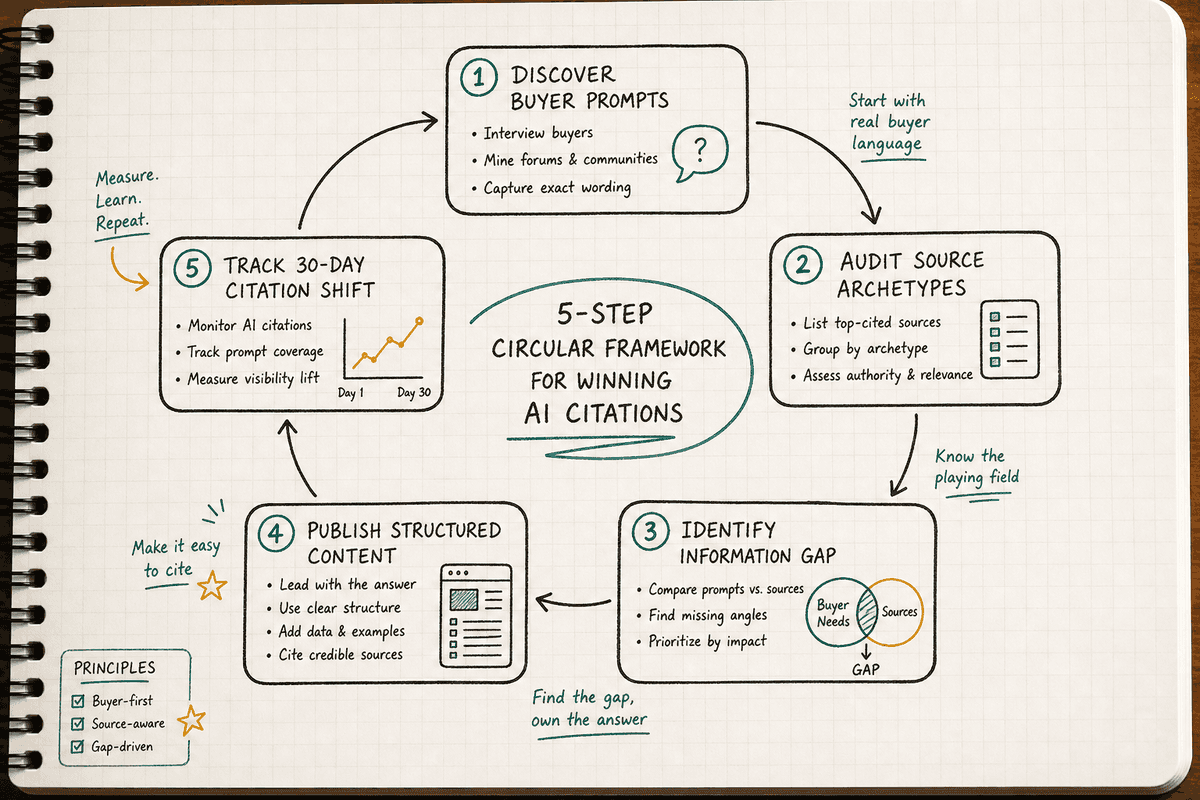
Step 1: Discover High-Intent Buyer Prompts
Avoid tracking vanity queries like your brand name or hyper-broad head terms. Map the actual question sequences your buyers ask when deciding on a solution:
- "What is the best alternative to [Competitor] for HIPAA compliance?"
- "Compare the pricing models of [Tool A], [Tool B], and [Tool C] for high-volume API calls."
- "Which platforms support automated webhook triggers for [Use Case]?"
Step 2: Audit the Cited Source Archetypes
When AI Mode answers these prompts without citing your website, inspect the citations it does use. You will typically find one of three source archetypes:
- Third-Party Review and Forum Nodes: Reddit threads, GitHub discussions, or G2 category roundups.
- Direct Authoritative Vendor Content: Competitor comparison pages or comprehensive technical guides.
- Independent Industry Blogs: High-authority publications explaining the mechanics of the topic.
For teams building specialized destination pages to capture these citation nodes, our guide on how to build an SEO landing page outlines effective structural layouts.
Step 3: Identify the Information Gap
Compare the competitor's cited page against your own content. Did the competitor provide:
- A clear structured comparison table with definitive data points?
- Code snippets or implementation schemas that Google's parser extracted?
- Clear entity definitions that matched the user's technical constraints?
Step 4: Generate, Review, and Publish Remediating Content
Using an execution-oriented platform like BeVisible, convert that gap into a targeted content assignment. Structure the content to make it effortless for Google AI Mode to parse and cite:
- Place concise, direct answers immediately following H2 subheadings.
- Use clear HTML tables for comparison data rather than vague narrative paragraphs.
- Include verifiable technical specifications, pricing figures, and explicit feature support statements.
Step 5: Track Citation Shift Over a 30-Day Window
After publishing and indexing your remediated content, monitor your AI Mode visibility score for that prompt set over a 30-day window. Track whether:
- Your domain begins appearing in auxiliary citation chips.
- Your brand moves from omitted to included in bulleted recommendation summaries.
- Third-party editorial sources begin referencing your newly published benchmarks.
Scenario: How a B2B SaaS Company Closed a 70% Visibility Deficit
To understand how AI Mode tracking translates into practical revenue impact, consider the case of a mid-sized B2B payroll and compliance software company.
The Problem
During an initial AI visibility audit, the company discovered that for 45 commercial buyer prompts (e.g., "Best global payroll platforms for remote engineering teams"), their primary competitor was cited in 82% of Google AI Mode responses. The company itself appeared in only 11% of answers, despite holding competitive organic rankings on page one of standard Google Search.
The Diagnostic
Using citation source decomposition, the marketing team realized that Google AI Mode was extracting answers not from standard product landing pages, but from:
- Detailed country-by-country tax rate guides.
- Transparent currency exchange fee tables.
- Specific software integration documentation pages.
Their competitor had published clear, highly structured data tables detailing tax handling across 30 countries. The company had gated their tax information behind a demo request form, making it completely invisible to Google's generative crawlers.
The Remediation
The company converted these visibility gaps into a targeted content sprint:
- They published open, comprehensive regulatory comparison hubs for their top 20 operating countries.
- They added clean markdown comparison tables summarizing integration support across common HR tech stacks.
- They connected monitoring directly into their editorial pipeline to track citation acquisition weekly.
The Result
Within six weeks of indexing, the company's AI Mode citation presence increased from 11% to 64% across their core prompt cluster. The direct traffic originating from generative citations showed a 3.4x higher conversion rate to sales calls compared to broad organic search traffic, because the buyers arriving via AI Mode had already received a synthesized recommendation matching their exact technical criteria.
3 Common AI Visibility Tracking Myths to Avoid
As you refine your AI tracking strategy, be mindful of widespread misconceptions that lead marketing teams to waste resources.
Myth 1: "High Domain Authority Guarantees AI Mode Citations"
Many teams assume that because their domain has a high PageRank or Domain Rating (DR 80+), Google AI Mode will automatically favor them. In practice, AI Mode prioritizes information density, structural clarity, and contextual precision over pure domain authority. A DR 45 domain with an exact, well-structured answer and verifiable data will routinely displace a DR 85 brand that provides vague, high-level marketing copy.
Myth 2: "Tracking Branded Queries Gives an Accurate Visibility Picture"
Monitoring prompts like "What is [Your Company Name]?" or "[Your Product] reviews" provides a false sense of security. Generative engines rarely fail to identify a brand when prompted by name. The true battleground for customer acquisition is unbranded category prompts, competitor comparison queries, and specific use-case questions where the buyer has not yet committed to a vendor.
Myth 3: "A Daily Single-Run Check Is Sufficient"
Because LLMs generate outputs based on probabilistic weights, checking a query once a day at 9:00 AM gives you a single data point on a moving distribution. If an AI tool claims you have "Rank #1" based on a single automated query, that ranking may fail to appear for the next three users who type the same prompt. Always evaluate visibility using statistical ranges and multi-run sampling.
Frequently Asked Questions
What is the difference between Google AI Mode and Google AI Overviews?
Google AI Overviews are AI-generated summary boxes that appear at the top of standard Google Search result pages for select informational queries. Google AI Mode is a dedicated, fully conversational search interface where every interaction is synthesized by generative models, featuring multi-turn dialogue, deep intent fan-out, and continuous conversational refinement.
Can I track Google AI Mode visibility using traditional rank trackers like Ahrefs or Semrush?
Traditional rank trackers monitor standard SERP features like blue links, featured snippets, and whether an AI Overview box exists on the page. However, they generally do not deconstruct the conversational text inside generative syntheses, track unlinked brand recommendations, sample probabilistic response variations, or evaluate conversational multi-turn prompts across platforms like ChatGPT, Gemini, and Perplexity.
How often should my team track Google AI Mode visibility?
For core commercial buyer prompts and primary brand comparisons, weekly multi-pass tracking is recommended to monitor stability and detect competitor movements. For broad top-of-funnel informational topics, bi-weekly or monthly tracking is sufficient to observe macro citation trends without generating excessive data noise.
What is the fastest way to get cited in Google AI Mode?
The most reliable method to earn citations is to identify the specific factual gaps in existing AI answers, then publish structured, indexable content containing clear direct definitions, HTML comparison tables, verified technical constraints, and transparent data points that Google's retrieval system can easily parse, verify, and reference.
Moving from Monitoring to Growth
Tracking Google AI Mode is no longer an experimental SEO tactic. It is a fundamental operational necessity for any business that relies on search to drive pipeline. As traditional organic click-through rates continue to redistribute into synthesized answers, the brands that monitor their generative footprint will protect their market share, while those relying on legacy rank trackers will find themselves invisible to high-intent buyers.
While tools like Otterly.ai opened the door to AI search tracking, winning this channel in 2026 requires more than passive metrics. Evaluating platforms like BeVisible enables your team to connect visibility monitoring directly with evidence-backed content creation and publishing workflows, closing citation gaps as quickly as they appear and turning AI search into a dependable growth channel.