
Tracking how artificial intelligence engines talk about your brand used to be a novel exercise. You opened ChatGPT, typed in "What are the best CRM tools for mid-market SaaS?", and took a screenshot if your product showed up in the answer. Today, tracking buyer prompts across ChatGPT, Perplexity, Gemini, Google AI Overviews, and Bing AI Mode is an active marketing discipline.
Platforms like Otterly.ai built an early reputation by making AI search monitoring accessible. They allow marketing teams to track share of voice, monitor sentiment, and observe how often competitors are cited in answer engine outputs.
Monitoring alone creates an immediate operational bottleneck. Discovering that a competitor is cited in 70% of Perplexity answers while your brand is absent in 100% of them is useful data. However, a dashboard full of missing mentions does not write articles, update comparison pages, or publish authoritative resources. Teams often find themselves taking CSV exports from monitoring tools, pasting them into separate copywriting tools, editing drafts in Google Docs, and manually uploading content to a content management system (CMS).
If your team wants to close the gap between discovering an AI visibility loss and publishing content that earns back citations, you need platforms built for content execution, not just read-only monitoring.
Why Teams Look Beyond Read-Only AI Search Monitoring
Read-only visibility tools provide diagnostic visibility. They show where your brand stands in generative search results, which competitors are cited, and what sources LLMs rely upon when synthesizing answers.
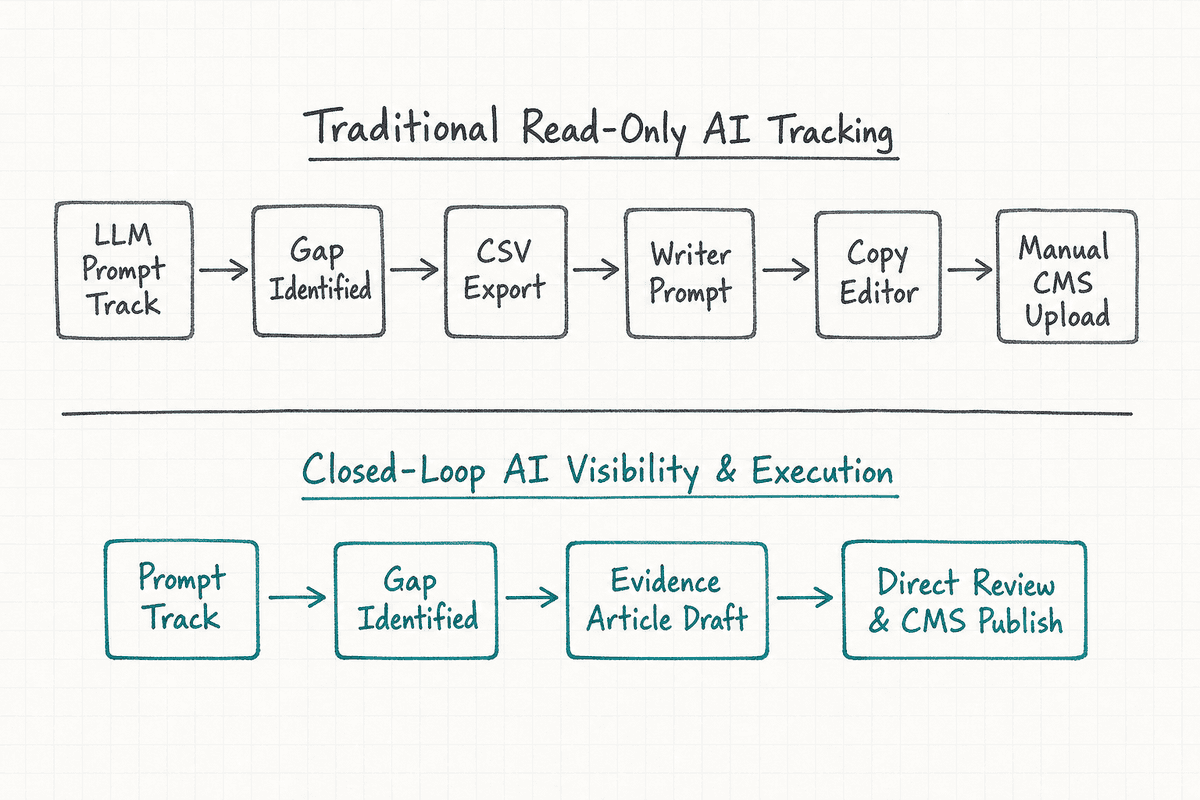
Diagnosing the issue is only the first step in Generative Engine Optimization (GEO) or AI Engine Optimization (AEO). The structural challenge modern growth teams face is the friction between identification and action.
+-----------------------------------------------------------------------+
|                 TRADITIONAL READ-ONLY AI TRACKING                     |
|  [ LLM Prompt Track ] -> [ Gap Identified ] -> [ CSV Export ]         |
|                                                      |                |
|                                                      v                |
|  [ Manual CMS Upload ] <- [ Copy Editor ] <- [ Writer Prompt ]        |

+-----------------------------------------------------------------------+
                                   VS
+-----------------------------------------------------------------------+
|             CLOSED-LOOP AI VISIBILITY & EXECUTION WORKFLOW            |
|  [ Prompt Track ] -> [ Gap Identified ] -> [ Evidence Article Draft ] |
|                                                      |                |
|                                                      v                |
|                                     [ Direct Review & CMS Publish ]   |

+-----------------------------------------------------------------------+
1. The Export-to-Execution Disconnect
When a dashboard flags twenty high-intent buyer prompts where your brand is missing, what happens next? In a standard monitoring tool, someone must manually copy those prompts, analyze the top-cited sources, determine what structural information is missing, write a brief, assign it to a writer or AI generator, review it, and manually publish it to the CMS.
By the time that article goes live, weeks may have passed, and competitor citations in Perplexity or Google AI Overviews have solidified.
2. Lack of Source-Grounded Content Generation
Standard AI writers generate content based on top-level keyword prompts without understanding why an LLM cited a specific competitor source. A true content execution engine analyzes the specific citations and authority sources used by engines like Gemini and Perplexity for a target prompt, then structures the article specifically to fill the citation gap with verified evidence.
3. Disconnected Publishing Workflows
Managing separate tools for AI tracking, keyword research, AI writing, and CMS scheduling increases subscription costs and fragments team workflows. A unified workflow connects prompt tracking directly to article creation, editorial review, and direct API publishing to platforms like WordPress, Webflow, or custom headless CMS setups.
What to Look For in an AI Visibility Platform With Content Execution
When evaluating Otterly.ai alternatives, distinguish between platforms that merely provide monitoring and those that provide an end-to-end execution pipeline.
+------------------------------------------------------------------+
|                   EVALUATION FRAMEWORK FOR GEO TOOLS             |
+------------------------------------------------------------------+
|  1. MULTI-ENGINE MONITORING                                      |
|     Tracks ChatGPT, Perplexity, Gemini, AI Overviews, AI Mode     |

+------------------------------------------------------------------+
|  2. CITATION & SOURCE RECONNAISSANCE                             |
|     Identifies target URLs, authoritative sources, media domain   |

+------------------------------------------------------------------+
|  3. EVIDENCE-BACKED CONTENT GENERATION                           |
|     Drafts articles directly matching identified gap insights    |

+------------------------------------------------------------------+
|  4. EDITORIAL WORKFLOW & HUMANIZATION                            |
|     In-line editing, review loops, internal linking, schema      |

+------------------------------------------------------------------+
|  5. DIRECT CMS PUBLISHING & RE-AUDITING                          |
|     Auto-publishes to WordPress/Webflow & monitors index impact  |

+------------------------------------------------------------------+
Top Otterly.ai Alternatives With Content Execution Features
Several platforms have emerged to serve teams looking beyond basic AI rank tracking. Here is a breakdown of the leading alternatives that combine AI monitoring with actionable execution capabilities.
1. BeVisible
BeVisible is an AI visibility monitoring and execution platform built specifically for SaaS founders, B2B marketing teams, growth leads, and agencies. While traditional trackers leave you with data, BeVisible bridges the gap between tracking generative search visibility and publishing the exact content needed to earn brand recommendations.
+-----------------------------------------------------------------------+
|                    BEVISIBLE CLOSED-LOOP WORKFLOW                     |
+-----------------------------------------------------------------------+
|  [ Prompt Tracking ]  --> Tracks ChatGPT, Gemini, Perplexity, AI Mode |
|          |                                                            |
|          v                                                            |
|  [ Gap Identification ] -> Pinpoints unmentioned prompts & top sources|
|          |                                                            |
|          v                                                            |
|  [ Article Generation ] -> Creates evidence-backed, long-form content |
|          |                                                            |
|          v                                                            |
|  [ Review & Publish ]   -> In-app editing, scheduling, direct CMS push|

+-----------------------------------------------------------------------+
How BeVisible Handles Content Execution
BeVisible helps teams monitor how AI assistants answer buyer questions, which brands they recommend, and which sources they cite. It tracks ChatGPT, Gemini, Perplexity, AI Mode, and AI Overviews across buyer prompts, then turns visibility gaps into evidence-backed opportunities, articles, review, scheduling, and publishing work.
Instead of exporting visibility losses into third-party tools, BeVisible isolates the exact prompts where competitors are recommended over your brand, inspects the underlying citations powering those answers, and auto-generates comprehensive, publish-ready articles designed to supply answer engines with clear, structured facts.
Key Features
- Multi-LLM Buyer Prompt Tracking: Continuously audits response outputs across ChatGPT, Gemini, Perplexity, Google AI Overviews, and AI Mode.
- Citation Reconnaissance: Reveals which specific articles, review aggregators, and media sites feed the recommendations generated by AI search engines.
- Evidence-Backed Content Generation: Generates comprehensive long-form posts directly tailored to answer buyer questions and fill identified visibility gaps.
- Integrated Review & Publishing Pipeline: Provides a workspace to edit, structure, schedule, and directly publish completed articles to connected blog platforms.
Ideal For
SaaS founders, growth marketers, and agencies who want a single, unified platform to detect missing AI search mentions and convert those gaps into published, indexable content.
2. Writesonic
Writesonic expanded from a standalone AI writer into a broader content engine that includes Generative Engine Optimization features.
+-----------------------------------------------------------------------+
|                      WRITESONIC WORKFLOW OVERVIEW                     |
+-----------------------------------------------------------------------+
|  [ GEO Analysis ] ---> Scans search visibility & competitor gaps      |
|          |                                                            |
|          v                                                            |
|  [ Content Engine ] -> Generates AI articles using real-time search   |
|          |                                                            |
|          v                                                            |
|  [ Export / Push ]  -> Exports to WordPress or third-party workflows   |

+-----------------------------------------------------------------------+
How Writesonic Handles Content Execution
Writesonic offers specialized tools for drafting SEO and GEO articles. By integrating real-time web search capabilities with AI writing assistants, it enables marketers to generate long-form blog posts, product comparisons, and landing pages based on trending search queries.
While its tracking capabilities are primarily tailored around keyword research and writing workflows, its article generation capabilities are mature, making it a viable option for teams seeking content generation with GEO capabilities [1].
Key Features
- Real-time web integration for updated facts and statistical citations.
- Templates for product roundups, comparison pages, and landing pages.
- Direct integrations with WordPress, Shopify, and Zapier for publishing workflows.
Drawbacks
Writesonic functions primarily as a content creation engine with added GEO tracking tools, rather than a dedicated AI buyer-prompt monitoring platform that continuously tracks multi-model share of voice.
3. Profound
Profound is an enterprise-focused AI visibility platform engineered to track brand representation across conversational answer engines and assist in content optimization [1].
+-----------------------------------------------------------------------+
|                       PROFOUND WORKFLOW OVERVIEW                      |
+-----------------------------------------------------------------------+
|  [ Enterprise Track ] -> Audits LLM prompt clusters at scale           |
|          |                                                            |
|          v                                                            |
|  [ Agent Insights ]   -> Uses automated agents to build AEO briefs     |
|          |                                                            |
|          v                                                            |
|  [ Team Handoff ]    -> Exports recommendations for content teams    |

+-----------------------------------------------------------------------+
How Profound Handles Content Execution
Profound uses AI agents to track how brands appear in AI engines like Perplexity, ChatGPT, and Claude. To address content needs, Profound offers AI Engine Optimization (AEO) templates and agent workflows that help enterprise teams craft content strategies aligned with answer engine citation patterns [1].
Key Features
- Deep prompt volume estimation and sentiment tracking across major LLMs.
- Agent-driven workflows for generating content recommendations and optimized answer structures.
- Enterprise-grade brand governance and sentiment monitoring.
Drawbacks
Profound provides robust analytical insight and content guidance, but enterprise teams often export its findings to separate content teams or external tools for full drafting and publishing execution [1].
4. Pixis Visibility
Pixis Visibility positions itself as an execution-oriented platform built to help growth teams act on generative search insights.
+-----------------------------------------------------------------------+
|                    PIXIS VISIBILITY WORKFLOW OVERVIEW                 |
+-----------------------------------------------------------------------+
|  [ Prompt Monitoring ] -> Scans brand presence across LLMs            |
|          |                                                            |
|          v                                                            |
|  [ Action Engine ]    -> Converts visibility gaps into tasks          |
|          |                                                            |
|          v                                                            |
|  [ Execution Pipeline]-> Generates and distributes brand assets       |

+-----------------------------------------------------------------------+
How Pixis Visibility Handles Content Execution
Pixis Visibility focuses on bridging the gap between monitoring data and tactical execution [1]. It tracks how brands perform across generative engines and provides direct workflows to optimize brand messaging, update digital touchpoints, and publish assets designed to influence answer engine citations.
Key Features
- Automated detection of brand omission across high-intent queries.
- Built-in recommendation engine for content updates and messaging pivots.
- Targeted content generation modules built for generative search engines.
Drawbacks
Pixis is geared toward larger growth organizations with complex multi-channel marketing campaigns, which can introduce setup complexity for leaner teams.
Detailed Platform Comparison Matrix
Practical Workflow: Turning AI Visibility Gaps into Published Articles
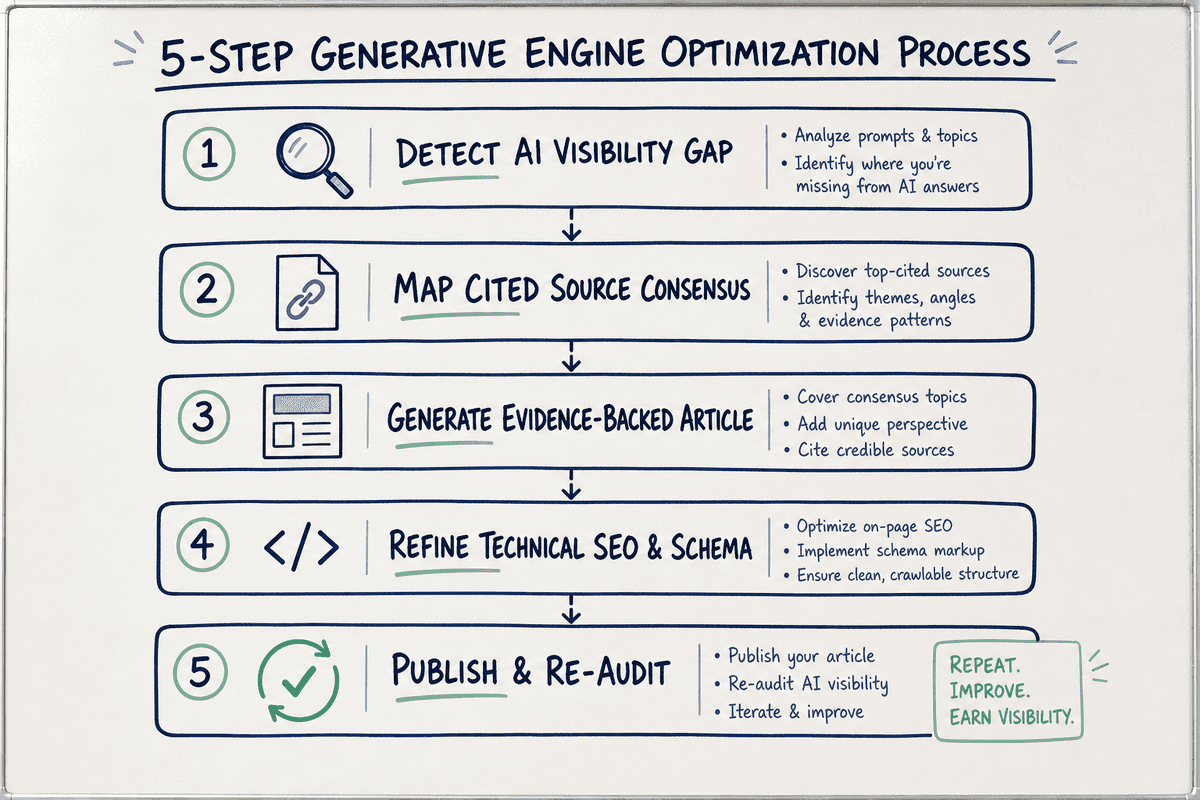
To understand why content execution tools matter, examine how a modern GEO workflow operates when moving from a prompt tracking alert to a published article.
+-----------------------------------------------------------------------+
|                  5-STEP AI CONTENT EXECUTION WORKFLOW                 |
+-----------------------------------------------------------------------+
|  STEP 1: Detect AI Visibility Gap                                     |
|          |                                                            |
|          v                                                            |
|  STEP 2: Map Cited Source Consensus                                   |
|          |                                                            |
|          v                                                            |
|  STEP 3: Generate Evidence-Backed Article                             |
|          |                                                            |
|          v                                                            |
|  STEP 4: Refine Technical SEO & Structural Schema                      |
|          |                                                            |
|          v                                                            |
|  STEP 5: Publish & Re-Audit Prompt Visibility                         |

+-----------------------------------------------------------------------+
Step 1: Detect the AI Visibility Gap
Your tracking engine flags an unmentioned high-intent buyer prompt:
"What are the best automated reporting tools for client management agencies?"
- Result in Perplexity: Competitor A, Competitor B, and Competitor C are recommended. Your brand is omitted entirely.
- Visibility Score: 0%
Step 2: Map the Cited Source Consensus
Before writing anything, analyze the citations relied upon by Perplexity, Gemini, and Google AI Overviews to answer that prompt. The engine typically cites:
- A comparison article from an industry blog listing top agency management tools.
- A reddit thread discussing agency reporting software.
- A technical guide on agency workflow automation.
The gap exists because your site lacks a dedicated, structured guide comparing automated agency reporting options that answer engines can easily index and extract facts from.
Step 3: Generate the Evidence-Backed Draft
Rather than writing a generic fluff post, use an execution engine like BeVisible to create an article structured around the precise questions and entities answer engines evaluate.
The draft must include:
- Direct answer summaries near the top of headings.
- Explicit evaluation tables comparing features, pricing, and deployment methods.
- Neutral, factual evaluations that provide clear context for LLMs to scrape.
If you are developing comprehensive landing pages to capture structured search traffic alongside generative recommendations, check out our guide on How to Build an SEO Landing Page.
Step 4: Editorial Review, Humanization, and Internal Linking
Review the draft to ensure brand accuracy, add real-world expertise, and connect the post to existing resources on your site.
For example, if your team maintains a repository of strategic resources, linking internally to relevant articles—such as our list of the 11 Best SEO Blogs Every SaaS Founder Needs—strengthens your site's topical authority for both traditional and generative search crawlers.
Step 5: Direct Publishing and Post-Index Re-Auditing
Once approved, publish the piece directly to your blog through your execution engine's CMS integration. Set a scheduled re-audit trigger within 14 to 30 days to check whether Perplexity, Gemini, or ChatGPT begin citing the new URL when re-prompted.
Real-World Scenario: Closing a Perplexity Citation Gap in 14 Days
To see how execution tools impact growth efficiency, consider a mid-market SaaS company operating in the developer tools space.
+-----------------------------------------------------------------------+
|                      REAL-WORLD CASE SCENARIO                         |
+-----------------------------------------------------------------------+
|  THE PROBLEM:                                                         |
|  * Perplexity prompt: "Best API monitoring tools for microservices"   |
|  * Brand mentioned in 0 out of 10 tests (Competitor cited in 8/10).   |
|                                                                       |
|  THE EXECUTION:                                                       |
|  * BeVisible identified missing technical schema and citation gap.   |
|  * Auto-drafted a 3,500-word architectural comparison guide.          |
|  * Published directly to Webflow CMS within 48 hours.                 |
|                                                                       |
|  THE RESULT:                                                          |
|  * Perplexity indexed the new URL within 9 days.                      |
|  * Brand visibility score increased from 0% to 60% on target prompts. |

+-----------------------------------------------------------------------+
The Initial Audit
The company tracked twenty prompts around API observability. For the high-intent query "Best API monitoring tools for enterprise microservices", their brand visibility score was 0%. Competitors appeared in 80% of test runs on Perplexity and ChatGPT.
The Problem With Read-Only Tools
Using a basic read-only tracking dashboard, the team knew they were losing visibility. However, their content backlog was full, and creating a detailed comparison guide through traditional agency workflows would take three to four weeks.
The Execution-First Approach
Using an execution platform, the team:
- Extracted Citation Patterns: Discovered that Perplexity relied heavily on structured architectural guides and direct performance benchmarks.
- Drafted an Evidence-Backed Post: Generated a 3,500-word comparative review covering API monitoring latency, microservice tracing, and setup overhead.
- Published Directly: Reviewed, polished, and published the post directly to Webflow in under 48 hours.
The Outcome
Nine days after publication, Perplexity indexed the new guide. On the next automated prompt re-audit, the brand's visibility score rose from 0% to 60% across target buyer prompts, earning direct citations as a recommended observability solution.
Strategic Nuances: The Difference Between Keyword SEO and LLM Citation SEO
Transitioning from traditional search engine optimization to Generative Engine Optimization requires shifting how you structure content for AI indexers.
+-----------------------------------------------------------------------+
|             KEYWORD SEO VS. LLM CITATION ARCHITECTURE                 |
+-----------------------------------------------------------------------+
|  TRADITIONAL KEYWORD SEO          |  LLM CITATION (GEO / AEO)         |
|  * Focuses on monthly volume      |  * Focuses on intent prompts      |
|  * Keyword density & H2 tags      |  * Direct answer density & tables |
|  * Backlinks as authority signal  |  * Entity relationships & consensus|
|  * Meta descriptions for clicks   |  * Extractable factual summaries  |

+-----------------------------------------------------------------------+
1. Direct Answer Density Over Keyword Placement
Traditional SEO often placed context and background information near the top of articles to maximize page dwell time. LLM crawlers favor direct, concise answer definitions positioned immediately beneath H2 and H3 subheadings.
2. Entity Consensus and Source Co-Citation
Answer engines synthesize answers by cross-referencing claims across multiple authoritative sources. Content structured with clear table comparisons, explicit pricing models, and objective feature matrices provides clear facts that AI systems can confidently summarize.
3. Rapid Refresh Cycles
Unlike Google search rankings, which can remain stable for months, generative answer engines dynamically update their response models as search APIs index new web content. A published article that directly addresses a citation gap can influence LLM recommendations in days rather than months.
Common Pitfalls When Moving From Tracking to Execution
As marketing teams adopt content execution platforms for AI search, several common operational mistakes can limit results.
+-----------------------------------------------------------------------+
|                    3 MAJOR GEO EXECUTION PITFALLS                     |
+-----------------------------------------------------------------------+
|  PITFALL 1: Treating GEO as Unfiltered Automated AI Generation        |
|  --> Generates generic text that fails LLM factual validation.        |
|                                                                       |
|  PITFALL 2: Fragmenting GEO Tracking, Writing, and Publishing         |
|  --> Creates operational delays and loses source-tracking context.     |
|                                                                       |
|  PITFALL 3: Ignoring Structural Schema and Technical Cleanliness      |
|  --> Prevents LLM search bots from cleanly parsing facts and data.    |

+-----------------------------------------------------------------------+
Pitfall 1: Treating GEO Content Execution as Generic AI Writing
Generating mass quantities of low-quality, automated text using basic prompts does not improve AI search visibility. Answer engines prioritize sources that offer clear structure, unique insights, and verifiable claims. Content execution platforms must ground their output in real citation data rather than generating unstructured text.
Pitfall 2: Disconnecting Strategy From Publishing
Buying one tool for AI prompt tracking, another for writing, and managing publishing manually in a CMS introduces friction. This setup leads to missed opportunities, as insights discovered in tracking dashboards sit unused in project backlogs.
Pitfall 3: Over-Optimizing for Search Keywords While Ignoring Answer Engine Layouts
Writing long introductions before providing direct answers weakens a page's impact in AI search. If an LLM parser cannot extract a clear, factual answer within the first few sentences under a heading, it will likely move on to a competitor's page that offers clearer, structured data.
Frequently Asked Questions
Can Otterly.ai generate and publish content directly?
No. Otterly.ai is designed primarily as a read-only monitoring and tracking platform. It tracks brand mentions, share of voice, and sentiment across LLMs, but it does not include integrated tools for auto-drafting evidence-backed articles, managing editorial schedules, or publishing directly to a CMS.
What is the difference between GEO (Generative Engine Optimization) and traditional SEO?
Traditional SEO focuses on optimizing web pages to rank high on search engine results pages (SERPs) for target keywords, relying heavily on backlink profiles, technical site health, and keyword density. GEO focuses on structuring content so conversational AI models (like ChatGPT, Gemini, and Perplexity) can parse, trust, and cite your brand as an authoritative answer when responding to complex user prompts.
How quickly do AI search engines cite newly published content?
It varies by platform. Search-connected engines like Perplexity and Google AI Overviews can index and cite newly published content within a few days if the page is indexed by search crawlers and provides clear, structured answers. Offline or periodically retrained foundation models may take longer to incorporate new information into their core weights.
Do I still need traditional SEO tools if I use an AI visibility platform?
Yes. Traditional SEO tools like Ahrefs or Semrush remain valuable for analyzing technical site performance, backlink profiles, and organic search demand. AI visibility execution platforms complement these tools by specifically addressing conversational search queries, citation gaps, and generative engine optimization workflows.
Choosing the Right Platform for Your Team
If your team only needs high-level executive reporting on where your brand appears across conversational search engines, a read-only monitor like Otterly.ai provides clean diagnostic data.
However, if your primary goal is to turn visibility losses into published, indexable content that actively earns back market share across ChatGPT, Gemini, Perplexity, and Google AI Overviews, select an execution-enabled platform.
By choosing a platform like BeVisible that combines multi-engine prompt tracking, citation reconnaissance, evidence-backed content drafting, and direct CMS publishing, you eliminate operational delays and transform raw AI analytics into measurable brand growth.