
Startup founders who regularly test their brand positioning are discovering an uncomfortable pattern. While traditional SEO tools show page-one rankings for industry keywords, buyers asking ChatGPT, Perplexity, Claude, or Google AI Overviews for direct software recommendations rarely see their company mentioned.
Traditional Google rank trackers like Ahrefs, Semrush, or AccuRanker were built to track ten blue links. They cannot tell you whether a generative model recommended your product, cited your documentation, or advised a prospect to buy from your competitor instead.
This tracking blind spot led to the rise of specialized Generative Engine Optimization (GEO) platforms. Peec AI emerged as an early option for bootstrapped teams, offering basic citation tracking across several large language models (LLMs) starting around €85 per month.
However, as startups scale their AI visibility strategy, basic tracking tools reveal serious operational limitations. Monitoring where your brand is missing does not fix the missing citation.
This guide analyzes why founders are seeking Peec AI alternatives, outlines the critical features required for accurate AI answer tracking in 2026, and compares the top platforms available to startup teams.
Why Founders Move On From Peec AI (The 3 Operational Bottlenecks)
Peec AI helped validate the need for monitoring conversational AI outputs. Yet, founders and growth teams frequently hit three distinct friction points when relying solely on low-tier, monitoring-only tools.
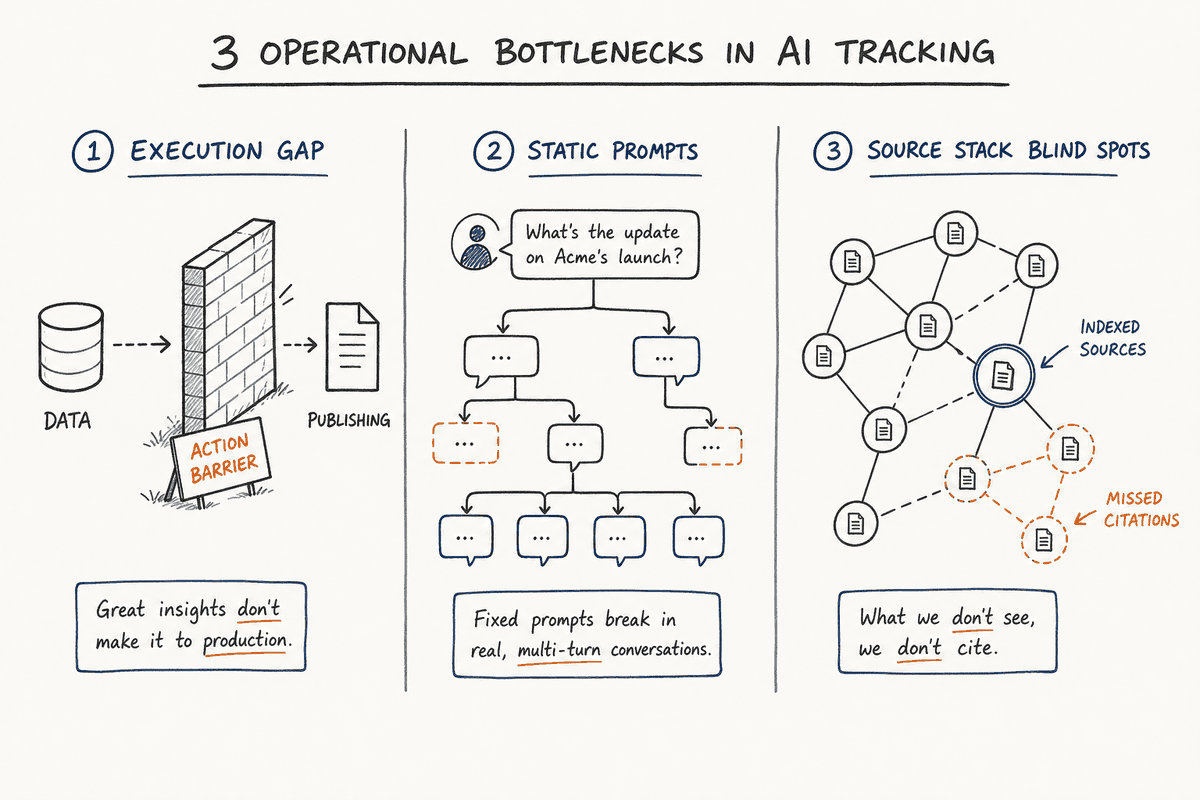
1. The Monitoring-to-Execution Gap
Knowing that ChatGPT omitted your SaaS tool when answering "What are the best open-source feature flag platforms?" is helpful context. However, a dashboard full of red negative indicators creates an actionability barrier.
Basic monitoring tools show visibility drops without providing a clear workflow to fix them. Founders end up with raw data, leaving content managers to manually guess which sources need updates, which review platforms to populate, or what articles to publish to earn the model's recommendation.
2. Static Prompts and Missing Multi-Turn Journeys
Real buyers rarely type a single static query into an AI engine and leave. They engage in multi-turn conversations:
- Turn 1: "What are top alternatives to Auth0 for early-stage startups?"
- Turn 2: "Which of these have pre-built React SDKs and SOC2 compliance?"
- Turn 3: "Compare the pricing plans for the top two options."
Simple tracking tools often run isolated single-turn prompts once a week. They fail to capture how conversational engines narrow down recommendations across realistic evaluation funnels.
3. Source Stack Blind Spots
LLMs synthesize answers from specific citation networks: Reddit threads, G2 and Capterra reviews, GitHub repositories, official documentation, and curated blog posts.
When a tool merely reports whether your brand appeared in an answer, it leaves you blind to why the model selected a competitor. Without deep citation mapping across the AI's source stack, teams cannot identify which web nodes require immediate brand presence.
Core Evaluation Criteria: What Startup Founders Need in AI Answer Tracking
Evaluating AI tracking tools requires looking beyond standard keyword position tracking. When comparing alternatives to Peec AI, assess each platform against five technical requirements:
Top 6 Peec AI Alternatives for AI Answer Tracking in 2026
To help you choose the right solution for your growth stage, here is a detailed breakdown of the top Peec AI alternatives available for startup founders.
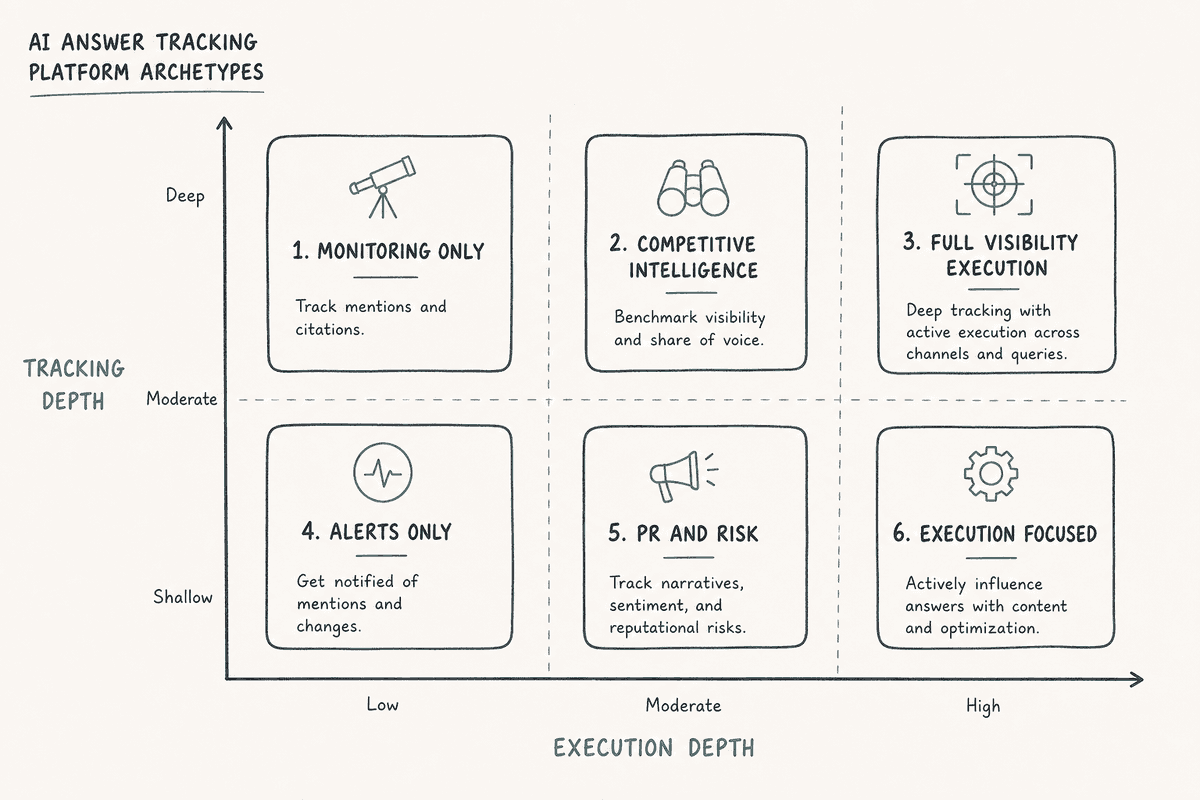
1. BeVisible: Best for AI Visibility Monitoring and Direct Publishing Execution
BeVisible is an end-to-end AI visibility monitoring and execution platform built for SaaS founders, B2B marketing teams, and growth agencies. Rather than stopping at passive tracking, BeVisible monitors how AI assistants answer buyer questions, tracks which brands are recommended, and identifies the exact sources cited across ChatGPT, Gemini, Perplexity, AI Mode, and Google AI Overviews.
[ Monitor AI Answers ] ➔ [ Map Source Stack ] ➔ [ Identify Gap ] ➔ [ Generate & Publish Content ]
Key Capabilities
- Full Search & Assistant Coverage: Tracks brand mentions, position, and sentiment across ChatGPT, Gemini, Perplexity, AI Mode, and Google AI Overviews using realistic buyer prompt matrices.
- Citation Stack Intelligence: Uncovers the specific web pages, review platforms, and forum discussions feeding LLM responses for your target prompts.
- Evidence-Backed Execution: Automatically transforms missing mentions and competitor wins into actionable content plans, briefing briefs, and complete article drafts.
- Integrated Publishing Pipeline: Review, schedule, and publish content directly to your site or blog to quickly build the contextual authority that LLMs cite.
Ideal For
Growth-focused startup teams that want to measure their AI visibility and immediately turn missing mentions and weak citations into published work without jumping between multiple disparate tools.
2. WorkDuo.ai (Hall): Best for Real-Time Sentiment & Brand Risk Monitoring
WorkDuo.ai (formerly known in early iterations as Hall) focuses on real-time conversation tracking and sentiment detection across LLMs.
Key Capabilities
- Monitors how conversational engines discuss your brand during direct comparison queries.
- Sentiment scoring detects whether AI assistants describe your product as buggy, expensive, or enterprise-ready.
- Real-time notifications alert reputation managers when negative statements appear in high-frequency prompt categories.
Tradeoffs
While excellent for brand protection and public relations oversight, WorkDuo.ai lacks deep organic execution features for publishing content to capture missing citations.
3. Scrunch: Best for Competitive Intelligence & Persona Mapping
Scrunch provides competitive intelligence for marketing teams looking to measure share of voice across distinct buyer personas.
Key Capabilities
- Classifies prompts by buyer persona (e.g., CTO vs. Procurement Lead vs. Software Engineer).
- Generates clear visual side-by-side matrices showing competitor recommendation rates across custom prompt buckets.
- Evaluates persona-specific buying funnel stages from broad problem discovery to vendor selection.
Tradeoffs
Scrunch offers high-level executive analytics, but smaller startup teams may find the interface overly complex if they simply need fast execution paths to close visibility gaps.
4. LLMrefs: Best for Weekly Low-Budget Citation Tracking
LLMrefs offers a lightweight option for early-stage bootstrapped teams needing basic weekly updates on brand citations across major models.
Key Capabilities
- Weekly automated runs across custom prompt lists.
- Simple scorecards tracking brand citation counts in ChatGPT and Perplexity.
- Accessible pricing tiers tailored for pre-revenue or micro-budget projects.
Tradeoffs
LLMrefs provides snapshot data with minimal source stack depth, lacking multi-turn prompt simulation and integrated content workflows.
5. Profound (GEO Insights): Best for Mid-Market and Enterprise SaaS Teams
Profound targets mid-market and enterprise marketing teams looking to map broad LLM search trends across massive keyword datasets.
Key Capabilities
- Enterprise-scale tracking across thousands of enterprise prompt combinations.
- Deep knowledge graph and Wikidata mapping to show how corporate entity data flows into LLM context windows.
- Multi-region tracking for international product positioning.
Tradeoffs
Higher price points and enterprise sales cycles make Profound less suited for early-stage founders seeking lean, rapid-execution tools.
6. Searchable AI: Best for Prompt Variation Discovery
Searchable AI focuses on prompt engineering research, helping marketers discover the wide variety of ways prospective buyers ask AI engines for recommendations.
Key Capabilities
- Prompt expansion engine uncovers long-tail conversational variations used by buyers.
- Semantic similarity clustering maps how slight phrasing adjustments alter model recommendations.
- Cross-model variance reports show where Gemini and ChatGPT disagree on product categories.
Tradeoffs
Searchable AI excels at prompt research, but requires teams to pair it with dedicated content creation and management tools to act on its insights.
Side-by-Side Comparison Matrix
The Math Behind AI Answer Tracking: Calculating AI Share of Voice (AI SOV)
Understanding your brand's presence in generative models requires moving away from traditional rank positions (1 through 10) toward AI Share of Voice (AI SOV).
In generative engines, a model may recommend three tools in a bulleted list or single out one software tool as the definitive answer.
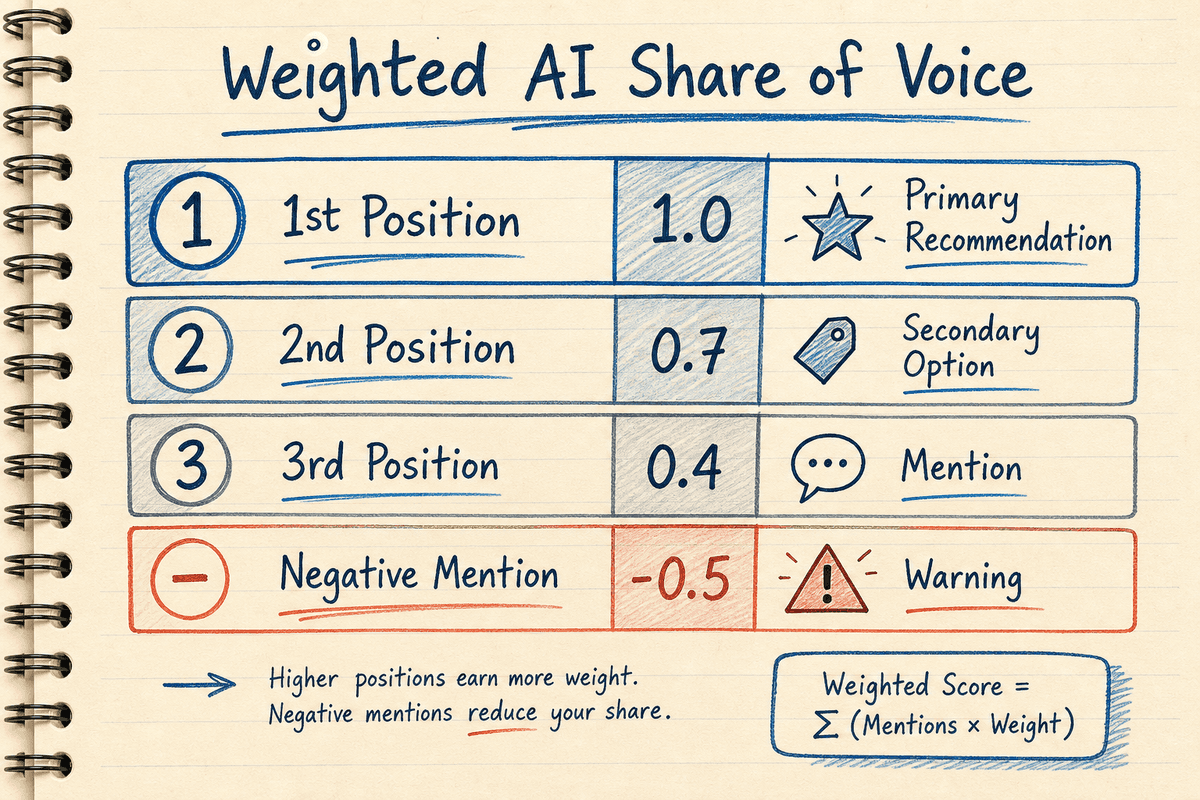
Standard AI Share of Voice Formula
At its simplest level, AI Share of Voice measures your brand's share of total citations across a defined set of target buyer prompts:
$$\text{AI SOV (%)} = \left( \frac{\text{Total Citations of Your Brand}}{\text{Total Category Citations Across All Competitors}} \right) \times 100$$
Example: You track 50 prompts related to "automated API monitoring." Across these 50 prompts, AI engines generate 200 total vendor citations. If your brand is cited 30 times, your raw AI SOV is:
$$\text{Raw AI SOV} = \left( \frac{30}{200} \right) \times 100 = 15%$$
Weighted Position-Based AI Share of Voice
Raw citation counts treat every mention equally. In reality, being recommended as the primary solution in the first line of an answer carries significantly more weight than being listed fourth in an honorable mentions list.
A robust calculation assigns a position multiplier ($W_p$) to each mention:
$$\text{Weighted Score} = \sum (\text{Mention}_i \times W_p)$$
Where position weights are defined as:
- First Position / Primary Recommendation ($W_1$): 1.0
- Second Position / Secondary Option ($W_2$): 0.7
- Third Position or Lower ($W_3+$): 0.4
- Negative Mention / Warning ($W_{neg}$): -0.5
By measuring Weighted AI SOV monthly, founders can determine whether content updates are shifting their product from casual mention status to the top recommended solution.
Real-World Case Study: Turning a 0% AI SOV into Category Dominance
To see how AI answer tracking drives practical growth, consider the journey of an early-stage B2B SaaS startup in the database performance space.
The Problem
The founding team spent eight months building a niche database optimization tool. Despite ranking on page two of Google for several core industry terms, their initial AI audit revealed a major issue:
- ChatGPT: Recommended two legacy database tools built in 2012.
- Perplexity: Cited an outdated Reddit thread from 2021 that claimed the founder's category "had no viable modern solutions."
- Google AI Overviews: Showed zero vendor recommendations, opting instead to display generic SQL code snippets.
Their raw AI Share of Voice across 30 high-intent evaluation prompts was 0%.
Initial Audit (0% AI SOV) ➔ Source Analysis ➔ Targeted Content Blitz ➔ 6-Week Re-index ➔ 42% AI SOV
The Strategy
Using an evidence-backed tracking framework, the team analyzed the underlying source stack that Perplexity and ChatGPT drew from when generating answers for their core buyer prompts.
- Uncovering Source Dependency: They discovered that ChatGPT relied heavily on comparison roundups published on high-authority developer blogs and GitHub README comparison tables.
- Identifying Community Gaps: Perplexity's citations linked directly to active Reddit discussions on r/devops and structured review entries on G2.
- Targeted Execution: Rather than churning out generic 500-word blog posts, the team published two detailed technical benchmark guides on their blog, actively updated their documentation with clear feature matrices, and ensured accurate, structured product specs were indexed on developer portals.
If you are structuring your own content strategy to capture search visibility, reading our guide on 11 Best SEO Blogs Every SaaS Founder Needs (2026) can help identify authoritative industry frameworks worth implementing.
The Outcome
Within six weeks of updating their documentation and publishing targeted technical content:
- Perplexity updated its citation graph, recommending the startup in 18 out of 30 test prompts.
- ChatGPT began highlighting the platform as the top modern alternative for cloud-native setups.
- Overall Weighted AI SOV increased from 0% to 42%, driving a measurable 34% increase in organic trial signups directly attributed to AI search prompts.
Myth-Busting: 3 Misconceptions About AI Tracking & GEO
As generative search replaces traditional search interfaces, several persistent myths continue to mislead startup teams.
Myth 1: "Winning in AI Search Requires Writing Hundreds of Blog Posts"
Reality: Generative models do not reward sheer content volume. LLMs favor contextual consensus, authoritative technical documentation, and clear entity relationships. A single comprehensive benchmark guide cited across multiple forum discussions, technical reviews, and docs will outperform thirty thin keyword-stuffed blog posts.
Myth 2: "AI Tracking Works Exactly Like Google Rank Tracking"
Reality: Google rank tracking relies on deterministic results indexed for fixed geographic locations. LLMs are non-deterministic, probabilistic models. Answering a prompt involves sampling temperature, contextual weighting, and real-time web retrieval. Effective AI answer tracking requires prompt sampling across multiple runs to verify true baseline visibility.
Myth 3: "Traditional SEO Landing Pages Are Obsolete"
Reality: Generative engines constantly crawl and summarize live web pages during retrieval-augmented generation (RAG). Clean HTML structure, fast page load speeds, clear H2/H3 architecture, and schema markup remain necessary for LLM bots to extract accurate claims from your website.
When designing landing pages that both human buyers and AI web crawlers can parse effectively, review our breakdown on How to Build an SEO Landing Page (7-Step Guide).
Strategic Framework: Building an Action-Oriented AI Visibility Workflow
To move beyond passive monitoring, implement this five-stage loop to systematic capture market share in AI-generated answers.
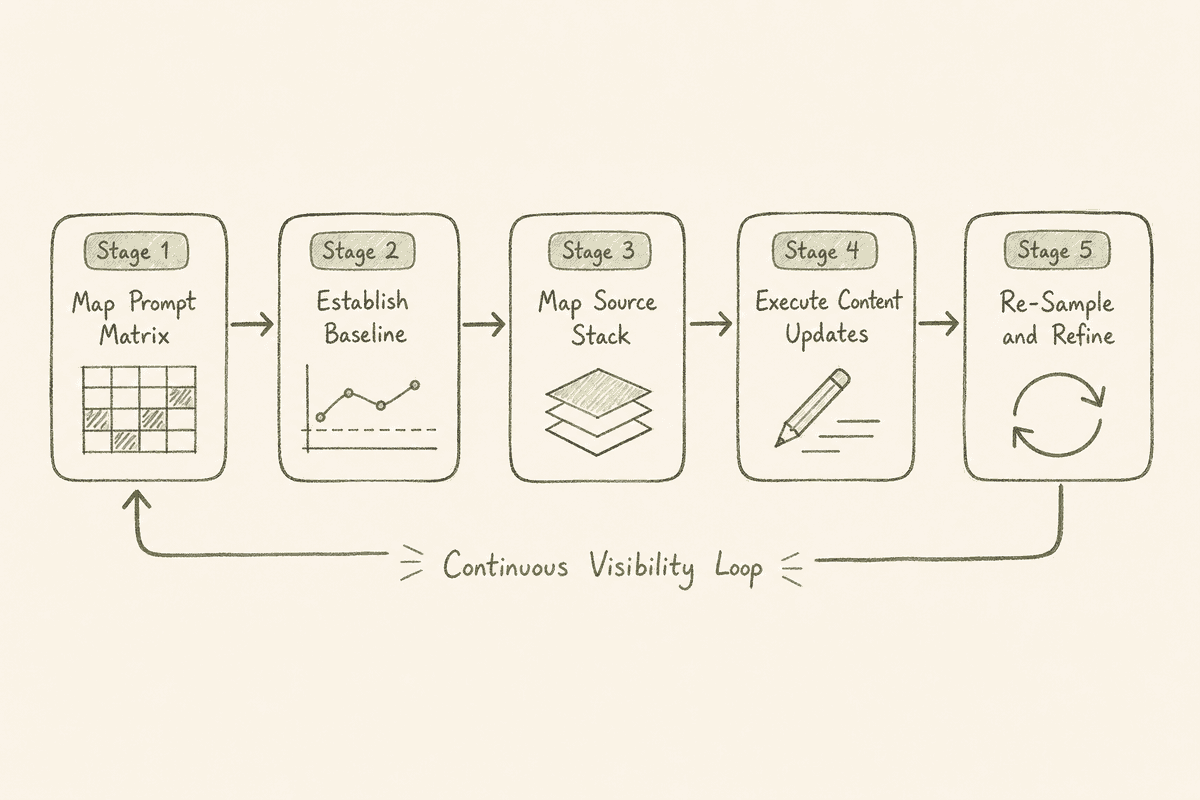
Stage 1: Map Your Persona Prompt Matrix
Do not limit your prompt list to short product names. Build a matrix covering three prompt intent layers:
- Category Discovery: "What tools exist for [use case]?"
- Feature & Compliance Evaluation: "Which [category] platforms support [specific feature / compliance standard]?"
- Direct Vendor Comparison: "Compare [Your Product] vs [Competitor A] for [target team size]."
Stage 2: Establish Your Multi-Model Baseline
Run your prompt matrix across ChatGPT, Gemini, Perplexity, AI Mode, and Google AI Overviews. Record your initial baseline metrics:
- Raw Citation Rate
- First-Position Recommendation Rate
- Sentiment Distribution (Positive, Neutral, Negative)
Stage 3: Map the Source Stack Nodes
Export the web links and domain sources cited by the models across your prompt set. Categorize these sources into distinct buckets:
- Official Product Documentation
- Third-Party Industry Roundups & Software Review Sites
- Community Forums (Reddit, Stack Overflow, Specialized Discord summaries)
- Data Nodes (Wikidata, GitHub repositories, Crunchbase profiles)
Stage 4: Execute Targeted Content & Citation Updates
Prioritize your execution based on visibility gaps:
- Missing from roundups? Contact publishers or create detailed direct comparison resources on your site.
- Outdated product features cited? Update your technical documentation and schema markup to reflect recent product updates.
- Competitors winning on specific features? Publish deep dive technical guides detailing your architecture and capabilities.
Stage 5: Re-Sample and Refine
LLMs periodically re-index and refresh their live retrieval indexes. Measure your AI SOV every two to four weeks following major content updates to track trajectory improvements.
Frequently Asked Questions About AI Answer Tracking
How often should a startup founder track AI model answers?
For most early-stage and growth startups, bi-weekly or monthly tracking provides the right balance. Because LLM training runs and retrieval index refreshes take time to propagate, daily tracking often introduces noise from normal probabilistic output variance. However, during major product launches or rebrand campaigns, weekly tracking helps monitor initial market pickup.
Why do ChatGPT and Perplexity give completely different recommendations for the same prompt?
Perplexity relies heavily on real-time web search retrieval across active news, community forums, and indexable web pages. ChatGPT combines its parametric pre-trained weights with real-time Bing search queries. Because their underlying source retrieval algorithms and system prompts differ, their synthesized recommendations vary accordingly.
Can early-stage startups win visibility in Google AI Overviews without enterprise Domain Authority?
Yes. Google AI Overviews frequently pull concise, highly specific answers from niche sites, specialized documentation, and forum threads that directly answer the user's explicit query. Clear structure, schema markup, and direct factual answers allow early-stage teams to earn citations alongside established market leaders.
What is the main difference between traditional SEO tracking and AI answer tracking?
Traditional SEO tracking checks your website's exact URL position on a fixed search engine results page. AI answer tracking measures how generative models synthesize information from across the entire web to recommend, evaluate, or cite your brand inside conversational answers.
Choosing the Right Tracking Stack for Your Growth Stage
Selecting a Peec AI alternative ultimately depends on your team's execution capacity and current stage:
- Pre-Seed / Bootstrapped Validation: If you simply need a cheap weekly ping to see if your brand name appears in ChatGPT, lightweight budget trackers like LLMrefs offer a low-friction entry point.
- Public Relations & Brand Reputation: If managing customer sentiment, preventing PR hallucinations, and tracking brand risk is your priority, platforms like WorkDuo.ai provide specialized monitoring.
- Growth & Scale-Up Execution: If you need to map full buyer journeys, analyze deep citation sources, and immediately convert visibility gaps into published, revenue-generating content, BeVisible delivers a complete workflow built for scaling SaaS brands.
By replacing passive monitoring with structured execution, startup founders can shape how AI engines understand, recommend, and convert their future customers.