
You are staring at a dashboard that proves ChatGPT, Gemini, and Perplexity are consistently recommending your biggest competitor to your target buyers. The charts are colorful, the data is clear, and the strategic gap is glaring. But then you hit a wall: what exactly are you supposed to do next?
This is the insight bottleneck. Many teams invest heavily in AI search tracking tools only to realize they have purchased an expensive mirror. The tool reflects the problem perfectly but offers zero mechanisms to fix it. Knowing you are missing from a large language model's (LLM) recommendation list is not a strategy. The strategy is the pipeline of content you build, publish, and distribute to feed those models the citations they need to change their answers.
Platforms like Peec AI have established a strong foothold by helping brands track their presence in AI recommendations. As reviewers have noted, Peec AI is highly effective for identifying specific gaps and outdated content topics 1. It excels at helping established brands defend their market share in AI search 2. However, for growth teams, marketing agencies, and scaling SaaS companies, monitoring is only half the battle. If a platform does not help you turn missing mentions and weak citations into published work, your team is stuck doing manual translation between analytics dashboards and your CMS.
The market has shifted toward AI visibility platforms with content execution capabilities—tools that detect a visibility gap and immediately surface the evidence-backed opportunities, briefs, and publishing workflows required to close it.
 In this guide, we will break down the myth of "passive AI ranking," explore the core differences between monitoring tools and execution platforms, and review the top Peec AI alternatives designed to help you execute on visibility gaps.
The Problem with "Visibility-Only" Platforms
Before looking at alternatives, it is critical to understand why the purely analytical approach to AI Search Engine Optimization (GEO/AIO) often fails in practice.
The fundamental myth of AI visibility is that large language models act like traditional search engines, merely crawling the web and serving up the most authoritative links. In reality, models like ChatGPT and Perplexity rely heavily on Retrieval-Augmented Generation (RAG). They do not just rank links; they synthesize answers by extracting entities, sentiments, and facts from high-trust citation nodes across the web.
If your brand is missing from an AI answer, it is not because you failed to tweak a meta tag. It is because the LLM did not find sufficient, structured, and consensus-driven evidence about your product during its retrieval phase.
Visibility-only platforms will alert you to this absence. They will send you a weekly report showing your brand mention rate dropped from 15% to 8% in ChatGPT. But they leave your content team with a massive operational headache:
- Manual Source Tracing: Which sources is the AI currently citing instead of you?
- Intent Translation: What specific questions did the user prompt contain, and how did the AI interpret them?
- Content Remediation: Do you need to update an existing landing page, write a new blog post, or launch a third-party review campaign to influence the model?
When a platform stops at the dashboard, marketing teams have to manually port data into spreadsheets, reverse-engineer the AI's logic, brief a writer, manage the drafting process, and handle the publishing. This disjointed workflow leads to execution paralysis. Teams know they are losing AI market share but lack the streamlined tooling to fight back.
Core Capabilities of an Execution-First AI Platform
To move from monitoring to action, an AI visibility platform must bridge the gap between data and content production. When evaluating alternatives to tracking-heavy solutions, look for platforms that integrate these specific execution features.
1. Evidence-Backed Content Opportunities
An execution platform does not just say, "You are missing from the prompt: 'Best CRM for financial advisors.'" It analyzes the sources the AI did cite for that prompt and identifies exactly what information those sources provided. The platform then generates a specific, evidence-backed content opportunity: "Create a technical comparison page detailing compliance features, because ChatGPT is currently citing G2 reviews that claim your competitor has better SEC compliance tools."
2. Brief Generation and Citation Structuring
LLMs consume content differently than human readers. They look for clear entity relationships, structured data, and high-density factual answers. Execution platforms assist in generating content briefs that naturally embed these elements. They guide writers to format content in a way that AI crawlers (like OAI-SearchBot or PerplexityBot) can easily parse, extract, and cite.
3. Integrated Publishing and Scheduling Workflows
The fastest way to fix an AI visibility gap is to update your own authoritative real estate. Platforms with content execution capabilities allow teams to draft, review, schedule, and publish directly from the insights interface. If a competitor wins a citation because they recently published a feature update, your team can instantly trigger a workflow to update your own feature pages to regain consensus.
4. Continuous Feedback Loops
Once you execute on a content opportunity, you need to know if it worked. Execution platforms automatically re-prompt the targeted AI models after your content is indexed. This creates a closed-loop system: find the gap, publish the fix, and verify the new AI recommendation.
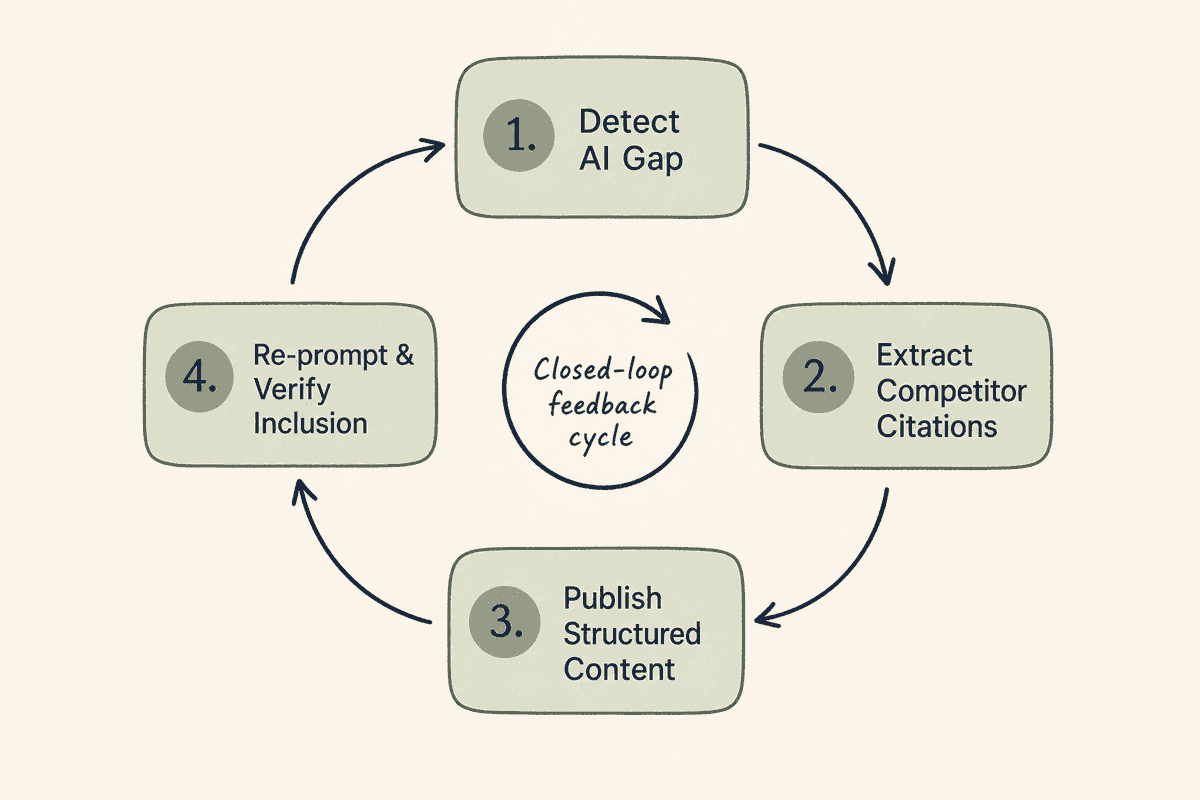
Top Peec AI Alternatives for AI Visibility and Content Execution
While Peec AI is a robust tool for analyzing model-specific breakdowns and defending existing brand presence, organizations looking for operational execution have several distinct alternatives.
1. BeVisible (The End-to-End Execution Layer)
BeVisible is built specifically for SaaS founders, B2B marketing teams, and agencies who need to measure AI-search visibility and immediately turn missing mentions into published work. Instead of stopping at gap analysis, BeVisible tracks ChatGPT, Gemini, Perplexity, AI Mode, and AI Overviews across buyer prompts, and directly translates those insights into action.
When BeVisible detects a weak citation or a competitor win, it turns that data into an evidence-backed content opportunity. The platform manages the entire lifecycle—from the initial alert to the article drafting, review process, scheduling, and final publishing work. For teams tired of porting CSV exports into project management software, BeVisible provides a seamless environment where visibility monitoring directly drives content execution.
2. AirOps
AirOps has positioned itself as a strong alternative by focusing on turning visibility deficits into immediate SEO and content maneuvers. According to recent industry reviews, AirOps excels at turning AI visibility gaps into prioritized content and SEO actions, allowing teams to execute directly based on the insights provided 3.
While it operates heavily in the programmatic space, its ability to assign priority to specific content gaps makes it a valuable tool for teams that need strict directional guidance on what to write next to influence LLMs.
3. Vismore
If your team is looking for something that breaks away from traditional tracking interfaces, Vismore is frequently cited by practitioners. User feedback highlights that Vismore is positioned as highly execution-oriented, actively attempting to move beyond basic tracking and into active content strategies 4.
Vismore appeals to content teams who want a workspace that feels less like a traditional SEO crawler and more like a tactical command center for updating web assets based on AI model preferences.
4. Visible (by SE Ranking)
For agencies and brands that want to keep one foot in traditional search while stepping into AI tracking, Visible offers a hybrid approach. It acts as a comprehensive monitoring layer that connects AI visibility tracking with traditional SEO metrics 4.
While it leans more toward monitoring than direct content production, its deep integration with SE Ranking’s historical data makes it easier for execution teams to justify budget and content resources by tying AI visibility metrics to known traditional search volumes.
5. Profound / Ahrefs AI Features
When comparing established SEO giants with newer AI platforms, teams often look at the clash between deep data and AI-specific tracking. Platforms like Profound, or the evolving AI features within Ahrefs, focus heavily on helping you find out exactly how visible your brand is in AI tools like ChatGPT, Gemini, and Perplexity 5.
These platforms provide immense amounts of data and authority metrics. However, they generally require you to bring your own execution workflow. You will get world-class data on why a competitor is ranking (backlinks, domain rating, historical traffic), but you will still need an external system to manage the resulting content execution pipeline.
6. OtterlyAI
OtterlyAI focuses on tracking brand visibility across the AI search ecosystem 6. It provides sentiment analysis and tracks whether LLMs are discussing your brand positively, negatively, or neutrally.
This is particularly useful for execution teams focused on digital PR and reputation management. If OtterlyAI detects negative sentiment in an AI Overview, the execution strategy usually involves reaching out to third-party reviewers or publishing highly targeted clarification content to shift the model's learned weights over time.
The 4-Phase AI Content Execution Workflow
Choosing the right platform is only the first step. To truly replace a tracking-only setup with an execution-driven model, your marketing or growth team must adopt a new operational workflow. Content execution for AI models requires a different cadence than traditional SEO blogging.
Phase 1: Intent Triage and Gap Analysis
When an AI platform alerts you to a visibility drop, the first step is triage. Not all AI prompts are worth fighting for. You must separate informational prompts ("What is enterprise resource planning?") from high-intent commercial prompts ("Best enterprise resource planning software for manufacturing").
Once you isolate a commercial prompt where your brand is missing, use your execution platform to pull the exact sources the AI is citing.
The critical question: Is the AI citing direct competitor websites, or is it citing third-party aggregators (like G2, Capterra, or Reddit)?
- If citing competitors, your own content is failing the RAG retrieval process.
- If citing aggregators, you need a digital PR execution strategy, not just a blog post.
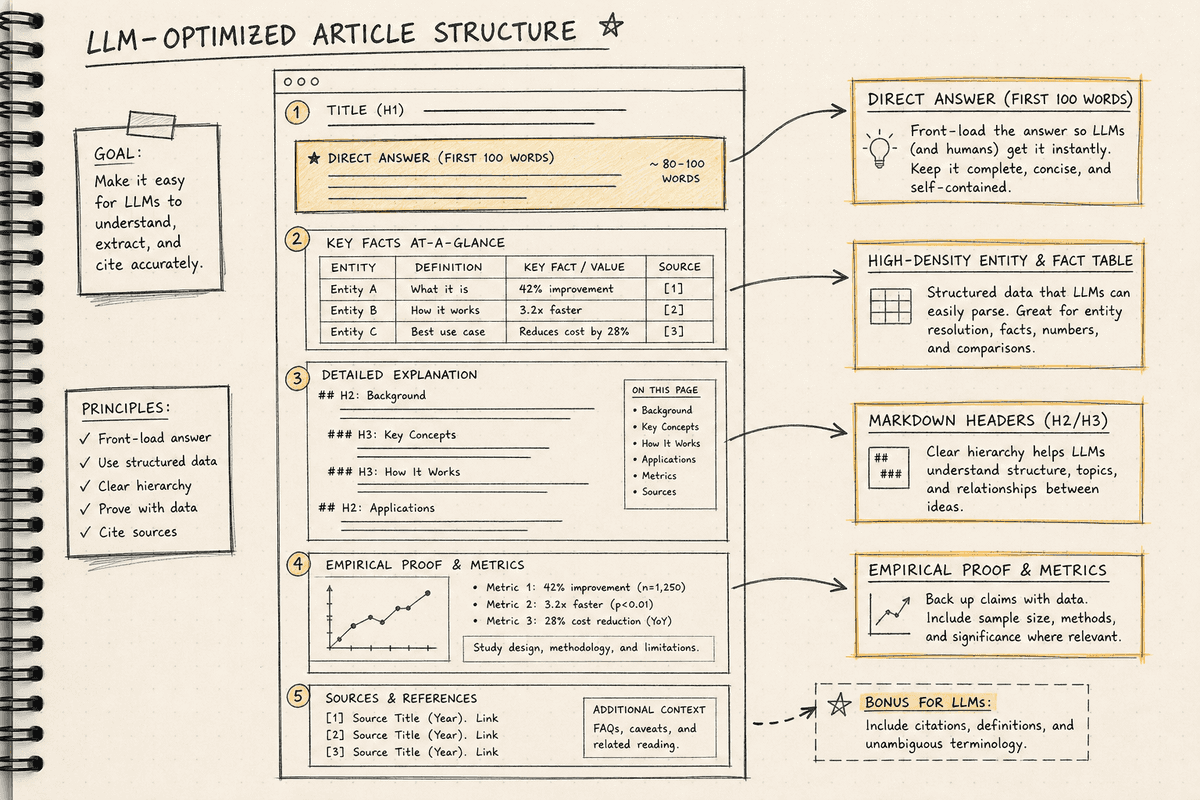
Phase 2: Evidence-Backed Content Structuring
When you decide to execute on a content opportunity on your own site, traditional SEO fluff will not work. LLMs have limited context windows and optimize for high information density.
A successful execution platform will help you build an SEO landing page or article that directly answers the prompt.
Use this structural checklist for AI-targeted content:
- Direct Answers First: Place the literal answer to the prompt in the first 100 words of the page. Do not bury the lede beneath long, winding introductions.
- Entity Density: Clearly state your product's name, category, primary features, and integrations. Use exact terminology.
- Data and Statistics: LLMs prioritize empirical claims. If you claim to be the fastest software, include the exact load times.
- Standardized Formatting: Use standard markdown-style structures (H2s, H3s, bulleted lists, and standard HTML tables) that bots can easily parse.
Phase 3: The Mini-Story — The Case of the Missing Mention
Consider a mid-sized B2B payroll software company. For months, they relied on a tracking-only platform and watched their brand disappear from Perplexity queries related to "payroll software for remote teams." The tracking tool showed them losing ground to a rival, but the content team didn't know how to respond. They spent weeks guessing, writing generic "future of remote work" blog posts that failed to move the needle.
They switched to an execution platform. The new tool didn't just report the drop; it analyzed the gap. It revealed that Perplexity was heavily weighting a specific feature: "multi-currency direct deposit." The competitor had a dedicated technical page explaining this feature. The payroll company had the feature, but only mentioned it briefly in a buried PDF manual.
The execution platform automatically generated a brief for a "Multi-Currency Payroll Guide." The content team drafted it within the platform, scheduled it, and published it as a structured HTML page. Within three weeks, the LLM re-crawled the site, ingested the high-density information about multi-currency support, and began citing the company alongside the competitor. This is the difference between watching a dashboard and executing a fix.
Phase 4: Validation and Re-Prompting
Execution without validation is just guessing. After publishing the content, your workflow must include automated re-prompting.
You need to schedule the platform to ask the same target queries ("best payroll software for remote teams") across ChatGPT, Perplexity, and Gemini at regular intervals (e.g., 7 days, 14 days, and 30 days post-publish). If your brand appears, the execution loop is successfully closed. If not, the platform should highlight what new entities the AI is prioritizing so you can iterate.
Technical Roadblocks in AI Visibility Execution
Even the best content execution platform cannot help you if the AI bots cannot physically read your website. Traditional search engines like Google have spent decades perfecting the ability to render complex JavaScript and Single Page Applications (SPAs). Emerging AI bots are not always as sophisticated.
The JavaScript Rendering Problem
If your marketing site or SaaS front-end relies heavily on client-side rendering (React, Vue, Angular), you might be invisible to AI crawlers. Tools like OAI-SearchBot (OpenAI) or PerplexityBot generally prefer static HTML. If your page requires complex JavaScript execution to display the actual text and entities, the bot may simply crawl a blank page and move on.
Executing a flawless content strategy on a technically flawed foundation is a waste of resources. If your platform flags that a recently published, highly optimized page is still not being cited by AI, you must audit your technical delivery.
You can resolve these issues by implementing Server-Side Rendering (SSR) or dynamic rendering. If your infrastructure relies heavily on these frameworks, reviewing the mechanics of single-page application SEO is an absolute prerequisite to AI content execution. Your execution platform will only register wins if you have properly configured your SEO for single page application environments to serve pre-rendered HTML to specific bot user-agents.
Navigating the Cost of Execution: Agency vs. Automation
One of the primary reasons companies stick to visibility-only tools is the perceived cost of content execution. Identifying a gap is cheap; hiring writers, editors, and SEOs to fix that gap is expensive.
This is where the automation layer of modern execution platforms provides significant ROI. When you compare the cost of manual intervention to software-driven workflows, the economics shift. Traditional agencies charge heavy retainers for manual gap analysis, brief creation, and drafting.
By using an AI visibility platform that handles the analysis and automates the briefs and workflows, you drastically reduce the hours required to produce a targeted asset. Understanding SEO charges UK and globally reveals a massive disparity between agencies using manual tracking methods versus those utilizing end-to-end execution software. Agencies that leverage execution platforms can pass those efficiency savings onto clients, or in-house teams can operate with a leaner headcount.
Feature Comparison: Visibility-Only vs. Execution Platforms
To make the distinction concrete, here is a breakdown of how the two types of platforms handle the exact same scenario.
Scenario: ChatGPT consistently recommends Competitor X over your brand for the prompt "Best automated billing software for agencies."
Frequently Asked Questions (FAQs)
What is the difference between AI search visibility and traditional SEO?
Traditional SEO focuses on optimizing web pages to rank higher on Search Engine Results Pages (SERPs) based on algorithms that evaluate links, keywords, and user experience. AI search visibility focuses on ensuring your brand and product data are ingested, understood, and prioritized by Large Language Models (LLMs) when they generate direct conversational answers. Traditional SEO aims to win a click; AI visibility aims to win the factual consensus of the model.
Can AI execution platforms guarantee placement in ChatGPT or Perplexity?
No platform can guarantee placement in an LLM's output, just as no tool can guarantee a #1 ranking on Google. LLMs generate responses probabilistically, meaning the exact output can vary slightly even with the same prompt. However, execution platforms drastically increase your probability of inclusion by ensuring the underlying data the LLM retrieves (the RAG process) heavily favors your structured, evidence-backed content.
How often do AI models update their citations?
This depends heavily on the model and its architecture. Real-time search models like Perplexity or ChatGPT with web search enabled can discover and cite new content within hours of it being indexed. Static models (those relying entirely on a pre-trained data cutoff) will not update their knowledge base until a new version of the model is trained. Execution platforms primarily target models with live retrieval capabilities, as these drive the highest commercial intent for B2B buyers.
Is AI content execution just programmatic SEO?
Not exactly. Programmatic SEO often involves spinning up hundreds of thousands of thin, templated pages to capture long-tail keyword permutations. AI content execution is highly targeted. It is about creating deep, fact-dense, and highly structured singular assets designed to serve as the definitive "source of truth" for an LLM trying to answer a complex buyer question.
Moving From Analysis to Action
Tracking your AI visibility is only the baseline of a modern search strategy. Knowing that Peec AI is highly effective at identifying outdated topics and helping established brands track their presence 1 is useful context. But if your team lacks the internal machinery to instantly act on those insights, the data will sit dormant.
The market rewards teams that close the gap between insight and execution the fastest. When you choose a platform that turns missing mentions and competitor wins into direct publishing workflows, you remove the friction that slows down most marketing departments. You stop wondering how to influence ChatGPT and start systematically feeding it the exact evidence it needs to recommend your brand.