
When prospective buyers ask ChatGPT, Perplexity, or Google Gemini to recommend the top software in your niche, your position on traditional search engine results pages (SERPs) matters less than whether your brand gets named in the generated answer. Peec AI built a solid reputation around geographic and regional prompt tracking, helping teams see how localized prompts surface their brand across different countries. However, modern marketing teams quickly encounter a frustrating operational ceiling: knowing that a rival appears in an AI response does not tell you how to displace them.
Monitoring without execution leaves growth teams with dashboard fatigue. You get reports showing competitor mentions, but no clear pathway to update the underlying sources, rewrite authoritative documentation, or publish targeted content that shifts LLM recommendation engines. If your team needs to track competitor Share of Voice (SOV) across AI engines while actively closing visibility gaps, exploring Peec AI alternatives becomes necessary.
This guide breaks down the best AI visibility software platforms with competitor tracking, comparing their analytics depth, cross-engine coverage, citation discovery, and content execution capabilities.
What Competitor Tracking Means in AI Search (Beyond Traditional Rank Tracking)
Traditional SEO tools track fixed blue-link rankings for discrete keywords. AI visibility platforms monitor fluid prompt outputs where large language models (LLMs) evaluate sources, synthesize opinions, and present top brand options dynamically. Tracking competitors in AI engines requires measuring completely different metrics than standard Google rank tracking.
To effectively monitor competitors in AI answers, software must track four key layers of generative engine behavior:
- First-Mention Share of Voice (FM-SOV): The percentage of prompt runs where your brand appears first in bulleted recommendation lists compared to direct rivals.
- Citation Source Attribution: The exact websites, blog posts, documentation pages, or review hubs that the AI model fetched to formulate its recommendation.
- Prompt Co-Occurrence Rate: How frequently your brand is framed as a direct substitute for a competitor (e.g., "X is an alternative to Y").
- Sentiment & Feature Framing: Whether the model describes your competitor as "expensive," "enterprise-grade," or "easiest to use," and how your brand's feature set is portrayed alongside them.
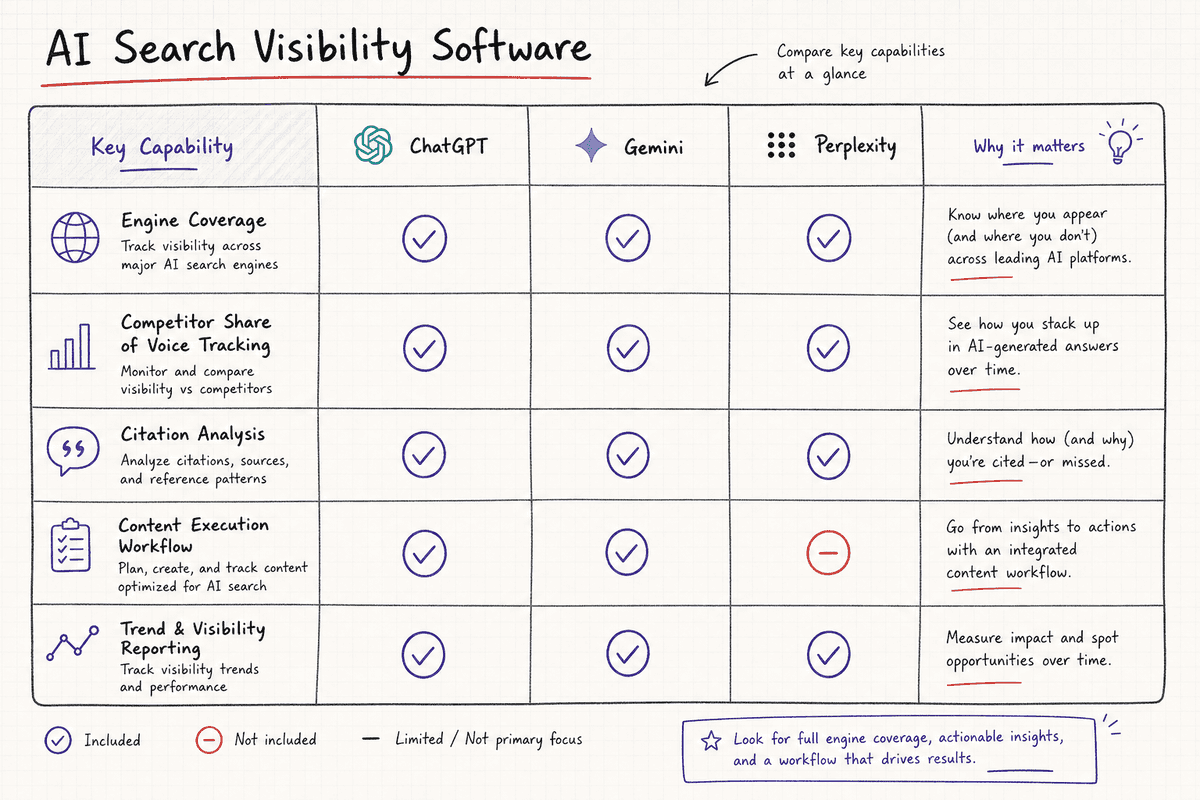
Quick Comparison: Peec AI vs. Top Competitor Tracking Alternatives
Before detailing each platform, the table below highlights how the leading AI visibility monitoring tools compare across model coverage, competitor tracking depth, execution features, and primary audience.
Detailed Reviews: Top Peec AI Alternatives
1. BeVisible
BeVisible is an AI visibility platform built specifically to bridge the gap between AI search analytics and real-world execution. While Peec AI shows you where your brand ranks in localized prompts, BeVisible goes several steps further by analyzing why AI models recommend your competitors and giving your team the tools to publish content that fixes those visibility gaps.
Key Capabilities & Competitor Intelligence
- Cross-Engine Prompt Tracking: Monitors buyer prompts across ChatGPT, Google Gemini, Perplexity, Google AI Mode, and Google AI Overviews simultaneously.
- Evidence-Backed Opportunity Engine: Identifies exactly which prompts mention your competitors, which sources the AI cited to validate them, and where your brand was omitted or downranked.
- Integrated Remediation Workflow: Automatically turns missing brand mentions and weak citations into actionable content briefs, comparison articles, review updates, scheduling, and direct publishing work.
- Citation Analysis & Gap Discovery: Pinpoints the exact third-party articles, SaaS roundups, and documentation pages driving competitor recommendations so your content team knows precisely what to publish or update.
Why It Replaces Peec AI
Peec AI provides clear regional visibility data, but leaves content teams stranded when it comes to acting on that data. BeVisible connects visibility monitoring directly to execution, enabling growth teams to turn competitor wins into published, authoritative articles designed to capture LLM citations.
Best For
SaaS founders, B2B marketing teams, agencies, and content leads who want to measure AI-search share of voice and convert competitor advantages into published, high-converting content.
2. Gracker AI
Gracker AI focuses on share of voice (SOV) and sentiment metrics, making it a viable alternative for B2B tech platforms seeking clear analytics on brand perception across AI outputs.
Key Capabilities & Competitor Intelligence
- SOV Benchmarking: Tracks how frequently your brand appears alongside competitors in category prompts, as highlighted in Gracker AI's visibility platform breakdown.
- Sentiment Signals: Measures whether model outputs frame your product positively or highlight feature gaps relative to rivals.
- Prompt-Level Categorization: Clusters prompt tracking by buyer stage, from top-of-funnel exploration to bottom-of-funnel product comparisons.
Tradeoffs Compared to Peec AI
While Peec AI emphasizes geographical granularity across localized prompts, Gracker AI focuses heavily on B2B software categories and overall sentiment tracking. However, it offers fewer automated workflow tools for writing and publishing remediation content directly from the interface.
Best For
B2B SaaS and enterprise tech marketing teams prioritizing sentiment analysis and share-of-voice reporting.
3. Brandlight.ai
Brandlight.ai targets enterprise organizations requiring robust telemetry, governance, and audit trails for their AI visibility data.
Key Capabilities & Competitor Intelligence
- Auditable Dashboards: Delivers cross-engine visibility with verified data tracking across ChatGPT, Gemini, Copilot, and Perplexity, as detailed in Brandlight's competitor tracking framework.
- First-Mention & Citation Governance: Measures share of voice, first-mention positioning, and citation quality while tying remediation velocity to brand lift, outlined in Brandlight's AI search tool analysis.
- Security & Compliance: Offers enterprise-grade infrastructure, including SOC 2 Type II compliance, Single Sign-On (SSO), and custom API access.
Tradeoffs Compared to Peec AI
Peec AI is accessible for smaller agencies and localized brands. Brandlight.ai is built for large enterprise governance programs where legal compliance, security audits, and multi-team reporting take priority over rapid content publishing.
Best For
Enterprise brands and corporate communications teams needing security-compliant AI tracking and formal share-of-voice telemetry.
4. Otterly AI
Otterly AI provides an entry-level monitoring environment tailored for startups and small agencies exploring generative engine optimization (GEO) for the first time.
Key Capabilities & Competitor Intelligence
- Side-by-Side Prompt Audits: Displays direct comparisons showing how ChatGPT, Perplexity, and SearchGPT respond to identical prompt inputs.
- GEO Audit Reports: Identifies broad citation patterns and evaluates whether your brand domain is indexed in key AI search indexes.
- Lightweight Competitor Tracking: Monitors basic brand mentions across a selection of target buyer prompts.
Tradeoffs Compared to Peec AI
Peec AI offers significantly more sophisticated regional tracking and multilingual prompt coverage. Otterly AI prioritizes simplicity and quick setup over deep regional segmentation or automated content publishing.
Best For
Early-stage companies and boutique marketing agencies seeking an affordable entry point into AI prompt monitoring.
5. TrySight / FAII
TrySight and FAII represent data-focused AI visibility tools that specialize in engine-level attribution and LLM output tracking.
Key Capabilities & Competitor Intelligence
- Model Reference Analytics: Tracks how models reference your brand across multiple parameters, as explained in TrySight's visibility software research.
- Domain Citation Aggregation: Compiles lists of top-referencing domains across LLM retrieval streams, supported by insights from FAII's monitoring software guide.
- Competitor Mention Alerts: Sends notifications when a rival gains new citation ground across monitored buyer prompts.
Tradeoffs Compared to Peec AI
These tools excel at data harvesting and analytics display. However, like Peec AI, they focus on reporting visibility metrics rather than helping marketing teams create, schedule, and publish content to claim missing citations.
Best For
SEO analysts and technical growth marketers who want raw LLM tracking data to feed internal analytics dashboards.
3 Critical Insights Competitor Tracking Tools Often Miss
Most AI visibility tools apply old SEO rank-tracking formulas to generative models. AI engines do not search or index pages the way traditional search engines do. When evaluating software options, look for platforms built around the mechanics of LLM response generation.
1. Citation Hijacking Across Comparison Pages
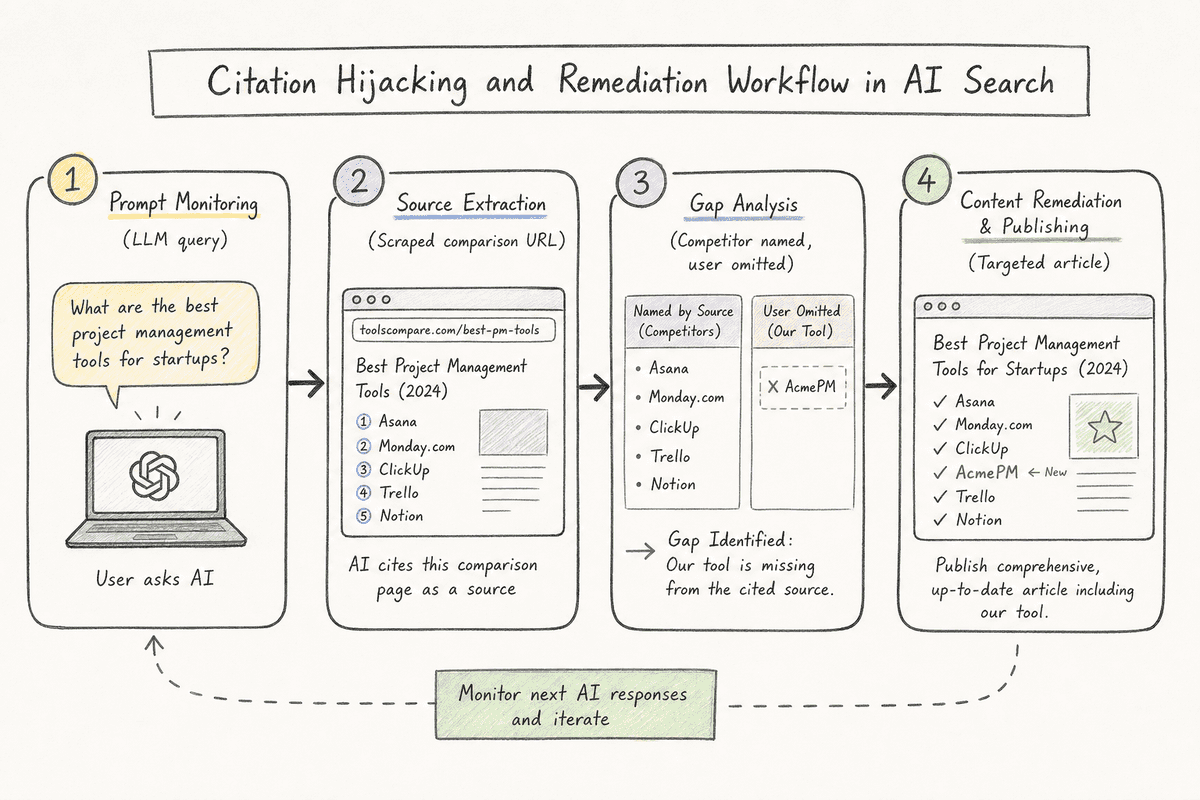
In traditional search, ranking for a competitor's brand keyword is difficult. In AI search, models routinely answer prompt requests like "What are the top alternatives to Brand X?" by scraping third-party comparison blogs and review pages. If a competitor dominates those source articles, the AI model will quote their review as authoritative truth while ignoring your product completely.
Standard monitoring tools highlight that you are missing from the response. Effective tools uncover the exact third-party citation URL driving the recommendation, enabling you to publish counter-documentation or pitch update listings directly to that source.
2. Prompt Co-Occurrence and Feature Framing
AI assistants do not just choose brands; they pair brands with specific attributes. A competitor might appear in 80% of prompts for "best enterprise analytics for security," while your brand only appears for "affordable analytics for small teams."
If your software only tracks binary brand mentions, you miss how the model frames your capabilities. Advanced competitor tracking breaks down feature-level co-occurrence, showing whether the model views your software as feature-complete or merely a budget alternative.
3. The Remediation Velocity Gap
Tracking visibility issues without an integrated publishing workflow creates operational drag. A growth team might discover 40 high-intent buyer prompts where a competitor dominates ChatGPT recommendations. If fixing that requires manually writing briefs, creating landing pages, and publishing updates across multiple CMS platforms, the report sits unused.
Platforms that connect monitoring directly to execution cut remediation time significantly. By identifying missing citations and immediately generating structured, publishable content designed for LLM indexes, teams close visibility gaps before competitors consolidate their position.
Step-by-Step Guide: How to Benchmark and Overtake Competitors in AI Search
Overtaking a competitor in AI search outputs requires a systematic process that combines continuous prompt auditing with targeted content publishing.
+-------------------------------------------------------------------------+
| STEP 1: Audit Buyer Prompt Clusters                                     |
| Identify high-intent queries (e.g., "Best X software for enterprise")   |

+-------------------------------------------------------------------------+
                                    |
                                    v
+-------------------------------------------------------------------------+
| STEP 2: Extract Competitor Citation Sources                            |
| Map the exact blogs, reviews, and docs AI assistants fetch for context  |

+-------------------------------------------------------------------------+
                                    |
                                    v
+-------------------------------------------------------------------------+
| STEP 3: Identify Content & Authority Gaps                               |
| Locate missing features, unaddressed use cases, and missing mentions    |

+-------------------------------------------------------------------------+
                                    |
                                    v
+-------------------------------------------------------------------------+
| STEP 4: Build & Publish Targeted Remediation Work                       |
| Publish authoritative landing pages and comparative guides directly     |

+-------------------------------------------------------------------------+
Step 1: Audit High-Intent Buyer Prompt Clusters
Avoid tracking vague, single-word queries. Focus on specific buyer prompts that indicate clear commercial intent:
- "What software should I use to automate customer onboarding for B2B SaaS?"
- "Compare Brand X vs Brand Y for mid-market security teams."
- "What are the top privacy-focused analytics tools with custom API access?"
Categorize these prompts into clusters representing key product capabilities and target industries.
Step 2: Analyze Competitor Citation Sources
When an AI model recommends your competitor, inspect the retrieval sources cited in the response footers. Pay close attention to:
- Independent industry blogs and roundup posts.
- Third-party comparison sites.
- High-authority technical documentation and developer guides.
Keeping up with industry publishing trends is critical here. Studying top SaaS growth resources—like those featured in our list of the 11 Best SEO Blogs Every SaaS Founder Needs (2026)—can help your team structure authoritative, citable content that generative models prefer to index.
Step 3: Identify Structural Gaps in Your Content
Cross-reference the information AI assistants retrieve about your competitor with the content available on your site. Common content gaps include:
- Missing comparison pages explicitly contrasting your feature set with rivals.
- Undocumented technical integration specs that competitors cover clearly.
- Lack of structured schema markup describing your core software capabilities.
Step 4: Publish High-Authority Remediation Content
To replace a competitor in AI recommendations, publish structured, highly authoritative content addressing the exact prompt context. Build dedicated landing pages designed to clear LLM evaluation filters.
If you are optimizing conversion assets, review our walkthrough on How to Build an SEO Landing Page (7-Step Guide) to ensure your pages satisfy both search engine algorithms and generative AI scrapers.
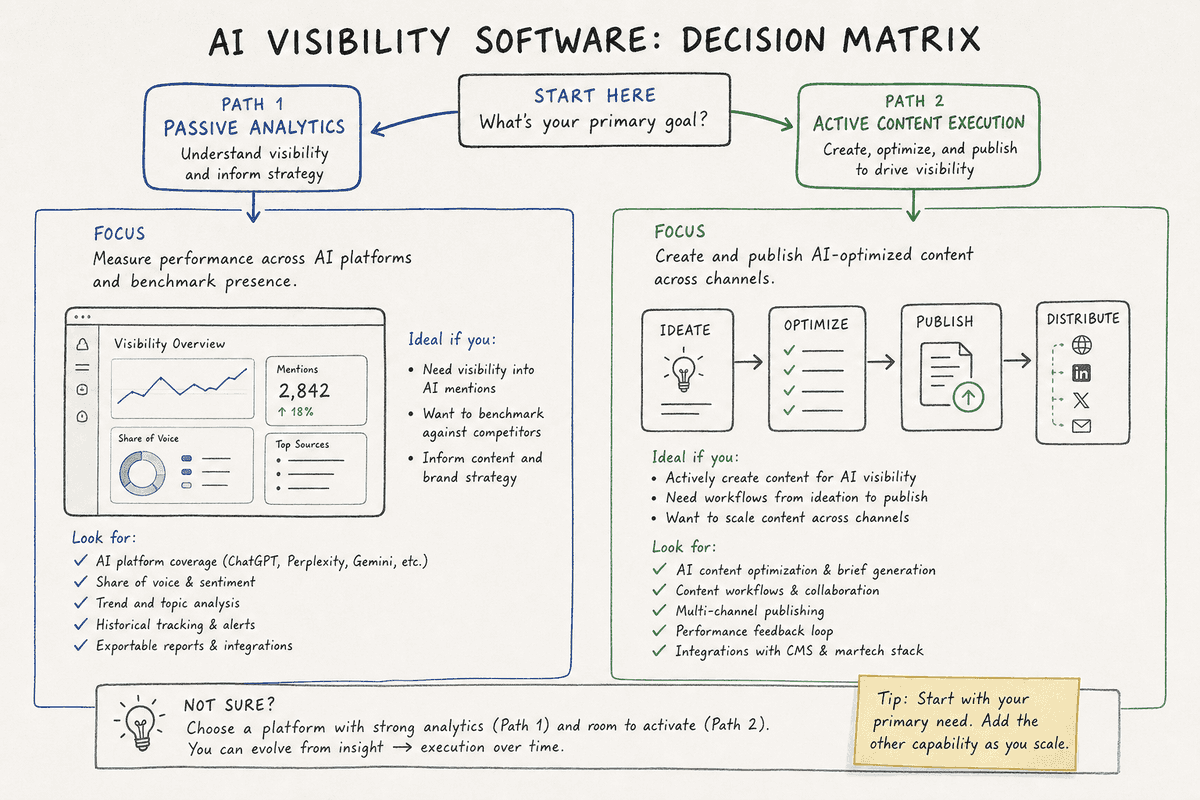
Evaluation Framework: Choosing the Right AI Visibility Software
Selecting the right Peec AI alternative depends on your team's structure, reporting requirements, and execution speed. Use this decision matrix to guide your selection.
Questions to Ask Software Vendors Before Buying
- Does the platform track retrieval sources in real time? Ensure the tool captures live web search citations (Perplexity, SearchGPT, AI Overviews) rather than relying solely on static training data.
- How does the software calculate Share of Voice? Confirm whether SOV is measured by simple brand inclusion or weighted by first-mention positioning and prompt context.
- Can our team execute content fixes within the platform? Determine whether the platform simply flags problems or provides integrated content creation, review, and publishing features.
Frequently Asked Questions (FAQs)
What makes AI visibility software different from traditional keyword rank trackers?
Traditional rank trackers measure where web pages rank on search result pages based on fixed algorithms. AI visibility software monitors dynamic text answers generated by LLMs across tools like ChatGPT, Gemini, and Perplexity. Instead of tracking rank positions (e.g., #1 or #5), AI visibility platforms measure Share of Voice (SOV), first-mention presence, prompt co-occurrence, and direct web citations.
How often do AI search engines update competitor recommendations?
AI search engines update recommendations continuously. Engines using real-time retrieval (such as Perplexity, SearchGPT, and Google AI Overviews) refresh their source citations constantly as web crawlers index new, authoritative content. Models operating on periodic training updates refresh recommendations during system retrains or retrieval-augmented generation (RAG) updates. Continuous prompt monitoring helps catch these shifts early.
Can you directly force an AI assistant to recommend your brand over a competitor?
You cannot force an AI model to mention your brand directly, but you can systematically influence its recommendations through Generative Engine Optimization (GEO). This involves publishing structured content that directly answers buyer prompts, earning citations on high-authority industry sources that LLMs crawl for context, maintaining clear product schema, and closing documentation gaps that competitors currently fill.
Why do teams move away from Peec AI?
While Peec AI is effective for regional and localized prompt tracking across international markets, many growth teams switch to alternatives like BeVisible when they need to bridge analytics with execution. Teams often require real-time citation tracking, prompt-level execution workflows, and automated content creation to actively close visibility gaps rather than just observing them on a dashboard.
Summary: Moving From Passive Monitoring to Active Execution
Monitoring your competitors across AI search outputs is only the first half of a modern growth strategy. Viewing regional rankings and share-of-voice charts on platforms like Peec AI gives you visibility into brand performance, but real market share gains come from closing the gaps those reports reveal.
By adopting an execution-first platform like BeVisible, SaaS founders and marketing teams can track buyer prompts across ChatGPT, Gemini, Perplexity, AI Mode, and AI Overviews while transforming competitor wins into published, evidence-backed content that secures your brand's place in future AI answers.