
For the last twenty years, search engine optimization meant tracking blue links on a highly predictable results page. You optimized a page, earned some backlinks, monitored a rank tracker, and watched your position move from 12 to 3. If you ranked number one, you captured the demand.
Today, that workflow is fundamentally broken. B2B buyers and consumers alike are bypassing traditional search results to ask ChatGPT, Perplexity, Gemini, and AI Overviews for direct software recommendations, agency lists, and vendor comparisons. If your brand is not mentioned and cited in those generative answers, you are entirely invisible to a growing segment of your market.
Peec AI emerged early in this transition as a tool designed to reverse-engineer what large language models (LLMs) know about a brand across various platforms [1]. It acts much like a search console for AI, helping teams detect hallucinations and track citation frequency.
However, as AI visibility monitoring matures, marketing teams, SaaS founders, and growth agencies require more than a raw data feed of LLM knowledge. They need actionable workflows. They need to know not just if they are mentioned, but how to turn weak citations, missing mentions, and competitor wins into targeted content execution.
If you find yourself needing broader engine coverage, workflow integration, or specialized citation analysis, this guide breaks down the best Peec AI alternatives and how to build a modern Answer Engine Optimization (AEO) stack.
The Paradigm Shift: Why Traditional SEO Tools Fail at AI Tracking
Before evaluating alternatives, you have to understand why standard rank trackers and traditional SEO suites fail at monitoring AI visibility.
Traditional search engines work via indexing and retrieval. Google crawls the web, adds pages to a massive database, and uses an algorithm to retrieve and rank the most relevant pages when a user types a query. A rank tracker simply scrapes that static page and reports your position.
Generative AI platforms operate entirely differently. LLMs do not "look up" a static list of links. They synthesize information dynamically based on their training data, real-time web retrieval (like Perplexity or ChatGPT with search enabled), and the specific nuance of the user's prompt.
 This creates three unique challenges for visibility tracking:
- Personalization and Context: An LLM might recommend your SaaS product when a user asks for "inventory software for startups," but completely omit you if they ask for "inventory software for small businesses," despite those terms meaning nearly the same thing in traditional keyword research.
- Implicit vs. Explicit Recommendations: Sometimes an AI will mention your brand in passing (e.g., "Competitor X is similar to Brand Y"). Other times, it will explicitly recommend you as the best solution. Traditional sentiment analysis struggles to tell the difference between a passing mention and a strong endorsement.
- Source Citation vs. Brand Mention: There is a difference between an AI mentioning your brand in its generated text and the AI actually citing your website as the source of its information.
Because of these nuances, teams cannot rely on traditional SEO metrics. You need tools specifically engineered to simulate prompt environments, map entities, and measure citation share.
What Makes a Great Peec AI Alternative?
When auditing the market for AI SEO tools and citation tracking platforms, the tools that provide the highest return on investment share a few core capabilities. Based on industry evaluation frameworks, including the 10-point evaluation checklist often used by citation analysis services [2], here is what you should look for:
Methodology Transparency
Unlike traditional SEO where we generally understand Google's ranking factors, AI visibility is a black box. You need to know exactly how the tool is gathering data. Is it using the platform's API (which often uses different, cheaper models than the consumer-facing interface)? Or is it using headless browsers to simulate real user sessions on ChatGPT Plus and Perplexity Pro? Session simulation is notoriously difficult to maintain but provides much more accurate data on what actual buyers see.
Comprehensive Engine Coverage
Tracking ChatGPT alone is insufficient. B2B buyers heavily utilize Perplexity for deep research, while broader consumer searches often trigger Google's AI Overviews (formerly SGE) and Gemini. A robust alternative must track visibility across multiple generative engines simultaneously.
Entity Mapping and Sentiment Analysis
A mention is not a recommendation. If a user asks "What are the drawbacks of using [Competitor]?" and the AI answers by citing your brand's comparative blog post, that is a massive win. If the AI hallucinates a negative review about your product, that is a crisis. The tool must separate neutral mentions from positive recommendations and negative warnings.
URL-Level Source Tracking
It is not enough to know the AI mentioned you. You need to know where the AI learned that information. Is it citing your homepage? Is it citing a review on G2? Is it citing a thread on Reddit? Understanding the source of the AI's knowledge dictates your marketing strategy.
Execution and Workflow Integration
Data without action is overhead. The biggest gap in early AEO tools was the inability to do anything with the data. Modern alternatives must help you turn visibility gaps into published work, review scheduling, and content updates.
Top AI SEO Tools for Citation Tracking
Depending on whether you need broad competitive benchmarking, deep-dive entity analysis, or execution-driven workflows, here are the top alternatives to Peec AI in 2026.
1. BeVisible (The Execution-Focused Alternative)
While many tools stop at showing you a dashboard of AI mentions, BeVisible operates as an end-to-end AI visibility monitoring and execution platform.
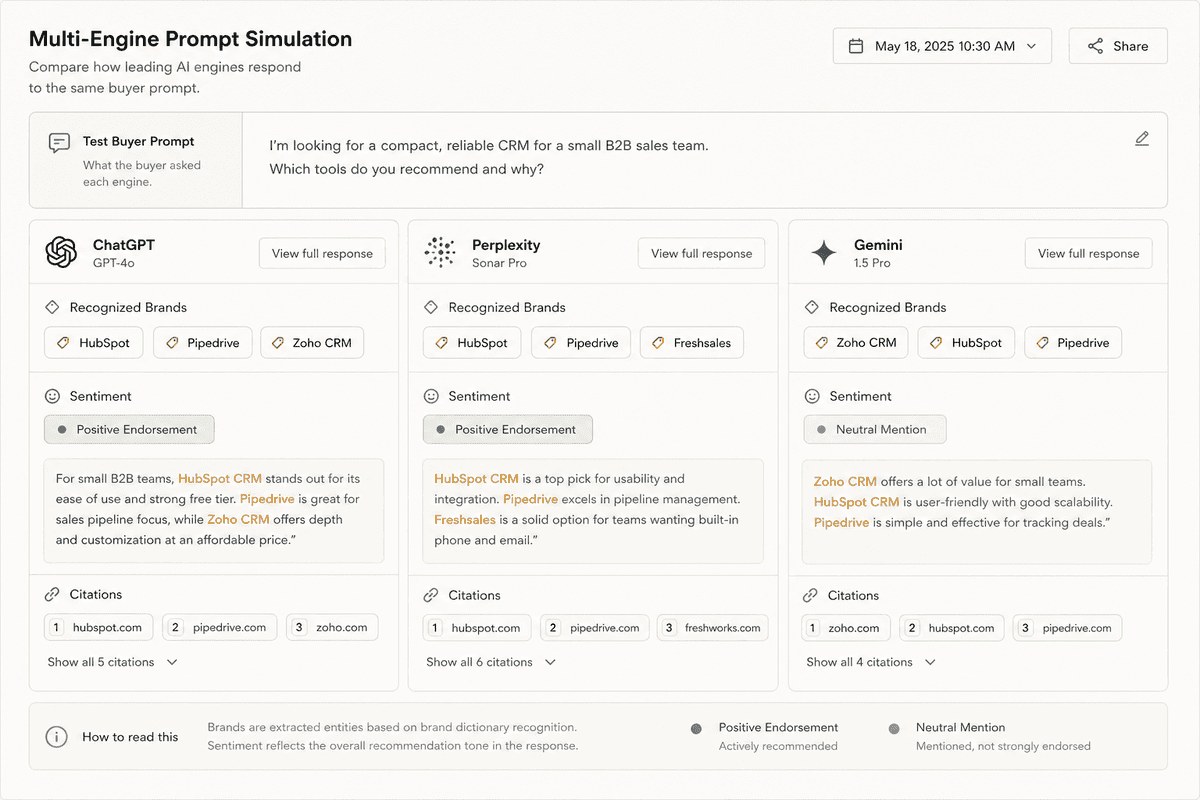
BeVisible helps teams monitor how AI assistants answer buyer questions, which brands they recommend, and which sources they cite. It actively tracks ChatGPT, Gemini, Perplexity, AI Mode, and AI Overviews across buyer prompts.
Where BeVisible differentiates itself from Peec AI is the transition from monitoring to execution. It does not just reverse-engineer LLM knowledge; it turns visibility gaps into evidence-backed opportunities, articles, review scheduling, and publishing work.
If Perplexity is consistently citing a competitor because they have a specific feature comparison page that you lack, BeVisible highlights that gap and allows content teams to scope, assign, and publish the necessary work to close it. For SaaS founders, B2B marketing teams, and agencies, this bridges the gap between AEO theory and actual marketing output.
When you discover a gap, you can immediately begin executing—for example, structuring a highly optimized page based on the AI's missing data points. If you are unsure how to structure that asset, reading up on How to Build an SEO Landing Page (7-Step Guide) provides a blueprint for pages that both humans and AI bots can easily digest.
2. Semrush AI Visibility Toolkit (Broad Brand Appearance)
Semrush recognized the shift toward AEO early and integrated the AI Visibility Toolkit into its broader suite. This tool is frequently noted as one of the most useful options for understanding broad citation patterns and brand appearance in AI answers.
If your team is already deeply entrenched in the Semrush ecosystem for traditional search, the AI Visibility Toolkit is a pragmatic choice [3]. It allows you to see how often your brand appears in AI-generated answers for your target keywords.
However, because it is part of a massive, generalist SEO suite, it can sometimes lack the granular, prompt-level execution features of specialized tools. It excels at answering the question, "Are we visible in AI?" but leaves the "How do we fix it?" largely up to manual interpretation.
3. Ahrefs Brand Radar (Competitive Benchmarking)
Similar to Semrush, Ahrefs has introduced features specifically designed to adapt to the generative search landscape. Ahrefs Brand Radar is a specialized tool for tracking brand mentions and citations specifically within AI answers.
Brand Radar is particularly powerful for competitive benchmarking across platforms like ChatGPT. Because Ahrefs has one of the most robust backlink and web crawler databases in the world, it cross-references AI citations with known web entities. It also tracks cited sources on social platforms, giving you a holistic view of where your brand authority is originating.
The drawback for teams looking for a direct Peec AI alternative is that Ahrefs requires a significant enterprise-level subscription to access its most advanced AI tracking features, making it a heavy investment for lean growth teams or boutique agencies.
4. Omnia (Deep-Dive Citation Analysis)
Omnia approaches AI SEO from an analytical, almost forensic perspective. Rather than serving as a daily dashboard for content marketers, Omnia offers specialized citation analysis services that provide deep, 10-point evaluations of your brand's AI footprint [2].
Omnia focuses heavily on URL-level tracking, highly accurate sentiment analysis, and precise entity mapping. It separates brand mentions from actual recommendations with a high degree of accuracy. If your primary concern is brand reputation management within LLMs—ensuring that the AI is not associating your brand with negative entities or hallucinating bad data—Omnia is a highly specialized alternative.
5. RadarKit (Real-time Prompt Simulation)
RadarKit takes a slightly different technical approach. Instead of relying purely on API access or historical index data, RadarKit captures real-time data from AI interfaces by simulating user searches.
It offers insights into which websites AI models actually trust, analyzes competitor citations, and monitors the sentiment of brand mentions across six different LLMs. By simulating the exact prompts a user might type, RadarKit provides a highly realistic view of the consumer experience.
The Invisible Market Leader: A Case Study in AI Visibility
To understand why transitioning to specialized citation tracking matters, consider the scenario of a mid-market B2B inventory management SaaS. Let's call them InventoryX.
For five years, InventoryX invested heavily in traditional SEO. If you searched Google for "best warehouse inventory software," they consistently ranked in the top three. They had a fast website, excellent backlinks, and well-structured technical SEO.
But their demo requests started dropping in mid-2025.
When their growth team ran a manual check on Perplexity and ChatGPT, asking, "What is the best inventory management software for a mid-sized warehouse?" InventoryX was nowhere to be found. The AI engines were recommending three competitors, two of which were smaller, newer companies with inferior traditional search rankings.
Why did this happen?
By implementing an AI visibility monitoring workflow, the team discovered that LLMs like Perplexity heavily weight consensus and structured third-party validation over traditional domain authority. The AI engines were crawling and citing specific subreddits, heavily structured G2 comparison pages, and niche logistics forums. The smaller competitors had active presences on these platforms and had optimized their sites specifically for AI extraction. InventoryX had focused entirely on satisfying Google's algorithm.
Once they tracked the exact URLs the AI was citing, InventoryX could execute a targeted strategy. They stopped publishing generic blog posts and started building data-dense, highly structured technical documentation and comparison assets. They shifted PR efforts to secure mentions in the specific niche publications the AI engines trusted. Within three months, they achieved a 65% citation rate in their target generative prompts.
Key Metrics to Track in AI Search Visibility
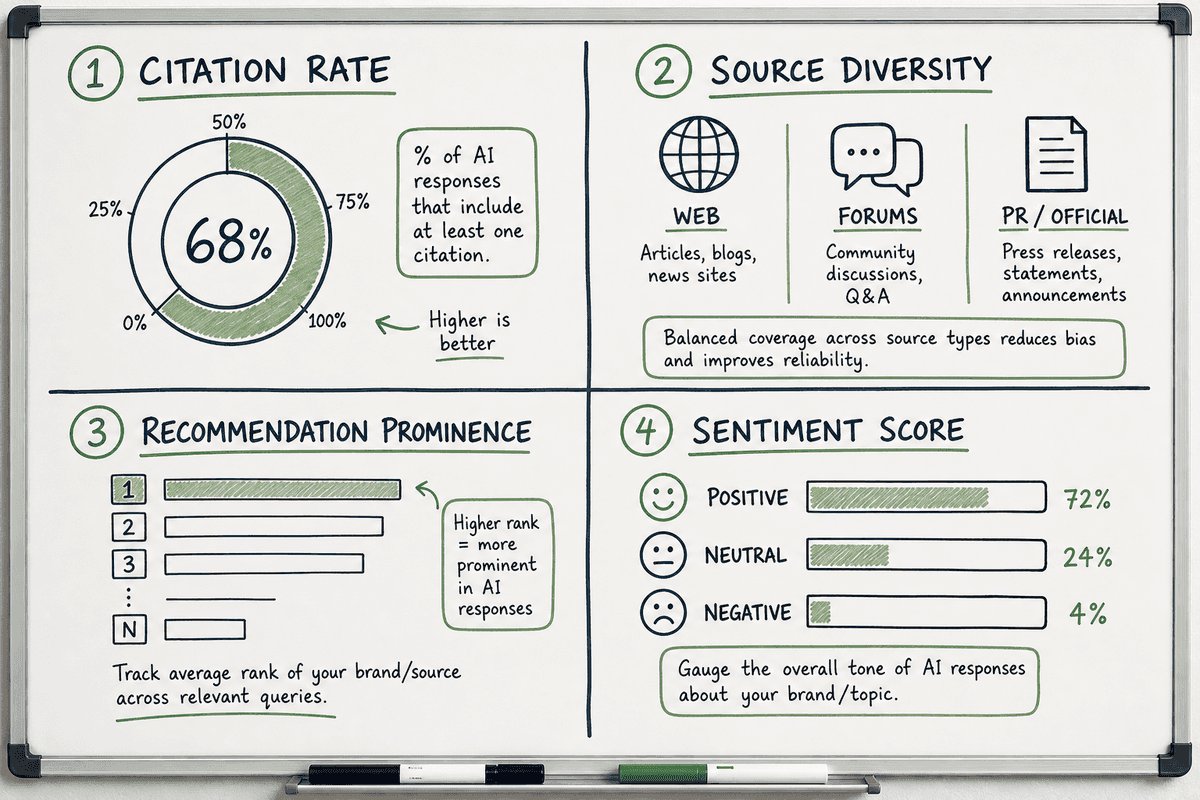
Transitioning from traditional SEO to AEO means learning a new vocabulary of metrics. You can no longer report on "Rank #2 for Keyword X." The results are simply too fluid. Instead, growth teams and SaaS founders should structure their reporting around the following key performance indicators [4]:
1. Citation Rate (The Baseline KPI)
Citation rate is the fundamental metric of AI visibility. It represents the percentage of tracked prompts where your brand is cited or explicitly recommended by the AI. If you are tracking 100 core buyer questions, and your brand appears in the answers to 40 of them, your citation rate is 40%. This replaces traditional "Share of Voice."
2. Source Diversity
Where is the AI getting its information about you? If 100% of your AI citations originate from a single directory listing, your AI visibility is incredibly fragile. If that directory updates its page or the AI model decides to deprecate that source's trust score, your visibility drops to zero overnight. A healthy AEO strategy tracks source diversity, aiming for citations originating from your own domain, PR mentions, review platforms, and user-generated content (like Reddit or Quora).
3. Recommendation Prominence
Where in the prompt output does your brand appear? Are you listed as the number one recommended tool in a bulleted list, or are you mentioned in the final paragraph as an "also consider" option? Tracking the prominence of the mention helps gauge the strength of the AI's entity association.
4. Sentiment Score
Because AI engines generate conversational text, context is everything. Tracking sentiment ensures that when the AI mentions you, it is highlighting your strengths rather than summarizing a list of user complaints.
How to Build Your AI Citation Tracking Stack
No single tool exists in a vacuum. The most sophisticated marketing teams build a stack that combines prompt discovery, tracking, and execution.
Step 1: Prompt Research and Discovery
Before you can track your visibility, you need to know what your buyers are actually asking the AI. You cannot just track traditional short-tail keywords. AI users ask highly specific, multi-variable questions (e.g., "What is the best SEO tool for a single-page application built on React, under $500 a month?").
Teams frequently use a combination of tools like AlsoAsked, Reddit, Google Search Console (GSC), and Bing Webmaster Tools to perform foundational prompt research [5]. Exploring community forums and existing long-tail search data gives you the raw material to build your tracking list.
Step 2: Monitoring and Citation Analysis
Once you have your list of 50 to 200 core buyer prompts, you feed them into your primary AI visibility tool—whether that is BeVisible, RadarKit, or the Semrush toolkit. The goal here is establishing your baseline Citation Rate and identifying the competitors who are currently dominating the answers.
Step 3: Technical Foundation and Execution
When you identify that a competitor is winning because the AI can easily parse their website, you have to look at your own technical foundation. Generative AI bots (like ChatGPT-User or PerplexityBot) need to be able to crawl and render your content effortlessly.
This is especially critical if your website is a Single Page Application (SPA) built on React, Angular, or Vue. If an AI bot cannot render your JavaScript, it cannot extract your content to use as a citation. Ensuring your technical foundation is solid is a mandatory prerequisite for AEO. If you are struggling with this, reviewing SEO for Single Page Applications: A 5-Step Guide (2026) will help bridge the gap between complex web architecture and AI crawlability.
Step 4: Measuring Impact
Finally, you must tie your AI visibility metrics back to actual business outcomes. While GA4 and Bing Webmaster Tools are traditional metrics platforms, they can be configured to track referral traffic specifically originating from AI platforms (like referral = perplexity.ai or chatgpt.com). Correlating an increase in Citation Rate with an increase in qualified referral traffic proves the ROI of the AEO campaign.
The Cost of AI Visibility Tracking vs. Traditional SEO
Budgeting for this new ecosystem can be challenging. Many SaaS founders and marketing leaders are accustomed to standard rank-tracking costs and are caught off guard by the pricing models of AI visibility tools.
Because tracking AI platforms requires processing massive amounts of text and often simulating complex user sessions, the compute costs are inherently higher than simply scraping a Google SERP.
However, ignoring AI visibility carries a much higher opportunity cost. If you are currently paying retainer fees for traditional SEO, it is vital to audit what percentage of those efforts are actually future-proofed for generative search. Many agencies are still charging premium rates for outdated deliverables that do not move the needle in LLMs. (If you are currently evaluating agency costs and deliverables, resources discussing SEO Charges UK: Agency Rates vs Automation (2026) or Hiring SEO Services in Phoenix? 5 Red Flags (2026) can provide helpful frameworks for demanding modern, AEO-inclusive reporting from your vendors).
Frequently Asked Questions About AI Citation Tracking
What is Answer Engine Optimization (AEO)?
Answer Engine Optimization (AEO) is the process of optimizing brand presence, digital content, and third-party entity associations so that Large Language Models (LLMs) and generative search engines reliably cite and recommend your brand in response to relevant user prompts. It focuses on structure, context, and consensus rather than traditional link-building.
How do you optimize for Perplexity vs. ChatGPT?
While the core principles of clear structure and entity association apply to both, their retrieval mechanisms differ. Perplexity heavily relies on real-time web retrieval, meaning it acts more like a traditional search engine synthesizing immediate, live data. Optimizing for Perplexity requires highly authoritative, recently updated content and strong PR mentions. ChatGPT (depending on the prompt and whether web search is triggered) relies heavily on its static training data, making historical domain authority, Wikipedia presence, and long-standing brand consensus more critical.
Are traditional SEO metrics completely dead?
No. Traditional SEO metrics like organic traffic, domain authority, and keyword volume still matter, especially for navigational and informational queries. Furthermore, Google's AI Overviews are built on top of Google's traditional Search index. Earning strong traditional rankings often directly influences whether you are cited in an AI Overview. AEO and SEO are parallel disciplines, not mutually exclusive ones.
Can I just use Google Search Console to track AI?
No. Google Search Console only tracks your performance within the Google ecosystem (Traditional Search, Discover, News, and to some extent, impressions where an AI Overview triggered). GSC provides zero visibility into ChatGPT, Perplexity, Gemini, or Claude. To track those platforms, you need a dedicated AI SEO tool.
The Shift From Observation to Execution
Tracking citations is only the first half of the battle. The tools that defined the early days of AI search, like Peec AI, provided an invaluable service by proving that LLM knowledge could be reverse-engineered and monitored. They gave us the dashboard.
The next evolution of Answer Engine Optimization requires leaving the dashboard and entering the workflow.
Knowing that Perplexity recommends your competitor is interesting data. Knowing why they recommend the competitor, identifying the exact content gap on your own site, and pushing a task to your content team to publish the missing data—that is how you win market share.
As you evaluate Peec AI alternatives, prioritize platforms that treat AI visibility not as a passive metric to report on, but as a strategic gap to close. The brands that build the tightest loop between AI citation monitoring and content execution will be the ones that dominate the generative search landscape over the next five years.