
Content teams often hit a operational ceiling when relying on a single AI writing assistant. Tools like PeeQ (often referred to as Peec AI) serve as excellent starting points for generating text, but as a content pipeline matures, cracks inevitably appear. You start noticing repetitive phrasing, a lack of deep SERP integration, or a rigid brand voice that fails to adapt across different formats.
Scaling content in 2026 requires more than a generic text box. It demands a specialized stack where research, drafting, SEO optimization, and visibility monitoring operate in tandem. When buyers turn to ChatGPT, Gemini, and Perplexity for answers, the tools you use to write must support a broader strategy: capturing and maintaining AI-search visibility.
If you are evaluating your current content stack and looking to transition away from a monolithic approach, here is a breakdown of the strongest Peec AI alternatives, categorized by the specific workflows they solve for modern content teams.
Why Content Teams Outgrow Basic AI Writers
The transition away from a foundational tool usually triggers when a team shifts from focusing on quantity to focusing on predictable outcomes.
Basic AI writers often suffer from three critical failure modes at scale:
- The Context Window Trap: Early AI tools struggle to maintain brand guidelines, tone constraints, and negative constraints across long documents. You end up spending more time editing out generic AI tropes than you would have spent writing the piece from scratch.
- Disconnected Research: Generating a 2,000-word article without real-time SERP data or competitive analysis results in "thin" content. It reads well but fails to rank or answer the specific questions buyers are asking AI engines.
- The Visibility Disconnect: Creating content is only half the battle. If your AI writer isn't explicitly tied to a strategy for capturing citations in AI Overviews or Perplexity, you are flying blind.
 To build a resilient operation, teams are decentralizing their toolkits. Instead of asking one platform to do everything, they combine specialized applications tailored to specific stages of the content lifecycle.
Top Peec AI Alternatives Grouped by Use Case
The alternative you choose should align directly with your team's primary output. An agency producing hyper-optimized local SEO pages requires a fundamentally different architecture than an in-house SaaS team writing thought leadership.
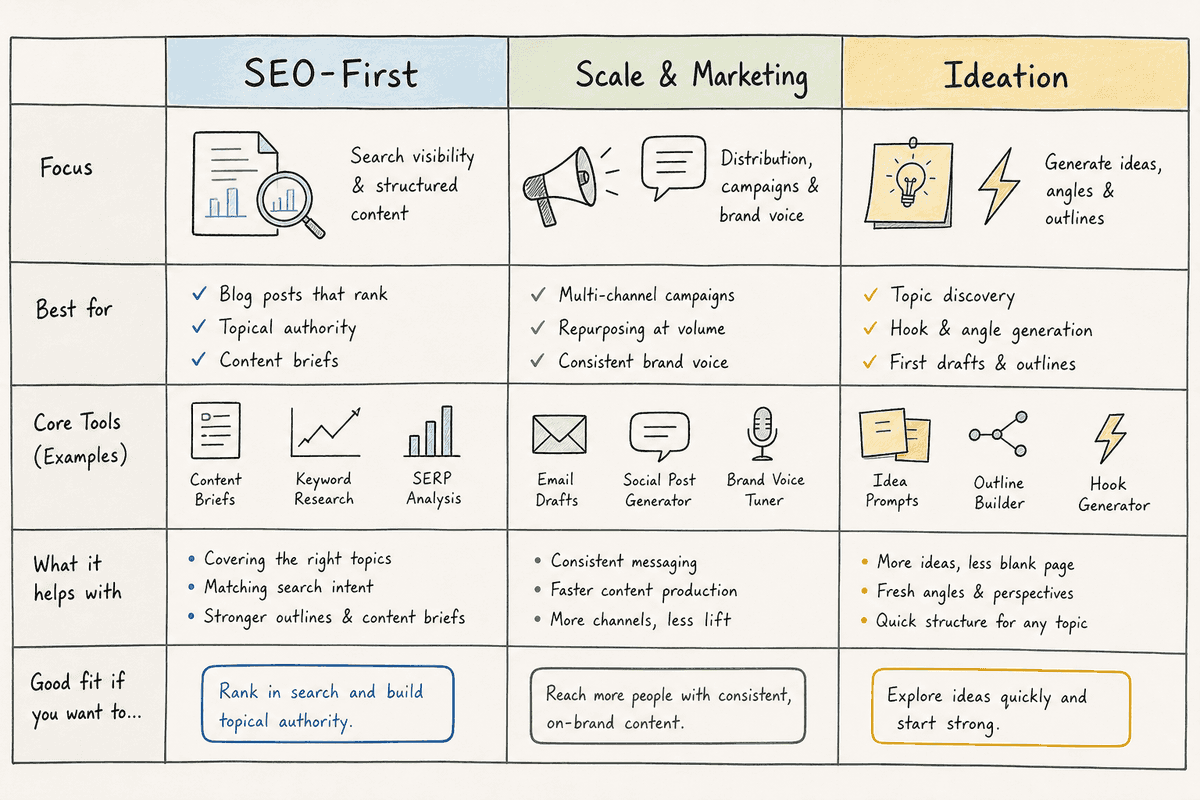
1. The SEO-First & Research-Backed Writers
If organic traffic and search visibility are your primary KPIs, your AI tool must understand the SERP before it writes a single word. These tools integrate content research with drafting.
Frase
- Strengths: Frase is built around the concept of the content brief. It scrapes top-ranking results for your target query, extracts headings, identifies statistical claims, and maps out the questions competitors are answering.
- When to choose: You want research-backed content and SEO-focused workflows in one centralized place. It forces writers to build a structured outline based on search intent before allowing the AI to draft.
- Edge Case: Frase is highly analytical. If your team writes narrative-driven newsletters or opinion pieces, the SEO guardrails may feel restrictive.
Surfer SEO (with AI Writer Integration)
- Strengths: Surfer offers the industry's most rigorous on-page optimization. Its AI writing capabilities are tightly coupled with live SERP-based guidance, ensuring exact keyword densities, entity coverage, and structural requirements are met automatically.
- When to choose: You are obsessed with technical SEO alignment and want tight optimization alongside drafting. This is especially useful if you are following frameworks like How to Build an SEO Landing Page (7-Step Guide).
2. Broad Marketing & Long-Form Workhorses
For teams that act as a shared service across a company—handling everything from blog posts to ad copy to email sequences—generalist platforms with robust template libraries are essential.
Jasper (formerly Jarvis)
- Strengths: Jasper pioneered the marketing-focused AI writer. It boasts an extensive library of content templates and allows you to program specific brand voices. It handles blog posts, social media sequences, and long-form content with equal competency.
- When to choose: You need fast, repeatable content blocks with marketing-oriented prompts and have multiple stakeholders who need access to a standardized brand voice.
Writesonic
- Strengths: Highly versatile with a strong focus on landing pages, blog content, and ads. It includes baked-in SEO features and multiple tone styles that can be switched dynamically.
- When to choose: You need a broad toolkit that bridges the gap between creative copywriting and structured landing page generation.
3. Fast Ideation & Short-Form Sprinters
Not every content team writes 3,000-word guides. Social media managers, product marketers, and UI copywriters need rapid iteration, not deep research.
Copy.ai
- Strengths: Exceptional for quick idea generation, product descriptions, social posts, and short-form copy. The UX is incredibly friendly and optimized for brainstorming.
- When to choose: You want rapid brainstorming and starter copy without wading through complex configuration screens.
Peppertype.ai
- Strengths: Focused heavily on short-form content, headlines, and micro-copy. It uses high-efficiency productivity prompts to generate "snackable" outputs.
- When to choose: You need fast outputs for social media campaigns, UI copy, or high-volume A/B testing for ad headlines.
4. The E-commerce Specialists
Managing a catalog of 10,000 SKUs requires programmatic generation. Standard chat interfaces fail when you need to process spreadsheets of product specifications.
CopySmith
- Strengths: Laser-focused on e-commerce. It excels at bulk-generating product descriptions, category pages, and content that aligns directly with conversion and sales goals.
- When to choose: You are optimizing massive product catalogs and need to integrate directly with platforms like Shopify or WooCommerce to push updates at scale.
5. Workflow & Knowledge Native
Sometimes, the best AI tool is the one that lives where your team already works.
Notion AI
- Strengths: Deep integration into your existing wikis, project boards, and sprint planning documents. It allows you to summarize meeting notes into content briefs, or expand a bulleted list into a draft without leaving the workspace.
- When to choose: Your content operation is heavily integrated with other departments (product, sales, engineering) and you prioritize seamless collaboration over specialized SEO features.
The Missing Link: Monitoring Your Brand's AI Visibility
Replacing Peec AI with a more specialized writing tool solves the production problem. But in 2026, content teams are facing a completely different existential threat: AI-search visibility.
Buyers are no longer just typing keywords into traditional search engines and clicking blue links. They are asking ChatGPT, Gemini, and Perplexity complex, multi-step questions:
- "What are the best enterprise CRM tools that integrate with Slack?"
- "Compare the pricing of X vs Y for a team of 50."
- "Which agencies specialize in local optimization?"
If you spend cycles using Frase or Jasper to write the perfect article, but ChatGPT hallucinates a competitor's name when a buyer asks for a recommendation, your content pipeline has failed to deliver pipeline value.
This is where the workflow must evolve. You cannot just generate content; you must monitor how AI assistants answer buyer questions, which brands they recommend, and which sources they cite.
Turning Visibility Gaps into Published Work
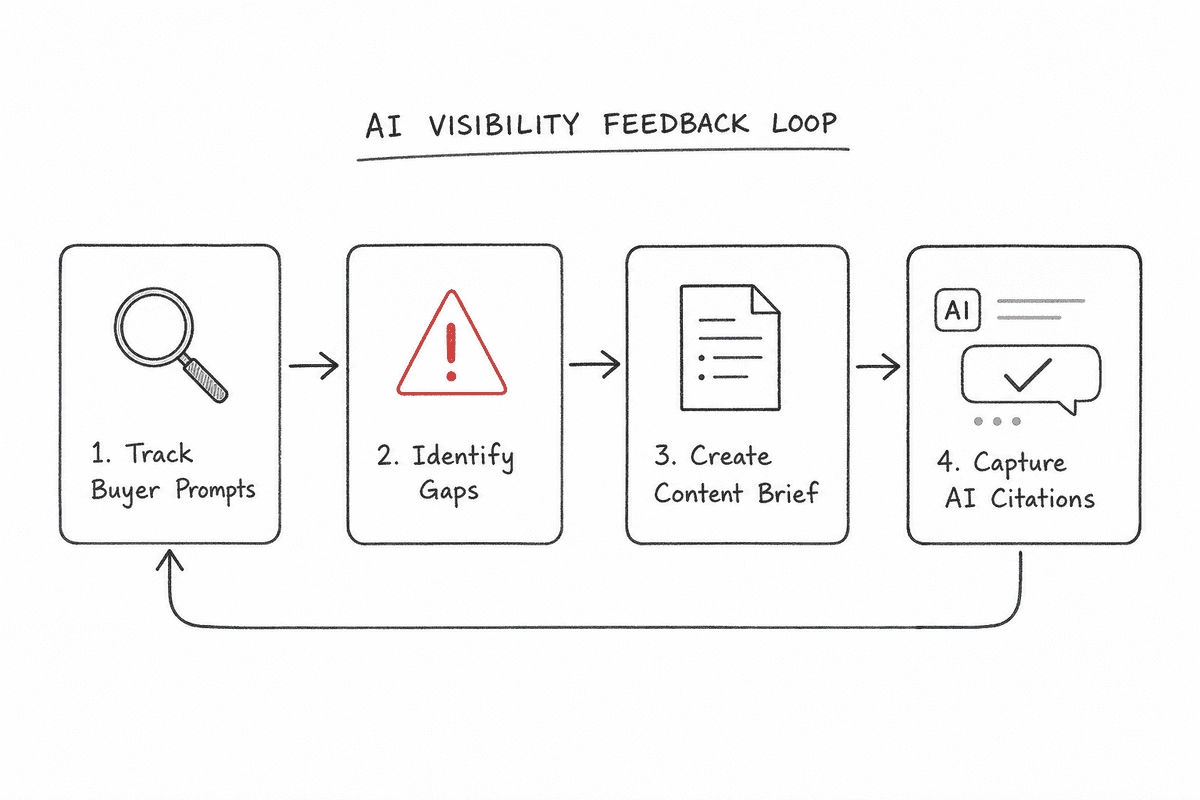
Platforms like BeVisible help teams track these AI engines across targeted buyer prompts. The process bridges the gap between generation and measurement:
- Monitor the Prompts: Track how Perplexity or AI Overviews respond to your core commercial queries.
- Identify the Gaps: Discover where your brand is missing, where competitors are winning, or where the AI is citing weak, outdated sources.
- Execute the Opportunity: Turn those missing mentions into evidence-backed opportunities. If ChatGPT cites a specific type of comparison matrix to answer a query, you use your AI writing stack (like Jasper or Surfer) to build a better version of that exact matrix on your site.
This creates a closed-loop system. You aren't just writing into the void; you are executing targeted content designed specifically to capture citations in the LLMs your buyers use.
Decision Criteria: How to Choose Your Alternative
Selecting the right tool requires mapping your team's constraints to the software's capabilities. Use this matrix to evaluate your next move.
Budgeting and ROI
When transitioning away from a legacy tool, budget allocation often comes under scrutiny. It is important to contextualize the cost of these tools against human hours saved. For agencies weighing software costs against traditional billing models, this dynamic is critical to profitability (a topic explored deeply in resources evaluating SEO Charges UK: Agency Rates vs Automation (2026)). The ROI isn't just in words-per-minute; it's in the reduction of editing cycles and the improvement in search performance.
Myth-Busting: "One AI Tool Can Run The Whole Stack"
A common misconception among SaaS founders and marketing leaders is that upgrading to the most expensive tier of a single tool will solve all content challenges.
The Reality: The underlying LLMs (like GPT-4o, Claude 3.5, etc.) are largely commoditized. The true value of these alternatives lies in their workflow wrappers.
Surfer SEO and Copy.ai might use the same underlying foundation model for certain tasks, but their system prompts, UX, and data integrations are entirely different. Surfer forces the LLM to cross-reference a live database of keyword densities. Copy.ai forces the LLM to brainstorm rapidly with a creative temperature.
Attempting to force an SEO tool to write punchy Facebook ads, or forcing an ideation tool to write a technically accurate, structurally sound pillar page, will result in failure. Build a modular stack. Use tools for their intended purpose.
Building the 2026 Content Pipeline
To successfully migrate away from Peec AI, implement this structured workflow:
- Audience & Query Research (The Input): Don't start with a blank page. Understand what your buyers are asking. Look at traditional search volume, but more importantly, look at conversational prompts.
- AI Visibility Baseline (The Strategy): Before drafting, check how AI engines currently answer this topic. If you are targeting a specific niche, know who is already being cited.
- Brief Creation (The Guardrails): Use a tool like Frase to build the skeletal structure. Define headings, target entities, and mandatory internal links (e.g., ensuring you link to foundational guides like 11 Best SEO Blogs Every SaaS Founder Needs (2026)).
- Drafting & Optimization (The Execution): Use Jasper or Surfer to flesh out the brief, applying strict brand voice instructions.
- Human Synthesis (The Polish): Never publish raw output. A human editor must inject specific case studies, proprietary data, and nuanced opinions that the AI cannot synthesize.
- Post-Publish Monitoring (The Feedback Loop): Once live, monitor whether your new asset is successfully being picked up and cited by ChatGPT, Gemini, and Perplexity when buyers run relevant queries.
FAQs About AI Content Tools
Can these tools replace human writers entirely? No. The most successful teams use AI to handle the "heavy lifting" of structure, first drafts, and entity coverage, allowing human writers to focus on subject matter expertise, original research, and narrative flow. AI reduces the time from blank page to first draft, not first draft to published piece.
How do I maintain a consistent brand voice across multiple tools? Document your brand voice outside of the tools. Create a standardized "System Prompt" document that defines your tone, negative constraints (words you never use), and stylistic preferences. Paste this context block into whichever tool you are using for a specific task.
What happens if AI search engines change their citation algorithms? This is exactly why you need dedicated visibility monitoring. If Perplexity updates how it weighs domains, your referral traffic could drop overnight. By tracking these changes proactively, you can adapt your content strategy—updating formats or improving source authority—before the drop impacts your quarterly goals.
Scaling an effective content operation requires moving past basic text generators. By aligning specialized AI writers with a rigorous visibility tracking strategy, your team can ensure that the content you invest in actually reaches the buyers who need it.