
When content teams evaluate platforms like Peec AI, they usually hit a familiar inflection point. Drafting high-volume copy has become a solved problem, but ensuring that content actually gets cited by answer engines like ChatGPT, Perplexity, Gemini, and Google AI Overviews remains a massive challenge.
Many teams look for Peec AI alternatives because their existing stack falls into one of two traps. Either it generates generic text that fails to rank in modern search interfaces, or it offers shallow brand tracking that fails to show why competitors are getting recommended in AI buyer prompts while your product remains invisible.
Selecting the right alternative requires understanding whether your primary bottleneck is copy output, traditional on-page SEO, or AI search visibility monitoring and execution. This guide breaks down the best Peec AI alternatives across each category, complete with feature comparisons, real-world workflows, and clear decision frameworks.
The Shift in Content Strategy: Drafting vs. AI Search Visibility
To pick the correct tool, content operations must be divided into two distinct functional layers. Standard generative copy platforms handle text synthesis, while modern visibility platforms monitor and influence how LLMs process information.
+-------------------------------------------------------------------------+
|                         CONTENT TEAM STACK                              |
+-------------------------------------------------------------------------+
| 1. DRAFTING & COPYWRITING       | Jasper, Copy.ai, Notion AI            |
|    (Generates drafts & assets)  | Focus: Velocity & brand tone          |

+---------------------------------+---------------------------------------+
| 2. ON-PAGE SEO OPTIMIZATION     | Frase, Surfer SEO                     |
|    (Optimizes for Google SERPs) | Focus: Keyword density & headings     |

+---------------------------------+---------------------------------------+
| 3. AI VISIBILITY & EXECUTION    | BeVisible                             |
|    (Monitors LLM citations &    | Focus: ChatGPT/Perplexity mentions,   |
|     turns gaps into published)  |        source citations, & gap fixes  |

+-------------------------------------------------------------------------+
 Standard drafting tools focus on generating words faster. However, if your target audience asks Perplexity or ChatGPT for software recommendations and your brand is missing from the answer, fast content generation alone will not fix your pipeline. A modern stack must connect content creation directly to answer engine visibility.
Category 1: Generative Copywriting & Workflow Automation Alternatives
If your main reason for evaluating Peec AI is to speed up production workflows, standard copywriting platforms offer robust templates and governance.
1. Jasper AI
Jasper remains one of the most established platforms for enterprise marketing teams that need strict brand governance and multi-channel asset creation.
- Primary Use Case: Enterprise content generation across blogs, ads, social, and email campaigns.
- Key Strengths: Jasper provides comprehensive style guides, asset organization, and custom brand voices. It integrates directly into browser extensions, allowing writers to rephrase and expand text directly inside CMS tools.
- Where It Falls Short: Jasper is fundamentally a drafting engine. It does not track whether AI models like Claude, Gemini, or ChatGPT cite your published assets when users ask buyer-intent questions.
- Best For: Marketing teams looking to scale written output across multiple formats while keeping voice consistent.
2. Copy.ai
Copy.ai has evolved from a simple headline generator into an automated GTM content workflow engine.
- Primary Use Case: Automated content pipelines, product marketing copy, and automated social distribution.
- Key Strengths: Copy.ai excels at workflow automation. You can ingest a product release document and automatically generate blog summaries, email sequences, and press release drafts in a single batch.
- Where It Falls Short: While production speed is high, output quality often requires heavy manual editing to avoid predictable AI cadence patterns.
- Best For: Growth teams needing high-volume short-form asset generation linked to automated webhooks.
3. Notion AI
For teams that run their entire editorial calendar inside Notion, Notion AI offers integrated drafting without context switching.
- Primary Use Case: Workspace-integrated drafting, meeting summaries, and research synthesis.
- Key Strengths: Because it resides inside your content database, Notion AI can pull context from existing strategy notes, content briefs, and editorial calendars without requiring third-party exports.
- Where It Falls Short: It lacks specialized SEO scoring, topic coverage analysis, and AI search visibility tracking.
- Best For: Lean teams prioritizing centralized workflow speed over advanced SEO analytics.
4. Writesonic
Writesonic balances long-form article generation with built-in web browsing capabilities to reference current events.
- Primary Use Case: Fast article drafting and landing page copy generation.
- Key Strengths: Provides real-time search integration to pull live factual context into drafts, reducing manual fact-checking during the initial outline phase.
- Where It Falls Short: SEO recommendations are basic compared to dedicated research tools, and it offers no visibility into LLM referral tracking.
- Best For: Content teams producing news-adjacent articles or quick landing page drafts.
Category 2: Traditional SEO Research and On-Page Optimization Alternatives
When your goal is to rank in organic search engines by analyzing existing top-ranking pages, traditional SEO tools provide structured guidance.
5. Frase
Frase combines SERP research, outline creation, and text editing into a single workflow.
- Primary Use Case: SERP-backed content briefs and on-page optimization.
- Key Strengths: Frase extracts headings, questions, and statistics from top 20 Google search results, making it simple to construct research-backed outlines in minutes.
- Where It Falls Short: It focuses on traditional Google desktop and mobile SERPs, meaning it skips visibility data for conversational AI assistants.
- Best For: In-house SEO strategists creating briefs for freelance writers.
6. Surfer SEO
Surfer SEO is a long-standing tool for on-page text optimization based on real-time correlation analysis.
- Primary Use Case: Real-time on-page keyword density and structure scoring.
- Key Strengths: The content editor offers granular recommendations on word count, heading structures, image counts, and NLP entity usage.
- Where It Falls Short: Over-optimizing purely for Surfer scores can lead to unnatural phrasing. If you want to dive deeper into modern search strategies, reading the 11 Best SEO Blogs Every SaaS Founder Needs (2026) offers excellent context on building balanced editorial processes.
- Best For: On-page specialists who want strict quantitative guidelines during the drafting phase.
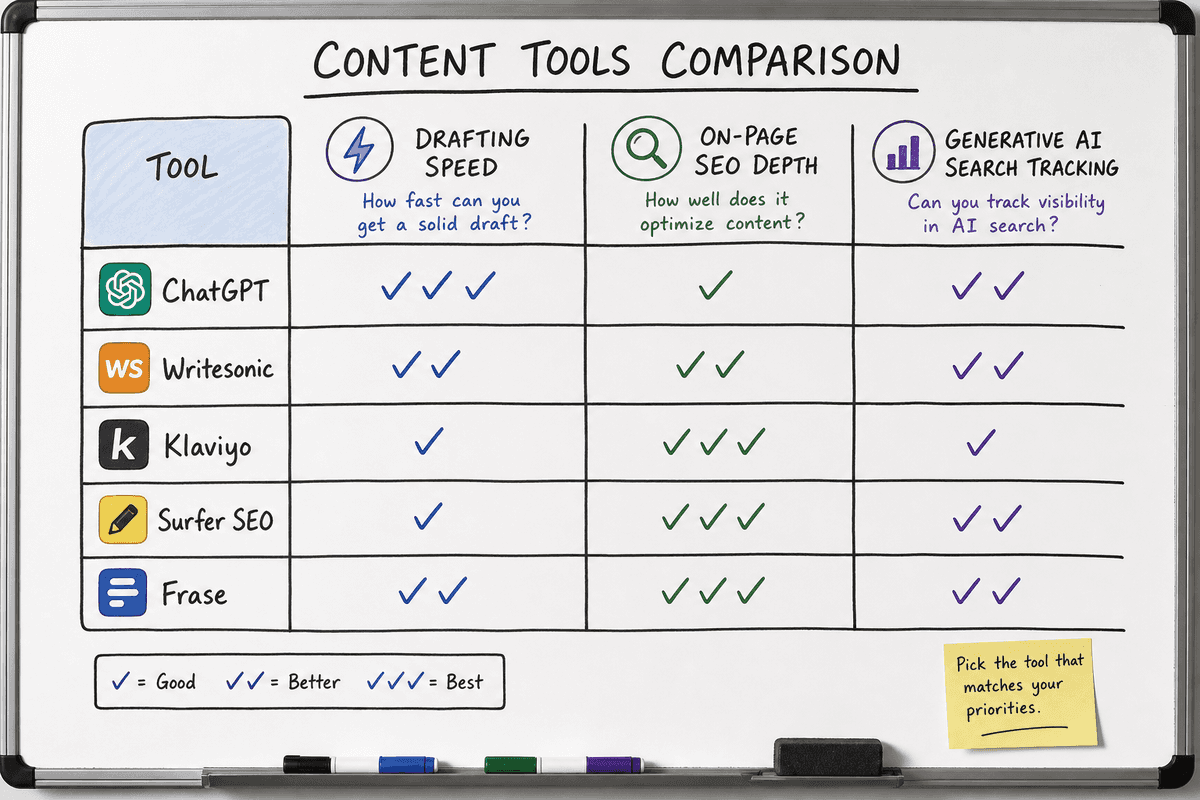
Category 3: Dedicated AI Visibility & Execution Platform (The True Beyond-Peec Stack)
Most content teams realize that monitoring keyword rankings on Google is no longer sufficient. Buyers now turn to ChatGPT, Gemini, Perplexity, and Google AI Overviews to get instant direct answers and software recommendations.
If you want to move past standard drafting and measure true generative search performance, a dedicated AI visibility platform is required.
7. BeVisible
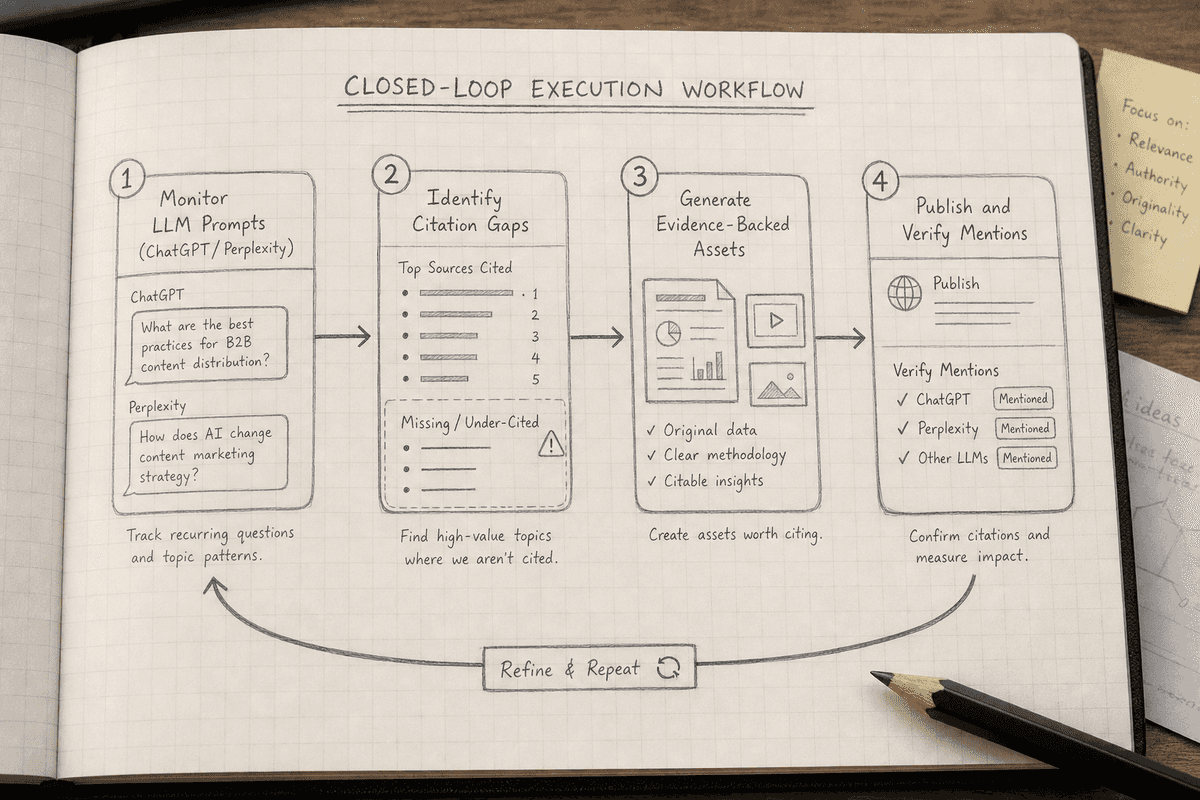
BeVisible is designed specifically for SaaS teams, growth marketers, and agencies that need to monitor AI search recommendations and turn missing brand mentions into published assets.
+-------------------------------------------------------------------------+
|                     BEVISIBLE CLOSED-LOOP ENGINE                        |
+-------------------------------------------------------------------------+
| 1. MONITOR LLMs      | Tracks ChatGPT, Perplexity, Gemini, & AIO       |
|                      | across core buyer prompts.                       |
| 2. IDENTIFY GAPS     | Pinpoints where competitors are recommended      |
|                      | and which sources are cited.                     |
| 3. EXECUTE & PUBLISH | Converts gaps into evidence-backed articles,     |
|                      | reviews, and scheduled updates.                  |

+-------------------------------------------------------------------------+
- Primary Use Case: AI visibility monitoring, citation tracking, gap discovery, and automated content execution.
- How It Works: BeVisible tracks how AI assistants answer specific buyer prompts, which competing brands get recommended, and which exact web sources are cited as authoritative evidence. When a visibility gap is detected, BeVisible turns that insight into evidence-backed content creation, reviewing, scheduling, and publishing workflows.
- Why It Outperforms Basic Drafting Tools: Standard tools generate articles blindly. BeVisible informs you exactly what evidence, entity connections, and citations are missing to win recommendations inside AI responses.
- Best For: SaaS founders, B2B growth teams, and agencies that need to prove and expand their brand visibility inside generative search engines.
Head-to-Head Feature Comparison Matrix
Comparing platforms across functional parameters helps identify which tool fills your operational gaps.
5-Step Framework: Transitioning Beyond Peec AI to an AI-First Content Engine
Replacing a tool or upgrading your tech stack requires a clear operational framework. Here is how leading teams transition from simple text generation to complete AI visibility management.
Step 1: Audit Your Prompt Share-of-Voice
Before writing another blog post, test 20 core buyer prompts across ChatGPT, Perplexity, and Gemini. Record whether your brand is mentioned, which competitors appear, and which domains are cited as sources.
Step 2: Categorize Visibility Gaps
Group your findings into three distinct gap types:
- Unclaimed Prompts: The AI provides a answer but mentions no specific brand.
- Competitor Monopoly: Competitors are recommended exclusively, backed by specific third-party reviews or niche articles.
- Weak Citation Data: Your brand is mentioned, but the underlying citation links to outdated or inaccurate pages.
Step 3: Design Evidence-Backed Content
AI models rely heavily on structural authority and authoritative source citations. When creating new assets, ensure your pages provide clear data points, structured tables, and definitive answers. For instance, when designing dedicated campaign pages, following a clear blueprint like our How to Build an SEO Landing Page (7-Step Guide) helps ensure search engines and LLMs easily parse your core value propositions.
Step 4: Automate Monitoring and Publishing
Implement continuous tracking to verify when AI assistants update their vector indices. Manual prompt testing is unsustainable at scale. Automated platforms notify your team the moment a competitor replaces your brand in a key prompt recommendation.
Step 5: Measure Referral Traffic and Conversions
Track direct referral traffic coming from Perplexity and ChatGPT citations alongside standard search traffic. Contrast the conversion rates of users originating from generative AI answers against traditional organic search.
Practical Case Example: Fixing an Invisible SaaS Recommendation
A B2B project management platform noticed a sudden drop in direct qualified leads. While their Google rankings for traditional keywords remained stable, buyers were increasingly asking Perplexity and ChatGPT for product evaluations.
Upon testing key prompts such as "What is the best project management tool for sub-contractors?", the team discovered:
- ChatGPT consistently recommended two key competitors.
- The AI cited three specific comparative review articles and a single industry forum thread.
- The team's brand was completely unmentioned.
Instead of blindly generating ten generic blog posts using a basic writing tool, the team used an AI visibility engine to analyze the citation sources. They published a structured comparison piece addressing the specific capabilities LLMs were pulling from competitor pages. Within three weeks of indexing, the brand began appearing in 70% of relevant conversational AI responses for that prompt vertical.
Common Pitfalls When Evaluating Peec AI Alternatives
Avoid these frequent operational mistakes when updating your content stack:
- Confusing Word Count with Authority: Generating 50 extra articles using low-cost AI writers will not guarantee inclusion in ChatGPT answers if the content lacks unique data or authoritative citations.
- Ignoring Vector Search Nuance: Traditional search engines rely heavily on backlink counts and exact keyword placement. LLMs evaluate semantic relationships, citation credibility, and context alignment.
- Measuring Google Rankings Alone: Tracking rank positions on desktop SERPs ignores the substantial volume of prospective buyers who use conversational search interfaces exclusively.
- Siloing Content Creation from Visibility Monitoring: Drafting teams that operate without direct visibility into LLM citations waste time writing content that addresses outdated search queries.
Frequently Asked Questions
What is Peec AI primarily used for?
Peec AI is typically evaluated by teams looking to integrate AI into their content workflows, draft copy, or monitor basic online presence. However, content teams often seek alternatives when they require deeper AI search tracking or structured execution engines.
Can traditional SEO tools track visibility inside ChatGPT and Perplexity?
Traditional SEO platforms like Semrush or Ahrefs focus primarily on Google and Bing search engine result pages. They do not track conversational AI recommendations, vector citations, or share-of-voice within models like ChatGPT, Gemini, or Perplexity.
How does AI visibility monitoring differ from standard keyword tracking?
Keyword tracking measures your position on a static list of search results for a specific phrase. AI visibility monitoring tracks how conversational models synthesize information from multiple web sources to answer complex, variable buyer prompts, identifying whether your brand is recommended as a solution.
Should our team replace copywriting tools with an AI visibility platform?
No, they serve complementary purposes. Drafting tools help copywriters write faster, while AI visibility platforms direct what should be written based on live gap data across AI assistants, ensuring your published work earns real market visibility.
Summary: Choosing the Best Stack for Your Team
Selecting the ideal Peec AI alternative comes down to your primary operational goal:
- Choose Jasper or Copy.ai if your primary requirement is scaling marketing copy across email, social, and ad campaigns.
- Choose Frase or Surfer SEO if your team focuses strictly on standard Google on-page keyword optimization.
- Choose BeVisible if you need to monitor how ChatGPT, Perplexity, Gemini, and AI Overviews treat your brand, discover buyer prompt visibility gaps, and convert those missing mentions into evidence-backed published work.