
You check your analytics dashboard and the numbers look fine. Your core landing pages rank well, your organic traffic is stable, and your paid campaigns are running efficiently. Yet, your inbound pipeline feels lighter than it did six months ago.
The culprit is often happening entirely off your radar. Your prospective buyers have stopped typing keyword fragments into traditional search engines. Instead, they are opening ChatGPT, Gemini, or Perplexity and asking highly specific, context-rich questions about the problems your software solves.
When those AI assistants generate an answer, they are not just providing a list of links. They are acting as conversational advisors, synthesizing information, and actively recommending solutions. If you do not know how to check whether AI is recommending your competitor instead of you, you are losing leads before you even realize they are in the market.
This shift requires a completely different operational approach than traditional SEO. Tracking AI recommendations manually is tedious, and while early tools like Peec AI introduced the concept of AI visibility, many growth teams are now looking for more robust platforms that not only track these mentions but connect them directly to content execution.
This guide breaks down exactly how to audit your AI visibility, what to look for when competitors steal your recommendations, and which tracking alternatives actually help you turn visibility gaps into published work.
The Paradigm Shift: Why AI Recommendations Are Not Search Rankings
To understand why your competitor is winning in AI chats, you have to understand how modern generative engines build their answers. AI does not rank websites based on domain authority or backlink profiles in the traditional sense. It relies on a combination of its underlying training weights and a process called Retrieval-Augmented Generation (RAG).
When a buyer asks an AI model for a software recommendation, the system first retrieves live data from its search index to understand the current consensus. It then synthesizes that retrieved text into a natural language response.
 If your competitor is mentioned across multiple high-trust third-party sites—like review platforms, community forums, and established industry blogs—the AI synthesizes those mentions and confidently recommends that competitor.
This means your beautifully designed, highly optimized product page is practically invisible to the AI if no one else is talking about it. AI models are recommending your competitors because those competitors have established a broader footprint of third-party validation. The AI treats third-party consensus as fact, whereas it treats your first-party claims as marketing collateral.
The Impact of AI Overviews on Traditional Traffic
This shift is not limited to standalone chatbots. Traditional search engines have integrated AI directly into the main search interface. When a user searches for a solution, they are increasingly met with an AI-generated summary at the top of the page.
Data shows that ai overviews are stealing 40% of clicks from traditional search results. If your competitor is the primary brand featured in that AI overview, you are effectively pushed below the fold, even if you hold the number one traditional organic ranking. You are invisible where the actual decision-making is happening.
How to Perform a Direct Prompt Audit (The Manual Baseline)
Before investing in specialized tracking software, every marketing team should understand how to manually audit their industry's AI visibility. This manual baseline helps you understand the nuance of how different models interpret buyer intent.
The most straightforward method is to manually "shop" your own industry. You need to log into the major AI platforms and test the exact prompts your ideal customers are using.
1. Build a Buyer Prompt Matrix
Do not ask the AI about your brand name. Brand queries will simply trigger the AI to pull up your homepage summary. You need to test unbranded, intent-based questions.
Map out a matrix of prompts based on different stages of the buying cycle:
- Discovery Prompts: These are broad questions where the buyer understands their problem but does not know the software categories available. (e.g., "How can a remote marketing agency manage client approvals more efficiently?")
- Categorical Prompts: The buyer knows the type of tool they need and is asking for a list. (e.g., "What are the top 3 accounting firms in London for tech startups?" or "Can you recommend a reliable CRM software for a small business?")
- Comparison Prompts: The buyer is weighing two competitors against each other. (e.g., "Which is better for enterprise data security: Competitor A or Competitor B?")
- Use-Case Prompts: The buyer needs a tool for a highly specific workflow. (e.g., "What is the best project management tool that integrates natively with GitHub and allows custom billing rates?")
2. Test Across Multiple Environments
Different AI models use different training data, different retrieval algorithms, and different underlying search engines. A brand that dominates ChatGPT might be completely absent in Google Gemini.
- ChatGPT (OpenAI): Heavily relies on Bing's search index for its web retrieval capabilities. It tends to favor highly structured data and established media sites.
- Gemini (Google): Tied directly to Google's knowledge graph and search index. It frequently pulls from YouTube and Google's own ecosystem.
- Perplexity AI: Built from the ground up as an answer engine. It relies heavily on rapid web retrieval and provides explicit citations for every claim it makes.
- AI Overviews (Google Search): The integration of generative AI into the standard Google search results.
You must run your prompt matrix through all of these platforms separately. Document which brands are recommended, the sentiment of the recommendation, and most importantly, the sources the AI cites to justify its answer.
3. Record the Findings and Trace the Citations
When you spot a competitor being recommended, your immediate reaction should not be to rewrite your homepage. Your immediate reaction must be to look at the footnotes.
Curious how other agency, founder, and operator folks handle this: when AI recommends a competitor, do you check the source behind... the claim? You absolutely must. The citation is the leverage point.
If ChatGPT recommends your competitor for "best healthcare CRM," hover over the little [1] next to their name. Where does it link?
- Did it pull from a G2 comparison grid?
- Did it pull from a high-ranking industry blog post?
- Did it pull from a detailed Reddit thread?
This citation trail reveals exactly what content the AI values for that specific query.
The Breakdown: What to Check First When AI Recommends a Competitor
Finding out that your competitor is winning the AI recommendation game is painful, but it provides a clear roadmap for what you need to do next. When a competitor appears in the output for a high-value prompt, run through this specific diagnostic checklist.
Analyze the Third-Party Consensus
AI engines love consensus. If five different independent websites list your competitor as a top-tier solution, the AI synthesizes those five sources and presents the competitor as the definitive answer.
Look at the citations provided by the AI. Are they first-party sources (the competitor's own blog) or third-party sources (independent reviewers, affiliates, forums)? In almost all cases, the AI relies on third-party sources to establish trust.
If the AI is pulling from listicles ("Top 10 Tools for X"), you need to conduct a gap analysis. Are you on those same lists? If not, your PR or outreach team needs to contact the authors of those listicles and pitch your inclusion. If the AI relies on that specific URL for its information, getting your brand added to that URL is the fastest way to alter the AI's future responses.
Inspect the Community Sentiment
Community platforms are heavily weighted by modern language models because they represent authentic human experience, which helps counteract AI-generated spam on traditional blogs.
Reddit and Quora are massive data pipelines for AI training and retrieval. If a user asks a detailed question about your competitor on Reddit, and the community responds positively, the AI ingests that sentiment. If your competitor has active community management and you do not, they will win the sentiment battle.
Review Video Citations
Video content, particularly YouTube, is increasingly used as a source for AI answers, especially in Google's ecosystem (Gemini and AI Overviews). YouTube gets cited a lot videos communities thirdparty sites review pages and listicles....
 If your competitor is being recommended because the AI is transcribing and pulling insights from a popular YouTube review or tutorial, you need to evaluate your own video presence. Are industry influencers reviewing your product? Do you have clear, properly tagged YouTube content that directly answers the prompts your buyers are asking?
The Scaling Problem: Why Teams Look for Peec AI Alternatives
The manual prompt audit is highly effective for a one-off sanity check, but it completely falls apart as a scalable operational strategy.
First, there is the issue of personalization and localization. If you manually test prompts from your laptop in New York, the AI might give you slightly different answers than if a buyer tests them from a mobile device in London.
Second, the AI landscape changes daily. Google updates its AI Overview triggers constantly. Perplexity alters its retrieval weighting. A prompt that recommended your competitor on Tuesday might yield a completely different layout by Friday.
Finally, there is the sheer volume of data. If you have 50 core use cases, 3 buyer personas, and 4 major AI engines to track, you are looking at hundreds of manual queries every single week. Tracking this in a spreadsheet leads to data fatigue and organizational apathy.
This is why the market evolved to create AI visibility tracking tools. While Peec AI was an option in this space, teams with aggressive growth targets often find they need platforms that go beyond simple tracking and actually facilitate the execution required to fix the visibility gaps.
Top Peec AI Alternatives for AI Visibility Monitoring
When evaluating tools to replace or upgrade from your current tracking setup, you need to look at how the software handles the connection between discovery (finding out you are missing) and execution (doing the work to get cited).
1. BeVisible
For teams that need to move directly from data collection to content creation, BeVisible is a robust alternative. BeVisible helps teams monitor how AI assistants answer buyer questions, which brands they recommend, and which sources they cite.
It tracks visibility across the major conversational models—ChatGPT, Gemini, Perplexity, AI Mode, and AI Overviews. It automatically runs your designated buyer prompts through these engines at scale and maps out exactly who is winning the recommendation.
The differentiator is the execution layer. Tracking AI mentions is only half the battle. BeVisible turns those visibility gaps into evidence-backed opportunities, articles, review, scheduling, and publishing work. When the tool identifies that a competitor is winning because they are cited in a specific cluster of third-party blogs, it helps you organize the outreach and content generation required to infiltrate those exact sources. It bridges the gap between passive monitoring and active marketing operations.
2. SE Ranking (AI Visibility Tracker)
For teams coming from a traditional SEO background who want AI tracking integrated into their existing keyword rank tracking workflow, SE Ranking offers a dedicated module.
Their AI Visibility Tracker that fits your delivery map allows users to measure a brand's or domain's AI presence across different engines. It breaks this presence down into specific brand mentions and domain citations. This is highly useful for technical SEO teams who want to view AI visibility alongside their traditional organic keyword rankings, backlink profiles, and technical site audits.
Turning Visibility Gaps into Executable Strategy
Knowing that AI recommends your competitor is useless unless you have a framework for changing the AI's mind. You cannot submit an XML sitemap to ChatGPT and hope for the best. You have to reverse-engineer the AI's knowledge base.
Here is the strategic workflow for capturing AI recommendations away from your competitors.
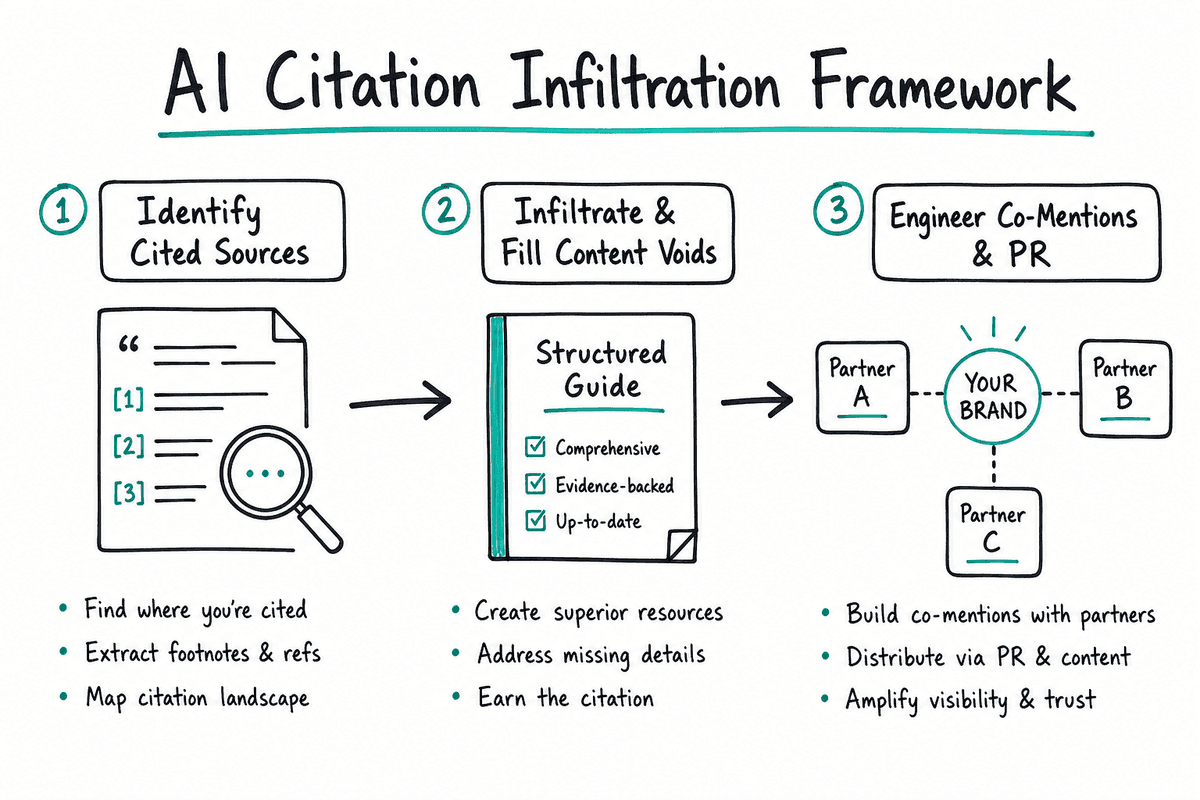
Step 1: The Citation Infiltration Strategy
If you use your tracking tool (or manual audit) and find that ChatGPT recommends Competitor X because of a specific set of URLs, your first priority is to get onto those URLs.
We call this Citation Infiltration.
Create a hit list of every third-party domain that the AI cites when discussing your competitors. These will usually fall into three categories:
- Software Aggregators: G2, Capterra, TrustRadius.
- Industry Media: High-authority blogs and news sites in your niche.
- Community Hubs: Reddit, Quora, specialized forums.
If the AI cites a G2 comparison grid that features your competitor, you need to run a campaign to generate more recent, high-quality reviews on your own G2 profile to trigger a re-evaluation of that category.
If the AI cites a blog post titled "The 7 Best Tools for Pipeline Management," you need to contact the editor of that blog. Offer them access to your tool, provide unique data, or find an angle that justifies them updating their article to include you as the 8th tool. When they update the article and the AI re-crawls it, your brand becomes part of the synthesized consensus.
Step 2: Fill the Knowledge Void with Targeted Content
Sometimes, the AI recommends a competitor simply because they are the only ones who have ever bothered to write extensively about a very narrow, specific problem.
If you notice a gap where the AI gives a poor answer—or heavily caveats its recommendation of a competitor because the information is sparse—you have found a knowledge void.
You need to create highly structured, incredibly detailed content on your own domain to fill this void. When building this content, refer to guides like How to Build an SEO Landing Page (7-Step Guide) to ensure the technical foundation is sound. The content must be formatted in a way that AI retrieval systems can easily parse. Use clear definitions, structured bullet points, and definitive answers without marketing fluff.
If you run a modern web application, ensure your technical architecture allows AI bots to actually read your content. Heavy JavaScript frameworks can sometimes block AI crawlers if not configured correctly. Reviewing Single-Page Application SEO: What Works in 2026? will ensure your most important knowledge-base articles are actually accessible to the systems trying to cite them.
Step 3: Engineer Third-Party Mentions (Digital PR for AI)
You cannot rely solely on your own website. You need to engineer third-party mentions.
Start by finding non-competing businesses in your broader ecosystem that already have strong AI visibility. If you sell email marketing software, look for CRM platforms or analytics tools that dominate AI answers. Partner with them. Write guest content for their blogs, host joint webinars, and ensure your brand name appears next to their highly trusted domain name.
AI models are association engines. If your brand name consistently appears in the same paragraph as established, highly trusted entities within your industry, the AI will begin to associate your brand with that level of trust.
If managing this level of digital PR and technical optimization feels overwhelming, it may be worth bringing in external expertise. However, you must vet partners carefully. If you are exploring regional partners, looking at Top 7 Agencies for SEO in Durham (Ranked 2026) can provide a baseline for what to look for in a modern agency that understands the shift toward AI visibility.
The Contrarian Reality of AI SEO
There is a hard truth that many traditional SEOs are struggling to accept: for conversational AI recommendations, what you say about yourself matters significantly less than what others say about you.
For the past twenty years, SEO has been heavily focused on controlling the narrative on your own domain. You optimized your title tags, you perfected your keyword density, and you built a deep internal linking structure.
While those things still matter for traditional search, conversational AI actively discounts first-party bias. An AI model is programmed to provide the most helpful, objective answer to the user. If it simply repeats the marketing claims on your homepage, it fails at its objective.
Therefore, your primary "SEO" task in an AI-driven world is actually community management, digital PR, and brand sentiment optimization.
You have to be aggressively active where your buyers are asking questions. If your target audience lives on a specific subreddit, your team needs to be active there—not spamming links, but providing genuine, highly detailed answers that mention your methodology or your tool naturally. When the AI scrapes that subreddit, it ingests your expertise as part of the community consensus.
To stay ahead of how these models are weighting different types of content, it is crucial to stay educated. Regularly reading resources like the 11 Best SEO Blogs Every SaaS Founder Needs (2026) will help you track the subtle shifts in how Google, OpenAI, and Perplexity update their retrieval algorithms.
Comparing the Approaches: Manual vs Automated Execution
To summarize the operational shift required, look at how the workflow changes when you move from a manual, ad-hoc approach to a structured execution framework.
The gap between these two approaches is the difference between complaining that a competitor is winning and systematically dismantling their advantage.
Frequently Asked Questions
Why does ChatGPT recommend my competitor even though my site has more traffic?
Traffic does not equal trust in an AI's training data. If your competitor has more mentions on authoritative third-party sites, better reviews on software directories, or more active discussions on community forums like Reddit, the AI will view them as the consensus choice, regardless of your organic traffic numbers.
Can I block AI from crawling my site if it's recommending competitors?
You can use your robots.txt file to block specific AI crawlers (like GPTBot). However, doing so means you are removing your own first-party data from their index. If you block them, they will rely entirely on third-party sources to understand your brand. If those third-party sources favor your competitor, blocking the crawler will actually accelerate your loss of visibility.
How long does it take to change an AI recommendation?
It depends on the engine. For models that rely heavily on live RAG (like Perplexity or Google's AI Overviews), getting cited on a newly indexed, high-authority article can alter the recommendation in a matter of days. For models relying more heavily on base training weights, it can take months for a new training run to incorporate the shifting sentiment around your brand.
Shifting from Visibility to Execution
Realizing that AI models are recommending your competitors is a harsh wake-up call. The era of relying solely on ten blue links and perfectly optimized landing pages is over. Buyers want synthesized, confident answers, and the engines providing those answers rely heavily on off-site consensus, community sentiment, and third-party validation.
The solution is not to panic-rewrite your homepage. The solution is to systematically audit the exact prompts your buyers use, trace the citations that are handing victories to your competitors, and execute a targeted strategy to infiltrate those sources.
Whether you start with a manual prompt matrix or upgrade to a platform that connects monitoring directly to publishing work, the mandate remains the same: you must ensure that when an AI asks the internet who the best provider is, the internet unanimously answers with your name.