
You type your most lucrative bottom-of-the-funnel keyword into ChatGPT. You ask for a vendor comparison. The cursor blinks, the text generates, and your biggest competitor gets a glowing, bulleted recommendation. Your brand is completely absent.
For SaaS founders and B2B growth teams, this scenario is becoming a daily reality. Buyers are shifting their research workflows away from traditional search engines and toward conversational AI assistants like ChatGPT, Perplexity, and Gemini. If your brand is not mentioned, recommended, or cited in these AI answers, you are entirely invisible to a growing segment of your target market.
Historically, platforms like Profound have helped enterprises measure this new ecosystem by tracking citations and brand representation. But knowing you have a visibility problem is only half the battle. Many marketing and content teams are discovering that pure monitoring tools leave them with a dashboard full of red metrics and no clear way to fix them.
This guide breaks down the most effective alternatives to Profound for tracking brand visibility in AI answers. We will explore platforms that monitor the Generative Engine Optimization (GEO) landscape and, more importantly, platforms that help you bridge the gap between AI visibility data and actionable content execution.
The Shift from Traditional Search to AI Visibility
To understand why traditional SEO rank trackers fail in the AI era, you must understand how large language models (LLMs) retrieve and synthesize information.
When a buyer types a query into Google, the search engine retrieves a list of indexed links. Traditional rank tracking measures your position in that static list. AI assistants operate differently. They use a combination of parametric memory (the information baked into their training weights) and Retrieval-Augmented Generation (RAG), which allows them to pull live data from the web, read it, and synthesize a unique answer on the fly.
Because AI engines synthesize rather than list, your goal is no longer just ranking on page one. Your goal is to be included in the synthesis. This requires tracking a completely new set of metrics:
- Mention Frequency: How often does the AI include your brand name in its response to a specific prompt?
- Share of Voice (SOV): Out of all the competitors mentioned in a response, how much digital real estate is dedicated to your brand?
- Sentiment and Context: Is the AI recommending you as the premium option, the budget option, or warning users about your customer service?
- Citation Sources: When the AI (specifically models like Perplexity or Google's AI Overviews) cites a source for its claim about your brand, what URL is it pulling from?
 Tracking these elements requires specialized software built to query LLMs at scale, parse the natural language outputs, and map the relationships between brands, sentiment, and citations.
Why Look for Profound Alternatives?
Profound built its reputation by helping teams understand AI citations and brand representation. It is a robust platform, often favored by large enterprises focused on broad brand intelligence. However, several friction points drive SaaS founders, agencies, and B2B marketing teams to seek alternatives.
The primary limitation of traditional AI monitoring is the execution gap. Finding out that ChatGPT prefers a competitor because they have more recent case studies is valuable intelligence. But if your software only hands you a PDF report of that gap, your marketing team is still stuck figuring out the operational workflow to fix it.
Modern growth teams require tools that do not just flag a missing mention but actively help turn that weakness into a published asset. They need workflows that transition smoothly from identifying a weak citation to scheduling, writing, and publishing the exact piece of content required to feed the AI's RAG system.
Pricing and complexity also play a role. Comprehensive enterprise platforms often carry enterprise price tags and require extensive onboarding. Smaller, more agile teams frequently look for solutions focused exclusively on prompt-based AI search monitoring that they can deploy in minutes.
Top Platforms for Tracking Brand Visibility in AI Answers
The market for Generative Engine Optimization (GEO) and AI search monitoring is expanding rapidly. Below is a detailed breakdown of the leading alternatives, ranging from pure analytics dashboards to complete execution engines.
1. BeVisible (The Execution-Focused Alternative)
Most AI visibility tools stop at the dashboard. BeVisible is designed for teams that need to measure AI-search visibility and immediately turn missing mentions, weak citations, and competitor wins into published work.
BeVisible monitors how AI assistants answer buyer questions across ChatGPT, Gemini, Perplexity, AI Mode, and Google's AI Overviews. It tracks which brands are recommended and precisely which sources the AI relies on to form those recommendations.
Instead of leaving you with raw data, BeVisible operationalizes the fix. If ChatGPT ignores your SaaS product in favor of a competitor for a specific buyer prompt, BeVisible identifies the visibility gap and provides an evidence-backed opportunity to correct it. The platform ties directly into your content execution pipeline, facilitating the creation of articles, managing reviews, scheduling updates, and publishing the exact content the AI engines need to read to change their answers.
For teams that view AI visibility not just as a metric to track but as a channel to actively manipulate and win, BeVisible bridges the gap between monitoring and revenue-generating execution.
2. PromptTrack
PromptTrack focuses squarely on tracking how often your brand appears in LLM answers, with a heavy emphasis on ChatGPT, Gemini, and Perplexity. It is built specifically for GEO and AI SEO monitoring, allowing marketers to measure their share of voice across highly specific buyer prompts.
Teams use PromptTrack to automate the tedious process of manually typing queries into ChatGPT to see if they rank. By running these prompts at scale, the platform provides a clear view of where your brand stands in the AI response hierarchy over time. This makes it a strong alternative for teams that want a straightforward, specialized tool for measuring prompt-level share of voice without paying for bloated enterprise features.
3. Orbilo
For teams running multi-model AI brand monitoring, Orbilo offers an expansive tracking suite. While some tools limit themselves to OpenAI's ecosystem, Orbilo tracks mentions across ChatGPT, Claude, Perplexity, Grok, Gemini, and DeepSeek.
The platform provides a highly visual dashboard for Orbilo, covering visibility scores, sentiment analysis, competitor tracking, and prompt-based breakdowns. This multi-model approach is critical because buyer behavior is fragmenting. A developer might use Claude for research, while a marketing executive might default to ChatGPT. Orbilo helps you understand if your brand is strong in one model but completely absent in another, allowing you to tailor your content strategy accordingly.
4. Siftly
Siftly is designed for marketing teams that require ongoing visibility benchmarking across multiple AI platforms. It excels at parsing complex LLM outputs to report on mentions, ranking positions, and sentiment.
One of the standout features of Siftly is its focus on competitor co-occurrence. In AI answers, you rarely win the space entirely alone; you are usually recommended alongside two or three competitors. Siftly tracks which brands you are most frequently grouped with. If you are a premium SaaS product but the AI consistently groups you with budget entry-level tools, you know you have a positioning and sentiment problem in the training data that needs to be addressed through fresh content.
5. AI Visibility (Are We On AI)
Not every team needs complex sentiment analysis or SKU-level tracking. Some simply want to answer the foundational question: "Does the AI even know we exist?"
AI Visibility (often referred to as Are We On AI) is a simpler visibility tracker that monitors how often your brand appears across LLMs. It distills this data into a core visibility score, runs a competitor gap analysis, and tracks trends over time. It is an excellent entry-level alternative to Profound for startups or agencies looking to provide clients with a clean, easy-to-understand metric regarding their AI presence.
6. Alhena AI
Alhena approaches AI brand visibility from a highly granular perspective. While many tools stop at tracking the overall brand name, Alhena AI goes deeper, offering SKU-level tracking and monitoring whether AI engines actively recommend specific products over others.
This makes Alhena particularly valuable for e-commerce companies or SaaS businesses with complex, multi-tiered product suites. If you need to know not just whether ChatGPT mentions your company, but whether it specifically recommends your "Enterprise Cloud Storage" tier versus your "Small Business" tier, Alhena provides the necessary depth.
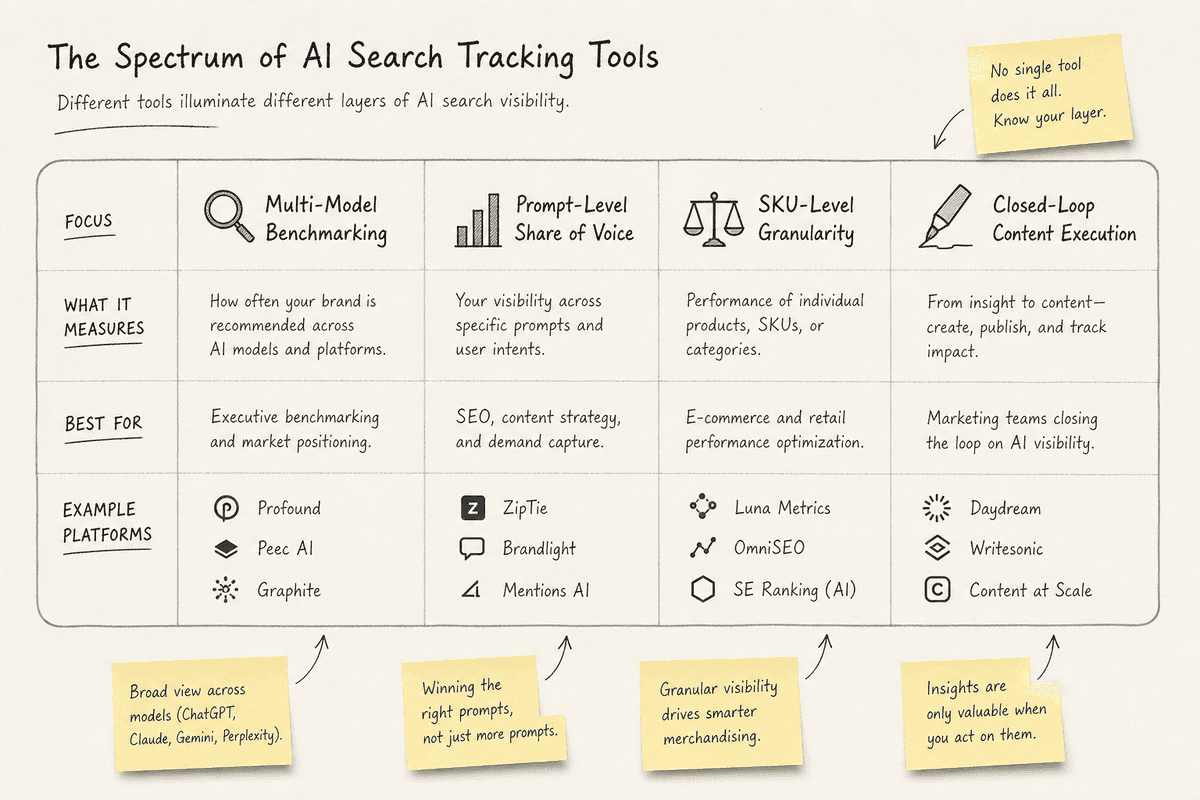
Feature Comparison: Choosing the Right Tracker
When evaluating these platforms, the specific needs of your B2B marketing or growth team should dictate your choice. To simplify the decision-making process, consider how these tools align across core capabilities.
The Mechanics of an AI Citation (And How to Influence It)
To use these platforms effectively, you must understand what you are actually measuring. When a platform tells you that your brand visibility is dropping in Perplexity, what is happening under the hood?
AI assistants generate answers through a process that predicts the next most likely word based on its training. When RAG is introduced, the AI first runs a background search on the query, reads the top-ranking articles, Reddit threads, and knowledge bases, and then synthesizes that live data into its response.
If your brand is missing, it is typically due to one of three failures:
- The Information Gap: The AI searched the live web for the prompt criteria, and your website (or third-party review sites mentioning you) did not contain explicit, semantically relevant text matching those criteria.
- The Authority Deficit: The AI found your content, but it found a competitor's content on a higher-authority domain, prioritizing their information in the synthesis.
- The Sentiment Drag: The AI found mentions of your brand, but the surrounding sentiment in forums (like Reddit or HackerNews) was highly critical, causing the model to exclude you from a "best of" recommendation.
Traditional SEO focused entirely on your own domain. Generative Engine Optimization requires a much broader view. AI models look for consensus. If your website says you are the best CRM for agencies, but no other independent blog, directory, or forum corroborates that claim, the AI is unlikely to recommend you.
This is why tracking platforms must identify citation sources. If you see that ChatGPT is citing G2, a specific Reddit thread, and a high-ranking affiliate blog to form its answer, your next move is clear. You must update your G2 profile, engage constructively in the forum, and pitch the affiliate blogger to include you.
The "Missing Mention" Scenario: From Data to Action
To illustrate how this works in practice, let's walk through a realistic scenario involving a B2B marketing team using an AI visibility platform.
Imagine a SaaS company that provides SEO automation tools. They have historically dominated traditional Google search for "best SEO automation software." However, their demo requests are slowly dropping.
The growth team decides to run their core buyer prompts through BeVisible. They test prompts like, "What is the best automated SEO tool for a lean marketing team?" across ChatGPT and Perplexity.
The results highlight a massive visibility gap. While they rank #1 on Google, Perplexity is recommending three newer, smaller competitors.
The team digs into the citation data provided by the tracking platform. They discover that Perplexity is ignoring their perfectly optimized landing pages and instead pulling its answer from three recent round-up blog posts published by marketing agencies, plus a trending discussion on a marketing Slack community that was mirrored to the web.
The AI visibility platform has done its job—it found the gap. Now, the execution phase begins.
Using the insights from BeVisible, the team initiates a targeted content sprint:
- Content Creation: They author a highly detailed, data-backed article comparing their automation features directly against the three newer competitors mentioned by the AI. They ensure this article is dense with the exact semantic terminology Perplexity was looking for.
- Digital PR and Review Management: They reach out to the authors of those specific round-up posts identified in the citation analysis, offering them free access to their tool in exchange for an updated, honest review.
- Publishing Workflows: They push their new content live, syndicate it to high-authority developer and marketing platforms, and force indexing.
Two weeks later, the team re-runs the prompt in the visibility tracker. The dashboard turns green. The AI is now reading their newly published technical comparisons, digesting the updated third-party reviews, and including them as a top recommendation.
This workflow highlights a critical truth about GEO: identifying the problem is a monitoring task; solving it is a content and publishing task. Founders who want to build the foundational knowledge to execute these strategies often start by studying how traditional search mechanics are evolving. Reviewing resources like the 11 Best SEO Blogs Every SaaS Founder Needs (2026) can provide the necessary context to merge traditional content strategies with new AI optimization workflows.

Critical Features to Look for in Your AI Visibility Stack
If you are migrating away from Profound or adopting AI tracking for the first time, evaluating vendors requires looking past slick user interfaces. The best platforms share a few non-negotiable capabilities.
Dynamic Prompt Testing
Standard keyword tracking is dead in the AI space. Buyers do not type "CRM software" into ChatGPT; they type "I run a 15-person marketing agency and need a CRM that integrates smoothly with Slack and has automated client reporting under $100 a month. What are my top three options?"
Your tracking platform must allow you to test these long-tail, highly contextual prompts. It should be able to store these buyer journeys and run them automatically every week to monitor fluctuations in the AI's logic.
Citation Source Mapping
Knowing that Perplexity recommended a competitor is useless if you do not know why. The tracking platform must scrape and present the exact URLs the LLM used to generate the answer. If the AI is pulling from a 2023 blog post that incorrectly lists your pricing, you need to know exactly which URL to target for a correction.
Sentiment Analysis Beyond Positive/Negative
Basic sentiment analysis classifies text as positive, negative, or neutral. Advanced AI visibility tools understand context. They can tell you if an AI is labeling your software as "complex but powerful" versus "difficult to use." Understanding these nuances helps your content team write exact counter-narratives to publish online.
Actionable Execution Pipelines
As highlighted throughout this guide, a dashboard of failing grades is demoralizing without a path to recovery. Platforms that integrate directly with your content pipeline—allowing you to move from discovering a missing mention to writing, scheduling, and publishing the corrective article—represent the future of the industry.
The Failure Modes of AI Brand Tracking
It is important to acknowledge that tracking AI answers is not an exact science. Because LLMs are probabilistic, they do not always give the exact same answer twice, even to the exact same prompt. Teams utilizing these platforms must be aware of common failure modes.
The Hallucination Trap: Sometimes, a visibility tracker will flag that a competitor has a massive new feature that the AI is praising. Upon investigation, you realize the AI hallucinated the feature entirely. Your content response shouldn't be to build the feature, but to publish clear, factual comparisons that correct the AI's training data over time.
Entity Confusion: If your brand name is a common dictionary word (e.g., "Apple" or "Notion"), basic tracking platforms will return massive false positives. You must ensure the platform you choose uses strong entity resolution, meaning it understands you are tracking "Notion the software company," not the concept of a notion.
Chasing the Algorithm: Just as Google updates its core algorithm, OpenAI and Anthropic constantly update their models. A prompt that yields a favorable answer in GPT-4o might yield a terrible answer in a future iteration. The goal is not to hack the prompt, but to saturate the web with so much high-quality, consensus-driven content about your brand that no model can logically ignore you.
Frequently Asked Questions
How is AI visibility different from standard SEO rank tracking?
Standard SEO tracks your domain's numerical position on a static search engine results page (SERP). AI visibility tracks whether a language model includes your brand in a synthesized, conversational answer, how it speaks about your brand, and which third-party sources it relies on to form that opinion.
How often do AI engines update their answers?
It depends on the model. Parametric memory (the model's core training) updates infrequently, typically every few months when a new version is released. However, RAG-enabled models (like Perplexity or ChatGPT with web search enabled) pull live data. If you publish a highly authoritative piece of content today, a RAG-enabled AI could theoretically read and cite it tomorrow.
Can you manipulate ChatGPT to recommend your brand?
You cannot buy a ranking in ChatGPT like you can buy a Google Ad. However, you can influence the model by practicing Generative Engine Optimization. This involves publishing dense, highly structured content, earning mentions on authoritative third-party sites, and ensuring a consistent, positive consensus about your brand across the web. When the AI scans the web to formulate its answer, it will reflect the reality you have engineered.
The shift toward AI-driven search is fundamentally changing how B2B buyers discover software and services. Relying solely on legacy enterprise platforms or ignoring the shift entirely leaves your brand vulnerable to being erased from the buyer's journey. By choosing a platform that not only monitors these AI answers but actively empowers your team to execute content strategies that fill the gaps, you transform a passive metric into a measurable driver of growth.