
When enterprise teams first started tracking their presence in generative engines, Profound emerged as one of the early platforms dedicated to Generative Engine Optimization (GEO). It gave marketing leaders a macro view of brand sentiment and share of voice inside engines like ChatGPT and Perplexity. However, as AI search workflows matured throughout 2026, many growth, content, and analytics teams reached a clear bottleneck: tracking top-level brand mentions is no longer enough. To win buyer queries, you need granular source citation analysis.
AI engines do not synthesize responses out of thin air. Tools like ChatGPT Search, Google AI Overviews, Perplexity, and Gemini rely heavily on Retrieval-Augmented Generation (RAG). They fetch specific URLs, scrape passage-level text, and cite third-party domains to ground their claims. If an AI model leaves your brand out of an answer, the root cause is almost always found in its citation sources.
If you are evaluating Profound alternatives, you are likely looking for platforms that go beyond basic mention counting to show you exactly which URLs AI models cite, why those sources are trusted, and how to convert those missing citations into high-impact content actions.
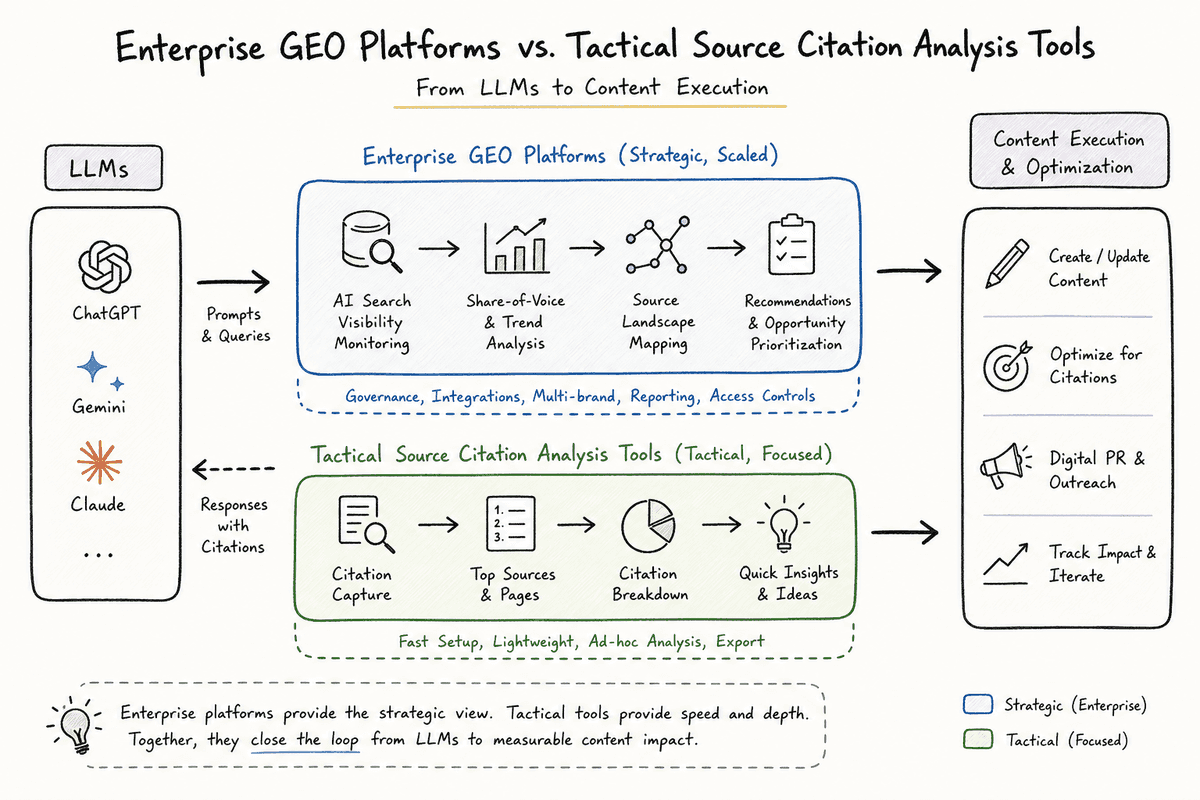
Understanding the Two Categories of AI Citation Tools
Before comparing specific platforms, it is important to distinguish between the two primary software categories that market themselves around AI search citations. Buying the wrong category will leave your team with either academic research tools or high-level sentiment dashboards that lack execution features.
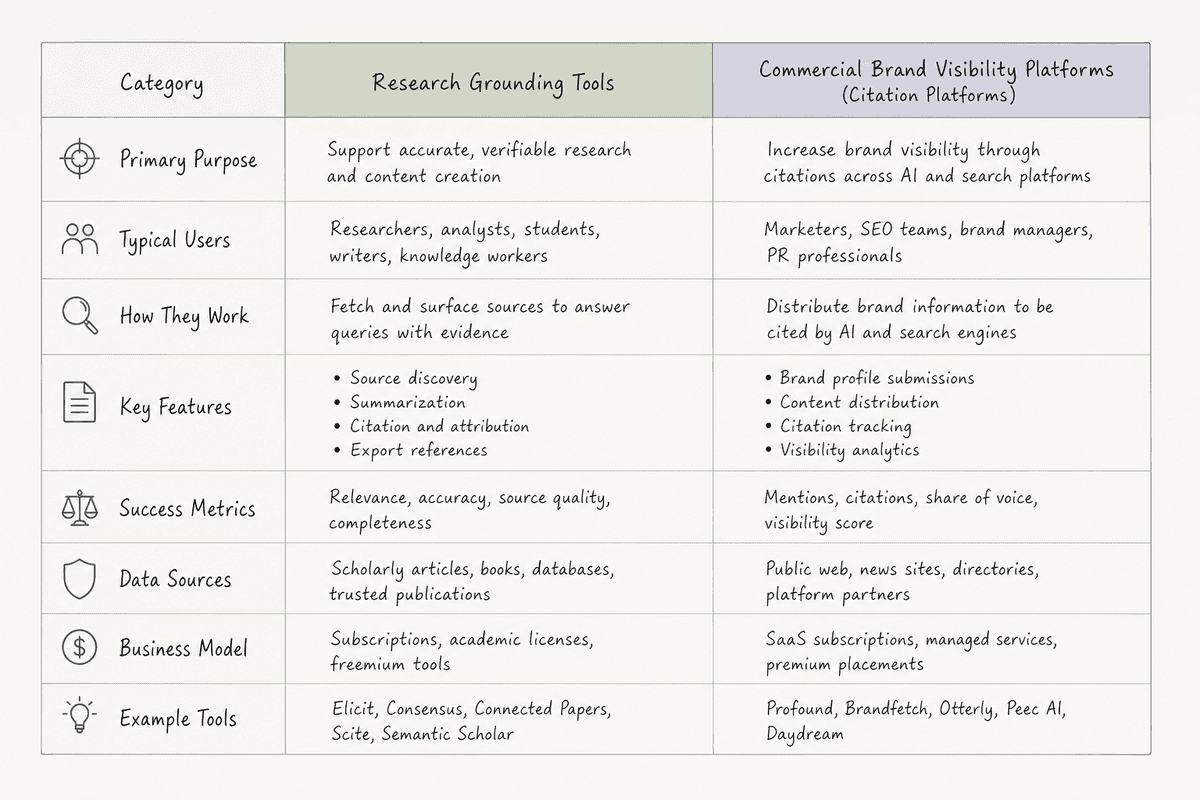
Category 1: User-Facing Research & Grounding Tools
These applications are built for researchers, analysts, students, and writers who need to verify facts, find primary documents, or build passage-grounded bibliographies.
- Primary Goal: Prevent AI hallucinations by anchoring prompt outputs to verifiable PDFs, academic papers, or live web pages.
- Typical Features: Passage-level text highlights, inline footnote extraction, academic paper graph matching, and custom document RAG spaces.
- Key Examples: Scite.ai, Sourcely, Atlas, and Perplexity Pro.
Category 2: Brand Visibility & Citation Analytics Platforms
These applications are built for SaaS founders, SEO directors, digital agencies, and enterprise marketing teams who need to monitor how major AI search engines treat their brand across commercial buyer prompts.
- Primary Goal: Track brand recommendations, audit cited domain lists, analyze citation sentiment, and generate content strategies to earn missing citations.
- Typical Features: Multi-engine prompt tracking (ChatGPT, Gemini, Perplexity, Google AI Overviews), competitor domain citation overlap, prompt intent classification, and visibility gap execution.
- Key Examples: BeVisible, specialized GEO analytics suites, and custom enterprise scraper frameworks.
This guide focuses primarily on Category 2 (Brand Visibility & Citation Analytics), while evaluating how specialized research engines in Category 1 can supplement your underlying content verification.
Why Citation Analysis Has Replaced Simple Share-of-Voice Metrics
Early AI monitoring software relied heavily on high-level metrics like "Share of Model" or "Brand Sentiment Score." While these numbers look clean in a quarterly presentation, they offer very little tactical value to a content team tasked with fixing missing mentions.
If ChatGPT recommends three of your direct competitors for the prompt "best customer analytics software for high-growth SaaS," knowing that your sentiment score dropped by 4% does not help you take action. Source citation analysis solves this by dissecting the underlying RAG pipeline.
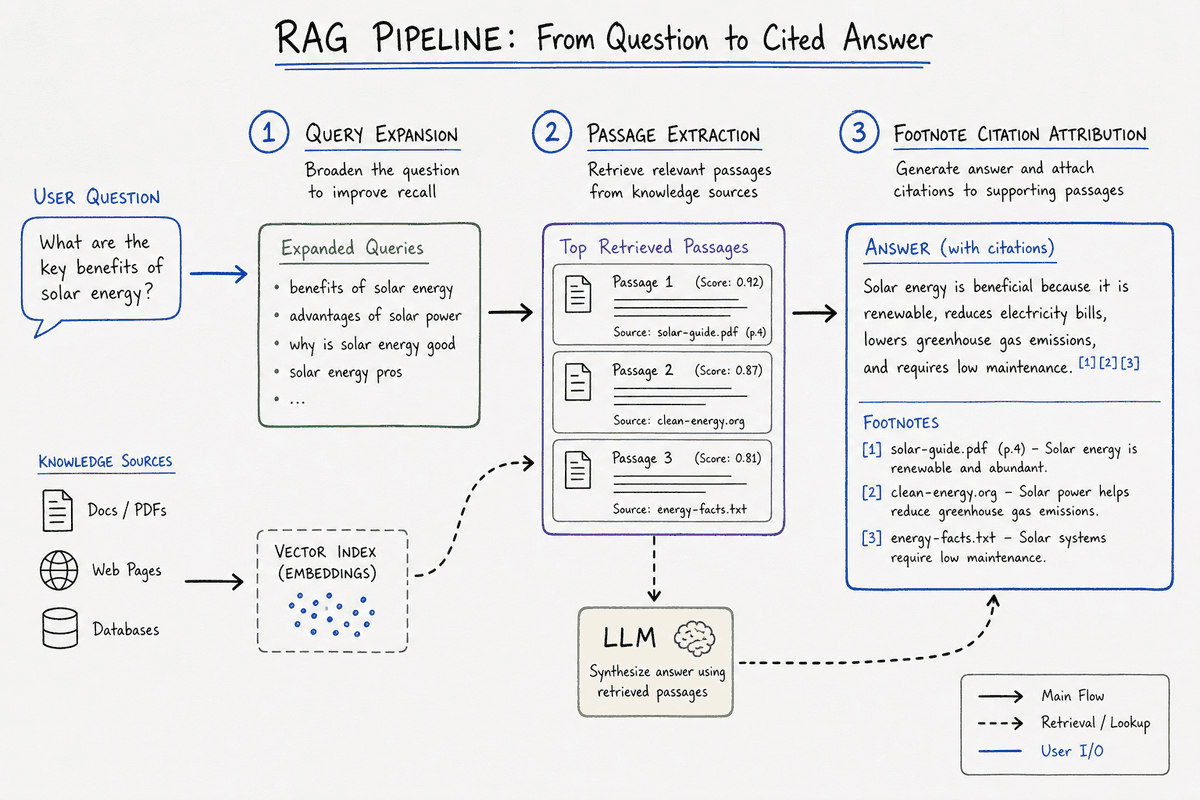
The Anatomy of an AI Citation
When an AI engine processes a buyer prompt, it performs three distinct operations:
- Query Expansion & Retrieval: The engine reformulates the user prompt into internal search queries and fetches 5 to 25 web pages from its index or index partners.
- Passage Extraction & Reranking: It extracts relevant sentences from those retrieved URLs, scoring them for topical authority, recency, and factual alignment.
- Synthesis & Footnote Attribution: The large language model (LLM) writes the final response, attaching hyperlinked footnotes or domain pills to the exact passages that informed its output.
By analyzing the URLs that pass through this pipeline, you gain visibility into the third-party review sites, comparison blogs, documentation pages, and news outlets that control AI recommendations in your industry.
Key Evaluation Criteria for Profound Alternatives
When replacing or supplementing Profound for AI search citation tracking, evaluate potential platforms against these five core benchmarks:
Top Profound Alternatives for AI Citation Tracking & Execution
1. BeVisible
Best For: SaaS founders, B2B marketing teams, growth teams, and agencies needing complete visibility tracking linked directly to content execution.
BeVisible was built specifically to solve the gap between measuring AI search visibility and taking action on it. While traditional enterprise platforms focus purely on high-level reporting dashboards, BeVisible monitors how AI assistants—including ChatGPT, Gemini, Perplexity, AI Mode, and Google AI Overviews—answer specific buyer questions, which brands they recommend, and which sources they cite.
Key Citation Features:
- Multi-Engine Citation Mapping: Tracks the exact URLs and third-party domains referenced across ChatGPT Search, Gemini, Perplexity, and Google AI Overviews for targeted buyer prompts.
- Visibility Gap Detection: Automatically identifies queries where competitors earn citations while your brand is omitted or cited passively.
- Evidence-Backed Execution Engine: Turns discovered citation gaps directly into structured opportunities, detailed content briefs, review workflows, and publishing schedules.
- Prompt-Level Tracking: Allows teams to track long-tail, multi-turn buyer prompts rather than basic head keywords.
Pros:
- Bridges the gap between analytics and content execution so teams do not get stuck in static reporting loops.
- Detailed breakdown of competitor citation sources across major LLM interfaces.
- Designed for agile SaaS teams and agencies looking for actionable ROI from GEO efforts.
Cons:
- Designed specifically for commercial brand visibility and marketing execution rather than academic literature grounding.
2. Specialized Enterprise GEO Platforms
Best For: Enterprise brands needing broad public relations monitoring and Fortune 500 corporate communications tracking.
Platforms built strictly for corporate enterprise communications offer extensive brand sentiment tracking across public datasets. They monitor large-scale brand mentions across global news feeds, social platforms, and major LLMs.
Key Citation Features:
- High-level share-of-voice calculations across historical datasets.
- Sentiment scoring categorizing responses into positive, neutral, or negative classifications.
- Broad media monitoring integrations alongside AI search engine tracking.
Pros:
- Excellent executive summary reporting for non-technical stakeholders.
- Useful for tracking massive international brands with broad public awareness.
Cons:
- High annual commitment costs often pricing out mid-market SaaS companies.
- Limited tactical guidance on how to fix specific missing page-level citations.
- Reporting often lacks granular URL-level citation path breakdowns.
3. Scite.ai & Sourcely (Academic & Scientific Citation Analysis)
Best For: Healthcare brands, research institutions, academic publishers, and technical B2B organizations verifying deep factual claims.
If your definition of citation analysis involves evaluating scientific literature, whitepapers, or academic consensus, tools like Scite.ai and Sourcely represent specialized alternatives focused on factual integrity.
Key Citation Features:
- Smart Citations (Scite.ai): Analyzes over 1.2 billion citation statements to show whether a citing paper supports, mentions, or contradicts a specific claim.
- Automated Bibliography Generation (Sourcely): Scans a repository of over 200 million academic papers to match assertions against peer-reviewed sources.
- Passage Context Verification: Shows the exact context surrounding a cited reference rather than just a metadata match.
Pros:
- Unmatched precision for scientific, medical, and high-rigor technical documentation.
- Eliminates hallucinated academic references completely within research workflows.
Cons:
- Not designed to track commercial buyer prompts or AI search engines like Google AI Overviews or ChatGPT Search.
- Provides no workflow for commercial SEO or brand visibility execution.
4. Perplexity Enterprise & Research Workspace
Best For: Internal research teams and strategic analysts looking for real-time web search citation tracing.
While Perplexity is primarily an end-user search engine, its Pro and Enterprise workspaces serve as powerful reference tools for studying how real-time RAG operations operate in practice.
Key Citation Features:
- Instant inline domain pills linking directly to referenced source material.
- Live file-upload capabilities allowing teams to query custom web indexes alongside live web results.
- Collection spaces for organizing cited research threads across complex topics.
Pros:
- Highly intuitive interface for real-time claim verification.
- Transparent citation mapping for everyday informational searches.
Cons:
- Measures only Perplexity's engine; does not provide comparative tracking for ChatGPT, Gemini, or Google AI Overviews.
- Lacks automated prompt tracking, historical trend lines, or competitive share-of-voice monitoring across targeted keyword sets.
Comparison Matrix: Finding the Right Profound Alternative
To help your team select the appropriate platform based on your specific operational goals, compare the core strengths of each approach below:
How AI Engines Select Source Citations: The Mechanics
To build a strategy around citation analysis, you must understand the criteria LLMs and RAG systems use when selecting which web pages to cite.
Many marketers assume that standard Google ranking positions dictate AI citations. While there is overlap—especially within Google AI Overviews—AI engines operating independent search indexes (such as ChatGPT Search and Perplexity) evaluate web sources using distinct semantic filters.
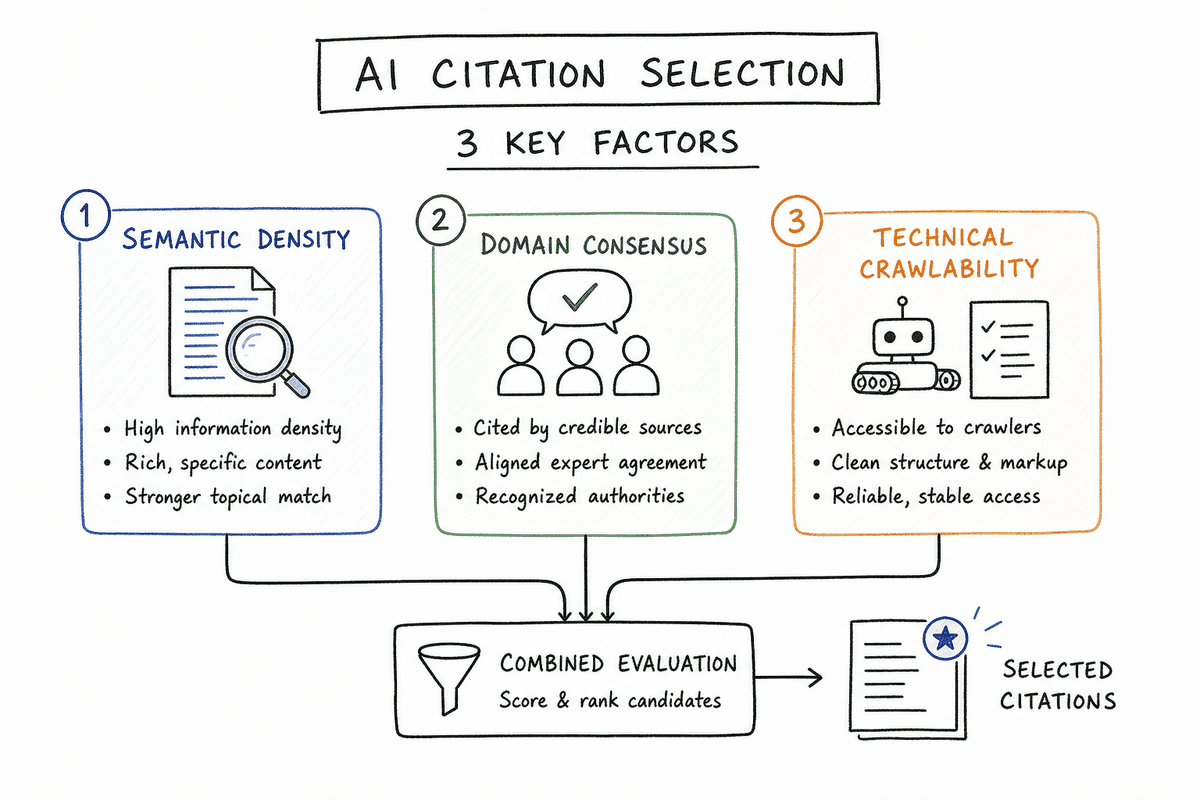
1. Semantic Density and Direct Answers
Standard search engines historically rewarded long-form content filled with comprehensive background context. In contrast, RAG extraction engines search for high semantic density. They favor pages that provide immediate, clear answers to specific questions within concise paragraphs, bulleted lists, and structured HTML tables.
If a page buries its core recommendation under 800 words of introductory fluff, an AI search scraper may skip it in favor of a competitor site that presents structured, extractable data.
2. Domain Co-Occurrence & Citation Consensus
AI search models place heavy weight on consensus. When synthesized models evaluate options for a prompt like "top enterprise CRM platforms," they query multiple review sites, industry blogs, and roundups simultaneously.
If your brand is mentioned exclusively on your own domain, AI search engines will rarely treat your site as an authoritative primary source for non-branded queries. However, if your brand appears consistently across three independent top-ten lists cited by the engine, the model builds high confidence in recommending your platform.
3. Freshness & Index Accessibility
AI retrieval systems favor recently updated content with clear date stamps and structured schema. Furthermore, technical accessibility is paramount: if your site blocks standard AI crawlers via robots.txt or relies heavily on unrendered client-side JavaScript, RAG bots will fail to scrape your content, forfeiting potential inline citations.
If you are managing technical architecture for web applications, ensuring that search crawlers can parse rendered content is a critical foundation. For teams operating modern JavaScript frameworks, reviewing specialized implementation guides—such as our breakdown on SEO for Single Page Applications: A 5-Step Guide (2026)—can help prevent crawlability issues that block AI bots.
Step-by-Step Playbook: Turning Citation Analysis Into Ranked Visibility
Simply monitoring missing citations does not grow your brand. You need an operational workflow that turns raw citation data into published content that wins AI recommendations.
Step 1: Map Your Core Commercial Prompt Universe
Start by listing the exact questions your ideal buyers ask during their evaluation process. Move beyond single keywords and capture full natural-language queries:
- Problem-aware queries: "How to streamline B2B SaaS churn analysis"
- Solution-seeking queries: "Best AI search visibility tools for marketing teams"
- Vendor comparison queries: "Platform A vs Platform B for enterprise brand tracking"
Step 2: Run Multi-Engine Citation Audits
Execute these prompts across ChatGPT, Gemini, Perplexity, and Google AI Overviews using an analytics platform like BeVisible. Document:
- Which competitor domains are cited most frequently across engines.
- Which specific URLs (third-party blogs, direct competitor pages, software review sites) serve as the citation base.
- The exact context and sentiment of your brand's presence (or absence).
Step 3: Categorize Missing Citations into Execution Buckets
When analyzing missing citations, categorize your findings into three strategic buckets:
- Owned Content Gaps: Queries where the AI cites competitor blog posts or landing pages because your site lacks a dedicated, high-density page on the topic. Creating authoritative pages—similar to standard strategy frameworks like those in our guide on How to Build an SEO Landing Page (7-Step Guide)—ensures your domain is available for AI indexing.
- Third-Party Inclusion Gaps: Queries where the AI relies exclusively on third-party comparison lists, Reddit threads, or industry roundups where your brand is currently omitted.
- Technical Indexing Gaps: Queries where your domain has relevant content, but AI engines cite alternative sources because your page structure makes passage extraction difficult.
Step 4: Execute Evidence-Backed Content & Distribution Updates
- For Owned Gaps: Publish clear, well-structured articles featuring bulleted summaries, comparative tables, and concise definition blocks near the top of the page.
- For Third-Party Gaps: Initiate targeted outreach to the specific third-party domains cited by the AI, securing inclusion on the exact pages the RAG engine already trusts.
- For Technical Gaps: Reformat existing content to prioritize direct answers, apply clean schema markup, and remove JavaScript rendering blockers.
Step 5: Re-Monitor and Track Citation Capture
Monitor your target prompts over a 14 to 30-day window. Track whether new content publications or third-party additions result in new inline citations across ChatGPT, Gemini, and Google AI Overviews.
Common Myths About AI Search Citation Analysis
Myth 1: Ranking #1 on Google Guarantees AI Citations
Reality: High traditional search rankings do not guarantee selection by LLM engines. While Google AI Overviews relies heavily on Google's index, engines like ChatGPT Search and Perplexity frequently cite lower-ranking secondary pages if those pages offer cleaner passage structure, higher semantic density, or direct comparative data tables.
Myth 2: AI Engines Only Cite High Domain Authority Sites
Reality: AI engines prioritize passage relevance over raw domain authority metrics. A smaller niche SaaS blog with a clear, direct answer to a specific technical question will routinely beat a massive news site that provides vague or indirect coverage.
Myth 3: Citation Tracking is Only Useful for SEO Teams
Reality: Citation analysis provides critical competitive intelligence for product marketing, PR, and executive strategy teams. Knowing which review platforms and blogs shape AI recommendations informs digital PR investments, affiliate partnerships, and messaging positioning.
Frequently Asked Questions
What is the main difference between standard SEO tools and AI citation tracking tools?
Standard SEO tools track keyword positions, backlink counts, and monthly search volume on traditional search engine results pages. AI citation tracking tools monitor natural-language buyer prompts across large language models (like ChatGPT, Gemini, and Perplexity), analyzing which specific web URLs and third-party sources the AI retrieves and cites when generating synthetic answers.
Why are my competitors being cited by ChatGPT when my product is superior?
LLMs do not evaluate software products directly; they synthesize web text. If competitors appear consistently across authoritative third-party review sites, comparison roundups, and clear industry blogs, the AI RAG pipeline identifies them as the standard answer. If your brand lacks representation across those cited sources, the AI engine will omit your product regardless of feature parity.
How frequently do AI search tools update their source citations?
Citation updates vary by engine. Platforms with live web search integration (like Perplexity and ChatGPT Search) can update cited sources within days of new content being indexed. Search engines running cached generative summaries (like Google AI Overviews) update citations as their index refresh cycles run, typically over a few days to several weeks.
Can I block AI crawlers while still getting cited in AI search engines?
No. Blocking major AI crawlers (such as GPTBot, PerplexityBot, or Google-Extended) via your robots.txt file prevents those engines from reading your site's content. While an AI engine might still mention your brand based on historical third-party references, it cannot pull fresh passage citations or link directly to your owned URLs if crawling is restricted.
Choosing the Right Path Forward
Tracking AI search visibility without evaluating source citations is like analyzing website traffic without knowing where it came from. As buyers shift their search habits toward conversational AI assistants, understanding the web pages, blogs, and review sites that power those answers becomes essential.
If you require academic fact-checking and scientific paper graph analysis, specialized research tools like Scite.ai provide deep context verification. However, if you are a SaaS founder, B2B marketer, or agency team focused on discovering where your brand loses visibility across commercial prompts—and executing work to win those missing mentions back—a dedicated monitoring and execution platform like BeVisible provides the direct path from citation insights to published results.