
A B2B buyer opens ChatGPT and types, "What is the best CRM for a mid-sized agency managing multiple client retainers?" Within three seconds, the model synthesizes data from across the web, evaluates capabilities, and recommends exactly three software providers.
If your brand is absent from that response, you just lost a high-intent prospect before they ever reached a search engine.
B2B marketing space has been heavily focused on LLM citations and AI visibility as conversational engines pull market share away from traditional search [https://www.youtube.com/watch?v=N7d97pCnrj4&t=3]. Monitoring your brand across AI answers requires a structured approach [https://www.scalenut.com/blogs/how-to-monitor-brand-presence-in-chatgpt-and-perplexity]. While enterprise marketing teams often look to platforms like Profound AI to understand their presence in these tools, it is not the only option on the market. In fact, depending on your team's structure and goals, it might not be the most effective one.
Marketing teams, SaaS founders, and growth agencies need systems that do more than just report on visibility. They need platforms that bridge the gap between knowing your brand is missing from an AI overview and actually doing something about it. Finding out how visible your brand is in AI tools like ChatGPT, Gemini, and Perplexity is the first step, and two platforms you might immediately consider are traditional SEO tools and specialized enterprise AI trackers [https://www.youtube.com/watch?v=buQMrMOR-1k].
But what if you need an alternative that aligns better with active content execution, budget, or multi-platform coverage?
This guide breaks down the most capable Profound alternatives for AI search monitoring in 2026, evaluating how they track LLM responses, handle sentiment analysis, and integrate with your broader growth workflows.
The Shift: Why Traditional Rank Tracking is No Longer Enough
For two decades, SEO has operated on a predictable paradigm: identify a keyword, optimize a page, build authority, and track your position in a static list of links. AI search breaks this model entirely.
 Large Language Models (LLMs) like ChatGPT, Anthropic's Claude, Google Gemini, and Perplexity do not return a list of links. They generate answers. They rely on Retrieval-Augmented Generation (RAG) to pull real-time data from the web, mixed with the parametric memory baked into their training data, to synthesize a direct response.
This introduces three critical variables that traditional SEO tools simply cannot track:
- Conversational Intent Over Keywords: Buyers do not use shorthand keywords in AI prompts. They write detailed paragraphs explaining their specific constraints, budgets, and use cases. Tracking "SEO agency" is useless if the buyer is asking, "Which SEO agencies specialize in React frameworks and have experience with healthcare compliance?"
- Recommendation vs. Indexing: Being indexed by Google means you exist. Being recommended by ChatGPT means the AI has evaluated your brand against a specific set of criteria and deemed you the superior choice.
- Citation Fragility: AI models are non-deterministic. The same prompt can yield a slightly different answer or cite different sources on Tuesday than it did on Monday. Tracking visibility requires frequent, controlled prompt testing.
Enterprise tools like Profound AI entered the market to help large organizations track these variables at scale. They provide extensive visibility analytics and LLM tracking. However, complex enterprise software often introduces friction. Marketing teams frequently find themselves staring at dashboards showing a 15% drop in ChatGPT mentions without a clear, executable path to fix the problem.
Evaluating Profound Alternatives: The 2026 Landscape
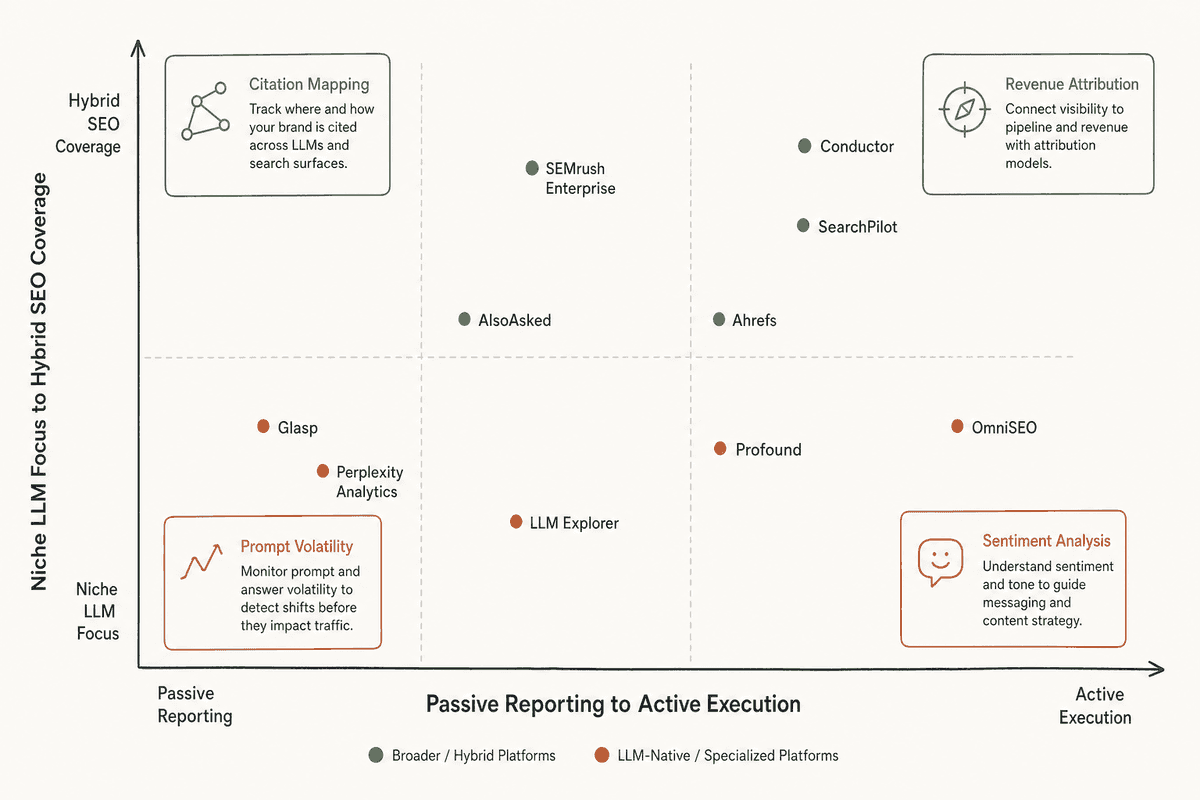
When evaluating alternatives to Profound, marketing teams must look at how each platform handles prompt tracking, multi-engine support (ChatGPT, Gemini, Perplexity, AI Overviews), sentiment analysis, and actionability.
Below is a detailed analysis of the leading AI search monitoring platforms designed for modern marketing teams.
1. BeVisible (Execution-Driven AI Visibility)
The most glaring failure mode of early AI tracking tools was the disconnect between data and action. A dashboard telling a content team that they are missing from Perplexity's answers is only marginally helpful if the team doesn't know why they are missing or how to secure a citation.
BeVisible is built specifically for teams that need to close this loop. It helps teams monitor how AI assistants answer buyer questions, which brands they recommend, and which sources they cite. It tracks ChatGPT, Gemini, Perplexity, AI Mode, and AI Overviews across buyer prompts.
Where BeVisible diverges from passive monitoring platforms is its focus on execution. It actively turns visibility gaps into evidence-backed opportunities, articles, review, scheduling, and publishing work.
Key Strengths for Marketing Teams:
- Workflow Integration: Instead of just reporting a drop in visibility, BeVisible flags the specific missing mentions, weak citations, and competitor wins, translating them directly into content briefs and publishing workflows.
- Source Attribution Analysis: It identifies exactly which third-party sites the AI engines are referencing when they recommend a competitor. If Gemini is citing a specific G2 review or a niche industry blog, BeVisible highlights that URL so you can target your PR and link-building efforts there.
- Actionable Gap Analysis: When ChatGPT recommends an alternative brand, BeVisible analyzes the context. Did the AI favor the competitor because of pricing transparency? Feature documentation? Knowing the "why" allows you to update your product pages accordingly.
For SaaS founders and B2B growth teams who need to move quickly from insight to published work, BeVisible acts as both the monitoring radar and the execution engine.
2. Nightwatch (The Versatile Hybrid)
As marketing teams bridge the gap between traditional search and AI search, running two completely separate software stacks can be cost-prohibitive and inefficient. Nightwatch has positioned itself as a highly versatile tool that combines LLM monitoring with traditional SEO tracking, prompt research, and citation-level sentiment analysis [https://nightwatch.io/blog/best-ai-search-monitoring-tools/].
Key Strengths for Marketing Teams:
- Unified Dashboards: Nightwatch allows teams to track their traditional Google Search rankings side-by-side with their visibility in AI overviews and LLM responses. This is particularly useful for agencies reporting to clients who want a holistic view of their digital footprint.
- Granular Prompt Research: The platform offers robust tools for understanding how users are structuring their conversational prompts, allowing marketers to optimize content for long-tail, natural language queries.
- Citation-Level Sentiment: Nightwatch doesn't just check if your brand was mentioned; it evaluates the context. Was your brand recommended as the premium, expensive option, or the budget-friendly alternative?
3. Analytical Insider (Growth-Connected Visibility)
Modern growth teams are increasingly tracking AI visibility across multiple tools and connecting that data back to broader growth and marketing efforts [https://www.youtube.com/watch?v=QN2WJ0W30_s]. Analytical Insider is designed for this exact use case, focusing on the intersection of AI visibility and revenue attribution.
Key Strengths for Marketing Teams:
- Multi-Tool Cross-Referencing: It monitors a wide array of AI tools, tracking discrepancies in how different models perceive your brand.
- Broader Marketing Connection: The platform is built to integrate with CRM data and attribution models, helping growth teams build a business case for investing in AI optimization by loosely tying visibility metrics to downstream traffic and lead flow.
4. Otterly AI (The Accessible Interface)
Enterprise tools can sometimes be overwhelming for mid-market teams or specialized content agencies. Otterly AI has gained traction by prioritizing a user-friendly interface alongside comprehensive multi-platform coverage.
Key Strengths for Marketing Teams:
- Ease of Use: A clean, intuitive dashboard that requires minimal onboarding. Content writers and SEO specialists can log in and immediately understand their brand's standing in major LLMs.
- Broad Platform Coverage: It reliably tracks ChatGPT, Gemini, and Perplexity, providing a solid baseline for teams just starting to explore AI visibility metrics.
5. Specialized Niche Tools: Knowatoa AI and Peec AI
Depending on your specific goals, you may not need a sprawling platform. Several specialized tools offer focused solutions:
- Knowatoa AI: This platform specializes almost entirely in sentiment analysis for brands across AI search platforms. If you are a large consumer brand and your primary concern is reputation management and ensuring the AI isn't associating your product with recent negative press, this tool provides deep semantic analysis of the AI's tone.
- Peec AI: For teams on a strict budget or those who just need the absolute bare minimum, Peec AI provides essential, basic LLM visibility tracking. It lacks the execution workflows of BeVisible or the hybrid tracking of Nightwatch, but it serves as an entry-level pulse check.
Core Capabilities Every AI Monitoring Platform Must Have
If you are replacing or avoiding an enterprise solution like Profound, you must ensure your chosen alternative still covers the fundamental mechanics of AI search. Evaluating these tools requires looking past glossy dashboards and testing their underlying technology.
Here are the specific capabilities a modern marketing team should demand from an AI search monitoring platform.
Conversational Prompt Tracking (Not Keyword Tracking)
Traditional SEO tools track static phrases: "best payroll software." AI monitoring tools must track conversational intent: "I run a 50-person remote agency in the UK and need payroll software that integrates with Xero and handles multi-currency. What are my best options?"
The platform must allow you to input complex, multi-variable prompts that reflect actual B2B buyer behavior. If the tool only allows you to track 2-3 word phrases, it is just a repurposed SEO scraper, not a true LLM monitor.
Source Citation Mapping
This is arguably the most critical feature. When Perplexity answers a prompt, it appends footnote citations linking to the sources it used to generate that answer.
Your monitoring platform must extract and aggregate these citations. You need to know exactly which domains the AI trusts for your industry. If ChatGPT consistently cites a specific G2 category page, a particular Reddit thread, and a niche industry blog when answering questions about your software category, those are the pages you need to influence.
Understanding this citation graph dictates your entire off-page strategy. Without this feature, you are flying blind.
Sentiment and Recommendation Scoring
A mention is not a recommendation. AI models can mention your brand in three ways:
- Positive Recommendation: "You should consider Brand X because of its superior analytics."
- Neutral Inclusion: "Options in this space include Brand X, Brand Y, and Brand Z."
- Negative/Cautionary Mention: "While Brand X is popular, users often report that its API is difficult to implement compared to Brand Y."
Your platform must parse the natural language of the response and categorize the sentiment. Tracking a high volume of mentions is actively harmful to your reporting if those mentions are cautionary.
Output Volatility Tracking
Search engine result pages (SERPs) are relatively stable. AI responses are volatile. A platform needs to test your target prompts frequently—often daily—and report on the volatility of the answers.
If your brand appears in the response on Monday but disappears on Wednesday, the platform should flag this instability. High volatility often means the AI does not have strong, consistent signals about your brand from the web, forcing it to hallucinate or pull secondary sources.
The Workflow: Transitioning from Passive Monitoring to Active Execution
The greatest failure mode for marketing teams adopting AI search monitoring is treating the data like a static report card. You review it at the end of the month, present it to the executive team, and make no changes to your daily operations.
To actually capture market share in ChatGPT and Perplexity, you must build an execution workflow. This is why platforms that turn visibility gaps into published work offer a distinct advantage.
Here is a practical framework for operationalizing AI search data.
Step 1: Baseline Auditing and Prompt Grouping
Start by mapping the buyer journey. Group your target prompts into three categories:
- Informational/Educational: "How do I calculate customer acquisition cost in a SaaS business?"
- Evaluative/Comparative: "What are the differences between Platform A and Platform B for enterprise data warehousing?"
- Transactional/Decision-ready: "Best enterprise data warehousing platforms under $5k a month."
Run these groups through your monitoring platform across ChatGPT, Gemini, and Perplexity. Establish a baseline visibility score for each stage of the funnel.
Step 2: Gap Analysis and Source Identification
Review the prompts where your brand was completely omitted or listed as a secondary option. Look at the competitors who won the recommendation. More importantly, look at the citations the AI used to build that recommendation.
Did the AI cite a competitor's highly detailed technical documentation? Did it pull from a recent third-party review roundup?
Step 3: Executing the Fix (The Content Response)
Once you know why the AI ignored you, you have to build the asset that fixes the gap.
If the AI cited a competitor's in-depth guide, you need to produce superior, more structured content. For teams learning how to structure this kind of content, understanding the fundamentals of page architecture is critical. Reviewing resources on How to Build an SEO Landing Page (7-Step Guide) can ensure the new asset is technically sound enough for both traditional crawlers and AI bots to parse.
If the AI requires deep, ongoing industry authority to trust your brand, your content team must prioritize publishing high-signal thought leadership. Identifying where to distribute and how to model this content can be accelerated by studying the 11 Best SEO Blogs Every SaaS Founder Needs (2026).
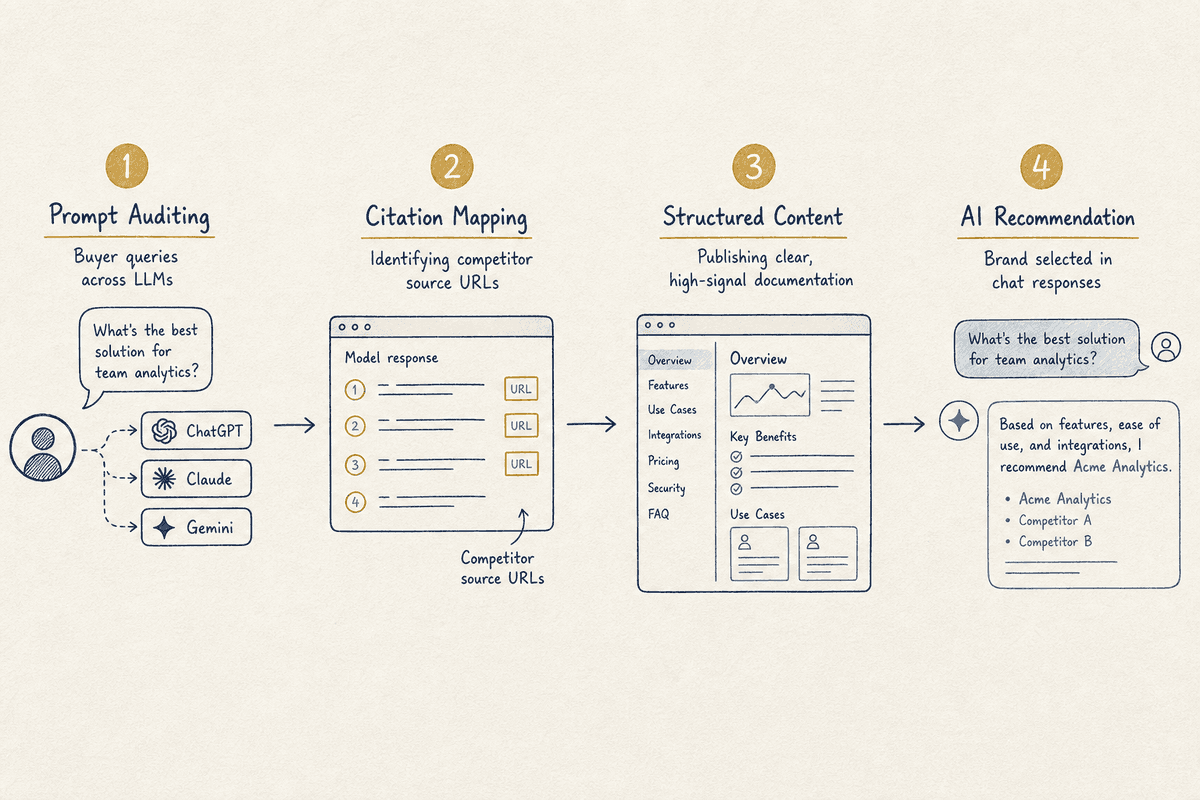
Step 4: Structuring for Retrieval-Augmented Generation (RAG)
AI models favor content that is highly structured, factual, and unambiguous. When executing your new content to fill a visibility gap, avoid marketing fluff.
- Use clear, declarative sentences.
- Format comparisons using standard markdown tables.
- Ensure technical specifications are clearly listed, not buried in paragraphs.
- Directly answer the exact constraints of the prompts you are targeting.
If you are a SaaS company and the AI prompt specifies "software for single-page applications," your documentation needs to explicitly use that terminology and structure the data logically.
Budgeting and Resource Allocation for AI Visibility
Adopting a new category of software requires budget re-allocation. A common question among marketing directors is whether AI search monitoring should replace traditional SEO tools or sit alongside them.
The reality is that both search ecosystems will coexist for the foreseeable future. Traditional SEO drives high-volume, top-of-funnel traffic. AI search drives highly qualified, lower-funnel evaluations.
When evaluating the cost of platforms, consider the total cost of ownership. Enterprise tools like Profound AI carry significant licensing fees designed for massive, multi-national organizations.
Mid-market B2B teams often find better ROI in platforms that bundle execution capabilities, reducing the need for separate project management and content briefing software. As the industry evolves, understanding the financial dynamics of visibility optimization is critical. Teams assessing their overall spend might compare the costs of keeping this in-house using an automation platform versus outsourcing it entirely, a dynamic similar to evaluating SEO Charges UK: Agency Rates vs Automation (2026).
The Cost of Inaction
The primary justification for investing in AI search monitoring is the cost of inaction. In B2B marketing, the evaluation phase is shifting rapidly. Decision-makers are using Perplexity to build their initial vendor shortlists.
If your competitor uses an AI visibility platform to optimize their content for these specific prompts, they will secure the default recommendation. Reversing an AI model's learned preference is significantly harder than capturing it early. The models train on historical interactions; the longer a competitor holds the top recommendation, the more entrenched they become in the model's parametric memory.
Building the Team: Who Owns AI Search Monitoring?
Integrating a Profound alternative into your marketing stack requires clear ownership. AI visibility blurs the lines between traditional SEO, product marketing, and public relations.
The SEO Team (or Agency): Traditionally, SEOs manage rank tracking. In the AI era, their role shifts to managing the monitoring platform, executing the prompt research, and analyzing the citation graphs. They are responsible for understanding how the bots are crawling the site and extracting data.
Product Marketing: Product marketers must be deeply involved in AI visibility. Because AI engines evaluate features, pricing, and specific use cases, product marketing must ensure that the website's messaging directly aligns with the complex prompts buyers are using. If an AI engine incorrectly claims your software lacks a specific feature, product marketing must update the public-facing documentation to correct the model.
Public Relations and Analyst Relations: In traditional PR, the goal is getting featured in major publications. In AI PR, the goal is getting featured in the specific niche blogs, directories, and review sites that the LLMs actually cite. The PR team uses the source citation data from the monitoring platform to build highly targeted outreach campaigns.
If you are outsourcing this function, ensure your agency partner understands this multi-disciplinary approach. Relying on an agency that treats AI search exactly like traditional link-building is a common pitfall.
B2B Scenario: Capturing the "Best Software" Prompts
To illustrate the value of an execution-driven platform, consider a mid-sized B2B payroll software company.
The Problem: The marketing team realizes that when users prompt Gemini with, "What is the best payroll software for construction companies with union labor?", their brand is never mentioned, despite having specific features for this exact market.
The Monitoring Phase: Using their AI monitoring platform, they track this prompt and 50 similar variations. The data reveals that ChatGPT and Gemini consistently recommend two competitors.
The Citation Analysis: The platform's source analysis shows that the AI is heavily relying on a specific Capterra comparison page and an article from a construction management blog published two years ago.
The Execution (The BeVisible approach):
- The platform automatically flags this visibility gap as a high-priority opportunity.
- It generates a content brief highlighting the exact semantic entities and technical features the AI associates with "union labor payroll."
- The marketing team publishes a dedicated, highly structured landing page explicitly addressing construction payroll, prevailing wage calculations, and union compliance.
- The PR team targets the construction management blog identified in the citation analysis, securing an updated mention in a newer article.
- Within four weeks, the monitoring platform shows the brand moving from unmentioned to the primary recommendation in ChatGPT.
This scenario highlights why passive tracking is insufficient. The value lies entirely in the execution phase.
Frequently Asked Questions About AI Search Monitoring
How often do LLM answers change for the same prompt? AI models are non-deterministic, meaning there is inherent variance in their outputs. However, the core recommendations for fact-based, B2B queries tend to remain relatively stable unless a major algorithm update occurs or a competitor publishes highly authoritative, heavily cited new content. Monitoring tools typically check daily or weekly to track this volatility.
Do traditional SEO tools cover AI search adequately? Most legacy SEO tools have hastily added "AI features," but they are fundamentally built on scraping 10 blue links. True AI monitoring requires different architecture: headless browsers executing natural language prompts and parsing conversational output, sentiment, and footnote citations.
Can you optimize for AI without a monitoring tool? You can guess, but you cannot optimize efficiently. Without a tool, you are manually typing prompts into ChatGPT, writing down the answers, and trying to guess why the AI chose those answers. At scale, across hundreds of buyer prompts and multiple engines, manual tracking becomes impossible.
Securing Your Digital Real Estate in 2026
The transition from keyword-based search to intent-driven AI synthesis is the most significant shift in digital marketing in two decades. The tools you use to navigate this shift will determine how efficiently your brand captures this new real estate.
While enterprise solutions like Profound AI offer deep analytics, modern marketing teams often require platforms that balance robust tracking with actionable execution. Whether you choose a versatile hybrid like Nightwatch, a growth-connected tool like Analytical Insider, or an execution-focused platform like BeVisible that turns visibility gaps into published work, the imperative remains the same: stop passively watching your AI visibility drop.
Analyze the prompts your buyers are actually using. Identify the sources the AI trusts. Build the structured content required to secure the recommendation. The brands that operationalize this workflow today will be the default answers generated by tomorrow's language models.