
When enterprise clients began noticing their competitors recommended inside ChatGPT, Perplexity, and Google AI Overviews, digital agencies scrambled to find software that could track generative search engine visibility. Profound emerged early as an enterprise-grade solution for monitoring large language model (LLM) footprints. For many agencies, however, the platform presents structural friction: high minimum contract commitments, rigid seats, and dashboards that show where a brand is missing without giving teams a clear operational bridge to fix the citation gap.
Modern agencies do not just need to show clients a visibility score on a monthly call. They need a platform that tracks prompt variations across multiple AI engines, identifies exactly which source documents LLMs cite, and helps the agency turn those gaps into published, revenue-generating content assets.
If your agency is evaluating generative engine optimization (GEO) and answer engine optimization (AEO) tracking platforms, this guide breaks down the best Profound alternatives, comparing their architecture, reporting capabilities, client workspace management, and execution workflows.
The Shift from Traditional Rank Tracking to AI Search Monitoring
Traditional search engine optimization relies on deterministic rank tracking. A user types a keyword into Google, Google returns a list of ten blue links with localized variations, and rank tracking software scrapes position data over time.
Generative engines do not operate on fixed position tables. When a buyer asks an AI assistant for a software recommendation, the engine dynamically synthesizes an answer using pre-trained weights, retrieval-augmented generation (RAG), and live web citations.
 An agency tracking AI search must monitor several distinct layers of generative visibility:
- Brand Recommendation Frequency: Does the model mention your client when a buyer asks an unbranded problem-solving prompt?
- Citation Source Analysis: Which third-party publications, review directories, forum threads, or owned blog posts does the model pull into its synthesis?
- Sentiment and Positioning: Is the client framed as an industry leader, a budget alternative, or a legacy tool with usability issues?
- Engine Divergence: How does the client's presence vary across ChatGPT Search, Google AI Overviews, Gemini, Perplexity, and Claude?
Tracking these dimensions across dozens of client accounts requires dedicated infrastructure. While building custom Python scripts against LLM APIs can pull raw text, it fails to account for real-time web retrieval, localized user context, and UI-level citations that real searchers see.
Why Agencies Are Looking for Profound Alternatives
Profound established itself early in the AI monitoring space, particularly for Fortune 500 brands and enterprise marketing teams. Yet as agencies try to operationalize AI search tracking across diverse client portfolios, several pain points frequently arise.
1. Enterprise Pricing That Squeezes Agency Margins
Profound's pricing model is built primarily for direct enterprise procurement. For agencies managing multiple retainers ranging from mid-market SaaS brands to local service providers, enterprise-level platform costs make it difficult to maintain healthy margins unless the tool is restricted to top-tier enterprise accounts. Agencies need scalable pricing tiers, flexible credit allocation, and multi-tenant structures that accommodate mid-market clients.
2. The Disconnect Between Visibility Data and Content Execution
Knowing that a client is missing from 70% of Perplexity answers for high-intent queries is only half the battle. The real agency deliverable is fixing that gap. Many monitoring platforms function purely as passive listening stations. Once the data is delivered, the agency account team must manually extract the missing citations, brainstorm content briefs, write draft articles, coordinate client reviews, and handle publishing across various CMS platforms.
Agencies lose billable hours when their visibility data sits isolated from their content production pipeline.
3. Surface-Level API Scraping vs. Real-World RAG Simulation
Some tracking tools query LLM backends via standard API endpoints. However, an API response from an LLM often differs significantly from what an end-user sees inside ChatGPT with web browsing enabled or inside Google's AI Overview interface. Real search experiences execute multi-step search queries behind the scenes, crawl live websites, and render dynamic citation cards. Agencies require browser-level simulation and live RAG tracking to deliver audit data that matches what client stakeholders see on their own screens.
4. Client Reporting and Multi-Account Isolation
Agency workflows demand clear multi-tenancy. Account directors need to toggle between client workspaces without cross-contaminating prompt datasets, citation libraries, or competitor benchmarks. Furthermore, client-facing reporting needs to be clean, customizable, and focused on commercial outcomes rather than confusing raw LLM metrics.
The Top Profound Alternatives for Agencies in 2026
The following platforms represent the leading AI search tracking and generative visibility tools built for marketing teams and agencies.
+------------------+-----------------------------+---------------------------------------+
| Platform         | Primary Strength            | Best Fit                              |
+------------------+-----------------------------+---------------------------------------+
| BeVisible        | Tracking + Execution Engine | Performance agencies & SaaS teams     |
| ZipTie.dev       | Page-level citation audits  | Technical SEO teams & e-commerce      |
| Otterly.ai       | Multi-engine monitoring     | Mid-market agencies & brand teams     |
| Semrush AIO      | Integrated search suite     | Traditional agencies adding GEO       |
| SE Ranking       | Unified SERP + AI tracker   | Small-to-mid agencies on a budget     |
| Peec AI          | LLM brand sentiment audits  | Enterprise PR & communications teams  |

+------------------+-----------------------------+---------------------------------------+
1. BeVisible: Closing the Gap Between AI Tracking and Content Execution
Best For: Growth agencies, SaaS marketing teams, and content operations that need to track AI visibility gaps and instantly turn them into evidence-backed, published content.
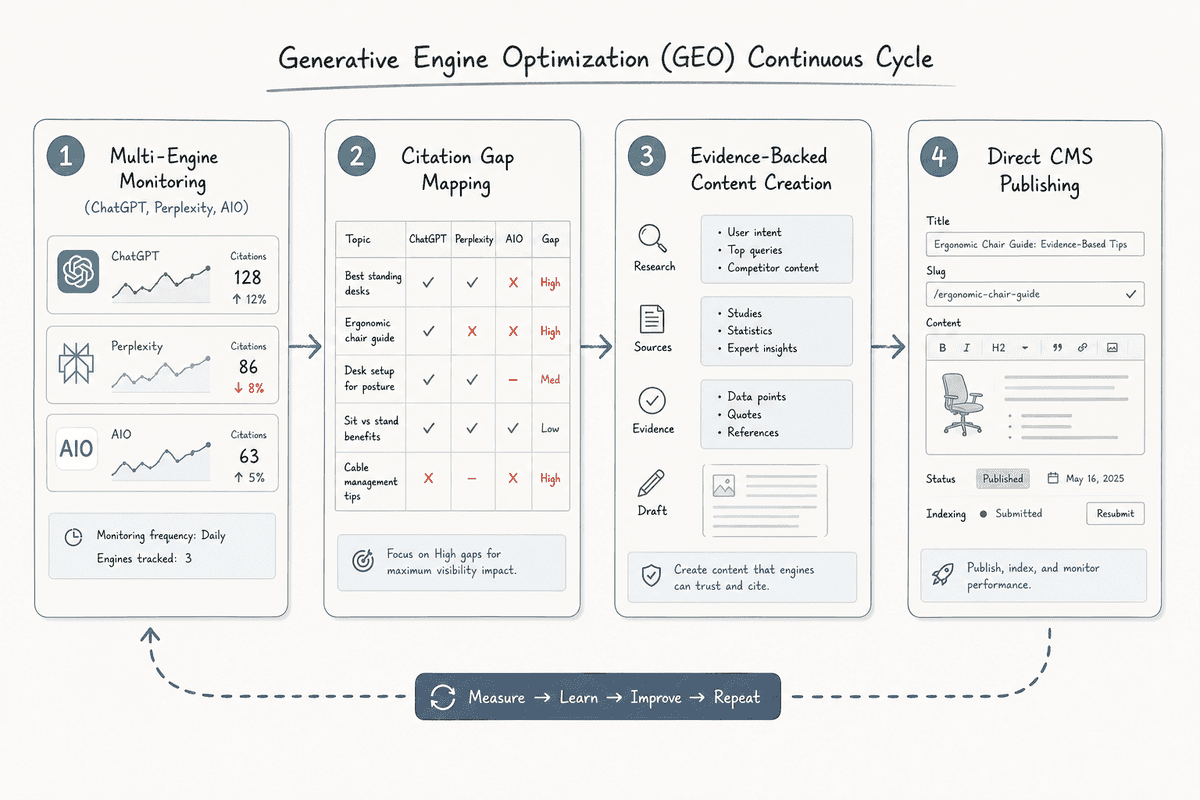
BeVisible is built specifically around the full lifecycle of AI search visibility: monitoring where brands appear, identifying why competitors are winning citations, and operationalizing the content creation required to capture missing recommendations.
Key Capabilities
- Multi-Engine Buyer Prompt Tracking: Monitors how ChatGPT, Gemini, Perplexity, AI Mode, and Google AI Overviews answer commercial and conversational buyer queries.
- Citation and Source Mapping: Dissects the exact digital footprint LLMs use to construct answers, highlighting specific competitor articles, industry lists, and technical documentation that engines reference.
- Evidence-Backed Content Opportunities: Automatically transforms identified visibility blind spots into structured content briefs and full-length articles tailored to the exact citation criteria of target AI models.
- Integrated Review and Publishing Workflows: Bridges the gap between detection and execution by providing built-in review, scheduling, and direct CMS publishing capabilities within the platform.
- Multi-Client Architecture: Allows agencies to manage distinct client domains, competitor sets, and prompt clusters from a unified dashboard without data overlap.
How It Compares to Profound
While Profound serves primarily as an analytical observatory for enterprise brand footprints, BeVisible focuses on the entire agency delivery workflow. When BeVisible identifies that a client is absent from an AI engine's answer, it generates the specific strategic angle, references the authoritative sources the engine trusts, and streamlines the creation of the target asset. This workflow enables agencies to turn tracking data into concrete monthly deliverables without juggling separate project management, content drafting, and tracking platforms.
2. ZipTie.dev: Technical Precision and Page-Level AI Overview Audits
Best For: Technical SEO agencies and enterprise e-commerce brands focused primarily on Google AI Overviews and granular URL citation mechanics.
ZipTie.dev takes an engineering-first approach to generative search tracking. Rather than relying on simple API polling, ZipTie renders real-world search environments at scale to capture how Google AI Overviews appear across millions of e-commerce and informational queries.
Key Strengths
- Browser-Level Environment Simulation: Captures actual desktop and mobile layouts of Google AI Overviews, ensuring zero discrepancy between reported data and live search results.
- Granular URL Citation Tracking: Identifies not just the domain being cited, but the specific URL, anchor text, and contextual snippet extracted by the engine.
- Indexation vs. Generative Visibility Correlation: Cross-references traditional Google search index status with generative inclusion, helping technical teams diagnose rendering barriers.
Agency Tradeoffs
ZipTie is exceptional for technical audits and deep Google AI Overview tracking. However, it is less focused on conversational multi-engine assistants like Claude or standalone ChatGPT search flows. Additionally, ZipTie does not offer integrated content production or direct publishing pipelines, requiring agency teams to export data into external tools for content creation.
3. Otterly.ai: Streamlined Dashboards for Mid-Market Monitoring
Best For: Mid-market digital marketing agencies that need reliable, multi-engine prompt tracking with straightforward reporting.
Otterly.ai provides clean, intuitive monitoring across the major AI search engines, making it a popular choice for agencies that want quick setup times and easily digestible reporting for non-technical clients.
Key Strengths
- Broad LLM Coverage: Tracks prompt responses across ChatGPT, Perplexity, Gemini, and Google AI Overviews within a single interface.
- Share of Voice and Sentiment Tracking: Quantifies brand presence relative to named competitors across custom prompt categories.
- Looker Studio and Data Connectors: Makes it easy to pipe AI visibility metrics directly into client-facing agency dashboards.
Agency Tradeoffs
Otterly.ai excels at brand monitoring and sentiment tracking, but offers limited technical depth regarding underlying RAG mechanisms. It tells you if you are mentioned, but provides fewer actionable recommendations on how to restructure your content or PR footprint to change the model's output.
4. Semrush AI Overview Toolkit: Consolidating Traditional and Generative SEO
Best For: Full-service SEO agencies already embedded in the Semrush ecosystem that want to monitor AI Overviews alongside organic keywords.
For agencies that rely heavily on Semrush for keyword tracking, backlink audits, and competitive research, the Semrush AI Overview Toolkit provides an accessible way to monitor generative SERP features without onboarding a separate vendor.
Key Strengths
- Unified Database: Connects traditional keyword rank tracking data with AI Overview appearance flags across large keyword sets.
- Historical Keyword Correlation: Lets agencies see how fluctuations in organic rankings correlate with inclusion in Google's generative answers.
- Familiar Client Reporting: Integrates directly into existing Semrush My Reports and automated client email schedules.
Agency Tradeoffs
Because Semrush's primary architecture is rooted in traditional search engine results pages, its AI monitoring is heavily weighted toward Google AI Overviews. It provides limited visibility into standalone, conversational search engines such as Perplexity or ChatGPT, which operate outside traditional keyword databases.
5. SE Ranking (SE Visible): Accessible Tracking for Transitioning Agencies
Best For: Boutique and mid-sized agencies expanding their traditional SEO packages into generative engine optimization.
SE Ranking has expanded its rank tracking suite to include AI search tracking capabilities under its generative visibility toolset. It offers an affordable entry point for agencies testing client demand for AEO services.
Key Strengths
- Cost-Effective Multi-Project Management: Flexible project structures allow agencies to track AI visibility for smaller clients without enterprise platform fees.
- Competitor Mention Overlays: Visualizes which competitors dominate generative answers for specific service or product categories.
- Intuitive Agency UI: Low learning curve for account managers who are accustomed to standard rank tracking software.
Agency Tradeoffs
SE Ranking provides a solid baseline for visibility monitoring, but lacks deep forensic citation analysis. It does not map the complex web of secondary sources and review platforms that feed LLM retrieval systems, making it harder to build targeted external outreach strategies.
6. Peec AI: Brand Sentiment and Enterprise Intelligence
Best For: Digital PR firms, corporate communications agencies, and enterprise brands concerned with LLM reputation management.
Peec AI approaches generative search from a corporate intelligence and brand perception angle. Instead of focusing solely on search clicks, Peec evaluates how AI models describe a company, its products, and its leadership.
Key Strengths
- Nuanced Sentiment Analysis: Categorizes AI mentions into positive, neutral, negative, and inaccurate brand statements.
- Hallucination and Misinformation Detection: Alerts communications teams when an LLM outputs outdated pricing, discontinued features, or false claims.
- Executive and Brand Defense: Monitors prompts related to company reputation, compliance, and industry standing.
Agency Tradeoffs
Peec AI is built primarily for brand defense and public relations rather than revenue-driven SEO or content marketing. It lacks workflow tools for organic content optimization, technical site audits, or direct CMS publishing.
Detailed Comparison: Profound vs. Leading Alternatives
When selecting an AI search tracking platform for your agency, evaluating core technical and operational features is essential:
How Agencies Can Operationalize AI Search Tracking
Tracking AI visibility is only profitable if your agency can package it into high-value client retainers. Clients rarely care about raw LLM token outputs; they care about pipeline, brand authority, and customer acquisition.
Here is how modern agencies build scalable service lines around generative search tracking:
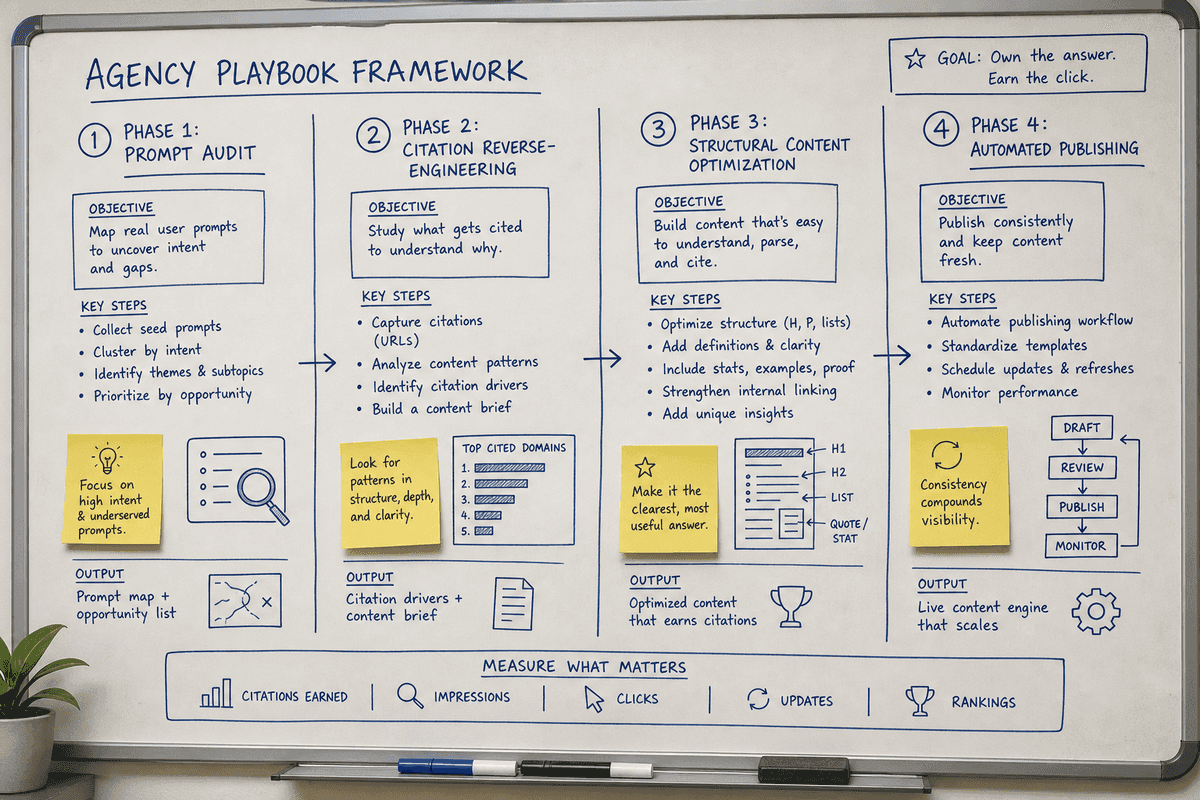
Phase 1: The Conversational Prompt Audit
Traditional keyword research begins with search volume databases. Generative search research begins with buyer journey mapping.
To build an actionable tracking portfolio for a client, divide prompts into four intent tiers:
- Problem Exploration Prompts: "What are the biggest challenges when scaling a B2B sales team?"
- Category Comparison Prompts: "What are the best CRM tools for mid-market logistics companies?"
- Alternative & Competitor Prompts: "How does [Competitor A] compare to [Competitor B] for enterprise security?"
- Validation Prompts: "Is [Client Brand] reliable for HIPAA-compliant file storage?"
By tracking 50 to 200 variations of these conversational queries across multiple engines, you establish an objective baseline: the client's current Generative Share of Voice (GSoV).
Phase 2: Citation Network Reverse-Engineering
When an AI engine answers a prompt, it rarely relies exclusively on the client’s homepage. It synthesizes data from an ecosystem of authoritative sources.
When an agency audit reveals that a competitor is consistently recommended, the tracking platform must answer three questions:
- Which third-party review platforms (e.g., G2, Capterra, Trustpilot) are cited in the answer?
- Which digital PR features or industry publications are linked?
- Which specific technical or educational blog posts provided the direct answer?
This citation map becomes your agency's direct action plan. If an LLM sources its recommendations from three specific comparison roundups, your immediate deliverable is getting your client placed on those three external pages while simultaneously creating superior owned content.
Phase 3: Content Production and Structural Optimization
LLMs evaluate content differently than traditional search crawlers. To get indexed and cited by generative models, content must be structured for machine extraction:
- Clear Entity Definitions: State clearly what the product or service is within the opening 100 words of a page.
- Direct Answer Architecture: Answer target sub-questions immediately beneath H2 headings before expanding into nuance.
- Structured Data and Tables: LLMs readily extract structured comparison tables, key metrics, and step-by-step frameworks.
When managing complex web architectures, agencies must ensure search crawlers can properly parse JavaScript-rendered content. For modern frameworks, implementing sound technical fundamentals is critical; review our guide on SEO for single page applications to avoid indexation pitfalls that prevent AI engines from crawling your site.
Phase 4: Closing the Loop with Automated Publishing
The most profitable agencies automate non-billable friction. When an AI tracking platform flags that a client lost citation share for a key commercial prompt, the workflow should immediately trigger a content update or new brief.
Using platforms like BeVisible, agencies can transition from visibility detection to content creation, client review, and direct CMS publishing within a single workspace. This eliminates administrative drag, ensures consistent publishing cadences, and demonstrates immediate ROI on client retainers.
A Case Scenario: Turning AI Visibility Gaps into Retainer Revenue
Consider how a B2B performance marketing agency uses AI search tracking in practice.
A digital marketing agency onboarded a mid-market cybersecurity client specializing in automated compliance software. During the initial audit, the agency discovered a stark visibility gap:
- In traditional Google organic search, the client ranked in the top 3 for "automated SOC 2 compliance software."
- Inside ChatGPT Search and Perplexity, however, the client was mentioned in 0 out of 20 commercial buyer queries. Competitors with lower traditional rankings dominated every AI recommendation.
AI Visibility Audit Results:
+------------------------------+--------------------+--------------------+
| Search Channel               | Client Visibility  | Competitor A       |
+------------------------------+--------------------+--------------------+
| Traditional Google (Top 3)   | 85% of keywords    | 40% of keywords    |
| ChatGPT Search Recommendations| 0% of prompts      | 75% of prompts     |
| Perplexity Citations         | 5% of prompts      | 80% of prompts     |
| Google AI Overviews          | 15% of queries     | 65% of queries     |

+------------------------------+--------------------+--------------------+
The Root Cause
The agency ran a deep citation audit using their AI search tracking platform. They discovered that Perplexity and ChatGPT were pulling recommendations from three specific sources:
- An independent Reddit discussion thread comparing SOC 2 tools.
- A comprehensive roundup article on a prominent technology blog.
- An in-depth comparison landing page hosted by a niche industry analyst.
The client had invested heavily in traditional keyword-targeted product pages, but had zero footprint across the third-party reference sources favored by generative models. Furthermore, their own blog content was gated behind PDF whitepapers, preventing AI web crawlers from reading and summarizing their data.
The Remediation Strategy
- Owned Content Architecture: The agency built an open, crawlable library of direct comparison articles and implementation guides answering specific compliance questions.
- Digital PR & Citation Outreach: The agency secured placement in two key industry comparison articles that generative models frequently referenced.
- Continuous Tracking: The agency monitored prompt visibility weekly to track how model updates and live web searches reflected the new citations.
Within 60 days, the client's brand recommendation rate rose from 0% to 65% across target ChatGPT prompts, resulting in a 28% increase in qualified demo requests sourced from AI search referrals. The agency successfully proved the direct commercial value of their GEO retainer.
Common Myths About AI Search Tracking
As generative engine optimization matures, several persistent misconceptions continue to mislead marketing teams.
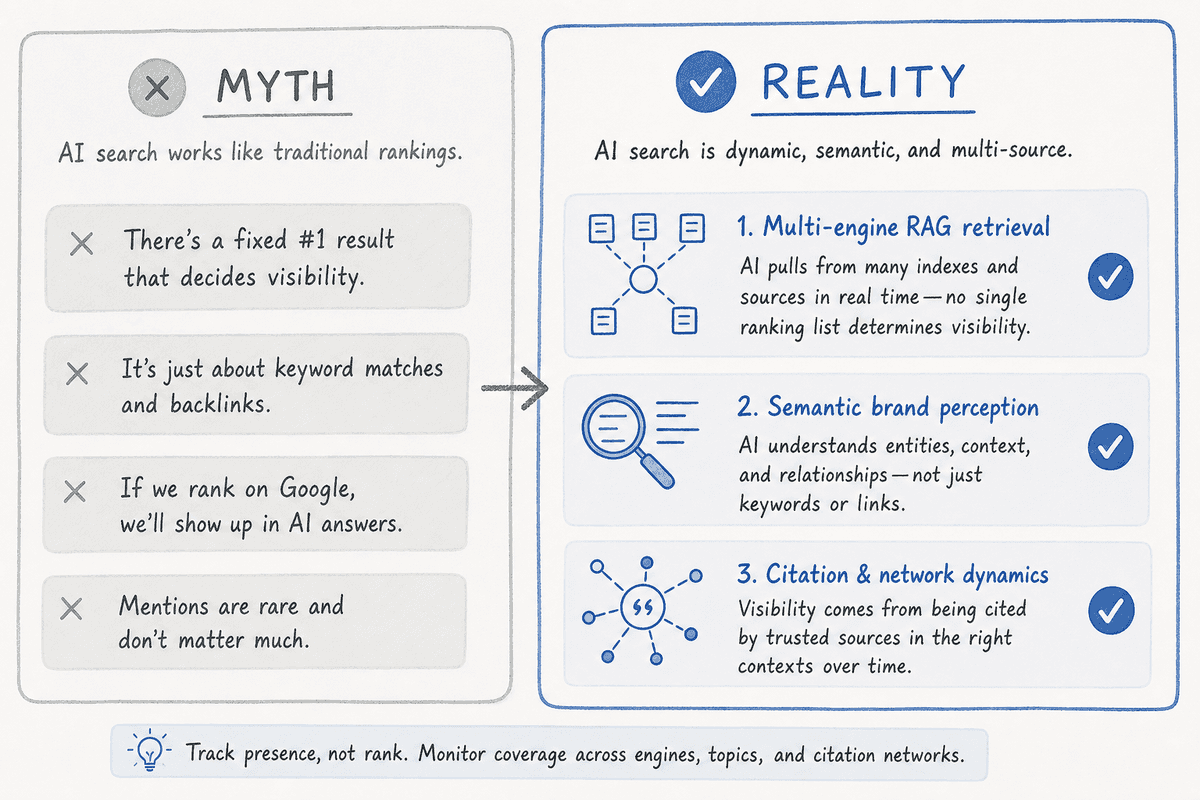
Myth 1: "AI Search Tracking Is Just Traditional Rank Tracking with New Labels"
Reality: Traditional rank tracking measures static URLs on a structured results page. AI search tracking measures semantic brand perception, entity relationships, dynamic multi-query RAG lookups, and citation extraction across non-deterministic models. A site can rank #1 on Google yet be completely ignored by ChatGPT if its content is unsuited for entity extraction.
Myth 2: "Optimizing for Google AI Overviews Solves for ChatGPT and Perplexity"
Reality: Each engine utilizes distinct retrieval architectures. Google AI Overviews lean heavily on Google's existing web index and topical authority systems. Perplexity utilizes custom web search aggregators with a heavy preference for recent, consensus-backed third-party articles and forums. ChatGPT Search blends Bing indexing with proprietary web retrieval algorithms. An agency must monitor each engine independently.
Myth 3: "LLM Outputs Are Completely Random and Cannot Be Measured Reliably"
Reality: While LLMs exhibit slight temperature-based variance, their retrieval-augmented generation systems are remarkably consistent when answering specific commercial queries. By running multi-prompt variations across consistent testing schedules, agencies can establish statistically sound baseline metrics that accurately reflect real-world buyer interactions.
Evaluating Platform Economics: How Agencies Should Price GEO Retainers
Adopting a new tracking platform requires calculating software costs against billable service margins.
When pricing AI search optimization for clients, agencies typically choose one of three models:
- The Add-On GEO Retainer ($1,500 – $3,500/month): Added to existing SEO or content retainers. Includes monthly prompt audits, GSoV reporting, and technical content optimization for AI citation capture.
- The Full-Service AI Search Retainer ($4,000 – $10,000+/month): A comprehensive offering covering continuous multi-engine monitoring, citation gap analysis, digital PR placement, and end-to-end content production.
- The Standalone AI Visibility Audit ($2,500 – $5,000 one-time): An entry-level audit benchmarking the client against competitors across 100+ buyer prompts, providing immediate strategic recommendations and serving as an on-ramp to long-term retainers.
To maintain healthy margins, the software you select should support multi-client scaling without forcing enterprise-level platform upgrades every time you sign a new account. For broader context on structuring agency pricing models, explore our breakdown on agency rates and automation.
Frequently Asked Questions
What is the difference between AEO and GEO?
Answer Engine Optimization (AEO) focuses on optimizing content to be returned as direct answers by conversational engines, voice assistants, and featured snippets. Generative Engine Optimization (GEO) is the broader discipline of optimizing a brand's total digital footprint so that generative AI models (like ChatGPT, Claude, and Gemini) accurately understand, recommend, and cite the brand in synthesized responses.
How often should an agency refresh AI search tracking data?
Because generative models refresh their web retrieval caches and pre-trained weights periodically, tracking high-intent commercial prompts on a weekly basis provides the optimal balance of actionable trend data without generating excessive metric noise. Monthly reporting is ideal for client deliverables, while weekly audits help content teams measure the impact of recent optimizations.
Can an agency track local AI search visibility?
Yes, but it requires tools capable of passing localized search parameters. When users query AI assistants for local services (e.g., "best commercial litigation firm near me"), engines use localized IP data and map pack citations to construct answers. Platforms that simulate browser environments can capture localized AI Overview and ChatGPT responses accurately.
Why do LLMs cite third-party review sites over brand homepages?
Generative models are trained to prioritize objective, consensus-driven information. When asked for product recommendations, an LLM perceives a third-party comparison article or review aggregator as less biased than a company's self-promotional sales page. Agencies must optimize both owned web properties and external citation sources to maximize generative visibility.
Choosing the Right Platform for Your Agency
Finding the right alternative to Profound comes down to your agency's business model, client portfolio, and delivery capabilities:
- If your agency requires an end-to-end platform that tracks prompt visibility across ChatGPT, Gemini, Perplexity, and AI Overviews, identifies citation blind spots, and turns those gaps into published articles, BeVisible provides the most cohesive operational workflow.
- If your focus is purely deep technical audits and enterprise e-commerce SERP simulation on Google AI Overviews, ZipTie.dev delivers granular URL-level citation diagnostics.
- If you want a straightforward monitoring dashboard for mid-market clients with Looker Studio connectivity, Otterly.ai offers clean, accessible reporting.
- If you want to keep all organic search and AI Overview tracking consolidated inside a legacy SEO database, Semrush provides convenient baseline integration.
Generative search has permanently altered how buyers discover products and services. Agencies that equip themselves with dedicated AI search tracking and execution platforms will lead the transition, delivering clear, defensible revenue growth for their clients.