
When a prospective buyer asks ChatGPT, Perplexity, or Google AI Overviews to recommend the best billing automation platform for mid-market SaaS, your marketing team is either in that synthesized answer or invisible.
Traditional rank trackers cannot tell you what happened. They report whether your homepage ranks in position four on a standard search results page. They do not report that Perplexity summarized a Reddit thread, an independent software evaluation, and two competitor case studies to deliver a direct recommendation that leaves your product out entirely.
Profound was among the early enterprise platforms to address this shift, offering answer engine monitoring and generative search tracking. Yet as generative engine optimization (GEO) matures, many B2B SaaS marketing teams find that enterprise-tier monitoring alone creates an operational bottleneck. Enterprise pricing tiers, rigid prompt packages, and dashboards that show visibility drops without providing execution workflows leave growth and content teams stuck. Knowing your brand is missing from 70% of Perplexity prompts is useful; knowing exactly which sources the model cited and how to produce content that fills the gap is what changes pipeline.
Below is an evaluation of the best Profound alternatives for SaaS marketing teams in 2026, breaking down how each platform approaches prompt tracking, citation analysis, multi-engine coverage, and the critical step from insight to published execution.
The AI Search Shift: Why SaaS Teams Need Dedicated Answer Engine Monitoring
SaaS buyer research has fundamentally bifurcated. Top-of-funnel informational queries and high-intent comparison queries are increasingly resolved inside generative interfaces. Buyers no longer click through ten distinct blue links to compare feature matrices across multiple tabs. Instead, they prompt large language models (LLMs) with nuanced, context-dense requirements:
- "What are the top SOC-2 compliant feature flagging tools that integrate natively with Datadog and cost under $1,000 per month for a 20-engineer team?"
- "Compare the churn prediction accuracy of [Competitor A] versus [Competitor B] for usage-based SaaS companies."
- "Which product analytics platforms offer self-hosted telemetry options for healthcare compliance?"
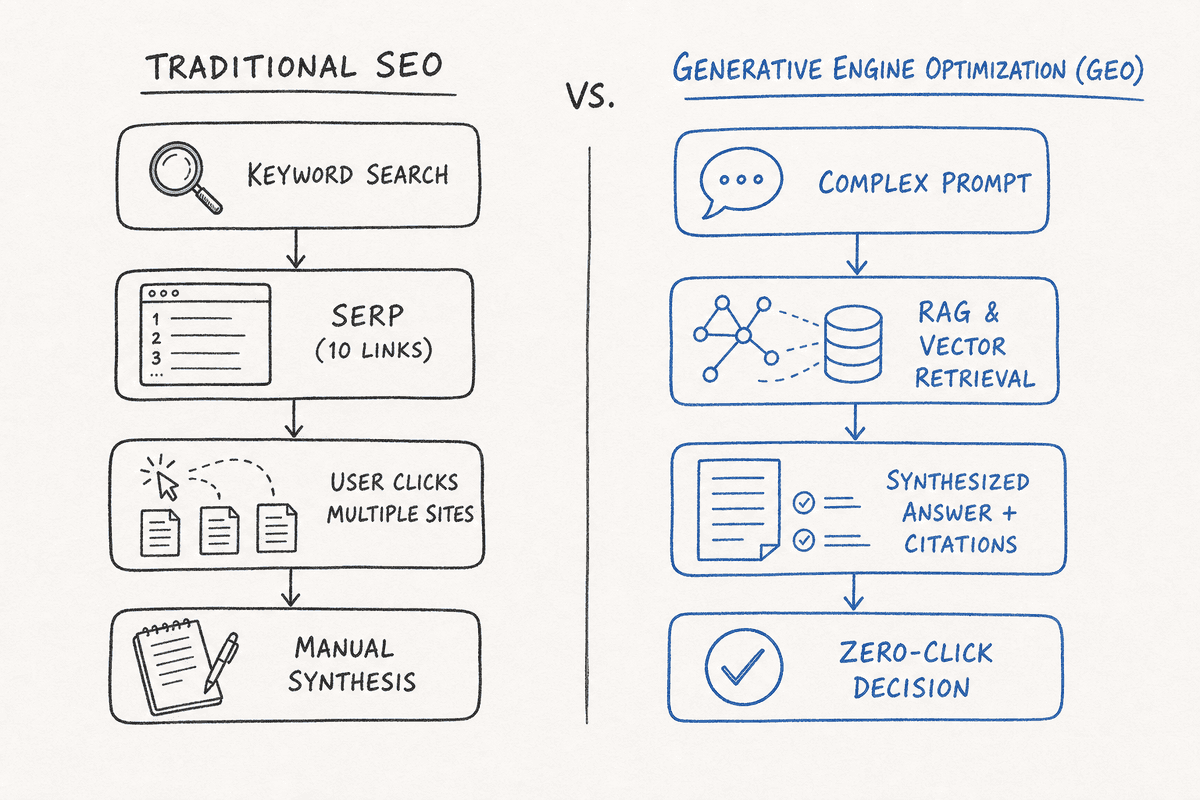
Traditional Search Engine Optimization (SEO)
Keyword Search  -->  SERP (10 Links)  -->  User Clicks Multiple Sites  -->  User Synthesizes

Generative Engine Optimization (GEO)
Complex Prompt  -->  RAG & Model Memory  -->  Synthesized Answer + Citations  -->  Zero-Click Decision
Standard search engine optimization focuses on keyword volume, crawl efficiency, backlink profiles, and single-page rankings. Generative engine optimization requires understanding retrieval-augmented generation (RAG), vector embeddings, citation co-occurrence, and sentiment synthesis across disparate web sources.
If your marketing stack relies solely on legacy rank trackers, you are measuring a shrinking slice of the buyer journey. Dedicated AI visibility platforms solve this by querying LLMs systematically across target buyer prompts, parsing the generated responses, extracting cited sources, and quantifying your brand's presence across the engines your buyers actually use.
Why Marketing Teams Seek Profound Alternatives
Profound established an early benchmark for enterprise AI brand visibility. However, SaaS marketing and content teams frequently encounter specific friction points that lead them to seek alternatives tailored to faster execution cycles and leaner operating models.
1. High Enterprise Barriers and Pricing Structures
Profound was architected primarily for enterprise digital PR teams, corporate communications, and Fortune 500 brand managers. For seed to Series C B2B SaaS companies, annual enterprise commitments and high seat costs create an unnecessary barrier. Growth teams require flexible seat models, scalable prompt limits, and pricing that aligns with content and growth team experimentation.
2. The "Measurement Without Execution" Gap
The most significant limitation of first-generation AI monitoring tools is that they function as passive diagnostic dashboards. They alert you that your brand's visibility dropped by 18% on Gemini across bottom-funnel comparison prompts. But they stop there.
Marketing teams are then left manually reading model citations, trying to identify which third-party websites or content gaps caused the omission, and drafting content briefs from scratch. Modern SaaS teams need tools that turn visibility deficits directly into evidence-backed editorial briefs, competitive counter-positioning, and publishable assets.
3. Limited Visibility into Dynamic RAG Sources
LLMs do not answer buyer prompts based solely on their static pre-training weights. When Perplexity, ChatGPT Search, or Google AI Overviews answer a query, they perform live web retrieval.
If an AI visibility tool merely tallies brand name mentions without isolating the specific URLs, domain authorities, review aggregators, and technical documentation the LLM ingested to formulate its answer, the marketing team cannot intervene. An effective alternative must provide granular citation source mapping.
4. Overly Rigid Prompt Tracking Environments
SaaS buyer queries are not static keywords. A prospect might ask the same question in dozens of conversational variations, introducing specific constraints around tech stacks, compliance requirements, or pricing tiers. Platforms built strictly around rigid keyword lists miss the conversational permutations that real B2B buyers submit.
Core Criteria for Evaluating AI Visibility Platforms
Before comparing specific software alternatives, SaaS marketing leaders should evaluate candidate tools against five foundational capabilities.
+-----------------------------------------------------------------------------------+
|                        THE AI VISIBILITY EVALUATION MATRIX                        |
+-----------------------------------+-----------------------------------------------+
| Capability                        | What to Look For                              |
+-----------------------------------+-----------------------------------------------+
| Multi-Engine Coverage             | ChatGPT (4o/Search), Perplexity, Gemini,      |
|                                   | Claude, Google AI Overviews, Copilot          |

+-----------------------------------+-----------------------------------------------+
| Granular Citation & Source Graph  | Extracts citing URLs, domain frequency, and   |
|                                   | authority tiers feeding model RAG pipelines   |

+-----------------------------------+-----------------------------------------------+
| Share of Model (SoM) Analytics    | Measures mention frequency, ranking order,    |
|                                   | and sentiment vs. direct named competitors    |

+-----------------------------------+-----------------------------------------------+
| Prompt Simulation & Clustering    | Simulates realistic multi-turn persona        |
|                                   | prompts across different buyer journey stages |

+-----------------------------------+-----------------------------------------------+
| Insight-to-Execution Workflow     | Translates visibility gaps into editorial     |
|                                   | briefs, content updates, and publishable work |

+-----------------------------------+-----------------------------------------------+
Multi-Engine Coverage
Your prospective buyers do not use a single AI engine. Technical developers and engineering leaders may gravitate toward Claude and Perplexity; enterprise procurement teams often use Microsoft Copilot; general business operators lean heavily on ChatGPT; while Google AI Overviews intercept standard web searches automatically. A robust platform must monitor across all major engines rather than relying solely on OpenAI APIs.
Citation and Grounding Source Attribution
When an AI assistant produces an answer, it grounds its synthesis in external sources. You need to know:
- Is the model citing your product documentation, a competitor's blog, a high-authority software directory (G2, Capterra), or an informal community thread (Reddit, Hacker News)?
- Which specific URLs appear most frequently across prompts in your software category?
- Which domains act as citation hubs for your competitors?
Share of Model (SoM) and Competitive Benchmarking
In traditional SEO, you measure Share of Voice based on click-through curves across keyword positions. In GEO, the metric is Share of Model (SoM): the percentage of relevant category prompts where an AI engine includes your brand versus your direct competitors, accompanied by the sentiment and positioning context of that mention.
Prompt Permutation and Persona Modeling
Static query tracking produces misleading data. An AI engine might mention your SaaS when asked "What is the best customer support software?" but completely omit your product when asked "What is the best ticketing software for B2B SaaS with automated SLA escalation?" The platform must support multi-layered buyer personas and conversational prompt modifiers.
Execution Integration
Measuring brand visibility is an overhead cost unless it directly informs your content production and optimization pipeline. The best platforms bridge the gap between tracking a gap and closing it by generating data-backed briefs, recommending specific target citations, and integrating with content management systems.
The Top Profound Alternatives for SaaS Marketing Teams
+------------------+------------------------------+-------------------------------------+
| Tool             | Best Suited For              | Core Differentiator                 |
+------------------+------------------------------+-------------------------------------+
| BeVisible        | SaaS teams needing tracking  | Tracks multi-engine visibility and  |
|                  | plus automated execution     | turns gaps into published content   |

+------------------+------------------------------+-------------------------------------+
| AirOps           | Content operations teams     | Connects visibility measurement to  |
|                  | with custom AI pipelines     | programmatic content workflows      |

+------------------+------------------------------+-------------------------------------+
| OtterlyAI        | Mid-market SaaS marketing    | Fast setup for brand monitoring,    |
|                  | and growth teams             | GEO audits, and citation tracking   |

+------------------+------------------------------+-------------------------------------+
| Peec AI          | Global and multi-region SaaS | Multi-language monitoring with      |
|                  | organizations                | daily visibility updates            |

+------------------+------------------------------+-------------------------------------+
| Vismore          | Performance marketers and    | Straightforward prompt tracking and |
|                  | search strategists           | competitive SoM benchmarking        |

+------------------+------------------------------+-------------------------------------+
| MarqOps /        | Marketing analytics and B2B  | Deep reporting on AI search share   |
| AIAttention      | demand gen leaders           | of voice and executive metrics      |

+------------------+------------------------------+-------------------------------------+
1. BeVisible
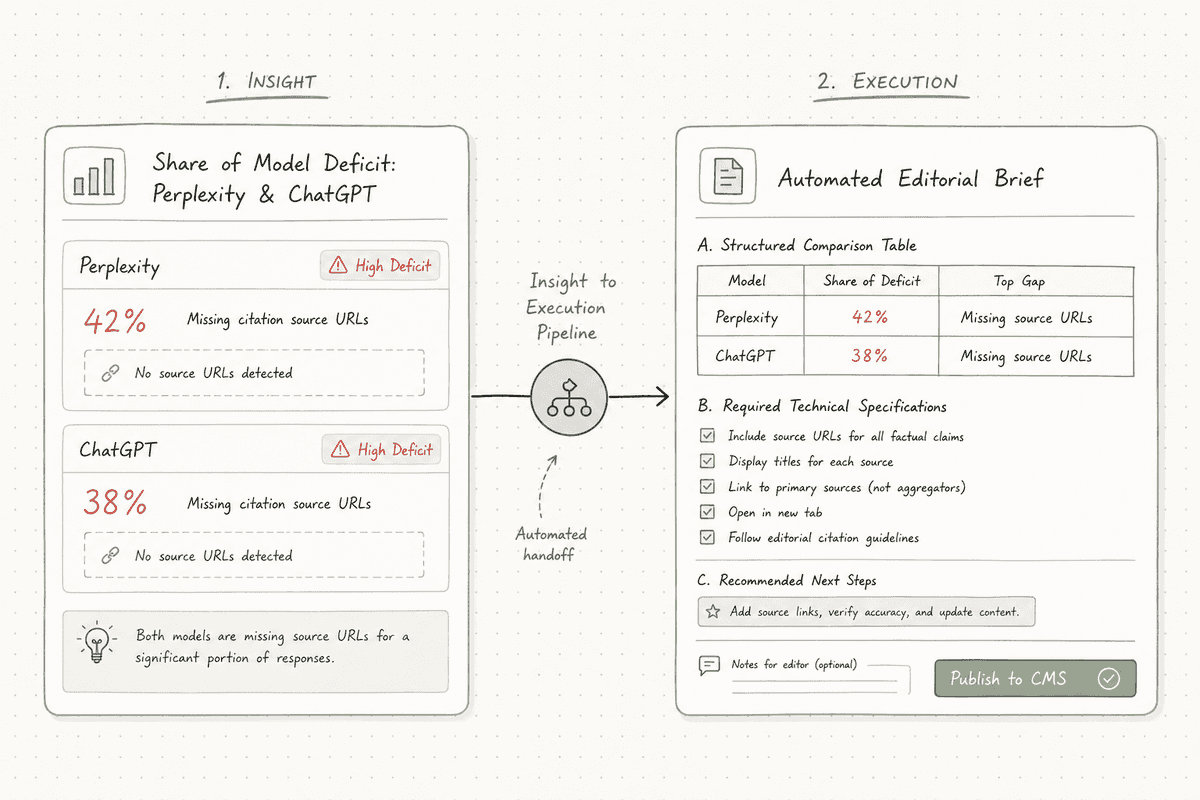
BeVisible was designed specifically to solve the "measurement without action" dilemma that plagues enterprise analytics tools. Rather than simply delivering charts showing where your SaaS is missing from generative search answers, BeVisible links AI monitoring directly to editorial execution.
Key Capabilities
- Full Multi-Engine Monitoring: Tracks how your brand and competitors are represented across ChatGPT, Gemini, Perplexity, AI Mode, and Google AI Overviews across custom buyer prompt sets.
- Citation and Source Mapping: Identifies the exact third-party publications, community discussions, and canonical articles that AI engines cite when answering questions about your software category.
- Evidence-Backed Opportunity Detection: When an AI engine recommends a competitor or fails to mention your SaaS, BeVisible highlights the specific information gap that caused the omission.
- End-to-End Workflow Engine: Transforms detected visibility gaps into structured editorial briefs, article drafts, scheduling, and published content designed to satisfy model retrieval mechanisms.
Where It Outperforms Profound
For SaaS marketing teams that do not have dedicated data science teams to interpret raw AI tracking data, BeVisible provides a direct operational bridge. It answers not just "What is our Share of Model?" but "What specific content must we publish this week to win inclusion in these twenty buyer prompts?"
Ideal Use Case
B2B SaaS founders, growth marketing teams, and content leads who want unified AI search tracking that connects directly to pipeline-driving content production.
2. AirOps
AirOps approaches AI brand visibility from a modular, workflow-first perspective, allowing growth and SEO teams to build custom AI pipelines that monitor brand presence and generate programmatic content updates.
Key Capabilities
- Custom AI Evaluation Workflows: Users can configure custom prompts and evaluation rubrics to test how different LLMs view their product catalog.
- Grid and Workflow Automation: Connects AI monitoring outputs directly to database grids, enabling automated bulk audits of brand citations across large prompt sets.
- Programmatic Content Generation: Allows teams to build automated workflows that ingest missing brand signals and draft targeted landing pages or informational articles.
Tradeoffs for SaaS Teams
AirOps offers exceptional flexibility, but it requires operational setup. Teams must spend time building and refining their monitoring pipelines rather than relying on an out-of-the-box tracking dashboard.
Ideal Use Case
Technical marketing teams and content operations leads who want granular API control and custom pipeline construction for enterprise-scale content production.
3. OtterlyAI
OtterlyAI has established itself as an accessible, user-friendly platform for tracking brand mentions across major conversational search engines, making it a viable alternative for mid-market teams looking to replace enterprise monitoring overhead.
Key Capabilities
- Multi-Platform Brand Audits: Scans ChatGPT, Perplexity, and Google AI Overviews to monitor brand positioning, sentiment, and recommendation rates.
- Citation Tracking: Details which web resources models use to justify their recommendations.
- Optimization Recommendations: Provides prescriptive recommendations on how to adjust website copy and digital PR efforts to align with model preferences.
Tradeoffs for SaaS Teams
While OtterlyAI provides clear dashboards and competitive auditing, it operates primarily as an analytical platform, leaving the actual production and deployment of remedial content to external workflows.
Ideal Use Case
Mid-market SaaS marketing teams seeking an intuitive, rapid-to-deploy monitoring tool for executive reporting and competitive brand share tracking.
4. Peec AI
For SaaS organizations operating across international markets, Peec AI provides specialized multi-lingual generative search monitoring.
Key Capabilities
- Cross-Language Prompt Evaluation: Tracks brand visibility across non-English buyer prompts in European, Asian, and Latin American markets.
- Daily Visibility Updates: Provides high-frequency tracking of model response shifts to catch sudden drops in brand recommendations.
- Competitor Benchmark Grids: Side-by-side visualization of competitor mention frequency across multiple languages and geographies.
Tradeoffs for SaaS Teams
Peec AI focuses heavily on the tracking and benchmarking layer. Teams looking for integrated content creation or deep CMS publishing automation will need to pair it with supplementary tools.
Ideal Use Case
Global B2B SaaS companies selling across multiple geographies who need to monitor international AI search results.
5. Vismore
Vismore focuses on delivering practical, no-nonsense generative engine monitoring that cuts through vanity metrics to highlight commercial intent prompts.
Key Capabilities
- Commercial Intent Focus: Prioritizes bottom-of-funnel comparison and purchasing prompts over generic informational queries.
- Share of Model (SoM) Dashboards: Delivers clean visual comparisons of brand vs. competitor recommendation percentages.
- Model Discrepancy Analysis: Highlights instances where ChatGPT recommends your product but Perplexity or Gemini omits it, pinpointing engine-specific retrieval biases.
Tradeoffs for SaaS Teams
Vismore provides sharp analytical clarity, but it is primarily focused on search strategists who want raw competitive data rather than automated execution pipelines.
Ideal Use Case
Performance marketers and organic search leads who want precise competitive visibility tracking without enterprise sales friction.
6. MarqOps & AIAttention
Platforms like MarqOps and AIAttention cater to enterprise demand generation leaders who require executive-ready reporting on AI search share of voice.
Key Capabilities
- Executive Share of Voice Reporting: Visualizes how brand perception in AI search correlates with category market share over time.
- Sentiment and Context Classification: Categorizes whether brand mentions are positive recommendations, neutral inclusions, or negative comparisons.
- Enterprise Role Management: Robust permissioning and multi-workspace support for large marketing departments.
Tradeoffs for SaaS Teams
Like Profound, these platforms lean heavily into the enterprise reporting paradigm, making them less suitable for agile growth teams that need to turn insights into content immediately.
Ideal Use Case
Senior marketing leaders at late-stage B2B SaaS enterprises who need executive dashboards for board reporting and category sentiment analysis.
Detailed Comparison: Profound Alternatives for SaaS
+---------------------+-------------------+---------------------+---------------------+---------------------+
| Feature / Metric    | BeVisible         | AirOps              | OtterlyAI           | Profound            |
+---------------------+-------------------+---------------------+---------------------+---------------------+
| Primary Focus       | Monitoring +      | Workflow & Content  | Mid-Market Brand    | Enterprise Brand    |
|                     | Content Execution | Automation Pipelines| Tracking & Auditing | & PR Monitoring     |

+---------------------+-------------------+---------------------+---------------------+---------------------+
| Engines Monitored   | ChatGPT, Gemini,  | Custom (OpenAI,     | ChatGPT, Perplexity,| ChatGPT, Perplexity,|
|                     | Perplexity, Claude| Claude, Gemini via  | Google AI Overviews | Gemini, Copilot,    |
|                     | AI Overviews      | API keys)           |                     | Claude              |

+---------------------+-------------------+---------------------+---------------------+---------------------+
| Citation & Source   | Full URL & Domain | Configurable via    | Domain & URL        | Domain & URL        |
| Graphing            | Attribution Graph | custom scraping     | level tracking      | level tracking      |

+---------------------+-------------------+---------------------+---------------------+---------------------+
| Insight-to-Content  | Native (Briefs,   | Native (via custom  | Analytical          | Analytical          |
| Execution           | Drafts, Publish)  | programmatic flows) | recommendations only| reporting only      |

+---------------------+-------------------+---------------------+---------------------+---------------------+
| Setup Complexity    | Low (Ready-to-use | High (Requires flow | Low (Ready-to-use   | Medium-High         |
|                     | workflows)        | building & logic)   | dashboard)          | (Enterprise setup)  |

+---------------------+-------------------+---------------------+---------------------+---------------------+
| Target Customer     | B2B SaaS, Content | Technical Marketers | Mid-Market SaaS     | Fortune 500 Brands, |
|                     | & Growth Teams    | & Growth Engineers  | Marketing Teams     | Enterprise PR Teams |

+---------------------+-------------------+---------------------+---------------------+---------------------+
How AI Engines Select SaaS Tools: The Mechanics of Retrieval
To choose the right alternative and use it effectively, marketing teams must understand how modern generative engines determine which SaaS brands to recommend.
When an AI engine processes a query like "What is the best customer success platform for reducing B2B churn?", it does not simply retrieve the page with the most backlinks. Instead, it follows a multi-stage retrieval and synthesis process.
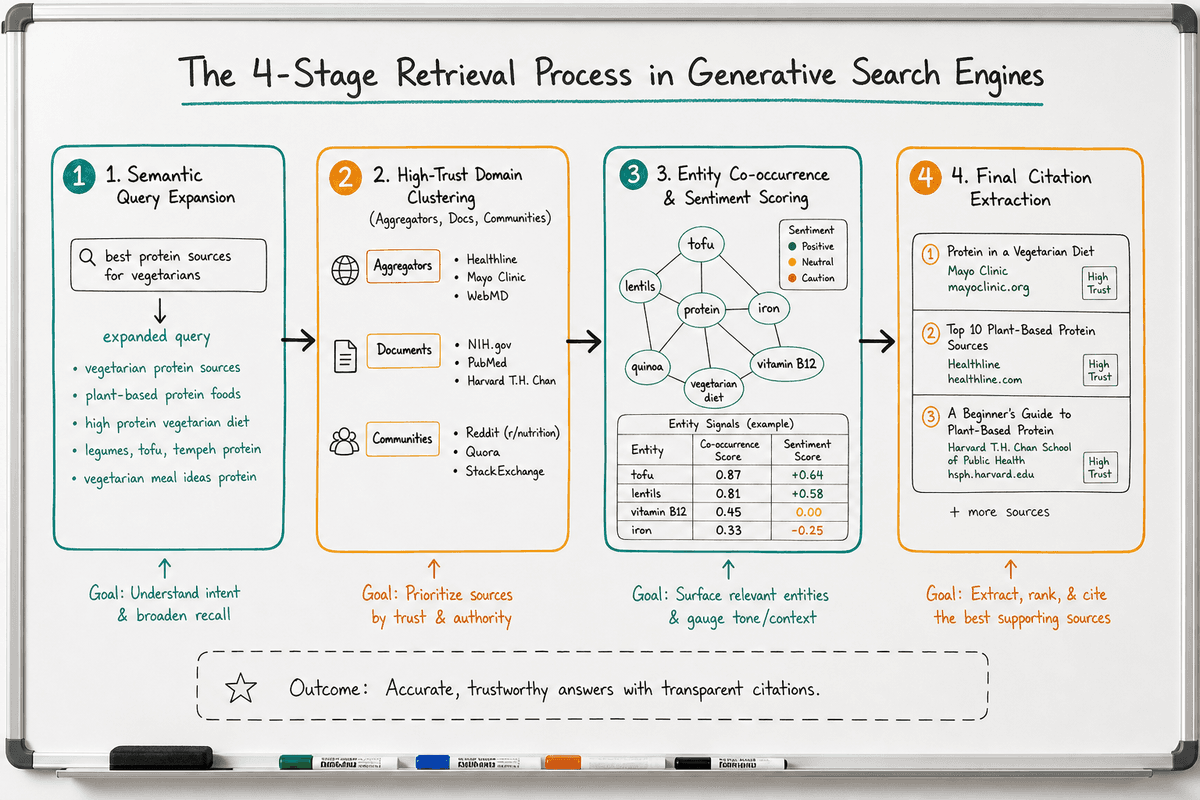
1. Query Expansion and Embedding Retrieval
The LLM breaks the buyer prompt into conceptual entities and intent vectors. It expands the query into related sub-concepts: customer health scoring, automated churn intervention, CRM integrations, and predictive analytics. It then searches its vector index and live search indexes for documents that match these semantic relationships.
2. High-Trust Domain Clustering
For commercial evaluation queries, LLMs heavily weight specific categories of external validation:
- Peer Reviews and Aggregators: G2, Capterra, TrustRadius, and Gartner Peer Insights.
- Community Consensus: Reddit (e.g., r/SaaS, r/marketing), Hacker News, and specialized Slack/Discord community exports indexed on the web.
- Authoritative Technical Documentation: Public API documentation, integration directories, and security compliance portals.
- In-Depth Comparative Analysis: Independent comparison posts, teardowns, and expert practitioner guides that provide objective evaluation criteria rather than promotional sales copy.
If your SaaS relies entirely on product landing pages packed with vague marketing buzzwords, model retrieval systems struggle to extract concrete facts. To understand how structured content architecture impacts crawlability and indexing, review our guide to building high-performing SEO landing pages.
3. Entity Co-Occurrence and Sentiment Synthesis
The engine analyzes how often your product entity appears in close semantic proximity to your product category, specific use cases, and positive sentiment markers. If fifty high-authority articles mention your competitor as the default solution for "enterprise SOC-2 compliance," the model learns this association as an empirical fact.
4. Direct Citation Extraction
Finally, the model synthesizes the answer, adding citations to the sources that provided the most concise, authoritative, and non-conflicting facts. If your competitors maintain comprehensive comparison articles, transparent pricing teardowns, and detailed documentation, the model cites them as grounding references.
Scenario: Diagnosing and Fixing an AI Visibility Deficit
To see how AI visibility tools work in practice, consider a realistic SaaS scenario.
The Problem
A Series B SaaS company offering an automated data pipeline tool noticed that inbound demo requests containing the phrase "We found you on Perplexity" had plateaued, while a direct competitor was capturing increasing market share.
Traditional SEO rank tracking showed that the company ranked in positions 3 to 5 on Google for "data pipeline automation software." On paper, their search performance looked stable.
The AI Visibility Audit
The team deployed an AI visibility monitoring platform to audit 50 high-intent evaluation prompts across ChatGPT, Perplexity, Gemini, and Google AI Overviews.
+-----------------------------------------------------------------------------------+
|                           PROMPT AUDIT RESULTS SUMMARY                            |
+-----------------------------------+-----------------------------------------------+
| Engine                            | Brand Recommendation Rate (Share of Model)    |
+-----------------------------------+-----------------------------------------------+
| ChatGPT Search                    | 22% (Competitor A: 78%, Competitor B: 64%)    |
| Perplexity                        | 14% (Competitor A: 86%, Competitor B: 72%)    |
| Google AI Overviews               | 30% (Competitor A: 70%, Competitor B: 55%)    |
| Claude (Direct Reasoning)         | 18% (Competitor A: 82%, Competitor B: 60%)    |

+-----------------------------------+-----------------------------------------------+
The Root Cause Discovery
By analyzing the citation source graph provided by the tracking tool, the team uncovered three critical blind spots:
- Missing Integration Documentation: When users asked for data pipeline tools that integrated natively with Snowflake and dbt, the AI engines cited a specific technical comparison article published by Competitor A. The company had those integrations, but the details were buried behind an unindexed help center login.
- Review Aggregator Category Disconnect: On G2, the company was categorized under "Data Integration" while buyers and LLMs were querying "Data Pipeline Automation." The models were pulling category leaders directly from the latter taxonomy.
- Absence in Third-Party Comparison Content: Out of the top 15 URLs most frequently cited by Perplexity for category comparison queries, the company was mentioned in only two. Competitor A was featured in twelve.
AI Tracking Insight:
Perplexity cited "techstack-reviews.com/best-data-pipelines" in 64% of prompts.
Target Brand was missing from the article.

Action Taken:
1. Outreach to site editorial team with updated product specifications.
2. Published an exhaustive public comparison page with benchmarks and integration specs.
3. Re-indexed technical documentation publicly.

Result at 60 Days:
Share of Model increased from 14% to 58% on Perplexity.
Inbound generative search referral traffic grew by 142%.
The Operational Playbook: Turning AI Visibility Gaps into Growth
Monitoring your Share of Model is step one. To translate AI visibility data into revenue, SaaS marketing teams should run a systematic four-stage execution cycle.
+-----------------------------------------------------------------------------------+
|                        THE AI VISIBILITY EXECUTION ENGINE                         |
|                                                                                   |
|  [ 1. Prompt Audit ]      Identify high-intent buyer prompts across all engines   |
|         │                                                                         |
|         ▼                                                                         |
|  [ 2. Source Extraction ] Map citing URLs, review gaps, and competitor hubs       |
|         │                                                                         |
|         ▼                                                                         |
|  [ 3. Targeted Production]Publish structured comparisons, docs, and PR updates    |
|         │                                                                         |
|         ▼                                                                         |
|  [ 4. Verification ]      Measure re-indexing, citation gain, and SoM lift        |

+-----------------------------------------------------------------------------------+
Stage 1: Build a Commercial Prompt Corpus
Do not track vanity brand searches like "What is [Your Company Name]?" LLMs will almost always answer brand-direct queries accurately. Instead, construct a prompt corpus focused on unbranded, high-intent commercial research across three tiers:
- Category Exploration: "What are the top automated QA testing platforms for mobile apps?"
- Constrained Selection: "Which SOC-2 compliant QA tools integrate with GitHub Actions and support React Native?"
- Competitor Head-to-Head: "Should I use [Competitor A] or [Competitor B] for continuous integration testing?"
Stage 2: Extract the Grounding Source Graph
For every prompt where your brand is omitted or unfavorably framed, extract the citing domains:
- Identify which third-party comparison sites appear consistently across engines.
- Check whether your brand profile on those sites is complete, up to date, and categorized accurately.
- Identify informational gaps in your public documentation that prevent RAG bots from confirming your product capabilities.
Stage 3: Publish Structured, Fact-Dense Content
LLMs prioritize structured, verifiable information over vague marketing claims. When producing content to capture AI citations:
- Use clean table layouts for feature comparisons, pricing tiers, and integration support.
- Provide concrete technical specifications (e.g., supported protocols, API rate limits, compliance certifications) in clear, plain text.
- Publish dedicated alternative and comparison pages that objectively break down the tradeoffs between your software and competitors. For examples of top-tier educational content strategies, explore our curated list of the best SEO blogs for SaaS founders.
Stage 4: Verify Re-Indexing and Measure Share of Model Growth
AI search engines re-index the web at varying speeds. Perplexity and ChatGPT Search update their real-time retrieval sources within days, while core LLM model weights take months to refresh. Monitor your Share of Model metrics bi-weekly to observe how new publications and digital PR updates translate into direct AI recommendations.
Common Misconceptions About Generative Engine Optimization
As marketing teams shift budget from legacy search tools to AI visibility platforms, several common myths can derail strategy.
Myth 1: "AI Optimization Replaces Traditional Technical SEO"
Generative search engines rely heavily on traditional search indexing infrastructure. Perplexity and ChatGPT Search use web crawlers to retrieve real-time data. If your website suffers from poor indexing, slow load times, unrenderable client-side JavaScript, or broken canonical tags, LLM crawlers cannot ingest your content. Technical SEO remains the prerequisite foundation for generative visibility.
Myth 2: "You Can Game AI Visibility with Keyword Stuffing"
In standard search, basic keyword frequency used to move rankings. LLMs, however, operate on semantic embeddings and transformer attention mechanisms. Repeating a phrase twenty times across an article will not trick a model into recommending your product. Models evaluate conceptual coherence, source credibility, and contextual validation across multiple web entities.
Myth 3: "Share of Model is Fully Deterministic"
Traditional Google rankings are largely deterministic: position three is position three for most users in a given region. LLM responses, by contrast, are probabilistic. Temperature settings, conversation history, and slight prompt phrasing variations mean an AI engine might recommend your product in four out of five identical queries. Effective AI visibility platforms measure statistical frequency over repeated iterations rather than treating a single prompt response as an absolute rank.
Frequently Asked Questions (FAQ)
How is Share of Model (SoM) calculated in AI visibility tools?
Share of Model represents the percentage of simulated queries in which an AI engine explicitly includes, mentions, or recommends your brand across a defined set of category-specific prompts. It is typically weighted by sentiment (positive, neutral, negative) and position within the generated list (e.g., being recommended first versus fifth).
Can small SaaS marketing teams optimize for AI search without large budgets?
Yes. Unlike traditional search, where enterprise competitors often dominate high-volume keywords through massive backlink moats, AI engines prioritize clear, structured, and accurate factual answers. A small SaaS team that publishes thorough, transparent comparison pages, comprehensive technical documentation, and maintains active presence on community channels (like Reddit and niche forums) can win significant citation share in generative search.
How often should SaaS teams run AI visibility audits?
High-intent commercial prompts should be monitored continuously or on a weekly schedule. Because LLM search engines constantly refresh their RAG retrieval sources and periodically deploy model updates, brand visibility can fluctuate rapidly when competitors publish new comparison assets or update their category positioning.
What is the difference between Answer Engine Optimization (AEO) and Generative Engine Optimization (GEO)?
Answer Engine Optimization (AEO) originally focused on winning structured answers in traditional search, such as Google featured snippets and voice search responses. Generative Engine Optimization (GEO) specifically addresses multi-model AI synthesis across tools like ChatGPT, Claude, Gemini, and Perplexity, focusing on how large language models retrieve, evaluate, and synthesize multiple web sources into conversational recommendations.
Moving from Monitoring to Action
Tracking where your brand stands in generative search is no longer optional for SaaS marketing teams. As prospective software buyers increasingly rely on AI assistants to shortlist vendors, evaluate feature sets, and make purchasing decisions, brand omission from LLM answers directly impacts your pipeline.
While early platforms like Profound proved the value of generative search analytics for enterprise PR teams, modern SaaS growth demands speed, granular source attribution, and seamless workflow execution. Choosing an alternative that bridges the gap between tracking a visibility deficit and publishing the exact content needed to fix it is how modern marketing teams build a durable advantage in the AI-first search landscape.