
When a B2B buyer types "best CRM for mid-sized agencies" into ChatGPT or Perplexity, they no longer see ten blue links. They receive a single, synthesized paragraph recommending three specific platforms, complete with pros, cons, and direct citations. If your SaaS is not part of that output, you have entirely lost a high-intent prospect before they even knew you existed.
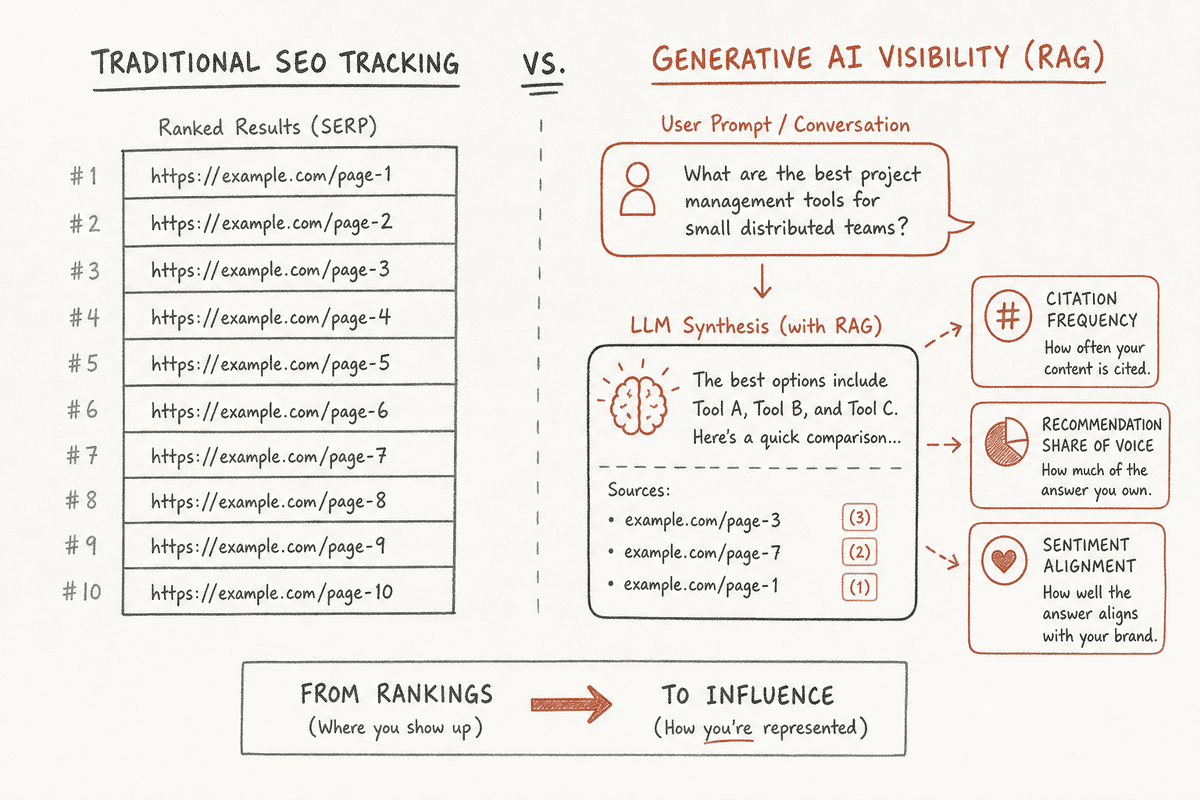
Traditional rank trackers cannot measure this. They look for static URLs on a search engine results page (SERP). Answer Engine Optimization (AEO) and AI visibility require a completely different measurement framework. As GrowthOS notes, AI visibility tools are distinct because they track how often and how positively your software is mentioned, cited, or recommended across summarized generative content, rather than tracking listicle rankings.
Profound has emerged as a well-known name in this space, offering enterprise-grade tracking. However, SaaS marketing teams frequently hit friction points with legacy-style enterprise platforms. They often need tools that move beyond passive reporting to active execution.
If you are evaluating how to track your brand across Gemini, ChatGPT, and AI Overviews, you need a platform built for modern workflows. Here is a breakdown of why SaaS teams look for Profound alternatives, and the best platforms available for measuring and manipulating AI search visibility.
Why SaaS Teams Outgrow Basic Rank Tracking
Large Language Models (LLMs) operate on a system called Retrieval-Augmented Generation (RAG). When a user asks a question, the AI scours the live web, retrieves relevant documents, reads them, and synthesizes an answer.
Traditional SEO focuses on getting a page to rank first. Generative Engine Optimization (GEO) focuses on ensuring the AI understands and trusts your page enough to cite it as the definitive source.
This creates three new metrics that traditional SEO tools simply cannot measure:
- Citation Frequency: How often does an AI assistant link to your domain as a source?
- Recommendation Share of Voice: When a user asks for tool recommendations, how often is your brand named compared to your competitors?
- Sentiment Alignment: When the AI mentions your brand, is the context positive, neutral, or negative?
To track these metrics, teams require specialized software. 42DM's platform overview emphasizes that selecting the right platform comes down to aligning the tool's tracking mechanics with your specific business needs—whether that is massive enterprise crawling or agile content execution.
The Profound Dilemma: Analytics vs. Execution
Profound is widely recognized as a heavy-hitting, enterprise-grade solution for holistic AI search visibility and answer engine optimization, heavily featured in discussions about the best AI SEO tools. It provides deep competitive benchmarks and tracks a wide array of answer engine citations.
However, SaaS founders and growth teams often seek alternatives to Profound for three distinct reasons:
- The "So What?" Problem: Having a dashboard that tells you ChatGPT recommends a competitor 60% of the time is only half the battle. The other half is knowing exactly what content to publish, update, or schedule to fix that gap. Many enterprise tools stop at the reporting layer.
- Resource Allocation: Enterprise pricing models often force smaller, highly agile B2B marketing teams to dedicate an oversized portion of their budget just to monitoring, leaving little capital for the actual content creation required to shift the needle.
- Workflow Fragmentation: Identifying a missing citation is an analytical task. Fixing it is a publishing task. Platforms that do not bridge the gap between discovery and execution force teams to export data into spreadsheets and manage the actual work elsewhere.
The Best Profound Alternatives for SaaS in 2026
Depending on your team size, whether you prioritize execution over mere reporting, and how deeply you want to integrate traditional SEO, the market offers several capable alternatives.
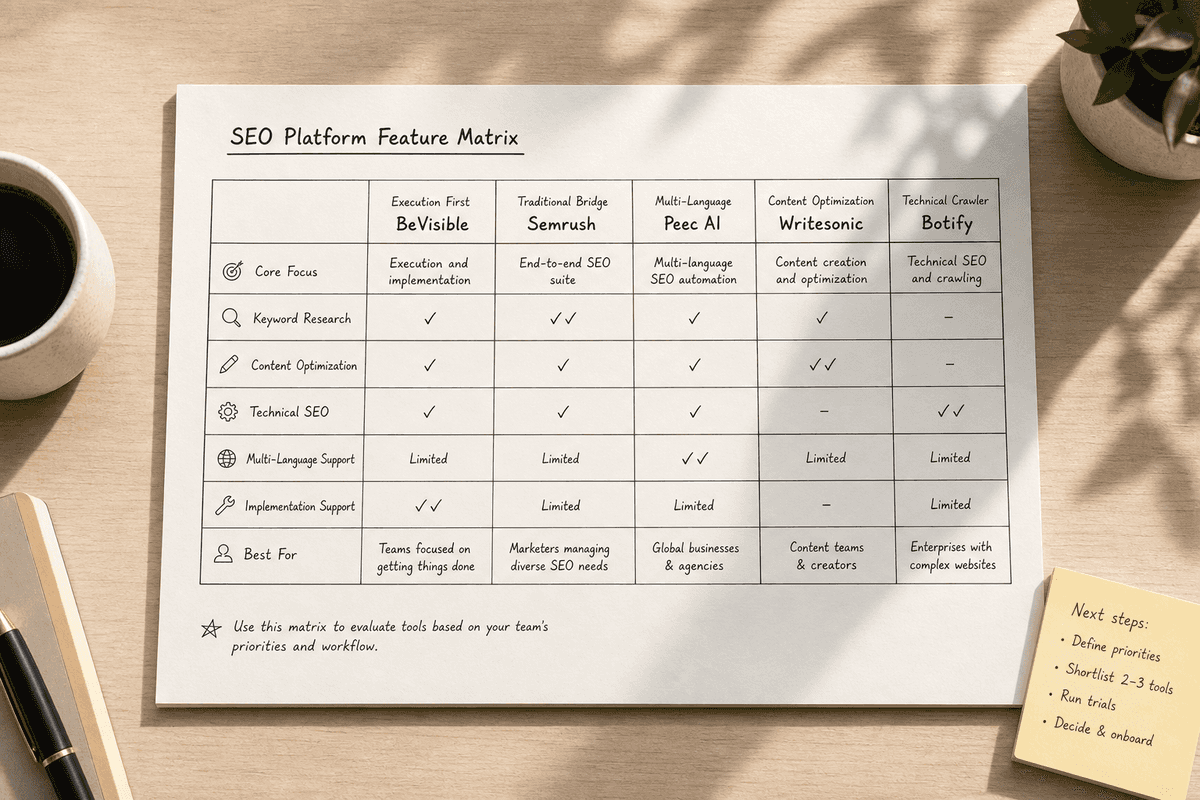
1. BeVisible (The Execution-First Alternative)
For SaaS growth teams and agencies that need to translate visibility gaps into immediate action, BeVisible is designed entirely around the execution workflow. Rather than just reporting on where you stand, it connects the dots between missing mentions and the work required to capture them.
BeVisible monitors ChatGPT, Gemini, Perplexity, AI Mode, and Google's AI Overviews across your target buyer prompts. When it detects that an AI assistant is recommending a competitor, citing a weak source, or omitting your brand entirely, it turns those gaps into evidence-backed opportunities.
Instead of exporting CSV files to a separate project management tool, teams use BeVisible to build their articles, schedule reviews, and manage the publishing work that directly impacts LLM context. It is the strongest alternative for teams that measure success by tasks completed and visibility gained, rather than just charts generated.
2. Semrush (The Traditional SEO Bridge)
Semrush remains a powerhouse for teams that cannot entirely abandon traditional SEO. While they are known for keyword research and backlink analysis, their foray into Generative Engine Optimization makes them a viable alternative for teams wanting everything under one roof.
Semrush excels at citation analysis. Because LLMs rely heavily on high-authority, well-structured content to form their answers, Semrush's ability to map traditional search dominance to AI citation likelihood is unparalleled. It is highly suited for large marketing departments that need to balance standard search volume with emerging generative queries.
If you are trying to understand the baseline costs of agency support for these massive tools, reviewing current SEO charges UK data can help benchmark whether bringing an enterprise tool like Semrush in-house is more cost-effective than outsourcing.
3. Peec AI (The Mid-Market Multi-Language Specialist)
For mid-sized teams heavily reliant on European markets or non-English queries, Peec AI frequently surfaces as a top contender.
According to Thomas Peham's feature matrix of AI visibility tools, Peec AI excels in tracking brand sentiment across multiple LLMs and handles multi-language environments exceptionally well. Position Digital's honest reviews also highlight it as a highly capable platform for smaller teams focused on strict citation analysis without the enterprise bloat.
If your SaaS serves distinct regional markets and you need to know exactly how a French or German prompt alters a Gemini recommendation, Peec AI provides that granularity.
4. Writesonic GEO (The Content Optimizer)
Writesonic approaches the AI visibility problem from the content creation side. Their Generative Engine Optimization tool is built primarily for marketing teams that want to write AI-friendly content from the ground up.
While it lacks the heavy architectural crawling capabilities of a tool like Botify, Writesonic GEO blends direct visibility tracking with immediate content optimization suggestions. It analyzes top-cited pages in AI answers and provides writers with the exact semantic density, entities, and structural formatting required to compete for that citation.
5. Botify (The Technical Enterprise Crawler)
Botify is the antithesis of the lightweight, agile tool. It is designed for massive SaaS websites—think enterprise platforms with tens of thousands of programmatic pages, support documentation, and user-generated content.
Botify focuses on AI crawler analytics. It monitors how the bots powering LLMs (like GPTBot or Google-Extended) crawl your site architecture. If an LLM cannot access or parse your technical documentation, it cannot recommend your product. Botify is ideal for technical SEO teams who need to ensure their vast web properties are fully digestible by machine learning models.
Core Capabilities to Evaluate in an AI Visibility Platform
When moving away from traditional rank trackers, you must evaluate tools based on how LLMs actually behave. A standard feature comparison often misses the nuances of generative search. Ensure any Profound alternative you consider includes the following capabilities:
Dynamic Prompt Testing
Search volume is static; prompts are conversational and dynamic. A buyer might ask, "What is the best project management tool?" or they might ask, "What is the best project management tool for a remote team of 50 people using agile methodology?" Your software must test variations of conversational prompts, not just rigid, two-word keywords.
Sentiment Validation
Being mentioned by ChatGPT is only beneficial if the mention is positive. If an AI overview lists your SaaS under a section titled "Cheaper Alternatives with Limited Features," that visibility actively harms your brand. The tool must apply semantic analysis to score the context of the recommendation.
Citation Source Mapping
When an LLM recommends a competitor, you need to know why. AI visibility tools must trace the recommendation back to its source. Did Perplexity recommend Competitor X because of a highly-ranking G2 review, an active Reddit thread, or a well-structured technical blog post? You cannot fix a visibility gap if you do not know which source the LLM is trusting.
A SaaS Scenario: Turning a Missing Mention into Market Share
Understanding the theory of AI visibility is one thing; operationalizing it is another. Consider a mid-market SaaS company selling inventory management software.
The growth team uses BeVisible to monitor the prompt: "What are the most reliable inventory systems for Shopify merchants?"
The data reveals that ChatGPT consistently recommends three competitors, completely omitting their brand. Digging into the citation source mapping, the team discovers that ChatGPT is pulling its answer from a specific round-up article on an eCommerce blog and a highly upvoted Reddit thread from two years ago.
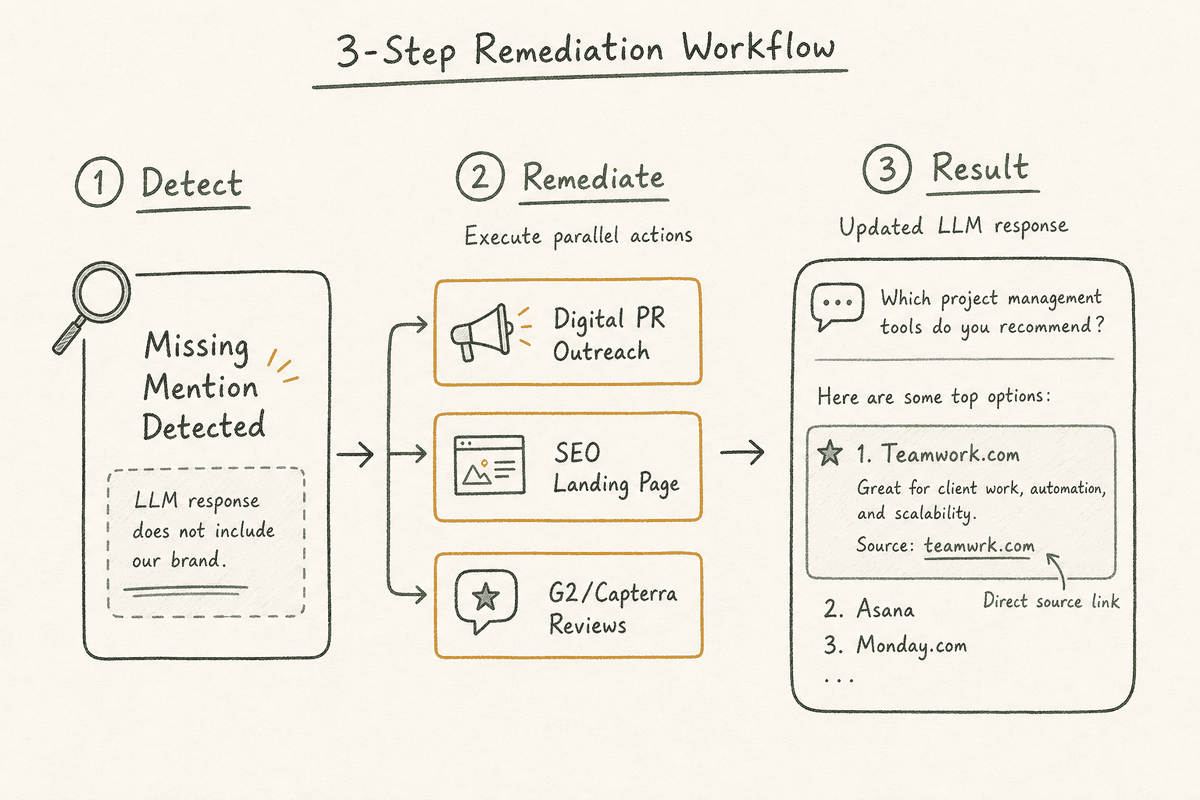
This is where a passive reporting tool stops, and an execution tool begins. The team immediately turns this gap into a three-step publishing workflow:
- Digital PR: They reach out to the author of the eCommerce blog to secure an inclusion in the round-up article, bringing the LLM's trusted source up to date.
- Content Creation: They learn how to build an SEO landing page specifically targeting the long-tail conversational prompt identified in the tool, structuring it with clear, authoritative lists that LLMs prefer to ingest.
- Review Generation: They launch a targeted campaign for their current Shopify merchants to leave detailed, specific reviews on G2 and Capterra, feeding fresh, positive sentiment directly into the data streams LLMs crawl.
Within six weeks, the updated context shifts the RAG retrieval process. ChatGPT begins listing them as the second recommendation, citing their new landing page and the updated third-party blog.
Bridging Technical Architecture and AI Visibility
While AEO requires new tools, it does not mean technical SEO is obsolete. In fact, clean technical architecture is the prerequisite for AI visibility. An LLM cannot recommend what it cannot read.
This is particularly true for SaaS companies that build their marketing sites or help centers using JavaScript frameworks. If a site relies entirely on client-side rendering without proper pre-rendering or server-side support, AI bots (like OpenAI's crawler) will often see a blank page. You can read our detailed breakdown on SEO for Single Page Applications to ensure your technical foundation isn't actively blocking your AEO efforts.
Similarly, relying on traditional SEO knowledge remains useful, provided you are reading modern, forward-thinking advice. Staying updated with the best SEO blogs ensures your team understands how the underlying web structure continues to feed the new AI ecosystem.
Frequently Asked Questions
What is the difference between SEO and AEO?
Search Engine Optimization (SEO) aims to rank a specific web page as high as possible on a search engine results page. Answer Engine Optimization (AEO) aims to structure content and build brand authority so that Large Language Models (like ChatGPT or Gemini) confidently cite your brand as the definitive answer to a user's conversational prompt.
Do I need to abandon my traditional SEO tools?
No. Traditional SEO tools like Semrush or Ahrefs are still necessary for keyword research, backlink analysis, and technical site health. AI visibility tools should run alongside them to capture the rapidly growing segment of zero-click, generative AI searches that traditional tools cannot measure.
How quickly can I change an AI's recommendation?
Unlike traditional SEO, which can take months to show movement, AI recommendations can shift rapidly depending on the model's update frequency and its reliance on real-time web retrieval. If an AI relies on live search (like Perplexity), updating a highly authoritative source can alter the AI's output in a matter of days. For pre-trained responses, changes take longer and depend on the model's training schedule.
Measuring AI visibility is no longer a speculative experiment for B2B SaaS; it is a baseline requirement for protecting your pipeline. Whether you opt for an enterprise analytics powerhouse or an execution-focused platform, the priority must be turning visibility data into published, authoritative content.