
You log into your AI tracking dashboard and check your brand's share of voice. The data shows that ChatGPT just dropped your software from its list of "top marketing automation platforms," and Perplexity is citing a three-year-old competitor blog post instead of your recent feature release.
Knowing you lost AI visibility is helpful, but the data alone doesn't fix the problem.
If your monitoring stack operates in a silo from your CMS, your workflow likely looks like this: export the keyword gaps, manually brief a content team, wait for a draft, log into WordPress to publish it, and hope the AI model eventually crawls the update. This disjointed process costs B2B teams weeks of lost citation traffic.
The shift to Generative Engine Optimization (GEO) requires tighter feedback loops. Brands need systems that connect the discovery of missing mentions and weak citations directly to execution. If you are evaluating Profound alternatives, the focus should be on tools and workflows that bridge AI visibility monitoring with direct WordPress publishing capabilities.
Here is a breakdown of the top tools, plugins, and platforms that handle both AI search visibility and the execution required to secure those citations.
The Disconnect Between Monitoring and Execution
Traditional SEO tools built workflows around Google Search Console data and keyword volumes. AI visibility tools, by contrast, reverse-engineer LLM outputs. They feed buyer prompts into models like Gemini, Claude, and ChatGPT, then analyze the responses to see which brands and URLs are cited.
Standalone platforms do this exceptionally well. They provide detailed metrics on "brand presence" or "recommendation share."
However, AI models do not behave like traditional search engines. You cannot force a citation just by adding a keyword to a meta title. LLMs retrieve information based on entity relationships, semantic density, and structured data summaries. To regain a lost citation in Perplexity, you often need to restructure your WordPress article's headings, update a specific semantic knowledge graph, or publish an entirely new evidence-backed asset.
When your AI monitoring tool doesn't communicate with your publishing pipeline, actionable insights pile up as unused spreadsheets.
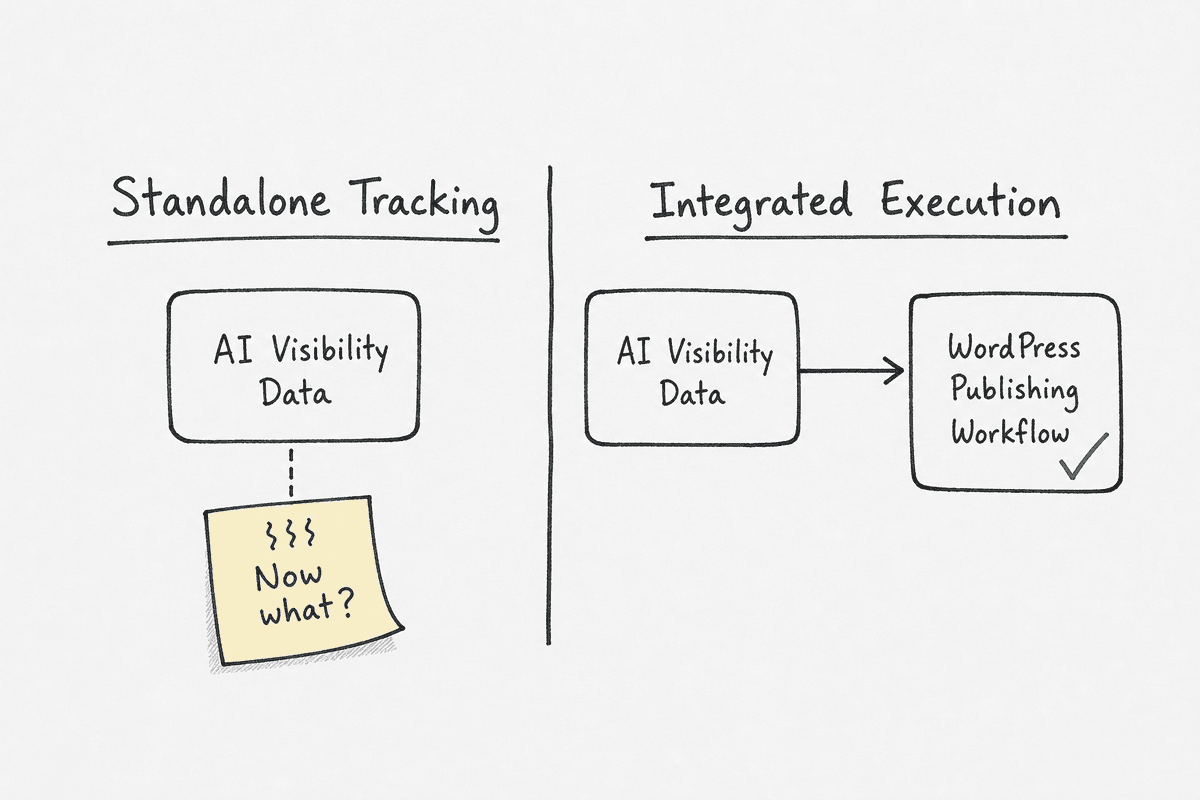
Leading Profound Alternatives for WordPress Execution
The market for AI visibility is splitting into two categories: native WordPress plugins that format your content for AI scrapers, and end-to-end platforms that handle both the tracking and the resulting publishing workflows.
1. BeVisible (End-to-End Tracking and Publishing Execution)
If your goal is to move from passive tracking to active content creation, BeVisible directly targets the execution gap.
BeVisible helps teams monitor how AI assistants answer buyer questions, which brands they recommend, and which sources they cite. It tracks ChatGPT, Gemini, Perplexity, AI Mode, and AI Overviews across buyer prompts, then turns visibility gaps into evidence-backed opportunities, articles, review, scheduling, and publishing work.
Rather than just alerting a SaaS founder that their brand is missing from a Gemini prompt about "best CRM integrations," BeVisible structures the workflow to fill that gap. By turning missing mentions and competitor wins into scheduled, published work, it acts as a complete pipeline for B2B marketing and growth teams who need to act on GEO data immediately.
2. All in One SEO (AIOSEO)
For teams managing execution natively within their CMS, AIOSEO is the most accessible entry point for AI optimization in WordPress. It has shifted from standard metadata management to actively preparing sites for AI crawler ingestion.
AIOSEO's standout feature for GEO is its integrated llms.txt Generator. This creates a clean, plain-text summary map of your WordPress site specifically designed for AI scrapers to ingest without rendering heavy CSS or JavaScript. It also includes an AI Insights tracker directly in the WordPress dashboard, showing your brand's presence across ChatGPT, Claude, Gemini, and Perplexity so writers can see impact without leaving the block editor.
3. Ayzeo
Ayzeo is built natively for Generative Engine Optimization. While standard SEO plugins treat AI as an add-on, Ayzeo focuses explicitly on helping your WordPress content gain AI model citations.
It runs real-time GEO readiness scoring on your posts as you write them. If you are drafting an article, Ayzeo evaluates the formatting, data density, and entity mentions to predict whether an LLM will favor it as a source. It offers automated llms.txt maintenance and features a citation rate dashboard directly inside WordPress, allowing content teams to track which specific published posts are successfully generating AI traffic.
4. Rank Math Content AI
Rank Math has integrated heavy semantic search intent analysis into its WordPress plugin. LLMs map articles differently than Google's traditional crawler; they look for logical formatting, clear entity relationships, and definitive answers to complex queries.
Rank Math Content AI analyzes search intent and guides you on how to format headings, lists, and content layout so that LLMs can extract your data easily. It also features an AI Search Traffic Tracker and an advanced llms.txt file builder, bridging the gap between how you structure a post and how an AI engine interprets it.
5. WordLift
WordLift approaches AI visibility through the lens of structured data. Rather than relying solely on textual analysis, WordLift translates your WordPress content into a complex, machine-readable Semantic Knowledge Graph (Schema markup).
This is highly effective for e-commerce, technical B2B sites, or agencies handling SEO in Durham and beyond. Enterprise AI search engines rely heavily on schema to accurately extract product specifications, brand data, and factual claims. WordLift automates the creation of this linked data within WordPress, ensuring that when an AI model searches for concrete facts about your business, the data is served in a format it explicitly trusts.
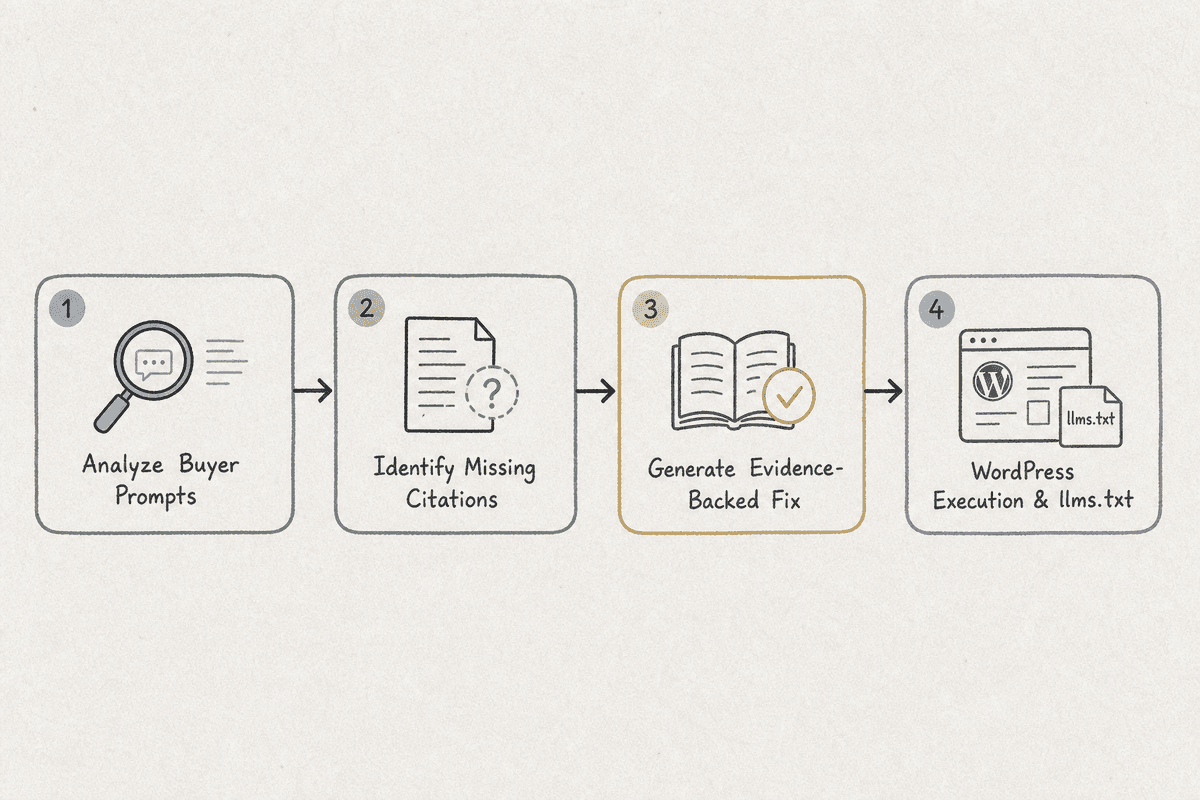
Building an AI Visibility Pipeline in WordPress
Replacing a standalone monitoring tool requires building a pipeline that moves smoothly from data acquisition to published WordPress content. Here is how modern growth teams structure this workflow.
Phase 1: Mapping Buyer Prompts
Traditional keyword research relies on short-tail phrases (e.g., "cloud storage"). AI search queries are conversational, hyper-specific, and context-heavy (e.g., "Which cloud storage solutions offer native HIPAA compliance and cost under $20 per user for a healthcare agency?").
You must track these specific buyer prompts. Monitor how Gemini, Perplexity, and ChatGPT respond to these long-form queries. Document which competitors are cited as sources and, more importantly, why they were cited. Did they offer a comparison table? A specific data point? A direct answer in an H2?
Phase 2: Evaluating the Visibility Gap
Once you identify a missing mention, categorize the gap:
- Missing Entity: The AI model simply doesn't associate your brand with the category.
- Weak Citation: The AI mentions you, but cites an outdated landing page or a third-party review instead of your official documentation.
- Format Failure: The AI prefers a competitor because their WordPress page uses clear listicles or markdown tables, while your page uses dense paragraphs.
Phase 3: WordPress Execution and Formatting
When you move into WordPress to fix the gap, standard SEO advice falls short. You are optimizing for an LLM's retrieval-augmented generation (RAG) system.
- Increase Data Density: LLMs cite sources that provide high information density with low token counts. Replace long, fluffy introductions with direct definitions, hard statistics, and concrete examples. If you are learning how to implement this, reviewing the 11 best SEO blogs can provide excellent examples of high-density technical writing.
- Use Markdown-Friendly HTML: AI scrapers strip out design elements. Ensure your WordPress theme outputs clean HTML. Use strict hierarchy (H1 > H2 > H3). Use
<ul>and<ol>tags instead of formatting lists with CSS. Use standard HTML tables for comparisons. - Deploy
llms.txt: If you are not using AIOSEO or Ayzeo, manually create anllms.txtfile at your site's root. This file acts like arobots.txtorsitemap.xml, but provides plain-text summaries and direct links to your most critical content, allowing AI bots to ingest your site map without rendering JavaScript.
Navigating Modern Web Architecture and AI Crawlers
One of the most frequent friction points between AI visibility and publishing involves web architecture. Many SaaS companies use headless WordPress setups or complex JavaScript frameworks to deliver content.
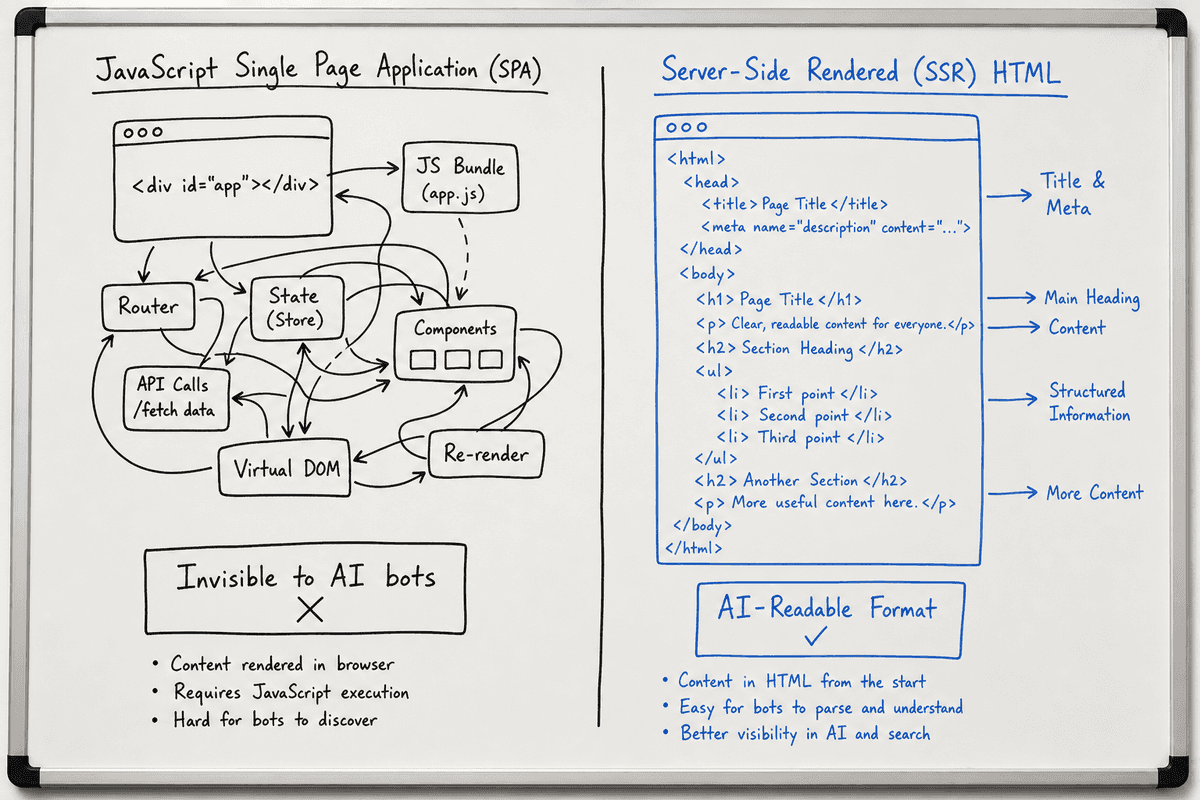
While Googlebot has become proficient at rendering JavaScript, newer AI bots from OpenAI, Anthropic, or Perplexity often struggle to parse content that relies heavily on client-side rendering. If your WordPress backend feeds a React or Vue frontend, your content might be invisible to the very LLMs you are trying to influence.
If your stack relies on these technologies, mastering SEO for single page applications is a prerequisite for AI visibility. You must ensure that server-side rendering (SSR) or dynamic rendering is in place so that an AI crawler receives a fully populated HTML document upon its initial request.
If you find that your AI monitoring tools show zero brand mentions despite publishing great content, rendering is often the culprit. Reviewing the technical requirements for implementing SEO in single page applications can help you diagnose whether AI bots are seeing a blank page instead of your published article.
Execution Edge Cases: Updating vs. Creating Net-New
A common dilemma when acting on AI visibility data is whether to update an existing WordPress post or publish a new one.
When to Update: If an AI model is already citing your page but pulling outdated pricing, incorrect features, or poor summaries, update the existing URL. AI models cache data, but they frequently re-crawl known authoritative URLs. Updating the structured data via WordLift or Rank Math, and pushing an updated XML sitemap, is usually enough to refresh the citation within a few weeks.
When to Create Net-New: If the AI is answering a specific buyer prompt by synthesizing data from three competitors, and you have no page that specifically addresses that intersection of topics, you need a net-new asset. For example, if the prompt is comparing enterprise pricing models, you shouldn't just shoehorn a paragraph into your homepage. You need to build a dedicated page. Following a structured 7-step guide to build an SEO landing page ensures the new asset is formatted correctly for both traditional search and AI ingestion from day one.
FAQs About AI Visibility in WordPress
Can you block AI bots while maintaining visibility?
This is a highly debated topic. Many publishers block OpenAI's GPTBot or CCBot in their robots.txt to prevent their content from being used to train future models. However, blocking these bots can also prevent your site from being cited in real-time answers (like ChatGPT's browsing feature). If your goal is AI visibility and brand presence in generative answers, blocking the crawlers is counterproductive.
How long does it take for Perplexity or ChatGPT to cite a new WP post?
Unlike Google, which might index a WordPress post within hours, LLM inclusion is harder to predict. Retrieval models (like Perplexity or ChatGPT with Search) can find and cite a well-optimized, newly published article within 24 to 48 hours if it is linked from a high-authority domain. However, being included in the model's actual base weights (training data) takes months and depends on their training schedules.
Is schema markup strictly required for LLM citations?
It is not strictly required for general text queries, but it is a massive advantage for factual extraction. If an AI needs to know the exact price of your SaaS tier or the location of your business, schema markup (like the kind generated by WordLift) ensures the AI doesn't hallucinate the answer based on outdated text buried in a paragraph.
Finalizing Your Tool Stack
Treating AI visibility as a passive metric is a missed opportunity. The brands winning in Generative Engine Optimization are the ones that tight-couple their tracking to their CMS.
By leveraging tools that natively understand WordPress—whether through direct plugins like Ayzeo and AIOSEO, or end-to-end platforms like BeVisible that turn gaps into scheduled publishing work—you eliminate the friction between knowing you lost a citation and actually doing the work to get it back. Focus on data density, clean semantic HTML, and rapid execution, and your brand will establish the authoritative footprint required for the next generation of search.