
Type your startup’s core use case into Perplexity, ChatGPT, or Google’s AI Overviews. If your competitors show up in the summarized response and your brand is nowhere to be found, you have an Answer Engine Optimization (AEO) problem.
For a long time, traditional SEO was the only game in town. You built backlinks, optimized headers, and waited for Google to rank your page. Today, early adopters and high-intent B2B buyers are bypassing standard search entirely. They ask generative AI models complex, multi-variable questions—and those models assemble answers by pulling from specific, trusted sources across the web. If your brand isn't part of the data the model retrieves, you effectively do not exist in the new discovery funnel.
Many founders initially turned to early AEO tracking tools like Profound (formerly Otterly AI) to monitor these brand mentions. Profound helped define the category by giving resource-constrained teams a way to track generative visibility. But as AI search matures, founders are realizing that simply watching a visibility score fluctuate on a dashboard isn't enough. You need tools that bridge the gap between identifying a missing mention and actually executing the work required to earn that citation.
If you are looking to graduate from passive monitoring to active execution, here is a detailed breakdown of Profound alternatives and how to build a high-leverage AEO stack for your startup.
Why Founders Outgrow Passive AEO Dashboards
Tracking AI visibility is a relatively new discipline, and the first generation of tools focused heavily on observation. Platforms like Profound made generative engine optimization approachable for beginners, offering intuitive dashboards and quick audits of how a brand appeared across AI engines. Profound's own generative engine optimization guides correctly point out that tracking mentions is the foundational step in AEO.
 However, a visibility dashboard is only as useful as the actions it triggers. Founders and growth teams often hit a wall known as the "Dashboard Trap." You log in, see that ChatGPT recommends a competitor 80% of the time for a critical buyer prompt, and then stare blankly at the screen. The software has diagnosed the illness but provided no medicine.
To actually change what an AI model says about you, you have to influence the Retrieval-Augmented Generation (RAG) process. When a user asks an AI assistant a question, the AI doesn't just guess; it runs a rapid search of its index (or the live web), retrieves contextually relevant documents, and synthesizes an answer.
If you want to be recommended, you need to create the exact evidence those models are looking for: third-party reviews, authoritative comparisons, high-information-gain articles, and entity-rich landing pages. Founders are shifting toward AEO software that doesn't just report the weather, but helps them build the shelter.
Top Profound Alternatives for Answer Engine Optimization
When evaluating alternatives to Profound, founders should look for software that aligns with their team's capacity to execute. Some teams need automated content workflows, others need deep technical crawling insights, and some just need a faster way to audit competitors.
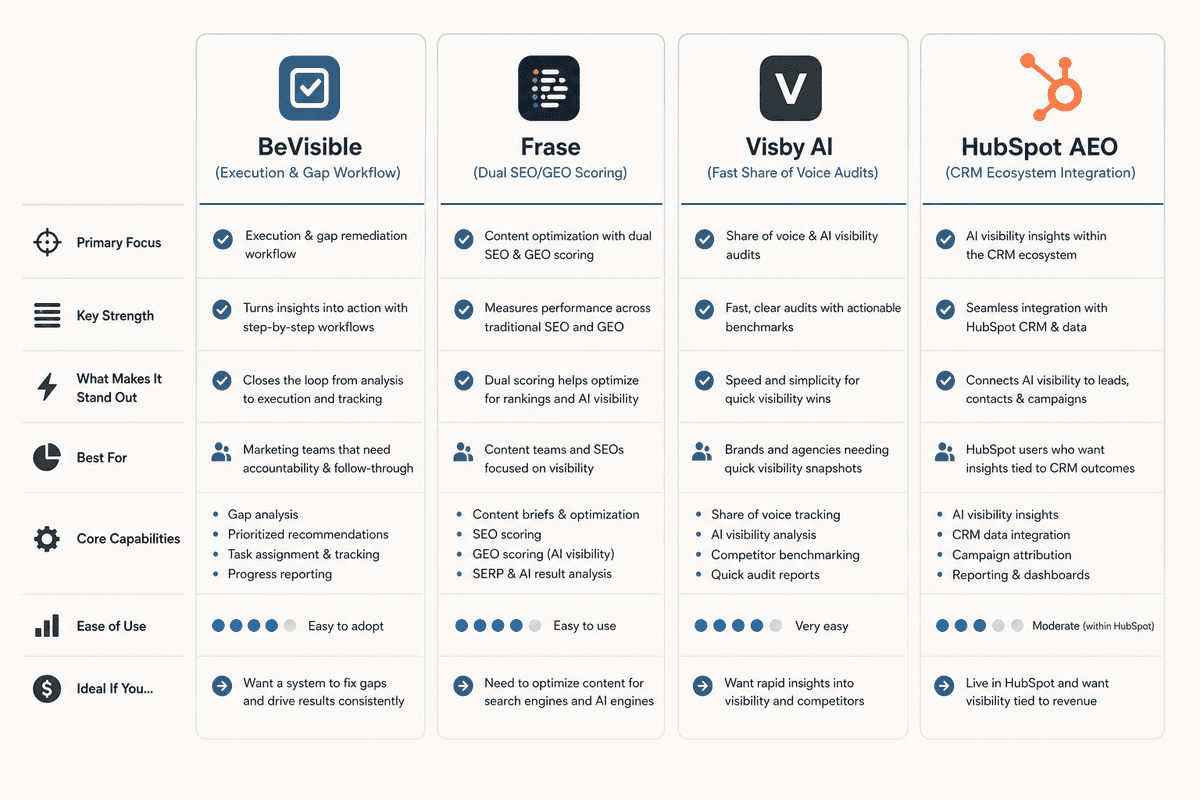
1. BeVisible: Best for Turning Visibility Gaps into Execution
Monitoring AI search visibility is only half the battle. BeVisible is designed specifically for SaaS founders, B2B marketing teams, and agencies that need to move directly from tracking to doing.
Instead of just reporting a static visibility score, BeVisible helps teams monitor how AI assistants (including ChatGPT, Gemini, Perplexity, AI Mode, and AI Overviews) answer specific buyer questions. Crucially, it tracks which brands the AI recommends and which primary sources it cites to form those recommendations.
When BeVisible identifies a gap—for instance, an AI model citing a weak competitor blog post for a query you should own—it turns that gap into actionable evidence-backed opportunities. The platform connects the dots between missing mentions and the required execution, helping teams organize the necessary article creation, review generation, content scheduling, and publishing work. It is built for teams that treat AI visibility as an execution channel rather than just a reporting metric.
2. Frase: Best for Content-Led Agentic SEO
If your primary AEO strategy revolves around optimizing your own first-party content, Frase is a powerful alternative. Frase approaches the problem from a content-generation and optimization angle, which they refer to as agentic SEO.
According to Frase's guide on getting cited by AI, their platform is built for the age of AI search by using dual SEO and GEO (Generative Engine Optimization) scoring. This means as you draft content, the software evaluates it not just for traditional search engine algorithms, but for the specific entity density and structural clarity that Large Language Models (LLMs) prefer when retrieving context.
Frase is highly effective for content teams that are already producing high volumes of blog posts and want to ensure that every new piece of content is structured in a way that maximizes its chances of being ingested and cited by AI engines.
3. Visby AI: Best for Rapid Competitor Audits
For founders who prioritize speed and a shallow learning curve, Visby AI frequently ranks high on software comparison sites. In fact, recent G2 categorizations for AEO tools highlight Visby AI as a highest performer and specifically note it as the easiest to use in the space.
Visby is designed to track how your brand appears across AI engines and identify competitor frequencies quickly. If you need to generate a board-level report on your AI Share of Voice (SOV) against three primary competitors by tomorrow morning, Visby provides a frictionless way to get those numbers without a complex setup process. It leans heavily into simplicity, making it a strong alternative for founders who found enterprise tools too cumbersome.
4. HubSpot AEO: Best for Integrated Ecosystems
If your startup already relies heavily on HubSpot for CRM, marketing automation, and CMS, their emerging AEO capabilities make sense to explore. HubSpot has introduced specialized modules for tracking how a brand is perceived in AI engines, including sentiment analysis of those mentions.
A unique feature of their ecosystem is the HubSpot AEO Grader, which evaluates your current visibility and provides actionable recommendations. Because it lives within the HubSpot environment, teams can theoretically tie AI visibility data closer to standard inbound marketing metrics and lead tracking, though it requires full commitment to the HubSpot platform.
The Contrarian Reality: Visibility Scores Do Not Pay Payroll
A common mistake founders make when adopting AEO software—whether Profound, BeVisible, or Frase—is treating AI visibility as a vanity metric.
It feels incredibly validating to log into a dashboard and see that ChatGPT recommends your software 90% of the time for a niche prompt. But if that prompt only has a search volume of ten users a month, that 90% visibility score is economically worthless. Conversely, you might have a 5% visibility score on a highly competitive, high-intent prompt like "best enterprise CRM alternatives," and moving that needle to 10% could generate hundreds of thousands of dollars in pipeline.
The software you choose must help you distinguish between vanity visibility and commercial visibility. Focus your execution entirely on prompts that indicate a buying decision is imminent. Tracking broad, informational queries might make your charts look better, but optimizing for them rarely drives early-stage startup growth.
A Founder’s Playbook: Turning AI Mentions into Revenue
To understand how to practically apply AEO software, let’s look at a realistic scenario.
Imagine you are the founder of a mid-market applicant tracking system (ATS). You run a query through your AEO tool for the prompt: "What are the best lightweight ATS platforms for mid-sized tech companies?"
The software reveals that Perplexity and Gemini consistently recommend two legacy competitors. More importantly, the tool shows you why. The AI engines are pulling their answers from three specific sources:
- A highly ranked G2 comparison grid.
- An active Reddit thread from
r/recruiting. - An outdated listicle on an HR tech blog.
Your brand is missing from all three.
If you were relying on a basic monitoring tool, you would simply know you are losing. But with an execution-focused workflow, this data dictates your marketing sprint for the next two weeks:
- The Review Gap: You immediately trigger an automated email campaign to your top 20 happiest customers, incentivizing them to leave detailed, specific reviews on G2 mentioning "lightweight" and "mid-sized tech."
- The Community Gap: You have your head of product write a highly technical, transparent post detailing how you reduced load times for ATS data processing, and you share it organically in relevant communities to generate natural discussion.
- The Content Gap: You notice the outdated HR listicle is citing old pricing. You realize you need a dedicated, heavily structured comparison page on your own site. You follow a proven framework for how to build an SEO landing page that directly addresses the "lightweight ATS" entity, ensuring it is formatted cleanly for AI crawlers to ingest.
Within a month, the RAG pipelines updating those AI models begin indexing your new reviews, your optimized landing page, and the fresh community discussions. Your AEO software registers the shift, and your brand begins appearing as a cited recommendation.
Technical Execution: Don't Let Your Code Block the Bots
It is entirely possible to execute a brilliant AEO content strategy and still fail because the AI models literally cannot read your website.
Generative AI models rely on specific crawlers (like ChatGPT-User or GoogleOther) to index information. If your startup's website is built as a complex, JavaScript-heavy Single Page Application (SPA), these bots might crawl your URL and see nothing but a blank page and a loading script. LLM crawlers are historically less patient and less capable of rendering complex client-side JavaScript than Google's primary search bot.
If your AEO software says you have zero visibility despite having great content, your first step should be a technical audit. Ensure your site uses server-side rendering (SSR) or static site generation (SSG) for critical marketing pages. If your engineering team is actively building in React, Vue, or Angular, they need to prioritize SEO for single page applications to ensure the DOM is fully hydrated and readable the moment an AI bot requests the page. The best content in the world cannot be cited if it remains invisible to the machine.
How to Evaluate AEO Software for Your Growth Stack
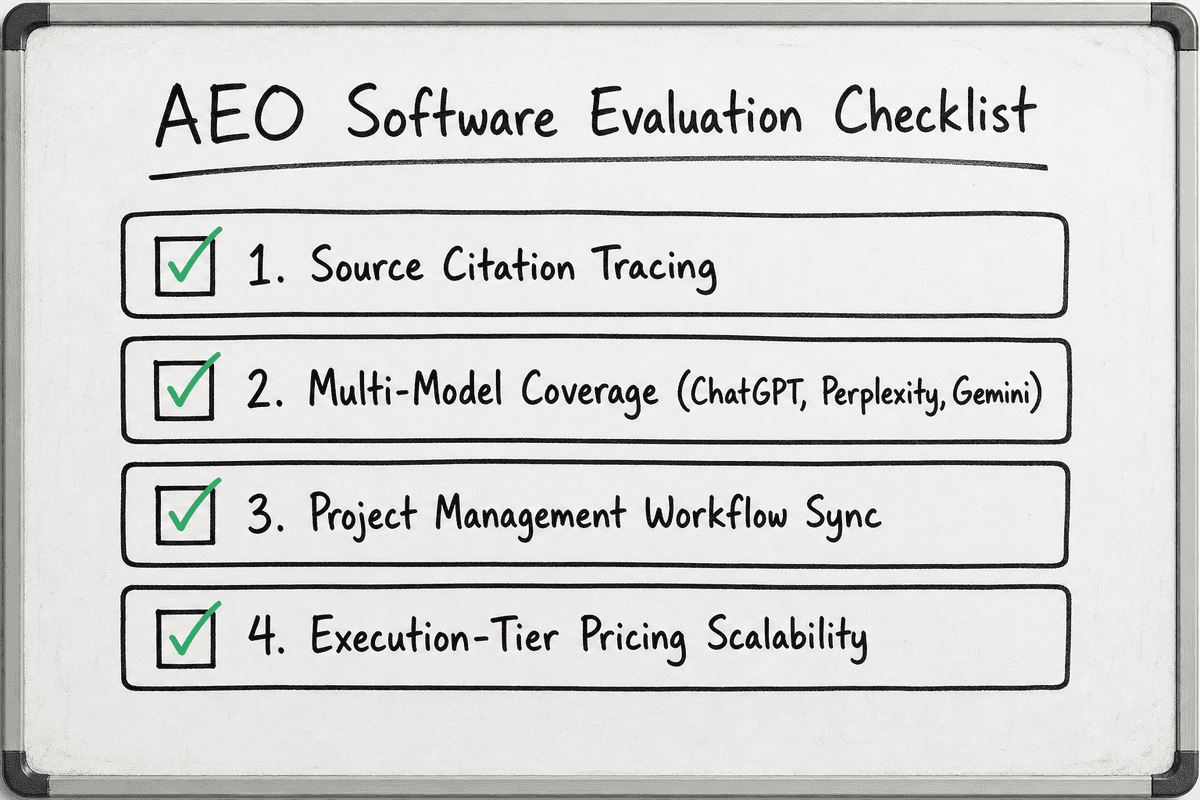
When you are ready to choose an AEO tool, use these criteria to filter the market:
- Citation Analysis Capability: Does the tool just tell you if you were mentioned, or does it tell you which source the AI cited to justify mentioning you? The latter is mandatory for reverse-engineering the AI's logic.
- Model Breadth: Optimizing for ChatGPT is different than optimizing for Google AI Overviews. Ensure the software tracks multiple language models and search environments, as buyer behavior is fragmenting across different interfaces. Making answer engine optimization accessible across all platforms is a common goal for these tools, but coverage varies wildly.
- Workflow Integration: Does the tool export tasks to Jira, Asana, or your content calendar? If identifying a gap requires copying and pasting data into a different project management tool to assign a writer, the friction will eventually kill the initiative.
- Pricing Scalability: As Profound's own platform reviews note, some tools start at $39/month while enterprise platforms run into the thousands. Pay for execution features, not just query volume.
Frequently Asked Questions
Is Answer Engine Optimization (AEO) different from traditional SEO?
Yes, though they share DNA. Traditional SEO optimizes for a search engine's ranking algorithm to secure a high position on a page of links. AEO optimizes for a Large Language Model's retrieval and synthesis process to be included as a factual entity within a conversational answer. AEO requires higher information density, clearer entity relationships (often using structured data), and a stronger presence on third-party validation sites (like review platforms and forums) than traditional SEO, which historically leaned heavily on domain authority and backlink volume. For those trying to keep up with the technical overlap, following the best SEO blogs is still highly recommended, as the two disciplines are merging.
How long does it take to influence AI engines?
The timeframe varies based on the engine. Perplexity and Google AI Overviews have access to real-time web indexing; a highly authoritative article published today could theoretically be cited by Perplexity tomorrow. ChatGPT and Claude rely on a mix of real-time browsing (if triggered) and their base training data. Altering their base knowledge takes months and relies on major model updates, but influencing their live-web retrieval can happen in days or weeks if your content is indexed quickly.
Should early-stage startups invest in AEO tools before product-market fit?
Generally, no. If you are still figuring out who your ideal customer profile (ICP) is, tracking AI mentions is premature. Your time is better spent talking directly to users. However, once you have product-market fit and are actively scaling your inbound marketing and content engines, AEO software becomes critical. By capturing AI search visibility early in your growth phase, you establish your brand as a primary entity in the AI's training data, creating a moat that is increasingly difficult for latecomers to cross.