
You run a target buyer prompt through Perplexity. Your competitor is listed as the top recommendation. Your brand is nowhere to be found. You log into an AI visibility platform like Profound, verify your falling share of voice, export a CSV of missed prompts, and hand it to your content team.
Then, the momentum stops.
Dashboards are excellent at highlighting the problem, but they do very little to solve it. When your marketing stack is built on Webflow, exporting spreadsheets of missing mentions creates immense friction. AI answer engines change their responses rapidly based on fresh citations, deep technical optimization, and context. If your visibility tool does not directly feed your publishing workflow, you are always going to be months behind the LLMs.
The market has recognized this execution gap. Standalone platforms are being challenged by alternatives that bridge the divide between monitoring a ChatGPT omission and publishing the page that fixes it. Chief among these alternatives are native CMS answer engine capabilities and execution-focused tracking platforms.
Here is why relying solely on isolated visibility dashboards is a losing strategy, and how to build a closed-loop system using Webflow's publishing ecosystem alongside execution-first visibility tools.
The Execution Gap in AI Search Monitoring
Most marketing teams treat AI search visibility like traditional rank tracking. They check their dashboard, see a drop in brand mentions, and add the topic to the content backlog for next quarter.
But LLMs like Gemini, ChatGPT, and Claude do not behave like traditional Google search. They do not just return links; they synthesize answers. If an LLM crawler scrapes the web and fails to understand your product's specific use cases or entity relationships, it will simply hallucinate a competitor into your spot or omit you entirely.
Consider a common scenario: A B2B SaaS company relies entirely on a passive visibility dashboard. They notice they are missing from Perplexity's "best CRM for manufacturing" queries. The dashboard alerts them, but the marketing team must manually brief the content, schedule it, draft the copy, and manually upload it to Webflow. By the time they publish the fix three weeks later, a competitor has already updated their features page with clear semantic structuring, and the LLM has firmly anchored that competitor as the definitive answer.
Fixing AI omissions requires rapid iteration: adjusting copy, adding specific FAQs, publishing highly relevant landing pages, and structuring technical metadata so the LLM bots can parse it instantly. When you separate your visibility insights from your publishing environment, you lose speed. Speed of execution is the only true competitive advantage in generative AI search.
The Myth of the "Share of Voice" Metric
One of the most persistent myths in the emerging AI search space is that "Share of Voice" (SOV) is the ultimate metric. Standalone tools often aggregate your brand mentions across thousands of prompts and spit out a clean percentage.
This metric is fundamentally flawed if it is not tied to action. An LLM's response is contextual and multi-faceted. You might have a 40% Share of Voice for a topic, but if the AI only mentions your brand in the context of "expensive enterprise tools" when your goal is to capture mid-market buyers, that 40% is actively harming you.
You need evidence-backed gaps, not just a percentage. You need to know exactly which sources the LLM cited to form that opinion, and you need a workflow to publish corrective content immediately.
Webflow AEO: The Native Closed-Loop Architecture
Recognizing that traditional SEO rules change when AI crawlers (like ChatGPT, Perplexity, and Claude) scrape the web to answer user prompts, Webflow natively introduced major features explicitly targeting this space under the umbrella of Webflow AEO (Answer Engine Optimization).
Because traditional search rules rely on backlinks and keyword density, whereas AI search relies on factual entity extraction, these tools ensure your site is structured so that AI engines can easily discover, read, and cite your brand.
The system functions in a "closed loop" integrated directly into the Webflow Designer and publishing workflow. Instead of paying for an external platform that merely tells you what is wrong, Webflow's native architecture helps you fix it where the content lives.
 Webflow divides its AI visibility suite into three distinct phases: Measure, Recommend, and Act.
1. Measure: AEO Analytics
Integrated directly into Webflow Analyze, this dashboard helps you monitor how your site interacts with the AI ecosystem before visitors even arrive. Traditional analytics track humans; AEO Analytics tracks the machines that inform the humans.
- Prompt Insights: Tracks how often your brand is mentioned or cited in live ChatGPT or other answer-engine responses for specific tracked keywords. It gives you baseline visibility metrics directly inside your CMS.
- LLM Bot Insights: Surfaces automated crawler activity directly from Webflow's hosting layer. It shows you exactly which AI bots (such as
OAI-SearchBotfor OpenAI,ClaudeBotfor Anthropic, orGoogleOtherfor Gemini) are visiting, which pages they prioritize, and how often they scrape your site. This log-level data is critical for knowing if your content updates are actually being digested. - AI-Referred Visitor Analytics: Filters and attributes traffic arriving specifically via generative AI tools, tracking what those users do once they land on your site. Are they bouncing, or does the AI referral carry high intent?
2. Recommend: AEO Agents
Instead of manually auditing every page against a spreadsheet export from a tool like Profound, Webflow utilizes native, brand-aware AI agents to identify gaps that might confuse an LLM crawler.
- Technical Optimization: The agents automatically flag missing alt text, broken links, metadata gaps, and unstructured headings that prevent bots from synthesizing your content accurately. If an H2 is not logically nested under an H1, the agent catches it, ensuring the structural integrity that LLMs rely on for context mapping.
3. Act: The Review and Publish Loop
The true differentiator from standalone dashboard tools is the immediate transition to execution. When an AEO agent suggests an optimization—whether it's restructuring schema markup or prompting you to fill a content gap—you can review the change and push it live to the Webflow site in clicks. There is no copying and pasting between tabs, no Jira tickets lost in the backlog, and no delays.
Bridging Visibility and Execution with BeVisible
While Webflow's native AEO capabilities are exceptional for on-page technical fixes and site-level crawler analytics, capturing market share for complex buyer questions often requires creating entirely new content assets or orchestrating large-scale updates.
This is where execution-focused AI visibility tools step in as profound alternatives to passive dashboards. At BeVisible, we built our platform specifically for teams that need to turn visibility gaps into published work, closing the loop between what the AI thinks and what your brand says.
BeVisible helps teams monitor how AI assistants answer buyer questions, which brands they recommend, and which sources they cite. It tracks ChatGPT, Gemini, Perplexity, AI Mode, and AI Overviews across buyer prompts. But rather than stopping at a metric or a CSV export, it turns those visibility gaps into evidence-backed opportunities, articles, review, scheduling, and publishing work.
If Perplexity is recommending a competitor because they have a dedicated page comparing CRM integrations, BeVisible surfaces that exact gap and the specific citation the AI used. You can then instantly spin up a brief and execute a new page, knowing exactly how to structure it based on the LLM's citation preferences. Learning how to build an SEO landing page specifically for AI crawlers involves structuring your copy as clear, factual statements that LLMs can digest as entities. BeVisible provides the exact blueprint for that execution.
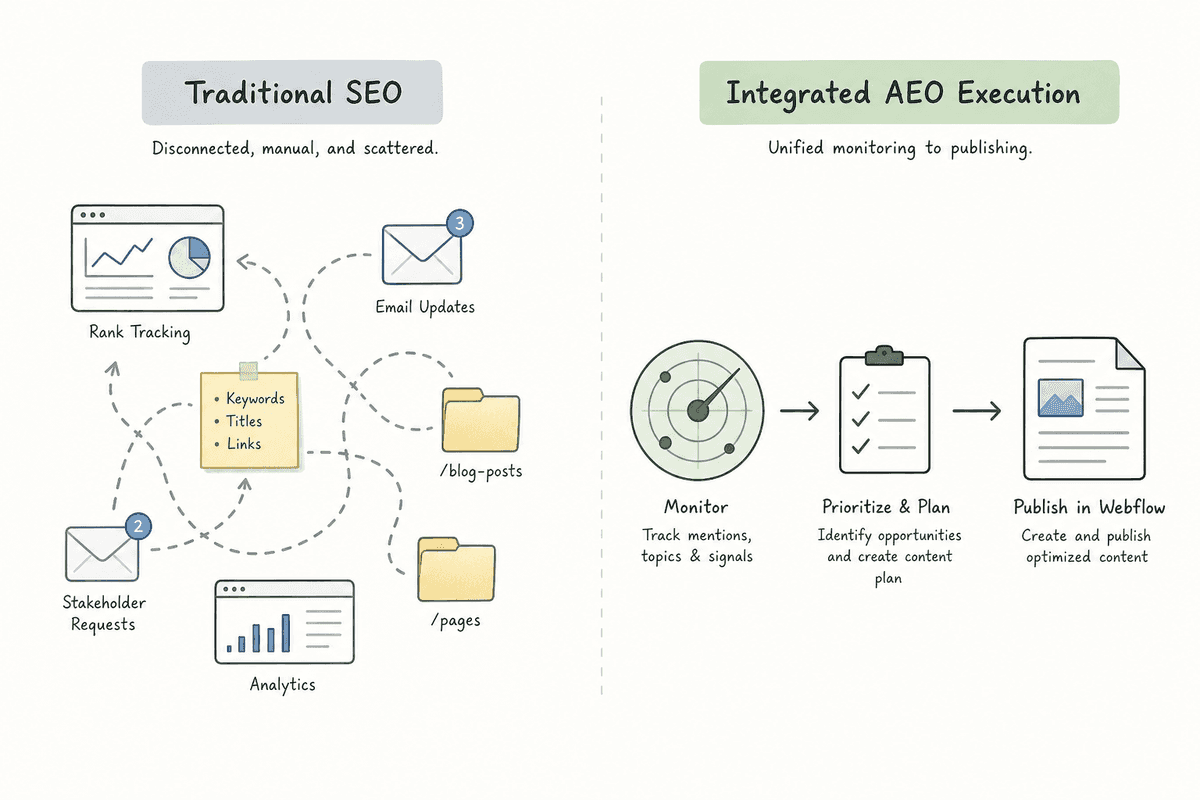
Traditional SEO Dashboards vs. AEO Publishing Workflows
To understand why the shift toward execution platforms is happening, it helps to compare the traditional SEO workflow with a modern AEO publishing workflow.
Designing Pages for AI Crawlers: The Webflow Perspective
When you move from monitoring to publishing, the way you construct pages inside Webflow must adapt. LLMs do not read your marketing copy to feel inspired; they parse it to extract facts. If your Webflow site relies on clever, vague marketing copy ("Unleash your potential with our revolutionary synergy platform"), LLMs will struggle to categorize you.
When executing content updates based on BeVisible insights, ensure your Webflow build adheres to these structural principles:
Semantic HTML is Non-Negotiable
LLMs rely heavily on document structure to understand the relationship between concepts. Use Webflow's native HTML tags correctly. An <h1> is the topic. An <h2> is a subtopic. An <h3> is a supporting point. Do not use heading tags simply to make text larger—use Webflow's typography classes for styling, and reserve heading tags for structural hierarchy.
Entity-Rich CMS Collections
If you are building a programmatic SEO or AEO strategy, structure your Webflow CMS Collections to map directly to entities. If you have an "Integrations" collection, do not just have a rich text field for the description. Include specific, plain-text fields for "Integration Category," "Data Synced," and "Setup Time." This allows you to output highly structured, predictable pages that LLMs can easily parse and confidently cite.
The Power of Factual Density
When an AI agent evaluates your brand, it looks for factual density. Does this company integrate with Salesforce? What is the starting price? Is it SOC2 compliant? When publishing a fix to a visibility gap, present these facts in bulleted lists or simple HTML tables. Avoid burying critical decision criteria inside dense paragraphs.
The Technical Roadblocks: Crawlers and Complex Architectures
A major reason why execution and publishing must be tightly coupled with visibility monitoring is the technical fragility of AI crawlers. If you are operating a Single Page Application (SPA) alongside your Webflow marketing site, the way LLM bots crawl your content becomes a massive liability.
LLMs do not have the patience or rendering budgets of Googlebot. Google will often queue JavaScript-heavy pages for rendering days or weeks later. AI bots like OAI-SearchBot or ClaudeBot are far more rudimentary. If your content requires complex JavaScript to render, or if it takes more than a few seconds for the initial HTML payload to deliver, they will simply abandon the crawl.
 When you build out new content to capture AI visibility, it must be instantly accessible. For teams managing complex frontend architectures, adhering to an SEO for single page applications technical checklist is mandatory. If the AI cannot read the page instantly, it will not cite the page, no matter how perfectly optimized your content is.
If you are struggling to get AI bots to index your dynamic content, you must evaluate what works in modern environments by deeply understanding single-page application SEO. Often, this means implementing Server-Side Rendering (SSR) or pre-rendering your critical marketing pages so that the bots receive a fully hydrated HTML document the millisecond they request it.
Evaluating Your Visibility Stack: 4 Critical Criteria
If you are looking to replace a legacy rank tracker or a passive AI visibility dashboard with a system that actually drives Webflow publishing, evaluate your options based on these four criteria:
1. Cross-Engine Prompt Tracking
Does the tool track beyond just one LLM? Your buyers are using ChatGPT for brainstorming, Perplexity for deep technical research, and Google's AI Overviews for quick navigational queries. Your tool must track them all and identify exactly which engines are citing your competitors.
2. Evidence-Backed Execution
Does the platform just give you a "share of voice" percentage, or does it show you the exact response, the exact citation, and the exact content gap? To beat competitors, your content team needs to know exactly what the LLM found lacking on your site. If Perplexity cited a competitor's pricing transparency, your execution tool should highlight that specific gap.
3. Direct Publishing Workflows
How many steps does it take to go from "we are losing this prompt" to "we have published the fix on Webflow"? Platforms must emphasize turning insights directly into scheduled, published work. Every time you have to export data to a secondary project management tool, you introduce delays that cost you AI visibility.
4. LLM Bot Crawl Analytics
Can you verify that the AI bots are actually fetching the pages you just published? If you are relying on advanced frameworks, you need to know if the bots are getting stuck. Without native log analysis (like Webflow's LLM Bot Insights), you are publishing into a black box.
Structuring Your Content Team for Answer Engine Execution
The shift from traditional SEO to AEO means content teams are no longer just writing for search volume. They are writing to establish entity relationships.
This requires a shift in personnel focus. The traditional "SEO Copywriter" who focused on keyword insertion is being replaced by the "Content Engineer"—someone who understands information architecture, schema markup, and how to structure a Webflow CMS for maximum factual density.
Your execution workflows must empower these content engineers. When a visibility tool flags a missing mention, the task assigned should not be "write a 1,000-word blog post." The task should be "update the Product Features CMS collection to explicitly state compliance standards, and publish." Keeping an eye on industry shifts by following the best SEO blogs can help your team stay ahead of how LLM training models evolve, ensuring your internal processes match the speed of the engines.
Moving Beyond Dashboards
The era of the passive SEO dashboard is ending. Watching a line graph drop while your competitor gobbles up ChatGPT citations is a recipe for irrelevance.
Profound alternatives are not just tools with different user interfaces—they are entirely different methodologies. They are systems that recognize that the speed of execution is the only true competitive advantage in generative AI search.
By utilizing Webflow's native AEO capabilities to ensure technical perfection, and integrating an execution platform like BeVisible to turn buyer prompt tracking directly into scheduled, published work, you close the loop. You stop reacting to missed mentions in a spreadsheet and start proactively feeding the AI engines the exact citations they crave. Execution is everything; ensure your stack is built to support it.