
Traffic models are fracturing. Traditional search consoles across B2B SaaS and agency domains are showing flatlining or declining clicks for informational queries, while generative platforms take over the top of the funnel. The reality is that your prospects and your customers are on AI tools looking up information, bypassing the ten blue links entirely in favor of synthesized answers from ChatGPT, Google Gemini, and Perplexity 1. In fact, ChatGPT alone is processing around 1 billion searches, fundamentally altering how buyers discover brands 2.
For marketing and growth teams, this shift introduces a massive measurement problem. Traditional rank trackers rely on crawling static search engine result pages (SERPs) to pinpoint a URL's position. But large language models (LLMs) do not rank URLs; they generate probabilistic answers based on training data and real-time retrieval (RAG).
Predictive models suggest that traffic from AI tools like ChatGPT will overtake traditional search 3. If your team is evaluating Profound alternatives to monitor this new ecosystem, you already know that simply tracking positions is obsolete. You need to monitor how AI assistants answer buyer questions, which brands they recommend, and which sources they cite. More importantly, you need a system that turns visibility gaps into evidence-backed opportunities, scheduling, and publishing work.
This guide breaks down the mechanics of AI search visibility, how to audit your brand's presence across major LLMs, and the specific strategies required to make your content the primary source these models cite.
The Paradigm Shift: Why Traditional SEO Mechanics Fail in AI Search
To understand how to improve AI search visibility, you first have to unlearn the core assumptions of traditional SEO. For two decades, optimization was about convincing a deterministic algorithm that your page was the most relevant match for a specific string of keywords. You built backlinks to pass PageRank, optimized title tags, and structured headers to map to target queries.
AI search engines operate on an entirely different architecture known as Retrieval-Augmented Generation (RAG).
When a user asks Perplexity or Google's AI Overviews a question, the system does not just retrieve a list of URLs. Instead, it:
- Translates the user's conversational prompt into a series of search queries.
- Scrapes the text from the top retrieved documents in real-time.
- Feeds that scraped text into an LLM context window.
- Synthesizes a unique, conversational answer based on that context, appending citations to the sources it pulled from.
If your content relies on keyword density but lacks clear, synthesizable facts, the LLM will skip it in favor of a source that is easier to parse. Furthermore, AI models look for consensus. If your website claims you are the best enterprise expense management software, but Reddit threads, G2 reviews, and industry forums do not corroborate that claim, the AI will not recommend you.
 To get cited by AI models, you must shift your focus from manipulating algorithms to building undeniable authority, trust, and highly structured, verifiable content.
Evaluating Profound Alternatives: What Must a Modern Stack Track?
The emergence of AI search has spawned a new category of tools designed to track LLM visibility, with platforms like Profound leading early market awareness. However, as teams mature in their AI search operations, they often find that passive monitoring is not enough. You do not just need to know if you were cited; you need to know why you missed a citation and exactly what content to publish to win it back.
When evaluating an AI visibility monitoring stack, whether you are comparing Profound alternatives or building internal capabilities, your tracking must cover four distinct pillars.
1. Cross-Engine Prompt Monitoring
Buyers do not use AI assistants the way they use Google. They use highly specific, multi-variable prompts (e.g., "What are the best CRM tools for a 50-person SaaS company that integrate natively with HubSpot, and what are their hidden pricing fees?").
An effective visibility tool must track these complex buyer prompts across the entire ecosystem: ChatGPT, Gemini, Perplexity, AI Mode, and AI Overviews. Tracking just one engine gives you a false sense of security, as OpenAI's SearchGPT behaves very differently than Google's Gemini.
2. Brand Recommendation Tracking
Are you being recommended as a solution, or merely cited as a dictionary definition? There is a massive difference in commercial value between an AI citing your blog post to define "SOC 2 compliance" versus the AI recommending your brand when a user asks, "Which compliance automation platforms are best for startups?" Tracking sentiment and recommendation context is mandatory.
3. Citation Source Analysis
You need to find out what citation sources (i.e., websites, forums, social posts) are influencing AI recommendations in your niche 4. If Perplexity recommends your competitor, you need to see exactly which URLs it scraped to form that recommendation. Often, it is not the competitor's website, but a third-party review site or a Reddit thread.
4. Execution and Workflow Integration
This is where passive tools fail. Identifying a visibility gap is only the first step. The ideal platform, such as BeVisible, takes these missing mentions and weak citations and directly translates them into action. It turns competitor wins into scheduled, published work, connecting the monitoring phase directly to the execution phase.
What Makes Content "Synthesizable" for LLMs?
The core concept in AI search optimization is "synthesizability." This refers to how easily an LLM can extract, understand, and verify the information on your page. AI models digest information in chunks. If your content is structured logically, devoid of marketing fluff, and rich in verifiable facts, it is significantly more likely to be extracted and cited.
Information Chunking and Semantic HTML
LLMs rely heavily on the underlying structure of a document to understand the relationship between concepts. Traditional search engines might forgive a poorly structured page if the backlink profile is strong enough. LLMs, acting as real-time readers, will not.
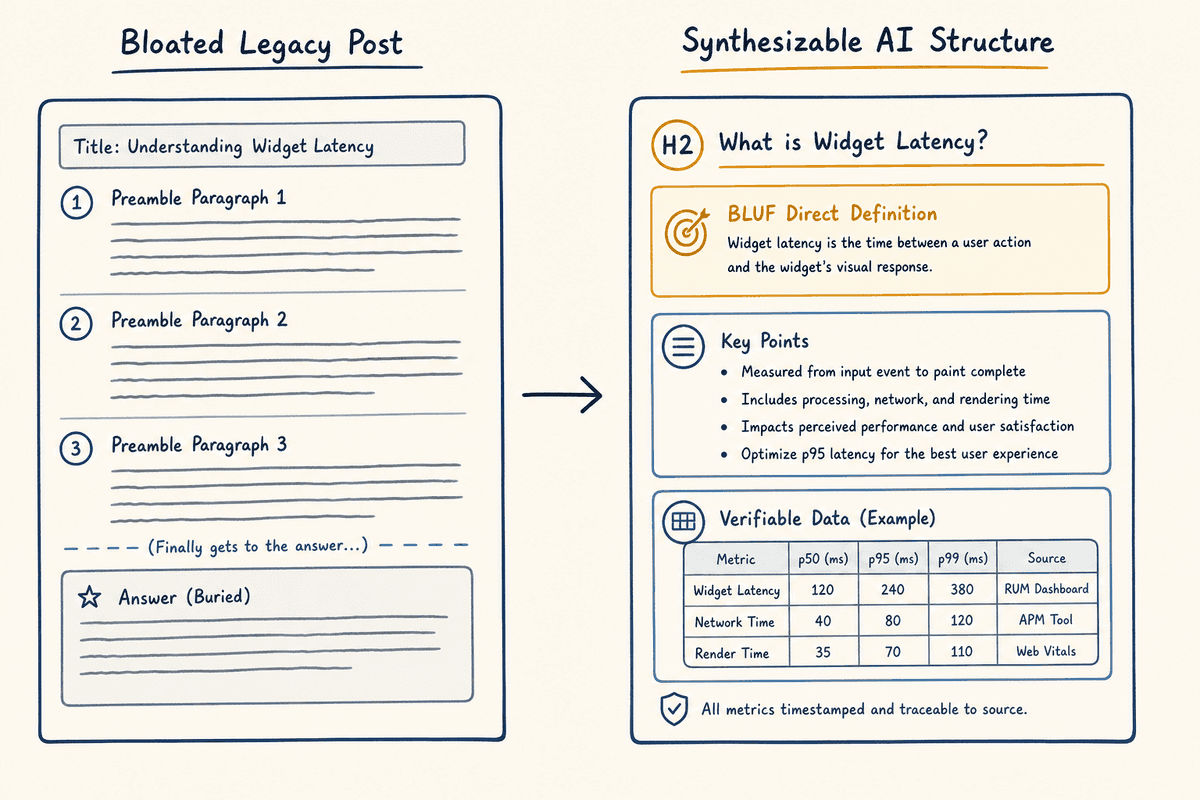
Use strict hierarchical formatting. Your H2s should introduce a distinct concept, and your H3s should break that concept down into components. When defining a term or answering a direct question, do it immediately after the heading.
If your heading is "What is AI Search Visibility?", the very next sentence should be a concise, objective definition: "AI search visibility is the measure of how frequently and favorably a brand is recommended or cited by large language models responding to user queries." Do not bury the answer under three paragraphs of preamble about how fast technology is changing.
Verifiability and Freshness
LLMs are designed to avoid hallucinations (making things up). To mitigate this, their RAG systems prioritize sources that present verifiable data. You can begin to do this by keeping your content fresh and verifiable, as regular updates signal to AI systems that your content is current 5.
When you make a claim, back it up with data, and clearly cite the original source of that data. If you are citing a statistic from 2021, the LLM may reject your page in favor of a competitor citing a statistic from 2026. Data tables, bulleted statistics, and explicit dates in your text dramatically improve your synthesizability score.
5 Proven Strategies to Improve AI Search Visibility
Moving beyond theory, improving your AI visibility requires a systemic change to how your marketing, growth, and content teams operate. The days of handing a writer a list of keywords and asking for a 1,000-word post are over. Here is the operational playbook for getting cited across ChatGPT, Gemini, and Perplexity.
1. Optimize for Conversational, Question-Answering Formats
Users speak to AI assistants differently than they type into Google. A Google search might be "B2B SEO agency UK rates." A ChatGPT prompt is, "I run a B2B SaaS in London. Should I hire an agency or use automation for SEO, and what are the typical costs for both?"
To capture this visibility, your content must mirror these natural language constructs. Structure your headers as the exact questions your buyers are asking. Instead of a generic header like "Cybersecurity Audit Services," use "Why do I need a cybersecurity audit before a Series B funding round?"
When answering these questions, use the "BLUF" (Bottom Line Up Front) method. Give the direct, factual answer immediately, then use the rest of the section to provide context, examples, and nuance. This satisfies the LLM's need for a quick extraction while providing the depth a human reader wants once they click through the citation.
2. Build Unassailable Brand Authority and Consensus
AI models do not take your word for it. If you want Perplexity to tell a user that your software is the fastest on the market, the LLM needs to see that claim validated across multiple independent domains.
You must find out what citation sources are influencing AI recommendations in your niche 4. Often, these are high-authority platforms where user-generated content thrives:
- Reddit and Quora
- G2, Capterra, and TrustRadius
- Stack Overflow or GitHub (for technical products)
- Industry-specific forums
If your brand is completely absent from these third-party platforms, you will struggle to gain AI visibility. A core part of your strategy should involve PR, digital PR, and community management. Encourage satisfied customers to mention their specific use cases in detailed reviews. When a user on Reddit asks for a tool recommendation, ensure your brand is part of the conversation (authentically). The LLM crawls these threads to establish consensus. If five independent users recommend your tool, the AI is highly likely to synthesize that consensus into its own answer.
3. Map the AI Journey for Your Specific Buyer Prompts
Traditional keyword research tools will not tell you what prompts your buyers are feeding into ChatGPT. You have to map this journey manually or use dedicated AI monitoring software.
Start by interviewing your sales and customer success teams. What are the exact, multi-part questions prospects ask on discovery calls?
- "How does your tool compare to [Competitor] for enterprise teams?"
- "What are the hidden implementation costs of deploying an ERP?"
- "Can we integrate your platform with our legacy on-premise database?"
Take these exact questions and run them through ChatGPT, Gemini, Perplexity, and Google AI Overviews.
- Analyze the Output: Does the AI give an accurate answer?
- Check Brand Mentions: Is your brand mentioned as a solution? Are your competitors?
- Trace the Citations: Where did the AI get its information? Click every citation link.
If the AI cited a competitor's blog post, analyze that post. Why was it synthesizable? Usually, it is because they provided a clear, structured answer. If the AI cited a Reddit thread where your brand is being criticized, you now have a reputation management task that directly impacts search visibility.
4. Ensure Technical Accessibility for AI Crawlers
An often-overlooked aspect of AI search visibility is technical SEO. If the AI's web crawler cannot render or access your content, you cannot be cited. Companies using modern web frameworks often accidentally block AI bots.
For instance, many SaaS companies build their marketing sites or knowledge bases using JavaScript-heavy frameworks. If you do not implement proper server-side rendering or dynamic rendering, AI bots like OAI-SearchBot (OpenAI's crawler) or Google-Extended might just see a blank page.
If your infrastructure relies on these frameworks, reviewing guidelines on Single-Page Application SEO: What Works in 2026? is critical. The technical checklist for AI crawlers is similar to traditional Googlebot:
- Ensure critical content is rendered in the initial HTML payload.
- Check your
robots.txtfile. Many companies hastily blocked AI crawlers in 2023 due to data scraping concerns, accidentally erasing themselves from AI search results. If you want visibility, you must allow crawlers likeOAI-SearchBot,PerplexityBot, andClaudeBotto access your informational pages. - Maintain clean, logical XML sitemaps to help bots discover new content quickly.
5. Turn Visibility Gaps into Publishing Workflows
The most critical step in improving your AI search visibility is execution. Monitoring is useless if it does not lead to published content.
When you identify a gap—for example, ChatGPT consistently recommends a competitor for a specific buyer prompt because they have a dedicated comparison page—you must turn that insight into an immediate content brief.
If you notice that AI Overviews prefer highly structured lists for a specific query, and your current page is a wall of text, the required action is a formatting overhaul. When assessing how to allocate resources for this, reviewing SEO Charges UK: Agency Rates vs Automation (2026) can help you decide whether to build an internal content team to execute these updates or outsource to a specialized agency.
The BeVisible methodology treats every missing mention and weak citation as a distinct publishing task. If Perplexity cites a weak, outdated source instead of your comprehensive guide, it usually means your guide is lacking the specific entity relationships the LLM was looking for. Update the article, add the missing context, ensure verifiable data is present, and force a recrawl.
Mini-Case Scenario: Recovering Lost Visibility in Perplexity
To illustrate how this works in practice, consider a realistic scenario for a B2B SaaS company selling supply chain management software.
The Problem: The company’s growth team notices a drop in high-intent inbound demos. They run a test prompt in Perplexity: "What are the most reliable supply chain forecasting tools for mid-market manufacturing?"
The company is completely absent from the answer. Worse, three of their direct competitors are heavily recommended.
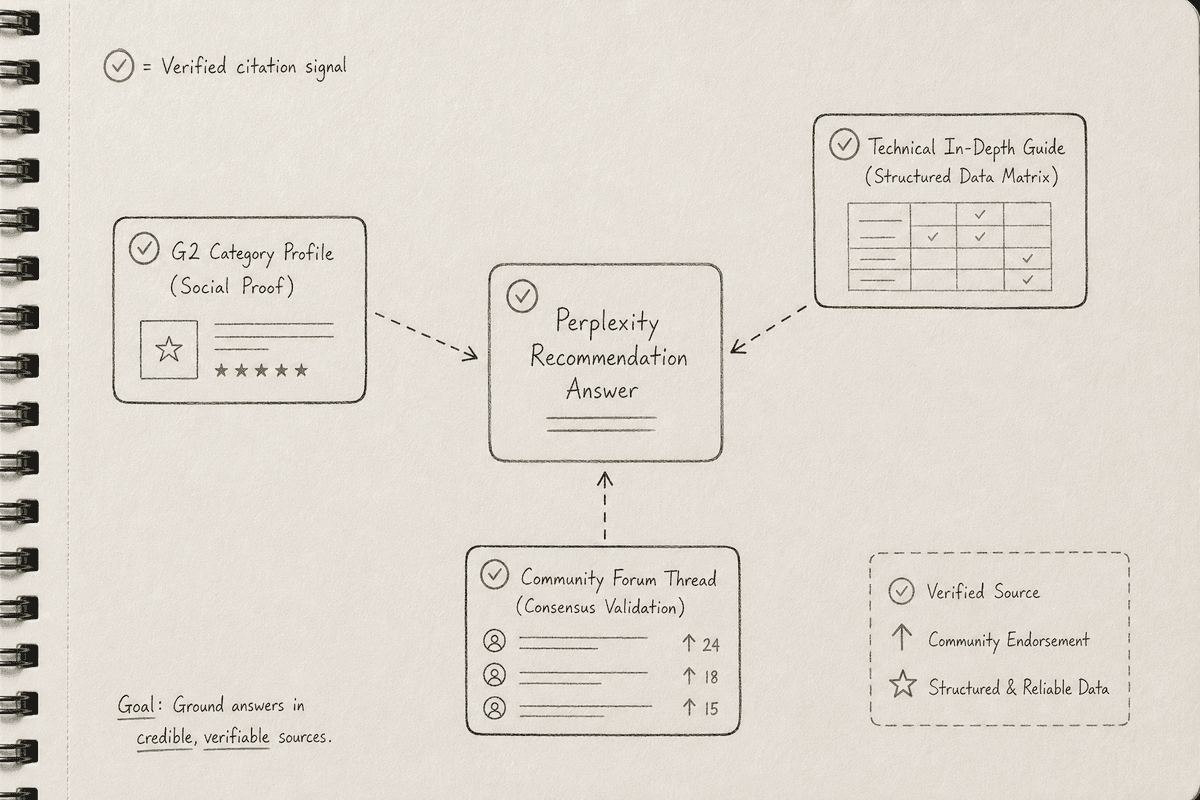
The Audit (Citation Analysis): The team clicks the citation links Perplexity used to generate the answer. The AI didn't scrape the competitors' homepages. Instead, it pulled information from:
- A highly ranked G2 category page.
- A detailed technical article on a specialized supply chain blog.
- A highly upvoted discussion in a manufacturing subreddit.
The Action Plan:
- Platform Optimization: The company realizes their G2 profile is thin and lacks recent reviews. They trigger a targeted campaign asking successful mid-market manufacturing clients to leave detailed reviews mentioning "forecasting reliability."
- Content Creation: They notice the supply chain blog article was cited because it contained a clear, comparative markdown table of forecasting algorithms. The company creates an even more comprehensive guide on their own site, complete with a structured matrix of forecasting models, heavily citing verifiable industry data.
- Community Engagement: They instruct their developer relations team to genuinely participate in relevant technical forums, answering questions comprehensively.
The Result: Six weeks later, when running the same prompt, Perplexity includes the company in its recommendation list, citing both their newly published guide (for technical definitions) and their updated G2 profile (for social proof and consensus).
Auditing Your Current AI Search Footprint
If you want to start improving your visibility today, you need a baseline. You cannot improve what you have not audited.
Step 1: Define Your Core Prompts
Do not use keywords; write full prompts.
- Informational: "How do I calculate customer acquisition cost for a bootstrapped SaaS?"
- Commercial Investigation: "What are the best CRM tools for healthcare companies that are HIPAA compliant?"
- Navigational/Brand: "What are the main downsides of using [Your Brand]?"
Step 2: Run the Prompts and Record the Output
Run these exact prompts across the big four: ChatGPT (with web search enabled), Perplexity, Google AI Overviews, and Gemini.
Document the following for each prompt:
- Was your brand mentioned?
- Was the sentiment positive, neutral, or negative?
- Were you cited as a source?
- Who were the cited sources?
- Who were the recommended competitors?
Step 3: Analyze the Content Gap
If you were not cited, look at the pages that were. What did they have that you lack?
- Did they have more up-to-date statistics?
- Was their formatting easier to parse (bullets, tables, bolded entities)?
- Did they cover a sub-topic you completely ignored?
Step 4: Execute the Fixes
If you need to restructure your content to be more AI-friendly, reviewing resources like How to Build an SEO Landing Page (7-Step Guide) can provide a baseline for structuring pages that satisfy both human readers and algorithmic parsers. Turn every gap into a specific task: update an old post, create a new landing page, or launch a review generation campaign.
Overcoming Common AI Optimization Pitfalls
As teams pivot toward AI search visibility, they frequently fall into a few predictable traps. Recognizing these failure modes early saves wasted content cycles.
Pitfall 1: Over-optimizing for a Single LLM Optimizing strictly for ChatGPT while ignoring Google’s AI Overviews is dangerous. They utilize vastly different architectures. ChatGPT (using Bing's index for real-time data) heavily favors explicit, structured answers. Google AIO is deeply tied to its existing Knowledge Graph and traditional E-E-A-T (Experience, Expertise, Authoritativeness, Trustworthiness) signals. A comprehensive strategy addresses synthesizability (for ChatGPT/Perplexity) while maintaining deep author authority (for Google AIO).
Pitfall 2: Treating AI Monitoring like Rank Tracking Checking a dashboard to see if your "AI visibility score" went up is a vanity exercise. The only reason to monitor AI search is to generate publishing and execution workflows. If your monitoring tool isn't telling you what to write or how to fix a missing mention, it is just expensive shelfware.
Pitfall 3: Blocking AI Bots in robots.txt
In 2023 and 2024, many publishers aggressively blocked CCBot, GPTBot, and Anthropic-ai to prevent their content from being used to train foundation models without compensation. While the sentiment is understandable, blocking these bots also removes your content from real-time AI search features. If you want to be cited in ChatGPT's search answers, OAI-SearchBot must be allowed to crawl your site.
To stay ahead of these shifting technical requirements, it is worth consulting authoritative industry voices. Keeping an eye on the 11 Best SEO Blogs Every SaaS Founder Needs (2026) can help you monitor when specific bots change their crawling behavior or when new AI search features are deployed.
Frequently Asked Questions
How long does it take for AI models to cite new content?
It depends entirely on the engine and its RAG architecture. Perplexity and ChatGPT (when using live search) can index and cite a newly published article within hours, provided the URL is easily discoverable or heavily shared on authoritative platforms like Reddit or X. For Google AI Overviews, the timeline typically mirrors traditional indexing; it requires Googlebot to crawl, render, and index the page before it is considered for an AI Overview snippet.
Do traditional backlinks still matter for AI search visibility?
Yes, but their function is shifting. Backlinks no longer just pass PageRank; they act as pathways for AI crawlers to discover consensus. If a high-authority industry blog links to your study, Perplexity is more likely to trust your data. However, a contextual mention (an unlinked brand mention in a highly relevant Reddit thread) can sometimes be just as valuable to an LLM trying to determine market consensus as a traditional hyperlink.
What is the difference between training data and RAG (Retrieval-Augmented Generation)?
Training data is the static information the LLM was originally taught on (which has a cutoff date). RAG is the process where the AI runs a real-time web search, scrapes the top current articles, and uses that fresh information to answer the prompt. To maintain AI search visibility, you are optimizing for RAG. You want the AI to retrieve your page today, read it today, and cite it today.
The New Standard of Search Execution
Improving AI search visibility is not about finding a new set of tricks to game an algorithm. It is about adapting to a web where the user relies on a highly sophisticated research assistant to do their reading for them.
You must transition from keyword insertion to entity relationships. You must move away from generic marketing copy toward dense, verifiable, synthesizable facts. Most importantly, you must stop tracking arbitrary ranking positions and start monitoring exactly how these models answer the specific questions your buyers are asking. By tracking ChatGPT, Gemini, Perplexity, and AI Overviews, and turning those visibility gaps into relentless, evidence-backed publishing, you secure the brand authority required to thrive in an AI-first discovery environment.