
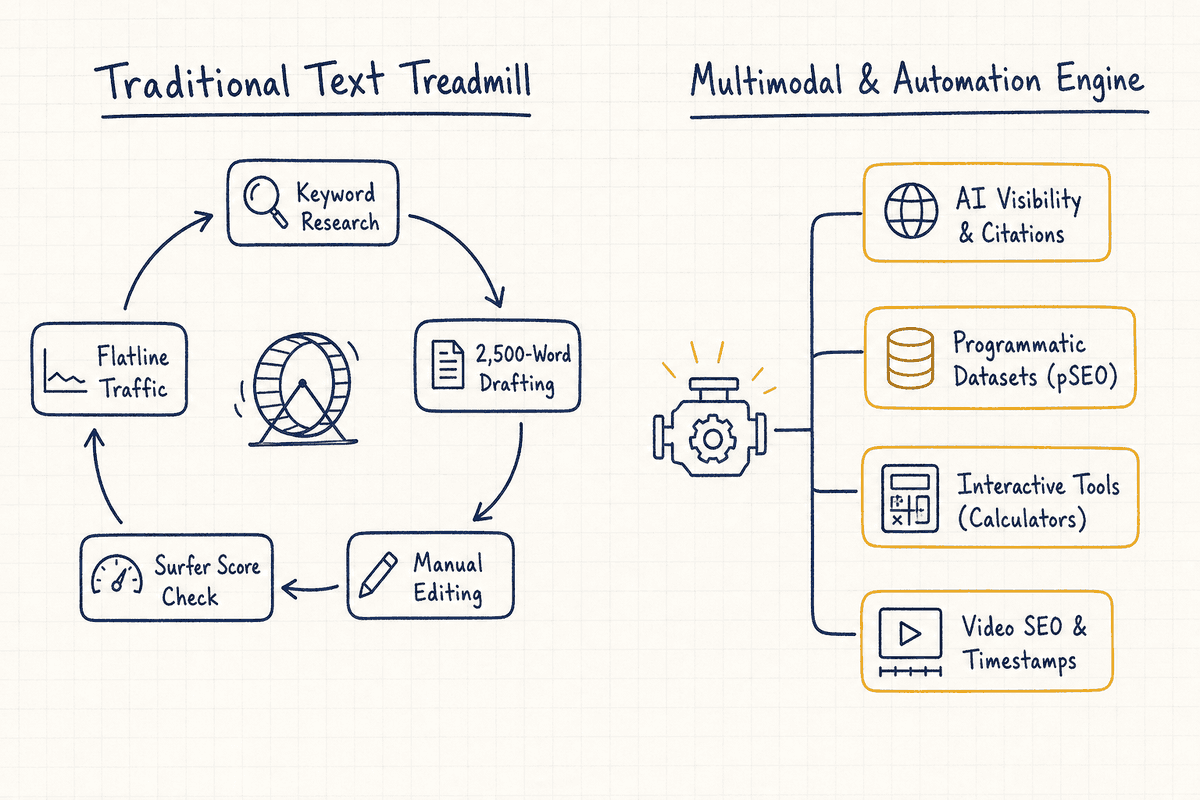
Marketing teams are trapped in a costly cycle. Week after week, content managers draft, edit, and publish thousands of words simply to compete for a handful of informational keywords. For years, the standard playbook involved running a target keyword through a content optimization tool, finding out the top pages averaged 2,400 words, and hiring writers to produce 2,500 words of mildly repetitive text. Tools that analyze keyword density and correlate on-page text with high rankings became the default solution for this workflow.
But search algorithms have fundamentally shifted. Traditional text-correlation tools assume your primary goal is to write manual prose. When you want to rank on Google without writing articles manually, you need to abandon the text-heavy playbook entirely. The alternative is shifting your strategy from manual text creation to automation, multimedia optimization, and structured data. Search engines index various types of media and actively reward clear, machine-readable information over blocks of human-written fluff.
You can bypass the traditional content treadmill. By focusing on AI search visibility, programmatic landing pages, embedded tools, and video assets, you can secure first-page rankings without typing a single traditional blog post.
The Myth of the 2,000-Word Manual Article
There is a persistent belief among SaaS founders and marketers that text volume equals content quality. This myth is a byproduct of the last decade of search engine optimization, where algorithms heavily relied on natural language processing to understand web pages. If you wanted to prove your page was authoritative on a topic, you needed to surround your keyword with hundreds of semantically related terms.
This led to the rise of content optimization software. You type in a keyword, the tool scrapes the top ten results, and it gives you a checklist of words to include. While this approach still works for traditional text SEO, it suffers from severe diminishing returns. It treats content creation as a commodity race where the winner is simply the site that spends the most money on manual drafting and editing.
Search algorithms have evolved beyond basic text correlation. They now prioritize utility, entity relationships, and immediate answers. If a user searches for a specific software comparison, a dynamic chart pulled from a structured database provides more utility than a 3,000-word narrative essay. If a user searches for a tutorial, a properly formatted video with timestamped chapters solves their problem faster than a wall of text.
Google’s integration of AI Overviews further diminishes the value of manual filler content. Large language models synthesize facts, data points, and direct answers from across the web. They do not need your introductory paragraphs. They need structured data, clear citations, and authoritative brand signals.
Why Legacy Optimization Tools Fall Short in 2026
When you rely exclusively on traditional content optimization platforms, you are optimizing for a version of search that is rapidly decaying. These tools excel at analyzing standard HTML text. They struggle to measure how well your brand is represented inside AI assistants, how effectively your videos answer user queries, or how robust your structured data is.
If you are trying to rank without writing manual articles, a tool that grades your text density is fundamentally the wrong instrument. You need a technology stack that measures visibility across different modalities.
If you are a SaaS founder or an agency leader, your goal is not to produce text. Your goal is to capture demand and secure visibility where your buyers are asking questions. That requires looking beyond traditional optimization and adopting execution models built for automation, engineering, and multimedia.
Strategy 1: Managing AI Visibility and Answer Engine Optimization
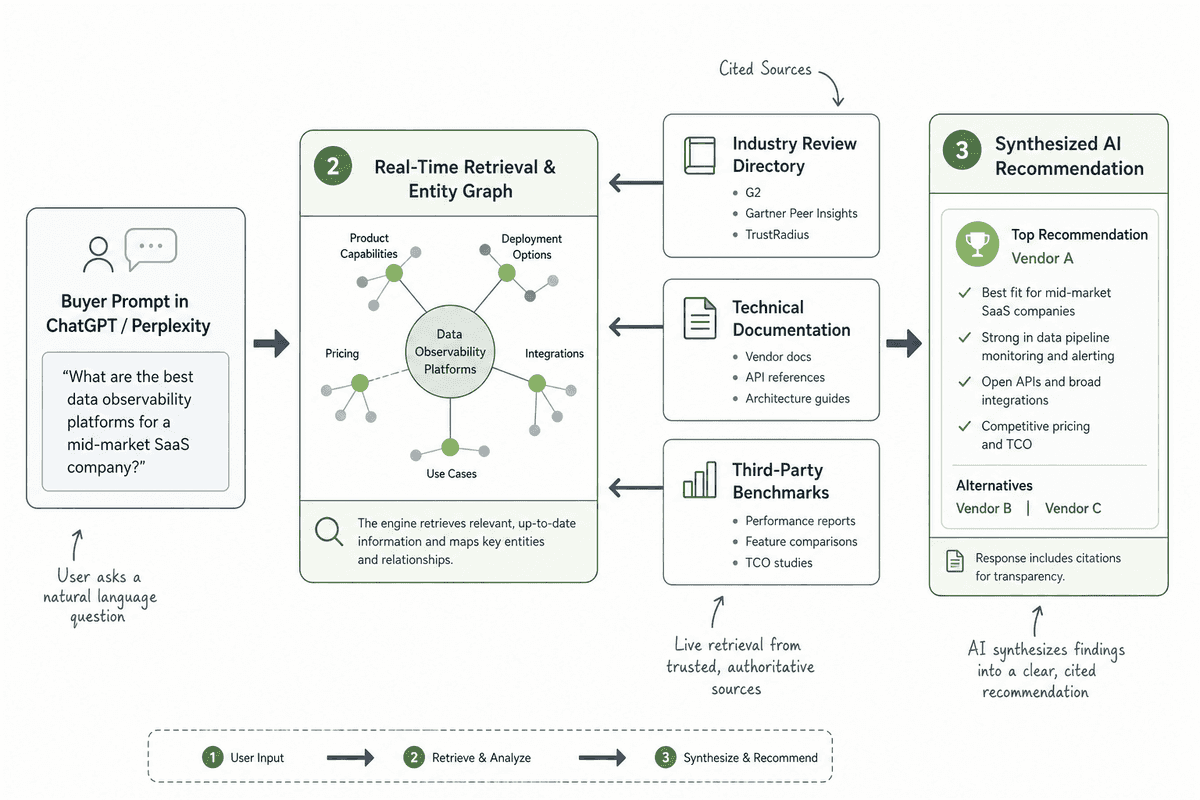
The definition of "ranking on Google" has expanded. Securing a traditional blue link is only one part of the equation. Buyers now ask complex, multi-layered questions to AI assistants, AI Overviews, ChatGPT, Gemini, and Perplexity. If your brand is not mentioned in those synthesized answers, your traditional search rankings will yield declining traffic.
Managing AI visibility is the most direct way to bypass manual article writing. Instead of guessing what content to write, you monitor how these AI models construct their answers.
Tracking Brand Mentions in AI Responses
Large language models generate answers based on entity relationships, brand authority, and consensus across training data and real-time retrieval. They do not care how many times you used a keyword on your homepage. They care if highly trusted industry sources cite your product as a solution.
BeVisible helps teams monitor exactly how AI assistants answer buyer questions. It tracks ChatGPT, Gemini, Perplexity, AI Mode, and AI Overviews across specific buyer prompts. Instead of writing generic top-of-funnel articles, growth teams use BeVisible to identify which brands AI assistants recommend and which sources they cite.
When you discover that ChatGPT recommends three of your competitors but omits your software, you have a specific visibility gap.
Turning Visibility Gaps into Automated Execution
Once you identify these gaps, you do not need to sit down and write a ten-page guide. You execute precise, targeted updates based on evidence. BeVisible turns these missing mentions and weak citations into actionable publishing work.
If an AI assistant cites a specific directory or a third-party review site when answering a buyer prompt, your fastest path to visibility is getting your brand listed on that exact third-party page. You let other sites do the ranking, and you position your brand within their existing real estate.
This is answer engine optimization in practice. You manipulate the inputs that feed the AI models. You update your knowledge graph entries, secure reviews on the exact platforms Gemini relies on, and inject structured data into your existing pages. You gain visibility entirely through technical execution and targeted digital PR, completely circumventing the need for manual blogging.
Strategy 2: Programmatic SEO (pSEO) and Data Aggregation
If you absolutely must host pages on your own domain to capture search traffic, writing them one by one is an inefficient use of resources. Programmatic SEO (pSEO) allows you to generate hundreds or thousands of indexable, high-value pages using databases rather than writers.
Programmatic SEO leverages structured datasets to create templates that dynamically populate with unique information. Think of travel booking sites, real estate platforms, or software integration directories. These companies do not employ writers to craft unique essays about every flight route or API connection. They use databases to render pages at scale.
Building the Dataset
The foundation of programmatic SEO is a unique, valuable dataset. You cannot simply scrape competitor sites and spin the text. Google routinely de-indexes programmatic sites that offer no unique value. Your dataset must solve a specific problem.
For a B2B SaaS company, this dataset might include:
- Integration capabilities and technical specs for various software platforms.
- Industry-specific salary data aggregated from job boards.
- Tax rates or compliance regulations by state and county.
- Benchmark metrics for specific marketing channels.
You structure this data in a relational database or a headless content management system. Each row in your database represents a distinct search intent, and the columns contain the specific data points that will populate the page template.
Designing the Page Template
Once your data is clean, you design a master template. This template acts as the skeleton for your programmatic pages. It dictates where the H1 heading goes, where the data tables sit, and how the structured data is formatted.
When figuring out How to Build an SEO Landing Page (7-Step Guide), the emphasis should be on user experience and data visualization. If your dataset contains numeric values, your template should render those numbers as charts or comparative graphs. The goal is to present the data so clearly that the user immediately finds their answer.
Automating Schema Generation
Structured data is a mandatory component of programmatic SEO. Because you are relying on databases rather than prose to communicate with search engines, you must use JSON-LD schema markup to explicitly tell Google what the data means.
Generating schema manually is tedious, but in a programmatic environment, it happens automatically. You map your database fields directly to schema properties. When the page renders, the code generates perfect, machine-readable context for the search engine bots. You can automate schema generation directly within your database-to-page workflow, ensuring every single asset you publish provides exact entity signals to the crawlers. This precise technical execution is exactly how you write content that ranks highly without typing out paragraphs. You can leverage automated tools to handle schema code generation directly on your clipboard for easy implementation.
Strategy 3: Multimedia Dominance Through Video SEO
One of the most powerful ways to bypass manual writing is to stop using text entirely. Google dedicates massive amounts of prime search engine results page (SERP) real estate to video content. For many "how-to" and tutorial queries, a YouTube video will rank higher than a well-written article.
Optimizing for YouTube effectively allows you to bypass the traditional text algorithms. It acts as a Trojan horse directly into Google Search.
The Power of Video in Search
When you record a software demonstration, a strategic teardown, or a slide presentation, you are creating a high-density information asset. You can speak 1,500 words in ten minutes. Turning that knowledge into a ranking asset requires zero manual article writing.
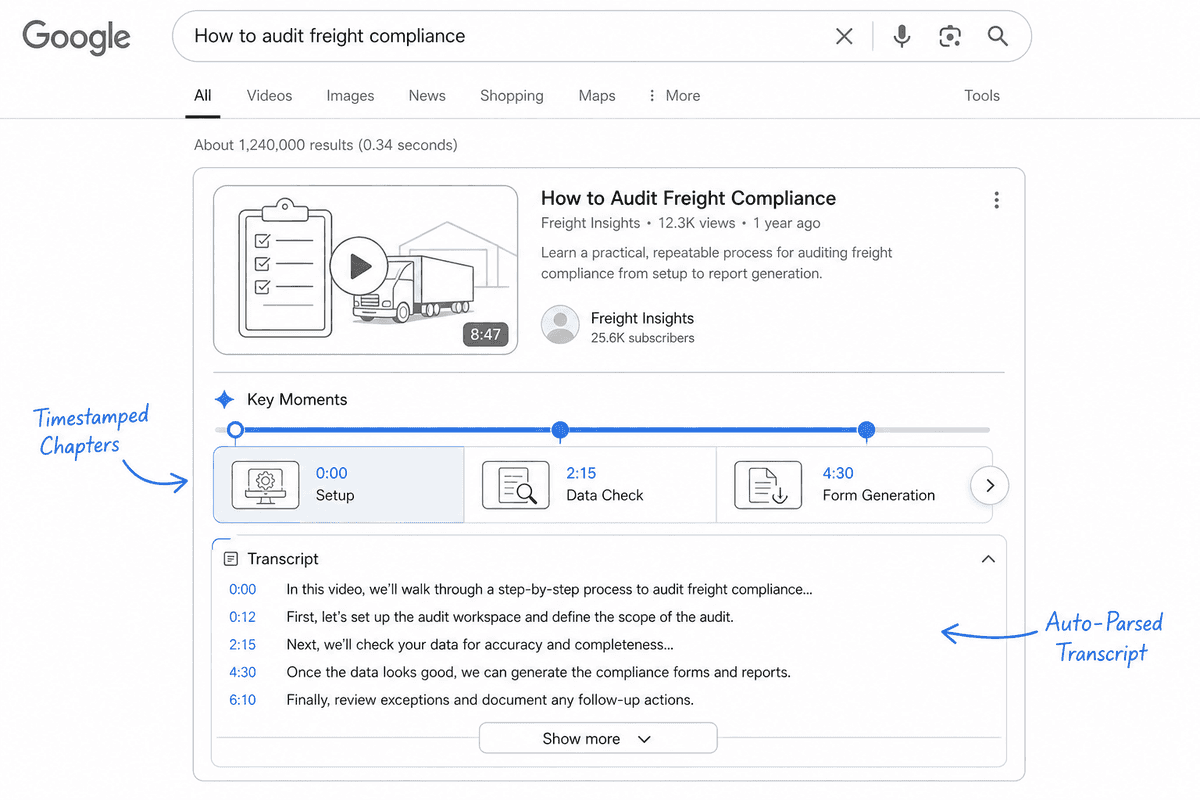
You can rank high on Google without writing content by shifting your focus entirely to video production and optimization. Google parses the audio transcript of your video, analyzes the timestamped chapters, and uses those signals to rank the video in the main search results.
The Video Optimization Workflow
To execute this strategy, you need a disciplined approach to video formatting.
- Keyword-Targeted Titles and Descriptions: Treat your video title exactly like an H1 tag. It must contain the primary search intent. The description should provide a clear summary of the video's utility.
- Structured Timestamps: This is the most critical step for Google Search visibility. You must break your video into logical chapters using timestamps in the description. Google uses these chapters to create "Key Moments" directly in the search results, allowing users to skip to the exact answer they need. This snippet feature often outranks traditional text articles.
- Automated Transcripts: Never rely on YouTube's auto-captions alone. Use an automated transcription tool to generate a clean, accurate SRT file and upload it manually. This feeds Google’s natural language processors a perfect text version of your video without you having to write a single sentence.
- Embedding for Cross-Pollination: Create a simple, minimal landing page on your site that hosts the video. You do not need to write an accompanying essay. A brief introductory sentence, the embedded video, and the raw transcript are enough to index the page and capture both standard web traffic and video search traffic.
Strategy 4: Engineering as Marketing (Tools Over Text)
If you have development resources, building a free tool is infinitely more effective than writing an article. This approach, often called "engineering as marketing," involves creating calculators, analyzers, generators, or diagnostic tools that directly answer a user's query through software rather than text.
Solving Intent with Code
When a user searches for "ROI calculator for warehouse automation," they do not want to read the history of warehouses. They do not want to read an explanation of what ROI stands for. They want to input their numbers and get a result.
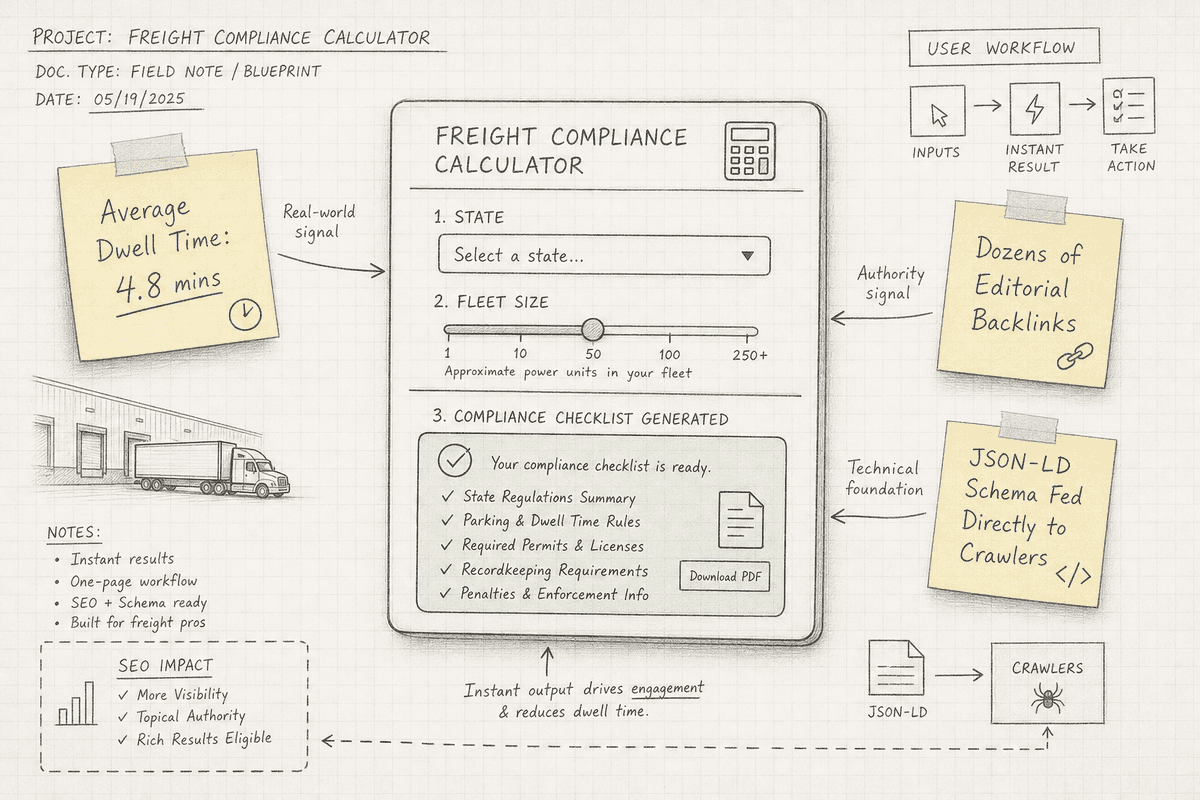
If your competitor writes a 2,000-word article explaining how to calculate the ROI manually, and you build a simple, single-page application (SPA) that calculates it for them instantly, your tool provides superior utility. Google tracks user behavior signals like dwell time, bounce rate, and return-to-SERP rate. The tool will consistently outperform the text article because it actually solves the user's problem.
Deploying Tools via Single Page Applications
These free tools are typically built as Single Page Applications using frameworks like React or Vue. Historically, SPAs struggled with search visibility because search engine bots had difficulty rendering JavaScript.
This is no longer a barrier. By implementing proper server-side rendering (SSR) or static site generation (SSG), you can ensure your tools are fully indexable. When deploying these assets, you must follow the SEO for Single Page Applications: The Technical Checklist to guarantee that crawlers can access the interactive elements and understand the page's purpose.
A well-engineered tool becomes a permanent asset. It naturally attracts backlinks because other websites will link to a useful calculator far more often than they will link to a generic blog post. It acts as a lead generation magnet, capturing emails in exchange for detailed reports. Most importantly, it requires zero ongoing manual writing to maintain its ranking.
Strategy 5: Dominating the Local Pack and Knowledge Graph
For specific types of queries, particularly those related to services or physical locations, traditional organic listings are pushed far down the page. The top of the SERP is dominated by the Google Local Pack (the map interface) and Knowledge Graph panels.
If you target these localized or entity-driven queries, writing articles is a waste of time. AI Overviews explicitly confirm that for local businesses, the fastest way to get to page one is not by writing articles; it is through a highly optimized Google Business Profile.
Exploiting the Local SEO Bypass
Even if you are a B2B SaaS company or a national agency, you can leverage localized SEO to capture high-intent traffic without writing content. Consider a search like "SEO agencies." Ranking for that term organically requires massive domain authority and endless content creation.
However, ranking for localized variants is a different game entirely. You can explore examples of this localized dominance when reviewing the Top 7 Agencies for SEO in Durham (Ranked 2026). The companies winning that specific local traffic are not doing it by writing 3,000-word blog posts about Durham. They are doing it by optimizing their Google Business Profiles.
It is entirely possible to rank on the first page of Google within 24 hours without even needing a traditional website, provided you optimize your Google Business Profile correctly for a specific local intent.
Execution Steps for Local Dominance
- Complete Entity Verification: Claim your profile and fill out every single data field. Hours, categories, services, and attributes must be perfectly accurate. This feeds Google's Knowledge Graph with structured entity data.
- Product and Service Menus: Do not just list your name and address. Use the profile features to build out complete menus of your SaaS tiers or agency services. These internal Google properties rank incredibly well for specific localized queries.
- Review Velocity and Sentiment: Google relies heavily on third-party validation. A steady stream of legitimate customer reviews acts as the ultimate ranking signal for the Local Pack. The text contained within those user-generated reviews serves as your "content." When a customer mentions "great API integration" in a review, Google associates your entity with that specific phrase.
- Geotagged Visual Assets: Uploading high-quality, properly named photos and videos to your profile signals active management and provides visual context to the search engine.
Strategy 6: Digital PR and Citation Building
Link building and brand mentions remain foundational to search visibility. However, the traditional method of acquiring these signals involves manual outreach and writing "guest posts" for other blogs. This is just manual article writing disguised as link building.
Digital PR offers a scalable, non-writing alternative. Instead of pitching written articles to editors, you pitch raw data, unique insights, or interactive tools.
Earning Mentions Through Data
Journalists, industry bloggers, and newsletter creators constantly need data to support their writing. If you provide that data, they will do the writing for you, and they will cite your brand in the process.
You can run a survey across your user base, analyze a public dataset, or pull anonymized usage statistics from your own software. You then package these findings into a simple, highly visual press release or a single landing page featuring charts and graphs.
When you distribute this data to industry publications, they use your statistics to write their own stories. You earn authoritative backlinks and brand citations across the web without having to draft the articles yourself. This strategy forces your brand into the exact authoritative sources that AI language models scrape when formulating their answers.
A Scenario: The SaaS Startup That Ranked Through Engineering
Consider a mid-sized B2B SaaS company selling compliance management software for the logistics industry. Their marketing team spent six months writing extensive guides on compliance regulations, safety protocols, and audit procedures. Despite publishing dozens of manual articles, they struggled to break past page three. Their competitors had larger budgets and older domains.
They abandoned the manual writing strategy and pivoted to an engineering and visibility model.
First, they used BeVisible to analyze AI visibility. They discovered that when users asked ChatGPT, "What are the best compliance tools for freight companies?", the AI consistently recommended three legacy competitors. BeVisible's evidence tracking showed that ChatGPT was pulling these recommendations from two specific software review directories. The startup immediately focused its efforts on securing top placements and verified reviews on those exact directories.
Second, they stopped writing compliance guides and tasked a junior developer with building a "Freight Compliance Audit Generator." This was a single-page application where users could select their state, input their fleet size, and instantly receive a checklist of required compliance forms.
They launched the tool and used digital PR to distribute the link to logistics newsletters and industry forums.
The results completely bypassed traditional text SEO timelines. Within weeks, the audit generator attracted dozens of high-authority backlinks from logistics associations. The tool began ranking in the top three organic spots for "freight compliance checklist" because users spent five minutes interacting with the calculator, sending massive positive engagement signals to Google. Simultaneously, their targeted review campaign shifted their AI visibility score, and ChatGPT began listing them as a recommended vendor in its synthesized answers.
They achieved dominant search visibility, captured high-intent leads, and influenced AI recommendations without writing a single manual blog post.
The Economics: Agency Rates vs. Automated Systems
Transitioning away from manual content creation fundamentally changes your marketing economics. Relying on freelance writers, editors, and traditional SEO agencies creates a linear cost structure. Every new keyword you want to target requires a new financial output for a new article.
When you invest in automated systems, structured data, and AI visibility tools, your costs become front-loaded and scalable. Building a programmatic SEO template requires upfront development time, but once it is live, generating the next 500 pages costs practically nothing.
This economic shift is critical for SaaS founders managing tight burn rates. If you examine the breakdown of SEO Charges UK: Agency Rates vs Automation, the long-term ROI heavily favors building technical assets over renting manual labor. You are shifting budget away from commodity writing and investing it into permanent engineering assets, proprietary data structures, and precise visibility tracking.
The "Beyond Surfer" Tech Stack
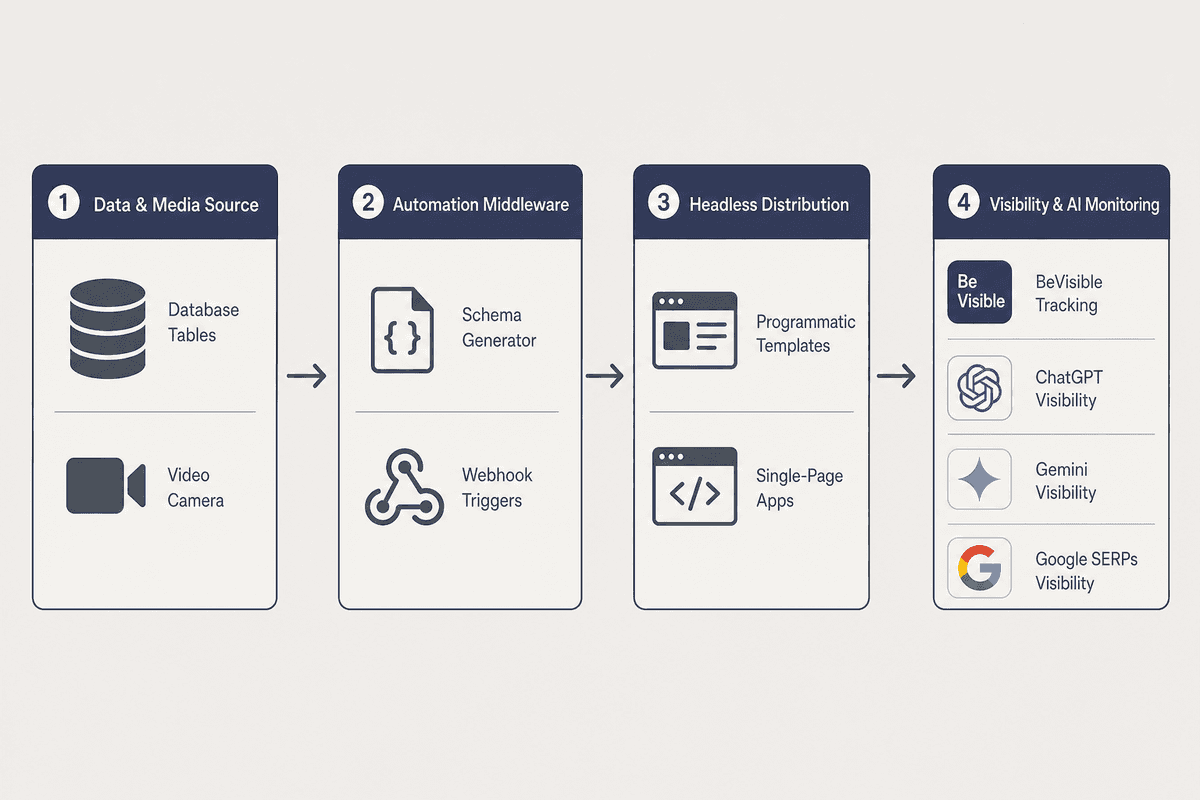
To execute a strategy that ignores manual text creation, you need a different set of tools. You must replace your content grading software with platforms designed for aggregation, automation, and visibility monitoring.
1. BeVisible (For AI Visibility and Gap Execution)
BeVisible is the command center for this new search reality. It tracks how AI assistants answer buyer questions, which brands they recommend, and which sources they cite. It monitors ChatGPT, Gemini, Perplexity, AI Mode, and AI Overviews. Crucially, it turns those visibility gaps into evidence-backed opportunities. You use it to find out exactly where your brand is missing from the AI ecosystem, allowing you to execute precise interventions instead of guessing what to publish next.
2. Video Optimization Platforms
If you are replacing text with video, you need tools to streamline production and optimization. Automated editing software that uses AI to remove filler words and generate instant, highly accurate transcripts is essential. You also need platforms that automatically format those transcripts into the correct JSON-LD schema for YouTube and Google Search ingestion. You can leverage AI SEO tools designed specifically to help create content that ranks automatically by formatting these video and data assets correctly.
3. Headless CMS and Database Connectors
For programmatic SEO, your stack must include a robust relational database and a frontend framework capable of rendering that data at scale. Using platforms that connect databases directly to static site generators allows you to spin up thousands of high-utility landing pages without ever opening a word processor.
4. Automation Hubs
You need middleware to connect these disparate systems. When a new row is added to your database, your automation hub should trigger your CMS to build a new page, generate the associated schema markup, and ping the search engines for indexing. This creates a closed-loop system where data input equals instant SEO output.
Frequently Asked Questions
Is programmatic SEO considered spam by Google?
Programmatic SEO is only considered spam if it provides no unique value to the user. If you simply scrape Wikipedia and generate millions of pages with slightly different titles, Google will penalize your site for thin content. However, if you use a proprietary database to build pages that genuinely help users compare products, calculate costs, or find specific local data, Google rewards it. Utility is the defining factor, not the method of creation.
How do I track success if I am not writing articles?
You track success based on visibility share, engagement metrics, and pipeline impact. Instead of tracking the keyword rankings of a specific blog post, you track how many times your brand is recommended by AI models using tools like BeVisible. You track the number of user sessions on your interactive calculators. You track the watch time and chapter clicks on your embedded videos. The metrics shift from "words published" to "answers provided."
Does using AI to generate text count as "not writing manually"?
Technically, using an LLM to generate a 2,000-word article means you did not write it manually. However, simply replacing a human writer with a prompt to generate the exact same commodity text does not solve the fundamental problem. The web is already flooded with generic AI text, and search engines are adjusting their algorithms to devalue it. True automation means moving beyond long-form prose entirely and focusing on structured data, interactive tools, localized entities, and actual AI visibility gaps.
Can I really rank without any text on my website?
You need text, but you do not need prose. A highly optimized page might only contain a few sentences of introduction, followed by structured data tables, an embedded video, and a functional calculator. The text exists purely to provide context for the interactive and multimedia elements. The heavy lifting for search visibility is done by the JSON-LD schema, the video transcript, the user engagement signals, and the external citations your tool attracts.
Shifting from Content Creation to Visibility Execution
The era of out-typing your competitors is over. Relying on traditional content optimization tools to refine manual paragraphs is a defensive strategy in a landscape that requires aggressive technical execution.
Search is no longer a simple index of text documents. It is a multimodal ecosystem of AI synthesized answers, video chapters, local entity graphs, and structured databases. To rank on Google without writing articles manually, you must stop operating like a publishing house and start operating like an engineering team.
Build datasets instead of drafts. Record videos instead of essays. Code calculators instead of tutorials. And most importantly, monitor your true visibility across AI assistants to ensure your brand is cited exactly where buyers are looking. By adopting this technical, evidence-backed approach, you secure sustainable search dominance while completely eliminating the friction and cost of manual article production.