
For B2B SaaS teams, the go-to-market (GTM) engine relies entirely on the quality of the data feeding it. Whether you are running account-based marketing (ABM) campaigns, building outbound sales sequences, or tracking how AI engines perceive your brand, bad data means wasted effort. While many teams historically looked into various data and influencer enrichment platforms, the market has rapidly shifted toward comprehensive sales intelligence and intent data platforms.
When evaluating Scrunch AI alternatives—or simply auditing your existing SaaS GTM stack—you are rarely just looking for a 1:1 replacement. You are looking for a platform that can enrich contacts, identify buyer intent, track technographics, and seamlessly plug into your CRM and publishing workflows.
More importantly for forward-thinking growth teams, this data needs to connect directly to your visibility strategy. When a platform like BeVisible alerts you that ChatGPT is recommending a competitor to your target buyers, you need an intelligence tool to instantly identify the decision-makers, content editors, and partnership leads at the publications driving those AI answers.
In this guide, we break down the top alternatives for SaaS teams looking to upgrade their competitive analytics, contact enrichment, and GTM insights, based on real-world use cases, data quality, and scaling costs.
The Shift in SaaS Data Requirements
The expectations for B2B data tools have evolved. Five years ago, finding an email address and a job title was enough. Today, SaaS buyers leave complex digital footprints across review sites, social channels, and AI search engines.
Founders and marketing teams now require platforms that offer:
- Dynamic Data Enrichment: Static lists decay at a rate of 30% per year. Modern tools must dynamically update CRM records when prospects change jobs, get promoted, or when companies secure new funding.
- Intent Signals: Knowing who a person is matters less than knowing when they are actively researching a solution in your category.
- Workflow Automation: Extracting data to a CSV and uploading it to a separate sequencing tool is a recipe for compliance breaches and dropped leads. The best platforms combine discovery and execution.
- AI Visibility Integration: When you identify gaps in your AI search presence, you need data tools to find the exact authors, analysts, and influencers who are currently shaping the AI narrative in your space.
 If you are auditing platforms for your GTM motion, here is the detailed breakdown of the tools that are currently dominating the SaaS landscape.
1. Clearbit: The Account-Level Enrichment Engine
Clearbit has long been the darling of technical B2B marketing teams. Rather than operating purely as a manual search interface for sales reps, Clearbit excels at working quietly in the background, enriching records as they enter your ecosystem.
Core Strengths
Clearbit’s biggest advantage is its API and webhook architecture. When a prospect types just their email address into your SaaS signup form, Clearbit can instantly append their company size, tech stack, funding round, and industry. This allows marketing teams to dramatically shorten lead capture forms—boosting conversion rates while still routing leads to the correct sales territory.
Their "Reveal" product is also heavily utilized by SaaS teams. Reveal matches the IP addresses of anonymous website visitors to companies, allowing you to see which target accounts are browsing your pricing page, even if they never fill out a form.
Major Drawbacks
Clearbit’s data quality relies heavily on its sources, and its pricing scales rapidly as your database grows. If you have a massive legacy CRM filled with dead leads, enriching the entire database can become prohibitively expensive. Furthermore, while their marketing data is top-tier, their direct-dial phone number coverage for outbound sales teams is often weaker than competitors who focus strictly on sales intelligence.
Ideal Customer Profile
Clearbit is ideal for marketing-led growth teams, demand generation marketers, and RevOps professionals who want to build sophisticated, automated routing rules based on firmographic intent signals.
2. ZoomInfo: The Enterprise B2B Behemoth
If you are scaling a mid-market or enterprise sales team, ZoomInfo is typically the default standard against which all other platforms are measured. It is less of a simple enrichment tool and more of a comprehensive Data-as-a-Service (DaaS) ecosystem.
Core Strengths
ZoomInfo boasts one of the largest and most actively maintained B2B datasets in the world. Beyond basic contact info, they provide incredibly deep org charts, allowing your enterprise account executives to map out the entire buying committee—from the end-user up to the CFO.
Their intent data (powered by tracking consumption across thousands of B2B publications) is robust. You can set up alerts so that your reps are notified the moment a target account begins researching keywords related to your product category. They also offer strong integration with almost every enterprise CRM and marketing automation platform.
Major Drawbacks
The total cost of ownership for ZoomInfo is high. Contracts are strictly annual (often multi-year), and the sheer volume of features can overwhelm lean teams. Additionally, because ZoomInfo scrapes and aggregates data from countless sources, data cleanliness can vary. You often need a dedicated RevOps manager to manage RingLead (their data hygiene tool) to prevent CRM duplication.
Ideal Customer Profile
ZoomInfo is built for scale-up to enterprise organizations with dedicated outbound sales development representative (SDR) teams, RevOps managers, and high-value Account-Based Marketing (ABM) strategies.
3. Apollo.io: The Lean, All-in-One GTM Stack
For many SaaS startups and mid-market companies, buying a data provider (like ZoomInfo) and a separate sales engagement tool (like Outreach or SalesLoft) is simply too expensive. Apollo.io solves this by bundling data discovery, email sequencing, and dialers into a single platform.
Core Strengths
Apollo provides an incredibly low barrier to entry. You can search their database of over 275 million contacts, select a list of ideal prospects, and instantly drop them into an automated email and LinkedIn sequence without ever leaving the browser tab.
Their Chrome extension works seamlessly over LinkedIn, allowing reps to pull contact data directly from a prospect's profile. Because Apollo aggregates data from its vast user base (via email connection sharing), its startup and mid-market contact data is surprisingly fresh.
Major Drawbacks
Because Apollo tries to do everything, some users report severe UI bloat. Managing complex team permissions, adjusting sequence schedules, and setting up strict CRM sync rules can be clunky. Furthermore, their pricing model is based on "credits." As your team scales its outbound volume, you can burn through export credits much faster than anticipated.
Ideal Customer Profile
Apollo is the undisputed champion for lean SaaS teams, founder-led sales motions, and growth agencies that need to execute outbound campaigns immediately without a lengthy implementation period.
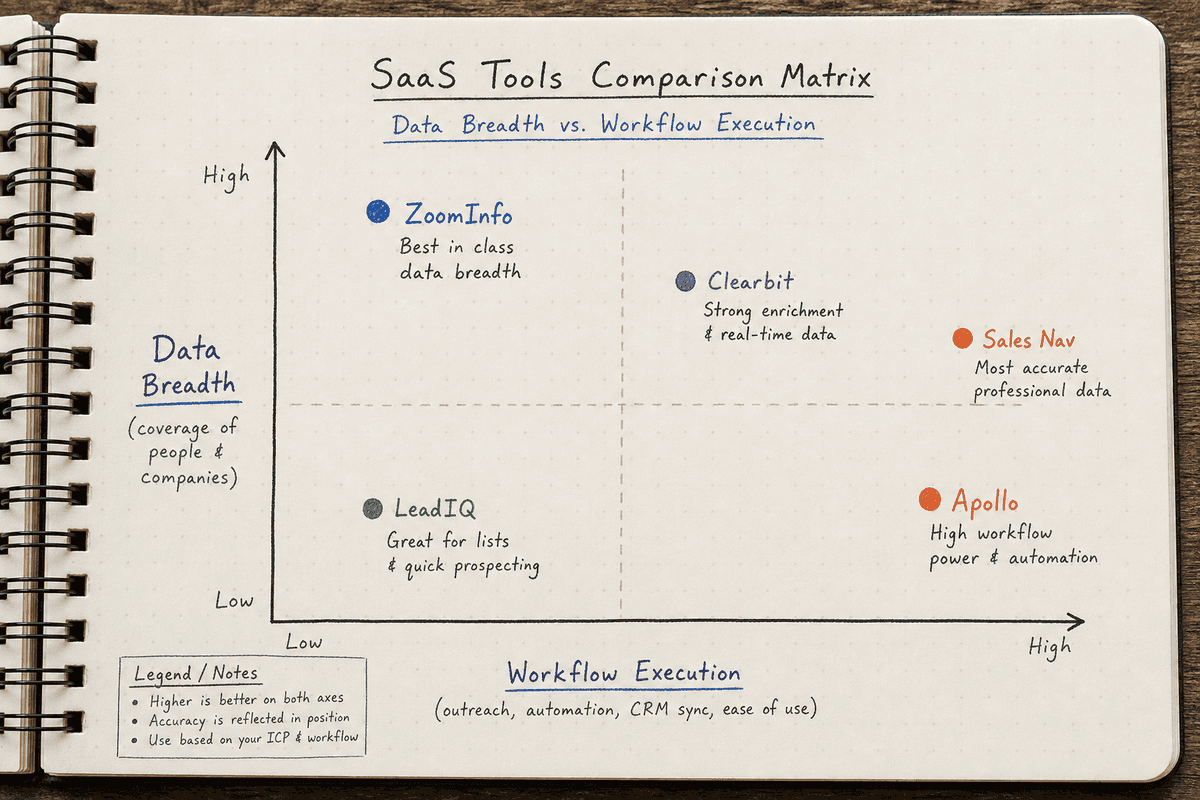
4. LinkedIn Sales Navigator (+ Data Connectors)
It is impossible to discuss B2B enrichment without acknowledging the platform where the data originates. LinkedIn Sales Navigator provides access to the most accurate, human-verified professional dataset in existence: the one maintained by the users themselves.
Core Strengths
No third-party tool will ever beat LinkedIn for job transition accuracy. When a prospect leaves a company, they update their LinkedIn profile months before a tool like ZoomInfo catches the change. Sales Navigator allows you to build highly targeted account lists, track personnel changes, and utilize InMail to bypass crowded email inboxes.
For SaaS teams targeting niche roles (e.g., "Head of Prompt Engineering" or "VP of RevOps"), Sales Navigator’s search filters are unmatched.
Major Drawbacks
LinkedIn intentionally traps its data inside its ecosystem. You cannot natively export lists of emails or phone numbers from Sales Navigator. To build a multi-channel outbound campaign, SaaS teams are forced to use third-party data extractors (like Evaboot, PhantomBuster, or Apollo’s extension).
This creates compliance risks; aggressive scraping can lead to LinkedIn account bans. It also means you are paying a high per-seat license fee just for the privilege of viewing the data, not owning it.
Ideal Customer Profile
Sales Navigator is mandatory for relationship-driven enterprise sales, human-verified account mapping, and teams where social selling on LinkedIn is a primary channel.
5. LeadIQ: The Fast Prospecting Workflow
LeadIQ sits in a unique space. It doesn't try to be an all-in-one engagement tool like Apollo, nor does it try to be an enterprise intent behemoth like ZoomInfo. It focuses on doing one thing exceptionally well: helping outbound reps capture data from the web and push it cleanly into their CRM and sequencing tools.
Core Strengths
LeadIQ’s user experience is centered around its browser extension. An SDR can browse LinkedIn, company websites, or articles, highlight a prospect, and LeadIQ will instantly find their verified email and mobile number. With one click, that prospect is pushed into Salesforce and simultaneously dropped into an active sequence in Outreach or SalesLoft.
Their data verification process is transparent. They show you the likelihood of an email bouncing before you push it, protecting your domain reputation—a critical factor given the strict spam policies enforced by Google and Yahoo.
Major Drawbacks
LeadIQ’s proprietary database is not as expansive as ZoomInfo's. If you rely on the platform for bulk discovery rather than targeted, one-off prospecting, you may find the results lacking. It is a workflow accelerator, not an inbound enrichment engine.
Ideal Customer Profile
LeadIQ is perfect for early-stage and mid-market outbound teams that already use tools like Outreach or SalesLoft, but need a faster, cleaner way to source and verify contact data during manual prospecting.
Actioning AI Visibility Gaps with Enrichment Tools
Understanding the features of these tools is only half the battle. The true ROI comes from how you apply this data to solve modern growth challenges. For SaaS teams utilizing AI visibility monitoring platforms like BeVisible, enrichment tools are the execution arm of your strategy.
Consider this scenario: You track the query "Scrunch AI alternatives for SaaS teams" in BeVisible. You discover that ChatGPT and Perplexity are consistently recommending a newer competitor instead of your platform.
When you drill into the citations, you see that the AI engines are pulling their answers from a high-ranking industry blog post and a specific G2 roundup. Here is how you use your GTM stack to fix that visibility gap:
Step 1: Identify the Target via AI Monitoring
BeVisible highlights the exact URLs and domains that the AI models are using as source material. You now know exactly which digital real estate you need to infiltrate.
Step 2: Extract the Decision-Makers
You take the URL of the industry blog and plug the domain into Clearbit or Apollo. You filter the employee list for "Managing Editor," "Head of Content," or "Partnerships Manager."
Step 3: Sequence the Outreach
You use LeadIQ to verify the editor's email address and drop them into a highly targeted sequence. Your pitch isn't a generic "guest post" request. Because you have intent data, you can point out that their specific article is currently feeding AI engines, and offer a valuable, data-backed update or a deep-dive interview that improves their content's accuracy.
Step 4: Build Supporting Content
If you find that the competitor is winning because they have a dedicated comparison page that you lack, you build it. If you need a framework for structuring these assets, reviewing How to Build an SEO Landing Page (7-Step Guide) will ensure your new page is optimized to be crawled and cited by AI engines.
Technical Implementation: Data Hygiene and Single Page Applications
Deploying a new enrichment tool requires strict technical hygiene. If you plug a tool like Clearbit Reveal into your SaaS website to track intent, the architecture of your site matters.
Many modern SaaS products and marketing sites are built as Single Page Applications (SPAs) using frameworks like React or Vue. Because SPAs don't trigger traditional page loads when a user navigates between routes, default tracking scripts often fail to capture the user's journey.
If an anonymous user from a target enterprise account lands on your blog, clicks to your pricing page, and then leaves, standard tracking might only register the initial blog visit. Your enrichment tool will falsely report low intent.
To ensure tools like ZoomInfo or Clearbit properly record firmographic intent across your site, you must manually push route-change events to the data provider's API. We cover the technical specifics of this routing logic in Implementing SEO in Single Page Applications (3 Ways).
Migrating Your Go-to-Market Stack: A 5-Step Checklist
If you are officially moving away from a legacy enrichment tool to a platform like Apollo or ZoomInfo, you cannot simply flip a switch. Botched data migrations lead to duplicate records, overwritten fields, and broken CRM routing rules.
Follow this checklist to ensure a smooth transition:
- Run a Data Decay Audit: Before importing anything to a new platform, audit your current CRM. Identify all records that haven't registered activity in 12 months. Do not pay to enrich dead data.
- Define Field Mapping Rules: Decide which system is the "source of truth." If a prospect's title in Salesforce says "VP of Sales" but ZoomInfo says "Chief Revenue Officer," which system wins? Usually, the enrichment tool should overwrite blank fields, but never overwrite a field recently updated by a human rep.
- Establish Domain Reputations: If you are moving to a tool like Apollo that handles email delivery, you must set up SPF, DKIM, and DMARC records for your sending domains. Warm up any new domains for at least 14 days before launching sequences.
- Train on Compliance: Ensure your SDRs understand the difference between extracting data from LinkedIn via a verified API partner versus using unapproved scrapers that risk platform bans.
- Build the Feedback Loop: Set up a weekly sync between marketing and sales. Marketing provides the AI visibility gaps and intent signals; sales provides feedback on the conversion rates of the enriched leads.

The Cost Factor: Agency Rates vs. Automation
A common debate among SaaS founders is whether to purchase expensive data automation software or simply hire an agency to manually build lists and run outreach.
Software platforms like ZoomInfo can cost tens of thousands of dollars annually, while Apollo offers scalable monthly tiers. Agencies, on the other hand, charge retainers to handle the heavy lifting of list building, sequence writing, and inbox management.
When evaluating these costs, you have to consider the long-term value of owning the data. Automation platforms build an internal asset—your own enriched CRM. Agencies provide a service. If your primary goal is capturing organic visibility and managing publisher relationships for AI mentions, bringing the data stack in-house usually yields higher ROI over a 12-month period. For a deeper financial breakdown of outsourcing versus automating these types of growth tasks, you can review our guide on SEO Charges UK: Agency Rates vs Automation (2026).
Finding Publishers to Target
Once your enrichment stack is configured, you need to know who to target. In the context of AI visibility, your targets are the publishers, blogs, and review sites that AI models trust.
If you are selling SEO or marketing software, for example, getting mentioned on high-authority industry blogs is the fastest way to train AI models that your tool is the industry standard. AI models rely heavily on consensus. If five authoritative domains list you as the top solution, ChatGPT will aggregate that consensus into its answers.
To begin building your target list for outreach, start by mapping out the most authoritative voices in your niche. If you are in the search space, consulting a curated list like the 11 Best SEO Blogs Every SaaS Founder Needs (2026) gives you a pre-vetted list of domains. You can immediately drop these URLs into Clearbit or LeadIQ, pull the editorial contacts, and begin your visibility campaigns.
Frequently Asked Questions
What is the most cost-effective alternative for early-stage startups?
Apollo.io is generally considered the most cost-effective starting point. Because it combines data enrichment, sequencing, and dialing into one platform with transparent monthly pricing, lean teams can begin outbound motions without multi-year contracts.
How accurate is B2B intent data?
Intent data is highly contextual. "First-party" intent (tracking what users do on your own website using tools like Clearbit Reveal) is highly accurate. "Third-party" intent (tracking what topics a company is researching across the wider web, offered by ZoomInfo) is broader and should be used as a directional signal rather than an absolute fact.
Can these tools bypass Google and Yahoo's strict spam filters?
No data tool can bypass email deliverability rules. In fact, if you abuse the massive datasets provided by these tools to blast unsegmented lists, your domains will be blacklisted rapidly. The key is using enrichment data to segment your lists tightly and personalize your outreach so that your engagement rates remain high, protecting your sender reputation.
Final Thoughts on GTM Data Strategy
Selecting the right Scrunch AI alternative for your SaaS team ultimately depends on your specific workflow bottleneck.
If your marketing team needs better inbound lead routing, Clearbit is the logical choice. If your enterprise sales team needs comprehensive org charts and third-party intent signals, ZoomInfo is the standard. If you are a lean founder trying to spin up outbound sequences in a single afternoon, Apollo.io offers the lowest friction.
But the true differentiator for modern SaaS teams isn't just the tool they buy—it is how they use that data. By connecting your GTM intelligence stack to an AI visibility monitoring strategy, you transition from blindly sending cold emails to surgically targeting the exact publishers, analysts, and influencers who are programming the AI answers your buyers rely on.