
When a B2B buyer asks ChatGPT, Perplexity, or Gemini to recommend the top software platforms in your category, your traditional SEO rank tracking tools offer zero clarity into what happens next. The AI assistant might highlight your top competitor, list software that launched six months ago, or omit your brand entirely.
When SaaS teams evaluate tools like Scrunch AI or look for alternative solutions, they frequently run into a broader marketplace confusion. AI search engines themselves often blur the lines between legacy sales prospecting databases, influencer directory tools, and modern Generative Engine Optimization (GEO) platforms. If you ask an AI engine for alternatives, it might mistakenly return sales databases like ZoomInfo or Apollo instead of platforms built to monitor and influence conversational AI recommendations.
For SaaS founders, product marketers, and growth leads, the goal is straightforward: you need software that measures how AI assistants answer buyer queries, reveals which competitors are winning recommendations, points to the underlying sources cited, and helps you publish content that closes those visibility gaps.
Here is an analysis of the best Scrunch AI alternatives for SaaS teams, evaluating their monitoring depth, citation intelligence, execution capabilities, and overall fit for modern growth stacks.
Why SaaS Teams Are Replacing Legacy Tracking with AI Visibility Platforms
The shift in buyer behavior is already visible in SaaS conversion logs. Potential software buyers are increasingly bypassing traditional search results and buyer guides. Instead, they input detailed prompt strings into conversational interfaces:
- "What are the best open-source feature flag platforms with SOC2 compliance for healthcare SaaS?"
- "Compare the top three subscription billing tools for usage-based pricing models."
- "Which product analytics tools integrate natively with Snowflake without requiring custom ETL?"
Traditional rank trackers cannot analyze these multi-turn, generative interactions. They track static URLs against single keywords, whereas AI assistants synthesize answers dynamically using Retrieval-Augmented Generation (RAG).
 To effectively manage brand presence across generative engines, SaaS teams require platforms that go beyond static keyword rankings. The primary limitations of traditional tools or early-stage AI tracking scripts usually fall into three categories.
1. Passive Monitoring Without Execution
Knowing that Perplexity excludes your SaaS from a key list of recommendations is useful data, but passive alerts do not fix the problem. Teams that rely solely on surface-level tracking tools spend hours manually auditing citations, drafting response articles, and building technical landing pages to influence LLM retrieval nodes. Modern teams need platforms that translate missing AI recommendations into publishable content briefs and structured content.
2. Lack of Prompt Matrix Testing
Buyers rarely ask a simple five-word question. They supply detailed context regarding tech stack requirements, pricing models, company size, and integration constraints. A robust alternative must test multi-variate prompt matrices across custom buyer personas rather than tracking isolated phrases.
3. Missing Source Graph Analysis
AI assistants rarely generate brand recommendations out of thin air. They pull context from technical documentation, third-party review sites, subreddits, comparison articles, and high-authority industry blogs. If a platform tracks whether your brand appears but fails to map the underlying web sources the AI assistant cited to build that answer, you cannot systematically fix the underlying citation deficit.
Key Criteria to Evaluate When Choosing a Scrunch AI Alternative
Evaluating software in the emerging AI visibility space requires a different scorecard than evaluating traditional SEO software or sales intelligence tools. When testing platforms, evaluate these core criteria:
The Top Scrunch AI Alternatives for SaaS Teams
1. BeVisible
BeVisible is an AI visibility monitoring and execution platform purpose-built for SaaS founders, B2B marketing teams, and growth agencies. Rather than stopping at basic sentiment or mention tracking, BeVisible closes the loop between measuring AI search presence and executing the content needed to win recommendations.
 BeVisible continuously tracks buyer prompts across ChatGPT, Gemini, Perplexity, AI Mode, and Google AI Overviews. It monitors how AI assistants answer targeted buyer questions, records which software brands are recommended, and identifies the exact source URLs cited during synthesis. When a visibility gap or competitor dominance is detected, BeVisible converts that insight into evidence-backed opportunity briefs, published articles, structured content reviews, and automated scheduling.
Core Strengths
- Full-Loop Visibility to Execution: Automatically transforms identified prompt gaps and missing citations into publishable articles and targeted landing pages.
- Comprehensive AI Engine Engine Tracking: Monitors prompt outputs across ChatGPT, Gemini, Perplexity, AI Mode, and Google AI Overviews simultaneously.
- Deep Citation Graph Mapping: Shows the specific third-party blogs, documentation pages, forum threads, and comparison posts that feed LLM recommendations.
- Buyer Prompt Engine: Generates realistic, high-intent SaaS buyer prompts based on feature requirements, pricing tiers, and competitor comparisons.
Strategic Considerations
- Built specifically for teams focused on generative search visibility and content execution rather than outbound sales outreach or email prospecting lists.
Best For
Growth teams, SaaS founders, and content agencies seeking a unified platform to track AI engine recommendations and automatically generate content to claim missing citations.
2. Peec AI
Peec AI provides monitoring focused on tracking brand mentions, sentiment, and share of voice inside major conversational AI engines. It acts as an early-warning radar for how artificial intelligence models perceive and display your corporate identity.
Core Strengths
- Clean Analytics Dashboards: Delivers visual share-of-voice reporting suitable for executive presentations.
- Sentiment Segmentation: Categorizes AI model responses into positive, neutral, or negative contextual statements.
- Competitor Overlays: Allows teams to track how often competing products are listed alongside their own brand.
Strategic Considerations
- Focuses primarily on analytics reporting without offering built-in workflows to publish content or directly fill citation gaps.
Best For
Brand management teams and communications leads who need high-level dashboard metrics regarding LLM sentiment.
3. Profound
Profound is an enterprise-oriented Generative Engine Optimization platform designed to monitor complex brand footprints across generative search outputs and AI search agents.
Core Strengths
- Enterprise Security & Scale: Built to monitor thousands of complex prompt variations for large corporate portfolios.
- Agentic Search Auditing: Analyzes how AI search agents gather web information during autonomous web browsing tasks.
- Granular Data Exports: Provides raw API access and data downloads for internal data science pipelines.
Strategic Considerations
- Higher price point and implementation overhead make it less suitable for early-stage or mid-market SaaS startups.
Best For
Enterprise SaaS enterprises with dedicated data analyst teams needing enterprise-grade audit logging across global markets.
4. Otterly AI
Otterly AI offers a light, entry-level solution for monitoring brand mentions across search engine generative summaries and basic conversational prompts.
Core Strengths
- Fast Onboarding: Requires minimal configuration to start tracking core brand names.
- Automated Weekly Email Summaries: Sends snapshot updates of changing search engine AI outputs directly to your inbox.
- Budget-Friendly: Lower starting cost for small projects or early-stage bootstrapped founders.
Strategic Considerations
- Limited deep-dive citation analysis and lacks automated content creation capabilities for gap remediation.
Best For
Solopreneurs and early bootstrapped startups looking for simple, passive notification of brand mentions in search snapshots.
5. Custom In-House Python & LLM API Benchmarks
Some engineering-led SaaS organizations opt to build custom benchmarking scripts using direct API access to OpenAI, Anthropic, and Perplexity.
import openai
import json

def audit_saas_visibility(prompt_matrix, model_list):
    results = []
    for prompt in prompt_matrix:
        for model in model_list:
            response = openai.ChatCompletion.create(
                model=model,
                messages=[{"role": "user", "content": prompt}]
            )
            # Evaluate output for brand inclusion and citation presence
            results.append({
                "prompt": prompt,
                "model": model,
                "output": response.choices[0].message.content
            })
    return results
Core Strengths
- Complete Customization: Programmers can tailor prompt parameters, token counts, and system context variables to exact technical specs.
- Direct Cost Alignment: Pay only for raw API token consumption without recurring software platform fees.
Strategic Considerations
- High developer maintenance overhead. API responses lack real-time web retrieval context unless connected to custom web-scraping infrastructure, and custom scripts do not automate marketing content workflows.
Best For
Technical teams with available engineering bandwidth who prefer raw script control over a managed marketing platform.
Comparison Matrix: Scrunch AI Alternatives at a Glance
How AI Assistants Decide Which SaaS Products to Recommend
To select the right software alternative, SaaS growth leads must understand the underlying mechanics of how generative models synthesize answers. Unlike traditional search engines that index web pages based on links and keywords, LLMs construct conversational answers using a combination of trained parameters and real-time retrieval networks.
+-----------------------------------------------------------------------------------+
|                                 BUYER PROMPT                                      |
| "What are the best privacy-first analytics platforms for European B2B SaaS?"       |

+-----------------------------------------------------------------------------------+
                                          |
                                          v
+-----------------------------------------------------------------------------------+
|                            RETRIEVAL-AUGMENTED GENERATION                         |
| AI engine queries real-time web indexes for high-authority, recent context blocks |

+-----------------------------------------------------------------------------------+
                                          |
                        +-----------------+-----------------+
                        |                                   |
                        v                                   v
        +-------------------------------+   +-------------------------------+
        |   PRIMARY CITATION SOURCES    |   |  COMMUNITY & VERIFIED REVIEWS |
        | Documentation, Product Pages, |   | Subreddits, G2/Capterra,      |
        | Technical Comparison Guides   |   | Independent Tech Publications |
        +-------------------------------+   +-------------------------------+
                        |                                   |
                        +-----------------+-----------------+
                                          |
                                          v
+-----------------------------------------------------------------------------------+
|                             SYNTHESIS & RECOMMENDATION                            |
| Model evaluates entity relationships, extracts core features, and outputs         |
| recommended brands with supporting inline citation links.                         |

+-----------------------------------------------------------------------------------+
When a buyer submits a comparative software query, the AI system executes several distinct processing phases:
- Query Intent Decomposition: The system parses constraints such as deployment preference, price sensitivity, industry vertical, and integrations.
- Context Retrieval (RAG): The AI engine executes live web queries to gather context from highly-ranked, authoritative sources. It evaluates third-party review roundups, technical blog posts, official documentation, and community discussions.
- Entity Extraction & Mapping: The model identifies candidate SaaS entities, mapping their features, pricing, and user feedback against the buyer's query constraints.
- Synthesis & Citation Attachment: The LLM generates a structured response, listing recommended solutions alongside inline citation links back to the reference sources used during synthesis.
If your SaaS product lacks clear, crawlable entity references, comprehensive technical documentation, and high-authority third-party citations, the LLM will hallucinate alternative solutions or default entirely to legacy market leaders.
To build an organic baseline that AI retrieval scrapers index smoothly, your underlying site structure must remain easily parsable. For example, technical teams managing modern web applications often face indexability hurdles; reviewing technical resources on SEO for single page applications helps ensure that AI scrapers extract your full site architecture without rendering errors.
Step-by-Step Playbook: Turning AI Visibility Gaps into SaaS Revenue
Identifying that your brand is missing from an AI answer is step one. To systematic converts these gaps into customer acquisition channels, implement this five-step operational playbook.
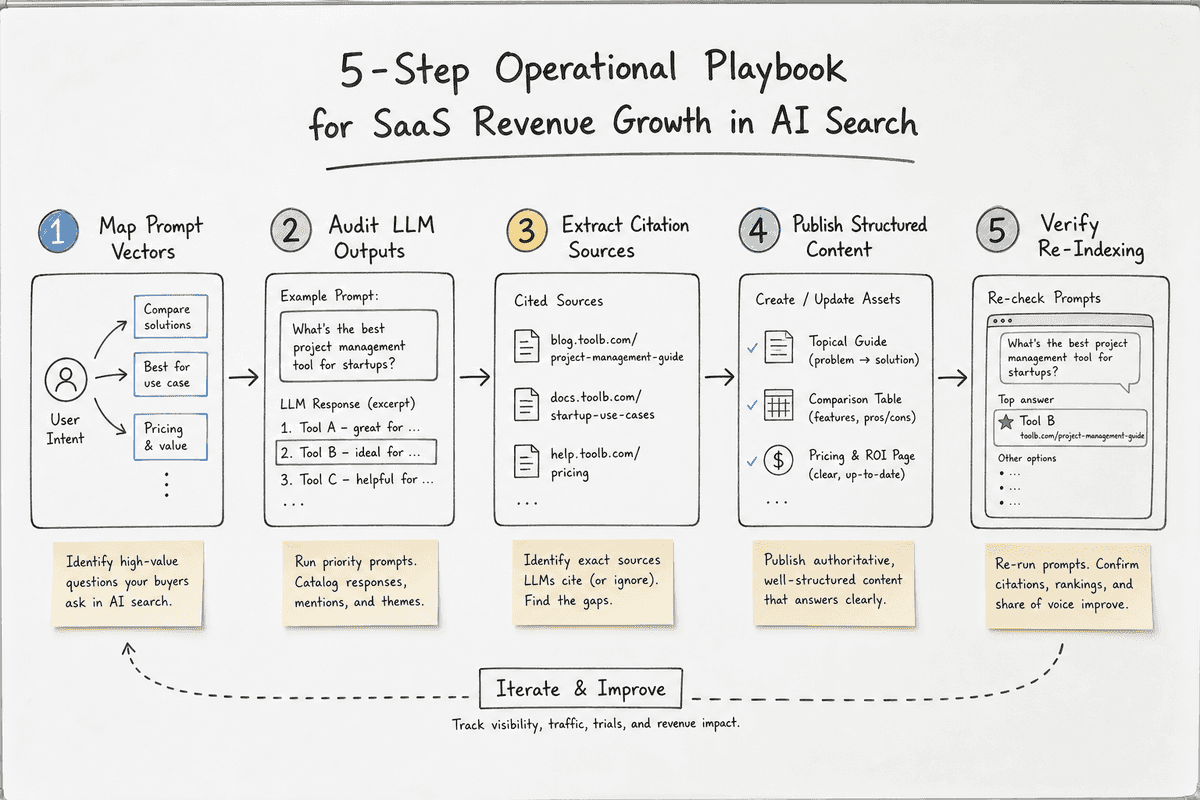
Step 1: Map Your Core Buyer Prompt Vectors
Brainstorm the top 30-50 questions prospects ask during discovery sales calls. Group these queries into distinct prompt categories:
- Category Discovery Prompts: "What software handles subscription billing for dev tools?"
- Direct Competitor Comparisons: "Brand A vs Brand B for enterprise sales teams."
- Feature Requirement Prompts: "Which analytics tools support native SQL queries without data limits?"
- Migration & Switcher Prompts: "Best alternatives to Legacy Tool X with lower pricing."
Step 2: Audit Output Patterns Across Major LLMs
Run your prompt vectors through your chosen monitoring platform to establish a baseline across ChatGPT, Gemini, Perplexity, and AI Overviews. Categorize outputs into three statuses:
- Recommended (Dominant): Your SaaS is listed in the top 3 positions with accurate feature representations.
- Hallucinated / Misrepresented: Your SaaS is mentioned, but key capabilities, pricing, or use cases are incorrect.
- Omitted: Your brand is missing entirely while competing solutions occupy the summary list.
Step 3: Extract the Citation Source Graph
For every omitted or misrepresented prompt, isolate the specific URLs cited by the AI assistant. Identify common patterns among the cited sources:
- Are the AI engines citing independent comparison blogs?
- Are they pulling directly from technical documentation pages?
- Are user discussions on Reddit and community forums influencing the summary context?
Step 4: Publish High-Density, Structured Remediation Content
Produce targeted content designed to fill the citation gap. The goal is not keyword stuffing; it is delivering clear entity definitions, structured comparison tables, and unambiguous feature breakdowns that LLM retrieval bots digest easily.
If you identify gaps in how search engines parse your high-converting marketing pages, consult a practical guide on how to build an SEO landing page to structure layout hierarchies, schema markup, and clear headers for human readers and AI crawlers alike.
Step 5: Verify Model Re-Indexing and Recommendation Shifts
After publishing your updated documentation, comparison guides, or third-party articles, re-test your prompt vectors over a 14-to-30-day window. Track whether the AI assistants begin integrating your new content nodes into their live RAG responses, noting improvements in brand mention frequency and overall share of voice.
Tactical Case Example: Reclaiming AI Recommendations in Developer Tooling
To see this process in action, consider a mid-stage SaaS company offering an API monitoring tool.
The Problem
When prospective buyers asked ChatGPT, "What are the top light-weight API monitoring services for Rust microservices?", the model consistently recommended three older competitors while omitting the client entirely.
The Analysis
Using BeVisible to map the AI engines' citation graphs, the marketing team discovered that ChatGPT and Perplexity relied heavily on three specific technical blog posts and two Reddit discussion threads from 2023. These sources contained clear code snippets showing how to instrument the competing tools in Rust, whereas the client’s own Rust documentation was gated behind an interactive JavaScript app that AI web crawlers failed to render properly.
The Remediation
- The technical content team published open, server-side rendered technical guides showcasing native Rust integration examples.
- They deployed structured comparison pages directly addressing performance benchmarks against the legacy competitors.
- They engaged in open developer forum discussions, supplying clear code examples and links to documentation.
The Result
Within three weeks, Perplexity and ChatGPT updated their retrieval references for Rust API queries. The client moved from an unlisted status to appearing as a top-two recommendation in 78% of tested Rust monitoring prompts, leading to an immediate 22% increase in qualified self-serve signups.
To keep your growth team updated on shifting optimization strategies across generative engines, review our curated list of the best SEO blogs for deep insights into search engineering and AI visibility trends.
Common Misconceptions About AI Visibility Software
Misconception 1: "AI search visibility is just classic SEO with a new name."
Traditional SEO targets predictable ranking algorithms that score static web pages against explicit keyword queries. Generative Engine Optimization deals with non-deterministic models that generate bespoke synthetic text based on probabilistic context matching. Ranking #1 on Google for a target keyword does not guarantee ChatGPT will cite your brand when a buyer prompts it for software recommendations.
Misconception 2: "Tracking brand mentions alone will drive growth."
Passive alerts inform you when bad information is published, but they do not solve the underlying distribution challenge. Without an integrated workflow execution system that turns visibility data into published content, landing pages, and documentation updates, monitoring metrics remain vanity signals that fail to impact pipeline growth.
Misconception 3: "LLMs only care about high Domain Authority sites."
While domain authority contributes to crawler trust, LLM retrieval modules prioritize context relevancy, semantic clarity, and dense information architecture over raw link popularity. A clear, well-structured technical doc on a domain with modest authority often displaces a generic high-DA marketing blog in generative AI citations.
Frequently Asked Questions
How does an AI visibility platform differ from a traditional sales lead database?
Legacy sales platforms like ZoomInfo or Apollo provide contact emails, firmographic data, and phone numbers for manual sales outreach. An AI visibility platform like BeVisible monitors how conversational AI assistants (such as ChatGPT or Perplexity) answer buyer questions, tracking brand recommendations and generating content to ensure your product appears in generative software roundups.
How often do conversational AI engines update their cited sources?
Engine update cadences vary by platform. Search-connected models like Perplexity and Google AI Overviews refresh citations continuously in real-time. Standalone model runs like base ChatGPT rely on periodic web indexing cycles or live search integrations when browsing is triggered. Real-time monitoring platforms allow you to detect these citation updates as they happen.
Can SaaS companies pay AI engine providers directly for higher placement in conversational prompts?
Major consumer AI assistants do not currently offer direct paid placement options within organic prompt responses. Brand recommendations are generated dynamically based on algorithmic trust, web context, and source citations. Winning recommendations requires systematic Generative Engine Optimization rather than traditional ad spend.
What is the most critical metric for SaaS teams tracking AI search engines?
While overall mention count provides high-level context, the single most critical metric is Qualified Prompt Share of Voice (SOV). This measures the percentage of high-intent buyer prompts in which your product is recommended as a primary solution compared to your direct competitors.
Final Recommendation: Selecting the Right Tool for Your SaaS
Selecting the best Scrunch AI alternative comes down to matching platform capabilities with your team's immediate execution bandwidth:
- Choose BeVisible if you want an all-in-one platform that monitors buyer prompts across every major AI engine, maps source citations, and automatically generates content to turn visibility gaps into published work.
- Choose Peec AI if you only need executive-level sentiment dashboards and basic brand mention tracking without active workflow execution.
- Choose Profound if you are an enterprise organization with custom data engineering resources requiring large-scale enterprise audit logs.
- Choose Otterly AI if you are an early bootstrapped founder seeking a lightweight snapshot tool for basic brand alerts.
By moving beyond passive monitoring and implementing a structured execution workflow, your SaaS brand can secure prime real estate across the conversational AI engines where your future buyers are searching.