
Most SaaS founders and indie hackers start their organic growth journey by piecing together a chaotic stack of software. You buy a $99/month keyword research subscription to find opportunities, pay $40/month for an AI writing assistant to draft the text, add a $60/month content optimization overlay to score the draft, and then spend two hours manually formatting it all in your CMS.
By the time you hit publish, you have spent more time managing software subscriptions and copying text between tabs than actually sharing valuable insights.
If you search online for the best tool for SEO blog writing, you will find hundreds of recommendations pointing to isolated point solutions. The reality in 2026 is that the traditional approach to blogging—stitching together disconnected software to rank on Google—is breaking under its own weight.
This guide breaks down exactly what an SEO blog tool is, the essential checklist for evaluating them, the top standalone tools currently on the market, and how you can bypass the manual work entirely by automating your entire publishing pipeline.
What Exactly Is an SEO Blog Tool?
An SEO blog tool is any software application designed to help you research, write, optimize, publish, or track content intended to rank in search engines.
Historically, these tools were highly specialized. A decade ago, you used one tool to check search volume, another to track your rankings, and a word processor to write the post. Today, the landscape is categorized into four distinct pillars:
- Keyword Research & Ideation: Tools that analyze search volume, keyword difficulty, and competitor gaps to tell you what to write about.
- Content Drafting: AI assistants and text generators that help you create the actual words, sentences, and paragraphs.
- On-Page Optimization: Software that grades your draft against top-ranking competitors, suggesting specific NLP (Natural Language Processing) entities, semantic keywords, and structural improvements.
- Publishing & Analytics: Plugins and dashboards that handle technical metadata (schema, canonicals, meta tags) and track organic traffic performance.
While 24 best SEO tools might exist in a curated list, trying to master all 24 is a poor use of a founder's time. The goal of using these tools is to acquire customers, not to become a full-time search engine analyst.
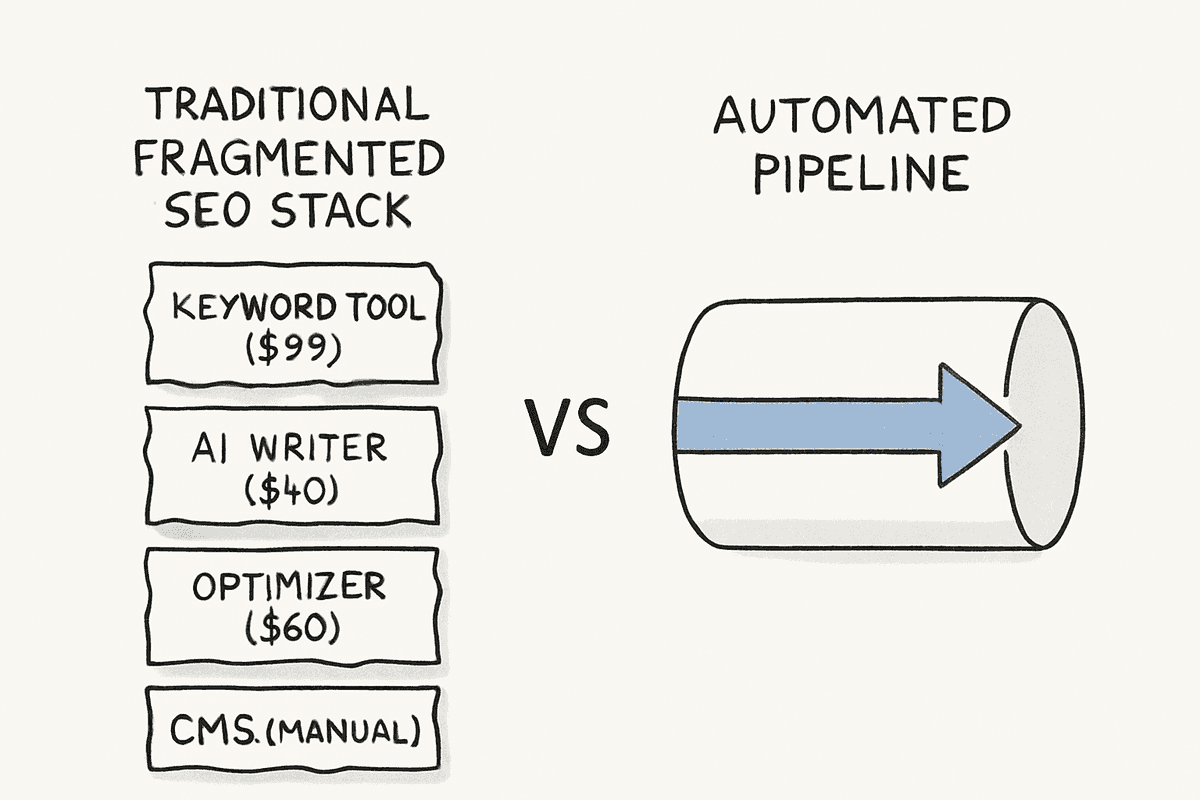
Why the Traditional SEO Tool Stack Is Breaking
For enterprise teams with dedicated content managers, specialized tools make sense. But for SaaS startups, e-commerce stores, and lean agencies, the fragmented stack creates severe bottlenecks.
1. Subscription Fatigue and Cost
When you add up the industry-standard tools for keyword research, NLP optimization, AI writing, and rank tracking, your monthly software bill easily eclipses $300 to $400. This overhead eats into the marketing budget before a single visitor lands on the site.
2. The Context-Switching Tax
Moving a single article through four different platforms degrades the quality of the content. You lose formatting when copying from an AI writer to an optimizer. You lose semantic meaning when trying to force-feed a list of 40 "suggested terms" into a paragraph just to get a green score.
3. The Rise of AI Search Engines
Google Gemini, ChatGPT, and Perplexity are changing how users consume information. Traditional SEO tools optimize for the old Google algorithm—focusing heavily on keyword density and word count. Modern content needs an answer-first structure, quotable sections, and tight formatting designed for AI extraction. Most legacy tools still grade your content based on outdated 2022 parameters.
My Essential Checklist: What Makes a Blog SEO Tool Great?
If you are evaluating software to support your organic traffic efforts, you need strict criteria. Here is the framework for choosing the right system.
Keyword Research: Real Intent Over Raw Volume
A great tool doesn't just show you that a keyword has 10,000 searches a month. It shows you if those searchers want to buy software or if they are students looking for a free PDF. Look for tools that group keywords into topic clusters rather than just listing them alphabetically.
Content Optimization: Beyond Just Writing
When evaluating optimization platforms, ignore tools that simply count how many times you used a specific phrase. The best platforms analyze the structure of top-ranking pages. Do they use tables? Are they utilizing bullet points? A modern content analysis tool should guide your formatting, not just your vocabulary.
Ease of Use: Time is Gold
If it takes you an hour to learn how to configure a project in the software, it's too complex. The interface should allow you to input a seed topic and immediately begin working. Every click required to export, import, or re-format content is wasted time.
Affordability: Respecting the Budget
Beware of tools that charge by the "credit" where a single article might burn through 10 credits due to multiple revisions. Predictable pricing is critical for scaling content.
10 Best SEO Tools for Bloggers to Boost Traffic (2026 Edition)
If you prefer to build your own stack manually, these are the standout point solutions across the four major categories.
1. LowFruits [Keyword Research]
When starting a new site with low domain authority, competing for high-volume head terms is a losing battle. LowFruits specializes in finding "weak spots" in the search results—keywords where user-generated content (like Reddit or Quora) or low-authority blogs are currently ranking. It is an excellent starting point for finding underserved long-tail queries.
2. SEOBoost [Content Creation Suite]
SEOBoost functions as a middle ground between research and writing. It helps you outline articles by pulling in the headings and subheadings used by your top competitors, allowing you to structure your post before you begin drafting.
3. Writesonic [AI Writing Assistant]
For rapid drafting, Writesonic provides a suite of templates specifically geared toward marketing copy and blog posts. It integrates live web data to keep factual assertions relatively up to date, though human review is always required.
4. Jasper [AI Writing Assistant]
Jasper remains one of the most robust AI writers for enterprise brand voice. By training it on your company's existing content, Jasper can mimic your tone, reducing the amount of editing required to make AI-generated text sound like your internal team wrote it.
5. NEURONwriter [AI Content Optimization]
NEURONwriter offers an affordable alternative to legacy optimization tools. It pulls SERP data, analyzes the semantic terms your competitors use, and gives you a real-time text editor with a scoring system. It is highly tactical for users who want granular control over their on-page SEO.
6. Surfer [SEO Content Optimization]
Surfer is the industry standard for correlational SEO. It compares your draft against the top 10 results for a given keyword and provides a strict checklist of words, heading counts, and image counts required to match the competition. However, strict adherence to its suggestions can sometimes result in robotic, over-optimized text.
7. Google Gemini [AI Chat Bot]
Using Google's own AI model for drafting and outlining is increasingly popular. Gemini is particularly useful for synthesizing complex topics into simple explanations or generating code snippets and technical examples for specialized SaaS blogs.
8. Google Search Console [Organic Performance]
The only source of absolute truth for how Google views your site. Google Search Console (GSC) is a free tool that tracks your actual impressions, clicks, and average positions. It is essential for identifying pages that are sitting on page two and need a minor update to push them to page one.
9. Google Analytics [Website Analytics]
While GSC shows you what happens before the click, GA4 shows you what happens after. You need this to track if your blog readers are actually converting into free trials, newsletter subscribers, or paying customers.
10. All In One SEO (AIOSEO) [WordPress SEO Content]
If you use WordPress, you need an SEO plugin to handle metadata. AIOSEO manages your XML sitemaps, outputs schema markup, and gives you a simple interface to write your meta titles and descriptions without touching code.
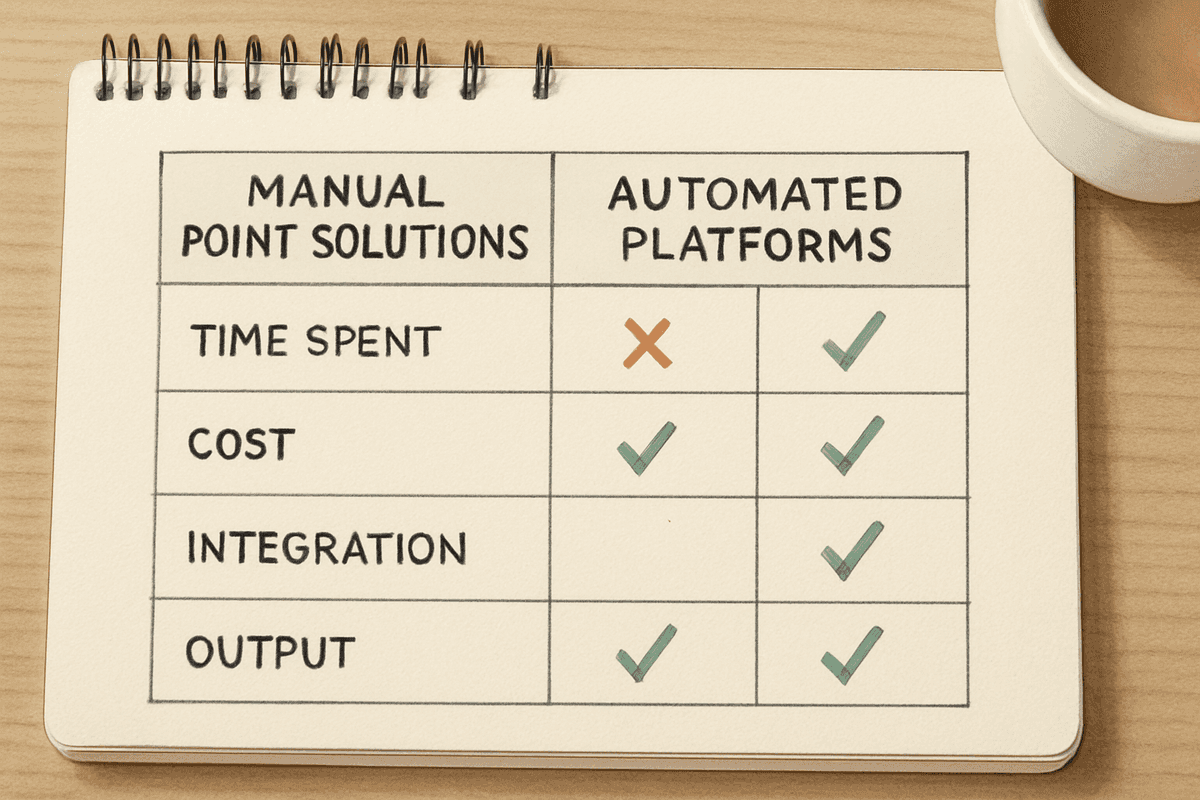
The Shift to End-to-End Automation
Looking at the list above, the problem becomes obvious. To run a successful organic strategy manually, you need LowFruits to find the topic, Surfer to grade it, Jasper to write it, AIOSEO to publish it, and GSC to track it.
This fragmentation is why many companies are abandoning manual tool stacks in favor of automated publishing platforms like BeVisible.
Automation platforms are not just "better AI writers." They are entire SEO departments condensed into software. Instead of requiring a human operator to move data from step A to step B, an automated system handles the entire pipeline: connecting to your site, researching your niche, building a content map, drafting, polishing, and publishing every 24 hours.
Case Example: The Agency vs. Automation
Consider the real-world costs discussed in our guide on SEO Charges UK: Agency Rates vs Automation (2026). A standard agency charges between $1,500 and $3,000 a month to deliver 4 to 8 articles. They are simply using the same tools listed above, marking up the cost of the software and their time.
An automated platform like BeVisible flips this model. For a fraction of the cost ($79/month on the Professional plan), the platform generates 30 high-quality, technically optimized articles a month. It doesn't just write them; it builds an answer-first structure, adds schema markup, creates branded cover images, inserts internal links, and pushes them directly to your CMS via API.
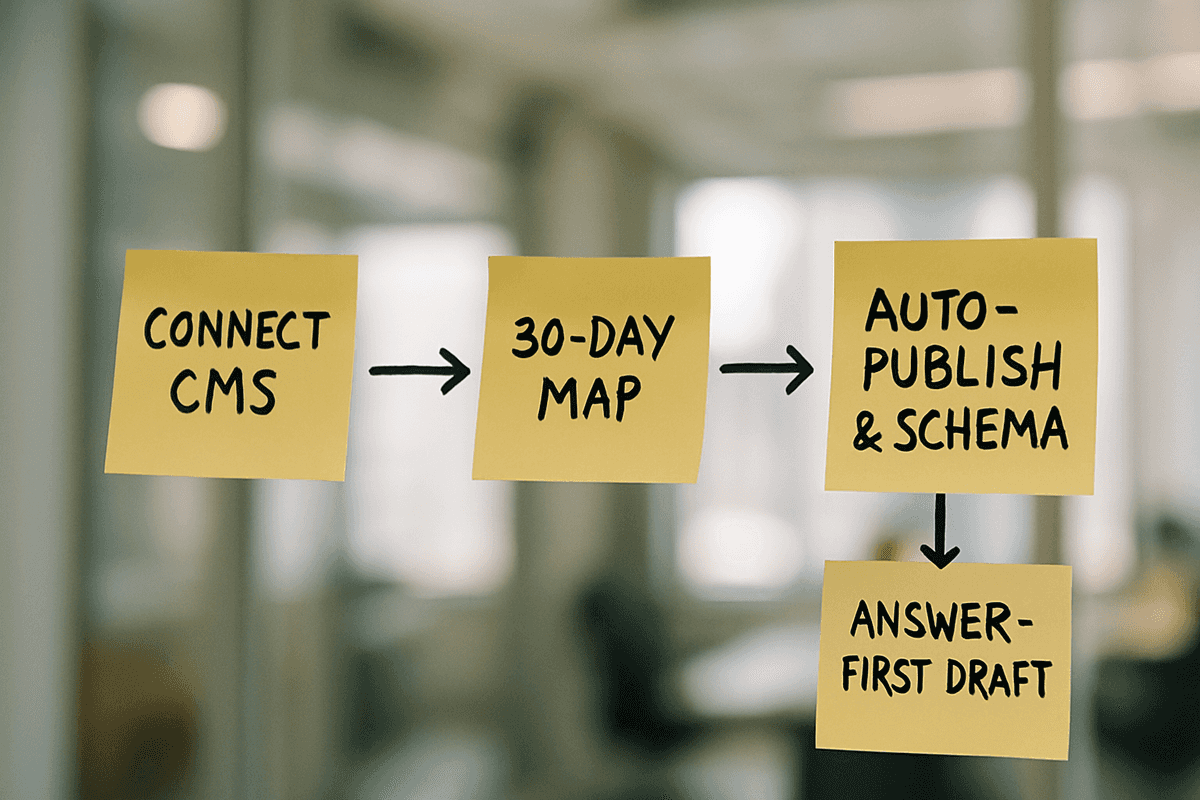
How to Automate Your SEO Blog Pipeline
If you want to stop managing tools and start scaling traffic, transitioning to an automated pipeline involves four distinct steps.
Step 1: Connect Your CMS and Define Your Niche
The foundation of automation is API integration. Whether you use WordPress, Webflow, Notion, Ghost, or Shopify, modern automation tools connect directly to your backend. You provide your site URL, define your exact SaaS niche, and set your target audience parameters.
If you are running a complex JavaScript-heavy site, ensure your technical foundation is solid before automating content. You can read our checklist on SEO for Single Page Applications: The Technical Checklist to ensure search engines can actually render your new pages.
Step 2: Auto-Generate a 30-Day Content Map
Instead of hunting for keywords one by one, an automated system analyzes your niche and competitors to build a topical cluster map. It identifies 30 high-intent topics that support your primary product offering.
For example, if you sell invoicing software, the system won't just target "how to invoice." It will build out specific, long-tail variations like "how to invoice international clients as a UK freelancer" or "late payment email templates for agencies."
Step 3: Implement Answer-First Architecture
Content generated by legacy AI tools often begins with long, rambling introductions. "In today's fast-paced digital world, invoicing is very important..."
Automated systems designed for 2026 strip this out. They use an answer-first architecture. If the search query asks a question, the first paragraph provides the exact answer. This structure is critical for capturing Google Featured Snippets and being cited by AI search engines like ChatGPT.
Step 4: Schedule Daily Publishing and Schema Generation
Consistency is the strongest signal you can send to search engines. Rather than publishing four articles on a Friday and nothing for three weeks, automated platforms drip-feed content every 24 hours.
During publication, the system automatically generates proper technical formatting. It creates tags, categorizes the post, assigns author metadata, and generates valid JSON-LD schema markup so search engines instantly understand the context of the page.
Internal Linking and Technical Considerations
One of the most tedious manual tasks in blogging is building internal links. Every time you publish a new post, you ideally need to go back to older posts and add links pointing to the new one. This builds a strong contextual web that passes authority throughout your site.
Advanced automated tools handle this dynamically. As your library grows, the system maps semantic relationships between articles. If an automated post about "landing page conversion rates" mentions the phrase "SEO landing page," the system can automatically link that text to your dedicated guide on How to Build an SEO Landing Page (7-Step Guide).
Additionally, consider your site's architecture. If your application is built on modern frameworks like React or Vue, your blog needs to be correctly rendered for crawlers. We cover this extensively in Single-Page Application SEO: What Works in 2026?. Your blog tool must be capable of injecting metadata directly into the head of your rendered HTML, regardless of your tech stack.
The Contrarian Reality: More Tools Don't Equal More Traffic
There is a persistent myth in the digital marketing industry that if you buy the most expensive optimization suite and get a perfect "100/100" score on your drafts, you are guaranteed to rank.
This is demonstrably false. In fact, over-optimizing content by forcing in unnatural NLP terms often triggers Google's spam algorithms. It creates robotic, unreadable text that frustrates users. As tested by platforms evaluating best AI SEO content optimization tools, the highest-scoring text frequently loses to naturally written, deeply informative content that directly answers the user's query.
The advantage of an automated platform like BeVisible is that it applies optimization guardrails naturally. It structures the document logically and uses semantic variations contextually, rather than gamifying a score at the expense of readability.
Final Thoughts
Managing an SEO strategy should not feel like working a second job as a software procurement manager. The traditional stack of isolated keyword tools, AI writers, and optimization graders served a purpose during the transition period of the early 2020s. But today, the operational overhead is simply too high for lean teams.
If you want to read more about how top founders view the current search landscape, explore our curation of the 11 Best SEO Blogs Every SaaS Founder Needs (2026).
By shifting from a manual tool stack to an automated end-to-end publishing platform, you eliminate the friction of content creation. You transform your website into a daily source of ranked answers, feeding both traditional search engines and AI aggregators automatically, allowing you to focus on what actually matters: building your product and closing customers.