
Most SaaS founders and content marketers approach SEO with a fundamental misunderstanding: they treat writing as the primary bottleneck.
So, they buy a generic AI text generator. They spend hours prompting it to adopt a specific brand voice. They copy the output into a secondary optimization tool, stare at a real-time score, tweak headers until the meter turns green, log into their CMS, format the text, find a stock image, and finally hit publish.
They sped up the drafting phase, but the pipeline is still broken. If your goal is to build an organic traffic engine, creating content isn't a writing problem—it's a production and mapping problem.
In 2026, the best SEO blog writing tools don't just generate words. They automate the entire workflow: mapping out topic clusters, conducting SERP analysis, structuring answer-first articles for AI search engines, and publishing natively to your site.
This guide breaks down the five tools that actually move the needle for SaaS startups, e-commerce stores, and indie hackers, moving you away from manual editing and toward end-to-end automation.
The Shift: From AI Editors to Automated Publishing Pipelines
Before diving into the tools, we need to clarify what an "SEO writing tool" actually means right now. The market has fractured into three distinct categories.
- Generative Assistants (The Prompter's Tools): These are platforms where you supply a prompt, and the AI returns a block of text. You are responsible for the topic idea, the keyword research, the SEO structure, and the final publication.
- Optimization Layers (The Graders): These tools scrape the current top 10 search results for a keyword and give you a checklist of terms to include. You still write the content (or paste it in from an assistant), but you use their editor to ensure you hit statistical keyword densities.
- Automated Pipelines (The Content Engines): These platforms connect directly to your website. They analyze your niche, build a long-term content calendar, write the articles with structural SEO baked in, and automatically publish them on a recurring schedule.
 If you are running a SaaS business or an agency, relying on the first two categories requires dedicating hours every week to project management. You have to hire editors to operate the tools.
This is why so many startups abandon their blogs after three months. The administrative overhead outweighs the immediate return. To survive the modern organic landscape—where Google Search and AI engines like ChatGPT and Perplexity require a constant drumbeat of high-authority, answer-first content—you need an automated pipeline.
Core Capabilities to Evaluate in 2026
When evaluating tools that write like humans, don't just look at the prose. The underlying technical infrastructure is what actually ranks the content. Here is the criteria you should use to grade any platform:
- Answer-First Structuring: AI search engines extract direct answers. If an article begins with a 300-word meandering introduction, it will be ignored by retrieval-augmented generation (RAG) models. The tool must place definitive, quotable answers at the top of the content.
- Autonomous Content Mapping: Does the tool require you to feed it individual keywords, or can it ingest your domain and automatically generate a cohesive 30-day strategy targeting low-competition, high-intent clusters?
- Schema Markup Generation: Does it automatically inject valid JSON-LD schema (like FAQ, Article, or HowTo) into the code so crawlers instantly understand the page context?
- Native CMS Integration: Does it stop at a Google Doc, or does it push the fully formatted article, complete with meta titles, descriptions, categories, tags, and internal links, directly to WordPress, Webflow, Ghost, or Shopify?
- Internal Link Architecture: Orphaned content doesn't rank. The system should read your existing sitemap and naturally weave in relevant internal links to establish topical authority.
If you are an agency owner trying to reduce overhead, mapping these features against traditional delivery costs is eye-opening. When comparing SEO charges UK agencies bill versus software automation, the economic advantage of pipeline tools becomes impossible to ignore.
The 5 Best SEO Blog Writing Tools for 2026
Based on automation capabilities, structural SEO features, and integration depth, here are the five best platforms to scale your organic growth.
1. BeVisible: Best for End-to-End Content Map Automation
BeVisible was built specifically to solve the pipeline problem. Instead of offering an empty text editor, BeVisible operates as an automated organic growth partner for SaaS founders, indie hackers, and content marketers.
When you connect BeVisible to your site, you aren't just getting an AI writer. The platform conducts deep competitor analysis and niche research to generate a complete 30-day content map. Once approved, the system takes over the entire production schedule, writing, polishing, and auto-publishing a new, highly optimized article every 24 hours.
Core Features:
- Daily Auto-Publishing: Integrates directly with WordPress, Webflow, Notion, Ghost, and Shopify via API. Articles go live automatically with metadata, tags, and categories perfectly formatted.
- AI Search Optimization: Content is generated using an "answer-first" structure. High-value insights are placed immediately after headers, making your site a prime target for extraction by ChatGPT, Perplexity, and Google's AI Overviews.
- Technical SEO Built-In: Every published post includes automatically generated schema markup and strategic internal links to your existing pages, ensuring no article is orphaned.
- Branded Visuals: Generates custom cover images optimized for your brand, avoiding the generic stock photo look that plagues most automated blogs.
The Trade-offs: BeVisible enforces a highly structured, automated cadence. If you are a micro-manager who wants to spend three hours debating the placement of a single comma in a massive editorial piece, a traditional human-in-the-loop editor might feel more comfortable. BeVisible is for operators who prioritize consistent, high-quality output and organic momentum.
Pricing & Value Context: The Professional plan offers 30 articles per month for $79 (launch discount). That breaks down to roughly $2.60 per fully researched, mapped, written, and published article. It includes unlimited revisions, a 3-day free trial, and native Google Search Console analytics to track performance.
2. Surfer: Best for Deep Manual Optimization and Auditing
Surfer remains a heavyweight in the "Optimization Layer" category. If you have an established content team and your primary goal is to take an existing article and forcefully optimize it to beat a specific competitor on page one, Surfer's Content Editor is incredibly effective.
Core Features:
- Real-Time SERP Analysis: Surfer compares your draft against the current top 10 ranking pages for your target keyword, offering granular data on word count, heading structures, and NLP (Natural Language Processing) entities.
- Content Audit: Excellent for running existing URLs through the system to identify missing semantic terms and "quick win" opportunities.
- Keyword Clustering: Provides a visual dashboard of topic clusters to help you manually plan out your content strategy.
The Trade-offs: Surfer is not an automated pipeline. While they have introduced AI generation features, the core value proposition requires a human operator to steer the ship. You have to interpret the data, massage the text to hit the desired "Content Score," and manually move the draft into your CMS. This workflow scales linearly: producing 30 articles a month in Surfer requires significantly more human hours than an automated tool.
3. SEOWriting.ai: Best for Bulk 1-Click Drafting
If your primary goal is raw volume and you prefer to handle the publishing and formatting yourself, SEOWriting.ai is a popular choice for affiliate marketers and niche site builders.
Core Features:
- 1-Click Generation: You can input a list of keywords, and the tool will batch-generate long-form articles in the background.
- Product Review Capabilities: Highly tailored toward affiliate content, with built-in modules for pros/cons lists, product comparison tables, and Amazon integrations.
- Basic WP Posting: Offers a WordPress plugin to push drafts over, though you may still need to adjust formatting and internal linking.
The Trade-offs: The output is heavily geared toward traditional affiliate sites rather than SaaS or B2B thought leadership. If you are building a deeply technical single-page application SEO guide or trying to capture high-ticket B2B leads, the bulk-generation approach can sometimes yield surface-level insights that require heavy manual editing to meet editorial standards.
4. Jasper AI: Best for Multi-Channel Campaign Coordination
Jasper was one of the earliest pioneers in the generative assistant space and has evolved into a comprehensive platform for enterprise marketing teams. It is less of a pure "SEO blog writer" and more of an all-encompassing brand voice engine.
Core Features:
- Brand Voice Memory: You can train Jasper on your specific style guides, product catalogs, and previous content so that everything it generates sounds distinctly like your company.
- Campaign Generation: From a single brief, Jasper can generate a blog post, four LinkedIn posts, a Twitter thread, and three variation emails for a newsletter.
- Browser Extension: Allows you to use the AI writer directly inside your CMS, email client, or social media manager.
The Trade-offs: Jasper lacks the automated scheduling and autonomous topic-mapping features required for a hands-off SEO engine. It is an incredibly powerful assistant, but it still requires a driver. It also comes with a premium price tag tailored for larger marketing departments rather than agile startups or solo founders.
5. All in One SEO (AIOSEO): Best for On-Page Metadata Optimization
While technically a WordPress plugin rather than a standalone blog writer, AIOSEO frequently appears in discussions of the best AI blog post generators because of how deeply it integrates AI into the final publishing step.
Core Features:
- AI Title and Description Generation: Uses OpenAI integration to suggest highly clickable meta titles and descriptions based on your article content.
- TruSEO On-Page Analysis: Gives you a real-time checklist directly inside the WordPress editor, ensuring you haven't forgotten external links, alt tags, or keyword density.
- Redirection Manager: Automatically tracks when you change an article URL and sets up the appropriate 301 redirect to prevent 404 errors.
The Trade-offs: AIOSEO does not write the body of the blog post. It is the final checkpoint. You would typically use AIOSEO in conjunction with a drafting tool. (Note: Platforms like BeVisible handle these metadata and structural checks natively before publishing via API, reducing the need for heavy plugin bloat on your CMS).
How to Build a 30-Day Automated Content Map
Choosing the tool is only 20% of the battle. The other 80% is the strategy you feed into it. If you tell an automated platform to write about "project management software," you will waste your crawl budget on zero-click impressions.
Here is a practical framework for building a 30-day content map that actually drives qualified SaaS traffic.
Step 1: Define Your Core Hubs (Not Just Keywords)
Stop looking for individual keywords with 10,000 search volume. Look for specific pain points that require a cluster of answers.
If you sell an API monitoring tool, your core hubs might be:
- Webhook failure troubleshooting
- API rate limiting best practices
- Legacy system integration challenges
Step 2: Map the Intent Spectrum
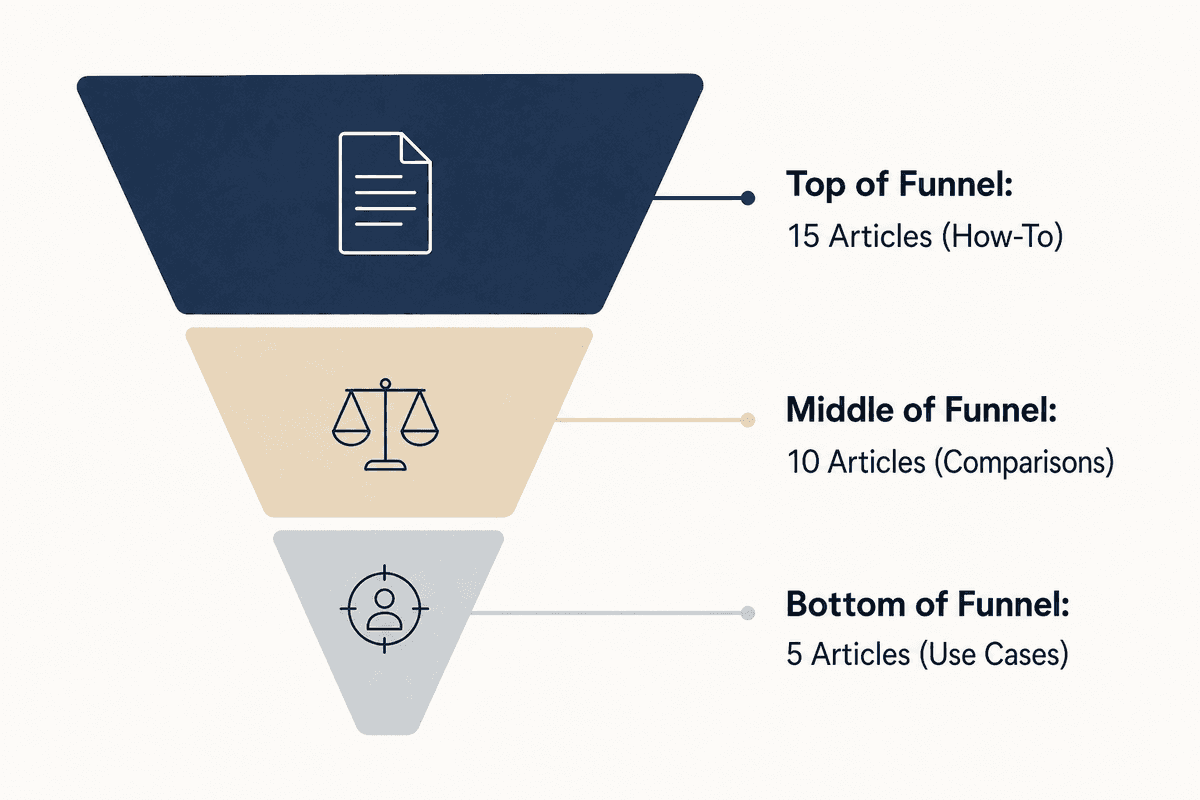
Your 30-day map should cover different stages of the buyer's journey. A balanced month of content (30 articles) should break down roughly as follows:
- Top of Funnel (15 Articles): "How to...", "What is...", "Best practices for..." (e.g., How to structure a RESTful API).
- Middle of Funnel (10 Articles): "Top tools for...", "X vs Y", "Frameworks for..." (e.g., 7 Best REST Client Alternatives).
- Bottom of Funnel (5 Articles): Highly specific use cases, "Red flags", Pricing guides. (e.g., Why hiring an API consultant is a mistake).
Step 3: Implement the Answer-First Structure
Every article in your map must follow a strict structural hierarchy.
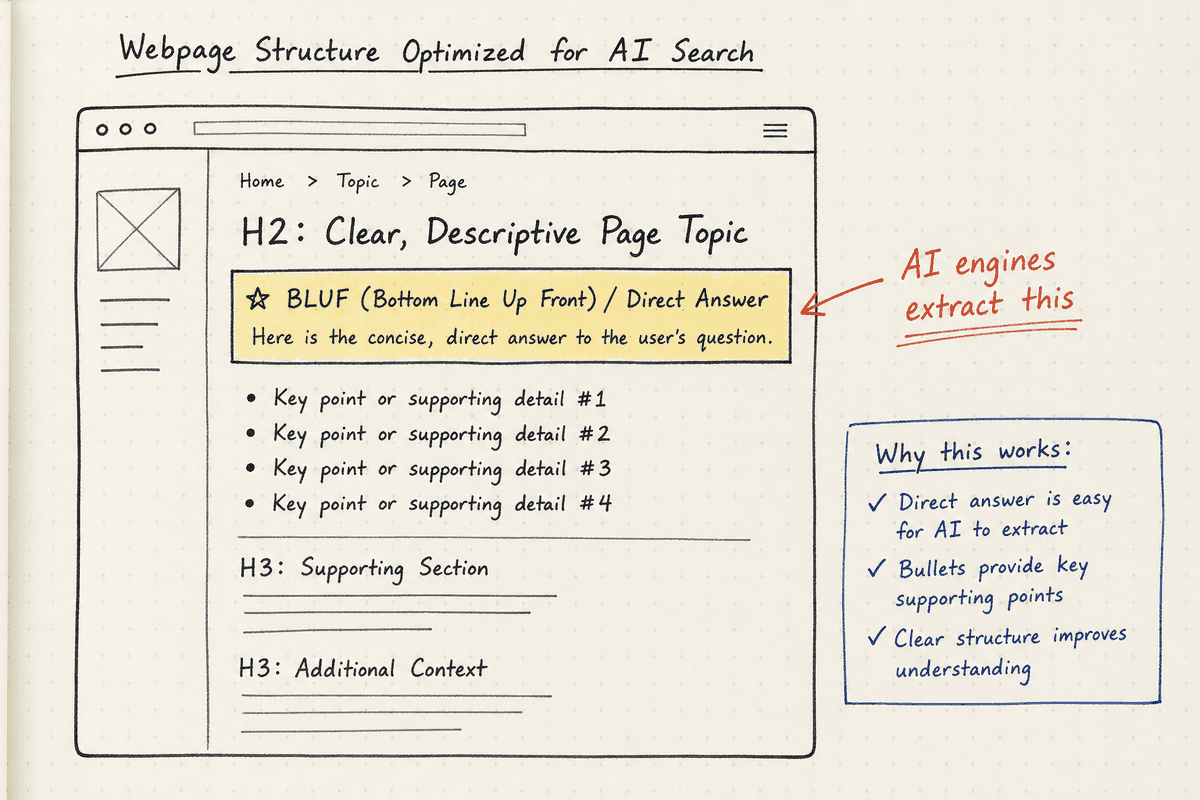
- The Query Heading: An H2 that directly matches the user's search query.
- The BLUF Paragraph: Bottom-Line-Up-Front. A 40-50 word paragraph immediately answering the query without filler.
- The Expansion: Bullet points, tables, or step-by-step guides expanding on the context.
- The Pivot: A natural internal link to a related sub-topic on your site.
If you use BeVisible, this exact structure is enforced by default. If you use a manual tool, you must build this into your prompt templates.
Step 4: Schedule and Interlink
Content builds momentum through proximity. If you publish 5 articles about "Webhook failures," they must link to one another.
When mapping your 30 days, pre-plan the internal links. Article 2 links to Article 1. Article 3 links to 1 and 2. This creates a tight semantic web that signals topical authority to Google.
Red Flags: When Content Automation Does More Harm Than Good
The promise of "set it and forget it" SEO is appealing, but executing it poorly can damage your domain reputation. If you are auditing an automated pipeline or evaluating an agency—perhaps comparing local options like hiring SEO services in Phoenix—watch out for these critical failure modes.
1. The "Fluff" Introduction
If an article starts with "In today's fast-paced digital landscape, [Topic] is more crucial than ever," the tool is broken. This is the hallmark of low-tier generative AI. It wastes the reader's time, dilutes keyword prominence, and actively repels AI search crawlers looking for concise facts.
2. Orphaned Content Output
Many cheap generation tools push content to your blog without analyzing what is already there. The result is a site with 500 isolated articles that don't connect. Google treats unlinked pages as unimportant. An automated tool must understand your existing sitemap and weave new articles into the existing architecture.
3. Missing or Broken Schema
Writing the words is not enough. Search engines rely on structured data to categorize content. If your tool does not automatically wrap FAQs in FAQPage schema or step-by-step guides in HowTo schema, you are leaving massive SERP real estate (like rich snippets) on the table.
4. Ignoring the AI Search Shift
We are moving beyond standard blue links. Users are asking Perplexity and ChatGPT direct questions. These engines build their answers by finding sources that are structured logically, highly factual, and easy to parse. If your blog writing tool is optimizing exclusively for 2015-era keyword density rather than 2026-era entity extraction, your traffic will slowly erode.
Frequently Asked Questions
Is AI-generated content still good for SEO in 2026?
Yes, provided the content adds value, demonstrates expertise, and directly answers the user's intent. Google's official stance does not penalize AI usage; it penalizes spam. The differentiator is no longer how the text was typed, but the structural quality, factual accuracy, and architectural integration (like schema and internal links) of the final page.
Can an automated tool completely replace a content team?
It replaces the execution layer. A tool like BeVisible handles the keyword research, drafting, formatting, and publishing. This allows a solo founder or a single marketing manager to output the volume of a 5-person agency team. You still need human oversight to dictate the broader business goals and approve the initial content maps.
How do you prevent automated content from sounding robotic?
By controlling the structure, not just the vocabulary. Robotic content happens when AI tries to mimic human transitions with filler phrases ("Let's dive in," "Furthermore"). High-quality automated tools avoid this by utilizing strict, information-dense formats: short paragraphs, bulleted lists, and practical frameworks that prioritize utility over narrative flair.
The Strategic Advantage of Automation
The most successful best SEO blogs in 2026 aren't the ones with the most poetic prose; they are the ones with the most consistent, structurally perfect answers to user problems.
If you are spending your weeks copy-pasting prompts, fighting with keyword optimization meters, and manually formatting headings in WordPress, you are acting as an editor when your business needs a director.
Transitioning to an automated pipeline like BeVisible allows you to connect your domain, approve a tailored 30-day map, and step back. By letting software handle the daily, rigorous execution of answer-first content, you can focus on what actually scales your SaaS: building the product and closing leads.
Ready to see what an automated content map looks like for your exact niche? Start treating your organic traffic like a predictable engineering system rather than a creative chore.