
Most SaaS founders treat SEO as a creative exercise. They hire freelance writers, brainstorm topics based on what feels relevant, and publish sporadically. Months later, traffic flatlines, and they assume SEO simply doesn't work in their niche.
But organic traffic isn't driven by sporadic creativity. It is driven by industrial consistency.
Getting to 100,000 monthly visitors requires treating your website like a publishing engine. It requires an exact, repeatable system—a blueprint—that connects technical foundation, aggressive keyword mapping, answer-first content structuring, and unrelenting daily publishing velocity.
There is a reason professional agency owners invest heavily in operating systems like Ryan Stewart's The Blueprint Training or Glen Allsopp's highly anticipated SEO Blueprint 3. Scaling organic traffic is an operational challenge, not a creative one. If you want agency-level results without a 10-person agency team, you need to operationalize every step of the pipeline.
This guide breaks down the exact 9-step SEO blueprint required to scale your SaaS, e-commerce, or content site to 100k monthly visitors, leaning heavily into automation and AI-era search optimization.
Step 1: Secure the Technical Foundation (Speed, Architecture, and SPAs)
Before you write a single word of content, your technical infrastructure must be flawless. Google and AI crawlers like ChatGPT or Perplexity operate on strict crawl budgets. If your site takes too long to load, or if the content is hidden behind client-side JavaScript, crawlers will simply leave.
The Single-Page Application (SPA) Trap
For SaaS companies, the most common technical failure point is the web framework. Modern apps are frequently built as Single-Page Applications (SPAs) using React, Vue, or Angular. While these provide excellent user experiences, they are notoriously difficult for search engines to index out of the box.
If you are running an SPA, standard SEO advice does not apply to you. You must implement specific rendering strategies so crawlers see fully formed HTML, not a blank <div id="root"></div> waiting for JavaScript to execute.
 To resolve this, you have three primary options:
- Server-Side Rendering (SSR): Using frameworks like Next.js or Nuxt.js to render the HTML on the server before sending it to the client. This is the gold standard.
- Static Site Generation (SSG): Pre-building all pages at deploy time. Ideal for marketing pages and blog content.
- Dynamic Rendering: Serving client-side rendered content to users, but routing known search engine user-agents (like Googlebot) to a pre-rendered static HTML snapshot.
If you need to dig deeper into the exact implementation, review this 5-Step Guide to SEO for Single Page Applications. For an evaluation of rendering methods, check out Implementing SEO in Single Page Applications (3 Ways).
The Technical Health Checklist
Beyond JavaScript rendering, your technical blueprint must include:
- XML Sitemaps: Automatically updating sitemaps submitted to Google Search Console (GSC). Break them into indexes if you exceed 10,000 URLs.
- Canonical Tags: Every page must self-reference its canonical URL to prevent duplicate content issues, especially if you use URL parameters for tracking.
- Robots.txt: Explicitly block crawlers from your
/app,/login, and/checkoutdirectories to conserve crawl budget for your marketing content. - Core Web Vitals: Aim for a Largest Contentful Paint (LCP) under 2.5 seconds. Optimize images using WebP formats and lazy-load assets below the fold.
Technical edge case: Ensure your internal linking doesn't rely purely on onClick JavaScript events. Crawlers only follow standard <a href="..."> HTML tags. For a comprehensive audit protocol, follow SEO for Single Page Applications: The Technical Checklist.
Step 2: Bottom-of-Funnel (BOFU) Keyword Mapping
The most common strategic mistake startups make is chasing top-of-funnel (TOFU) volume too early. They write ultimate guides like "What is Project Management?" that drive 10,000 visitors but zero sign-ups.
To build revenue, your blueprint must start at the bottom of the funnel. You want to capture users who already know their problem and are actively searching for software to solve it.
The 4-Tier Intent Framework
Map your entire keyword strategy using this hierarchy, executing Tier 1 before moving to Tier 2.
Tier 1: High-Intent Competitor Alternatives Searchers looking for "[Competitor] alternatives" are highly qualified. They are dissatisfied with their current vendor and have their credit cards ready.
- Example: "Zendesk alternatives for startups"
- Action: Create dedicated comparison landing pages. (Read: How to Build an SEO Landing Page (7-Step Guide)).
Tier 2: "Best [Category] Software" Lists Searchers comparing options in your category. You need to rank for these lists, either by building your own unbiased listicles or running PR campaigns to get featured on existing ones.
- Example: "Best automated SEO platforms"
Tier 3: Use-Case and Integration Queries Users searching for software that accomplishes a specific task or integrates with a tool they already use.
- Example: "Shopify inventory sync with Notion"
Tier 4: Problem-Solving Queries (Mid-Funnel) Users experiencing the pain point your software solves, but who aren't explicitly searching for software yet.
- Example: "How to reduce customer churn rate"
 By the time you finish mapping Tiers 1 through 3, you should have a list of 50 to 100 high-converting topics. These are the foundation of your first 100,000 visitors because they convert traffic into actual revenue, funding further TOFU expansion.
Step 3: Competitor Gap Analysis (Finding the Weak Spots)
Competitor gap analysis is how you find the path of least resistance. Instead of guessing what to write, you analyze what your competitors are ranking for—and more importantly, where their content is vulnerable.
This is where many agencies try to overcomplicate things to justify their retainers. In fact, understanding the math behind agency pricing vs. automated software—like the data broken down in SEO Charges UK: Agency Rates vs Automation (2026)—reveals that much of traditional SEO research is just expensive manual data entry.
Here is how to conduct a gap analysis efficiently:
- Identify 3-5 Direct Competitors: Put their domains into a tool like Ahrefs or Semrush.
- Run a Content Gap Report: Filter for keywords where at least two competitors rank on Page 1, but your domain does not rank at all.
- Filter by Intent, Not Just Volume: Discard generic terms. Keep the terms that indicate buying intent.
- Analyze the Weaknesses: Open the top 3 ranking pages for your target keyword. You are looking for specific vulnerabilities:
- Thin content: Are they answering a complex question in 500 words?
- Outdated dates: Is the content explicitly referring to 2023 or 2024?
- Poor formatting: Is it a massive wall of text without tables, bullet points, or clear headings?
- Lack of primary data: Are they just summarizing other blogs without offering original insights or screenshots?
If you spot these weaknesses, you have found an "attack vector." Your blueprint dictates that you write a piece of content that is objectively better: more structured, more current, and easier to read.
Step 4: Answer-First Content Structure
The era of 500-word rambling introductions is dead. Both human users and AI search engines (like ChatGPT, Perplexity, and Google's AI Overviews) want immediate answers.
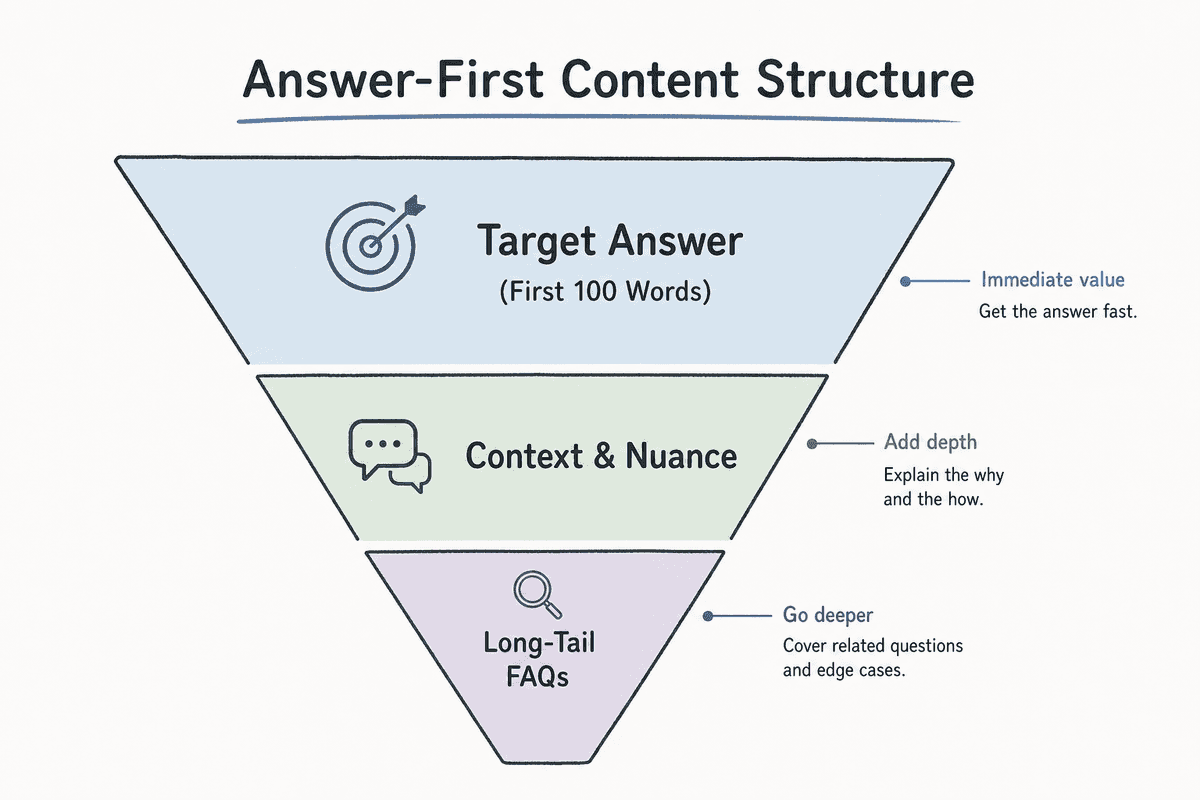
Your articles must be engineered using an Answer-First Structure, also known as the Inverted Pyramid.
The Inverted Pyramid for SEO
- The Target Answer (First 100 Words): Directly answer the query in the first two paragraphs. If the search is "How to configure a DNS for Webflow," give the 3-step technical answer immediately.
- The Context & Detail (Next 500 Words): Expand on the answer. Provide screenshots, code snippets, and edge cases.
- The Nuance & Comparisons (Middle of Article): Add comparison tables, pros and cons, and alternative methods.
- The Long-Tail FAQs (End of Article): Capture related PAA (People Also Ask) queries at the bottom of the page.
Designing Quotable Sections
AI agents pull information by looking for cleanly structured data. To optimize for Perplexity and ChatGPT, you must include "Quotable Sections" in your content.
- Use bolded lists: AI models parse
<ul>and<li>tags effectively. - Include summary tables: If you are comparing three tools, put the pricing, features, and target audience in a markdown table. LLMs heavily favor structured tabular data for their source citations.
- Define terms clearly: Use structures like "[Term] is defined as..." to explicitly feed definitions to AI scrapers.
Step 5: Establishing the 30-Day Content Map
Writing one article a week will not get you to 100k monthly visitors in any reasonable timeframe. You need to build topical authority fast. Topical authority occurs when search engines recognize your site as the definitive source on a specific subject, allowing you to rank for new keywords almost instantly.
To build topical authority, you need to map out your content in 30-day sprints.
The Hub and Spoke Model in Action
Choose one core topic (The Hub) for the month. For example, if you are an e-commerce platform, your hub might be "E-commerce SEO."
Over the next 30 days, map out 30 distinct subtopics (The Spokes):
- Spoke 1: Image optimization for product pages
- Spoke 2: Handling out-of-stock product SEO
- Spoke 3: Category page pagination best practices
- Spoke 4: 7 Best Etsy SEO Tools to Boost Sales in 2026
By isolating your focus to one massive cluster per month, you force Google to recognize your depth of expertise. It is far more effective to publish 30 articles on a single narrow topic in a month than to publish 30 articles on 30 different topics.
Step 6: Automated Content Generation & Daily Publishing Velocity
This is where traditional blueprints fail. Knowing what to write is only 10% of the battle; actually writing, editing, formatting, and publishing 30 high-quality articles a month is an operational nightmare.
If you try to do this manually, you will need a team of writers, an editor, an SEO strategist, and a VA to upload content to your CMS. This is why agencies charge heavy retainers. And frankly, it's why many founders end up searching for warning signs, like the ones detailed in Hiring SEO Services in Phoenix? 5 Red Flags (2026) or localized guides like Top 7 Agencies for SEO in Durham (Ranked 2026).
The BeVisible Publishing Engine
To hit 100k monthly visitors without inflating headcount, you must automate the production pipeline. This is exactly what BeVisible was built for.
Instead of managing a messy Google Drive of drafts, BeVisible transforms your website into an automated publishing engine. Here is how the automated workflow replaces the traditional agency model:
- Automated SERP Research: Connect your URL and niche. The platform automatically conducts keyword research and competitor analysis to build your 30-day content map.
- Daily Generation: Every 24 hours, BeVisible autonomously writes, humanizes, and SEO-polishes a new article based on the map.
- Built-In Optimization: Every article is generated using the answer-first structure, complete with quotable sections, deep internal linking, and perfectly structured Schema markup.
- CMS Integration: Via direct API connections, the polished article—complete with a branded cover image optimized for both traditional and AI extraction, metadata, tags, and categories—is published directly to WordPress, Webflow, Notion, Ghost, or Shopify.
 This daily cadence is critical. Google rewards active sites. By publishing high-quality, technically sound content every 24 hours, you train Googlebot to crawl your site daily. This velocity is the single biggest differentiator between sites stuck at 10k visitors and those scaling past 100k.
Step 7: Strategic Internal Linking (Passing PageRank)
Publishing 30 articles a month creates a new problem: orphan pages. If a page exists on your site but no other pages link to it, search engines will rarely crawl it, and it will receive zero PageRank (link equity).
Your SEO blueprint must include a strict internal linking protocol.
The Rules of Internal Linking
- The 3-Click Rule: Every page on your site should be accessible within three clicks from the homepage.
- Exact Match Anchor Text: Unlike external backlinks, where exact match anchor text can look spammy, internal links should use exact target keywords. If you are linking to your SPA SEO checklist, the anchor text should be "SEO for Single Page Applications: The Technical Checklist."
- Upward and Downward Linking:
- Spoke articles must link up to the Hub article.
- The Hub article must link down to all Spoke articles.
- Spoke articles should link laterally to other Spoke articles in the same cluster.
 Manual internal linking becomes impossible at scale. This is another area where automation wins. Platforms like BeVisible automatically scan your existing published cluster and intelligently weave contextual internal links into new articles before publishing, ensuring no page is ever orphaned.
Step 8: AI-Specific Optimizations and Schema Markup
The landscape is shifting rapidly. If your blueprint only targets traditional Google "10 blue links" search, you are building for the past. You must optimize for LLMs and AI Overviews.
Implementing Structured Data (Schema)
Schema markup is JSON-LD code placed in the <head> of your website that tells search engines exactly what the data on your page means. While it has been around for years, it is now mission-critical for AI extraction.
Ensure every blog post injects the following Schema:
- Article / BlogPosting Schema: Defines the headline, author, date published, and date modified.
- FAQPage Schema: If you have an FAQ section at the bottom of your article, wrapping it in FAQ schema dramatically increases the chances of dominating Google's "People Also Ask" boxes.
- BreadcrumbList Schema: Helps AI understand your site's hierarchy and topical clustering.
If you are using BeVisible's automated pipeline, this Schema is generated and injected automatically upon publication. If you are managing your CMS manually, you will need to use plugins (like Yoast for WordPress) or write custom scripts to inject it into your Webflow headers.
The "Information Gain" Metric
Google's recent algorithm updates heavily penalize "helpful content" that merely summarizes existing search results. To rank, you must demonstrate Information Gain—providing something the current top 10 results do not have.
Incorporate these elements into your articles:
- First-hand data from your SaaS platform.
- Screenshots of real software interfaces, not stock photos.
- Contrarian viewpoints that challenge conventional wisdom.
- Exact methodologies you use internally.
Step 9: Tracking, Refreshing, and Iterating
The final step in the blueprint is establishing the feedback loop. SEO is never "done." Content naturally decays over time as competitors publish new pieces and search intent shifts.
The 90-Day GSC Review
Every 90 days, log into Google Search Console (GSC) and run this exact workflow:
- Identify Striking Distance Keywords: Filter for queries where your site is ranking between position 11 and 20 (top of page 2).
- Optimize for CTR: For these specific pages, look at the Click-Through Rate. If it's below 2%, rewrite your Meta Title and Meta Description. Make them more compelling. Add numbers, brackets, or timeframes (e.g., "(2026 Guide)").
- Expand Thin Content: Take the pages ranking on page 2, open them, and add 500 words of highly specific, FAQ-driven content. Add a new comparison table or an updated infographic.
- Send Fresh Backlinks: Identify your most powerful existing pages and add new internal links pointing to the "striking distance" pages to push them onto Page 1.
Platforms with continuous automation handle this gracefully. For example, BeVisible offers unlimited revisions, allowing you to seamlessly push updates, refresh dates, and adapt to GSC analytics without disrupting your daily publishing flow.
Executing the Blueprint
Reaching 100,000 monthly visitors is a mathematical certainty if you follow the blueprint over a long enough time horizon. It requires fixing your technical foundation, mapping bottom-of-funnel intent, structuring content for both human readers and AI extractors, and—most importantly—publishing with relentless velocity.
Books like The SEO Blueprint: How to Get More Organic Traffic Right Now and extensive courses like The Blueprint Training have proven that a systematized approach beats sporadic blogging every time.
But as a SaaS founder, indie hacker, or startup operator, your time is your most scarce resource. You cannot spend 20 hours a week managing freelance writers, wrestling with CMS formatting, or manually building internal links.
To scale successfully, you need to turn the blueprint into an automated utility. By leveraging daily, AI-optimized publishing pipelines, you can transform your website into a daily source of ranked answers, capturing organic market share while you focus on building your actual product.
(For more reading on optimizing your SaaS growth, explore the 11 Best SEO Blogs Every SaaS Founder Needs (2026).)