
Most content campaigns fail in the handoff. An SEO strategist spends three hours pulling keyword data, hands a raw spreadsheet to a writer, and two weeks later receives an article that completely misses the mark. The piece might be beautifully written, but if it lacks the right search intent, heading structure, and competitive edge, it will never rank.
The gap between search data and a published, ranking article is bridged by one document: the SEO content brief.
According to Content Harmony, a content brief is the strategic blueprint that prevents expensive editorial rewrites. It translates raw data into a clear editorial wireframe, telling the writer exactly who they are talking to, what questions to answer, and what actions the reader should take next.
Here is exactly how to build an effective SEO content brief, complete with a template you can steal, and a workflow to stop wasting your marketing budget on content that fails to perform.
What Distinguishes a Winning Brief from a Wasted Budget?
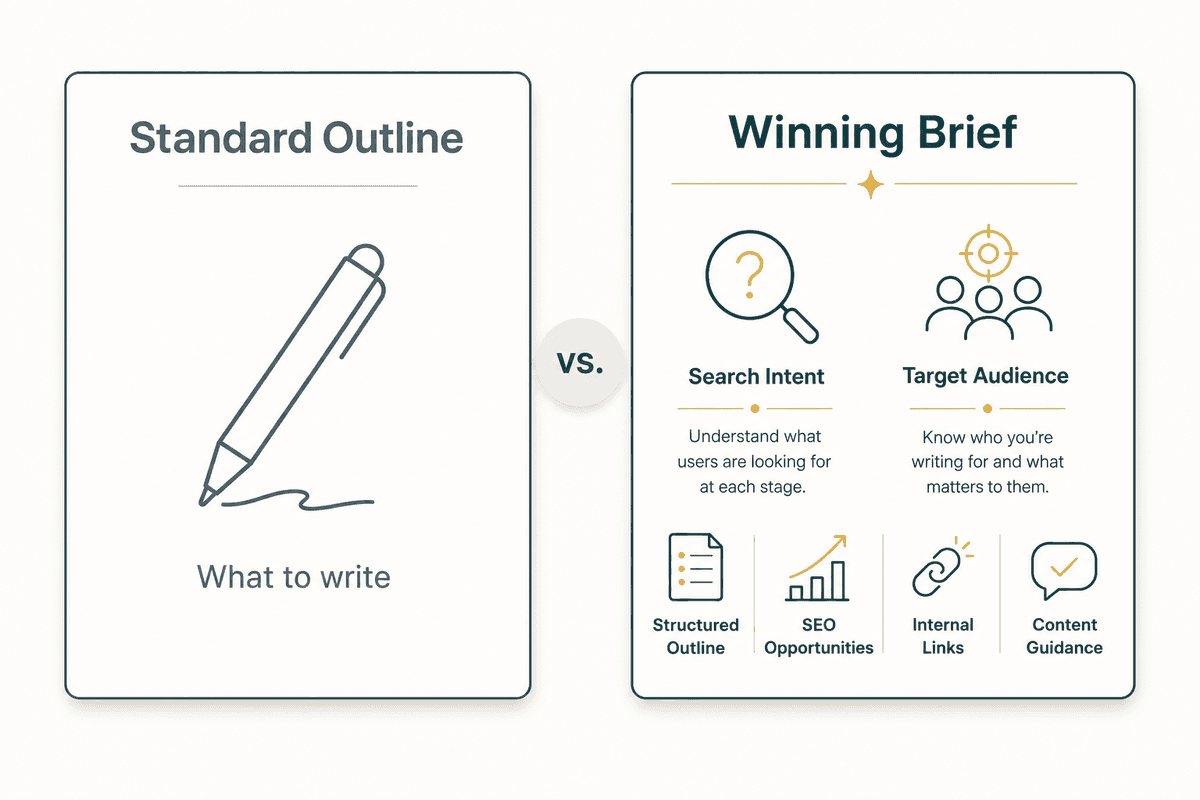
A standard outline tells a writer what to write about. An SEO content brief tells them how to structure the information to satisfy both Google's algorithms and the reader's immediate needs.
If you hand a writer the keyword "CRM software," they might write a 101-level glossary definition. But if your brief specifies that the search intent is "commercial" and the target audience is "mid-market sales directors comparing enterprise solutions," the writer will produce a bottom-of-funnel comparison guide.
Smart content managers use templates to standardize this process. It sets crystal-clear voice guidelines, arms writers with resources up front, and ensures technical SEO elements do not fall through the cracks.
The Ultimate SEO Content Brief Template
Before detailing the step-by-step process, here is the core structure of a highly effective brief. You can copy this checklist directly into Notion, Google Docs, or your project management toolkit.
How to Create an SEO Content Brief in 5 Steps
Creating a brief shouldn't take longer than writing the article itself. The "done is better than perfect" principle applies here: give writers enough structure to succeed without burying them in 15 pages of data they will ignore.
Step 1: Define Your Core Topic and Search Intent
Never start a brief with just a keyword. Start with the user's intent. Semrush highlights that targeting keywords without understanding explicit user intent is the fastest way to stall your organic growth.
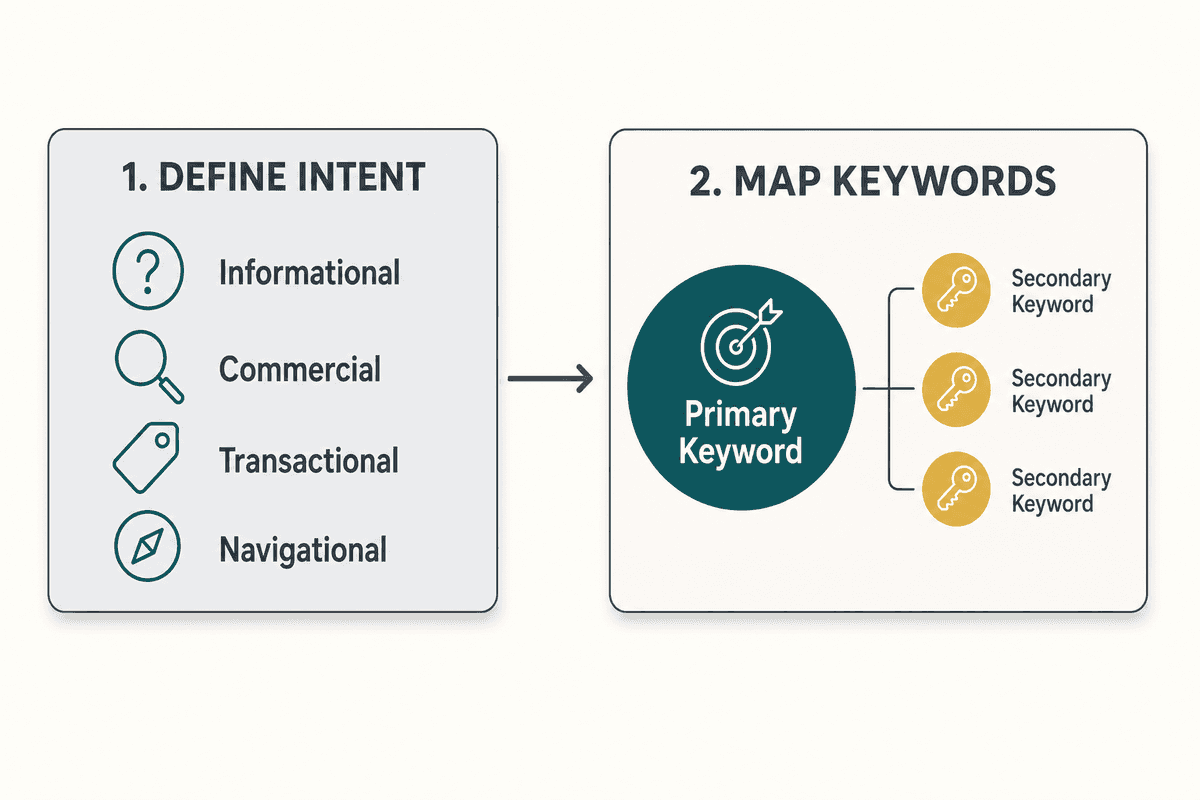
Search intent generally falls into four buckets:
- Informational: The user wants an answer or a guide (e.g., "how to create an SEO brief").
- Commercial: The user is researching options before buying (e.g., "best content brief generator").
- Transactional: The user is ready to buy (e.g., "Semrush pricing").
- Navigational: The user is looking for a specific page (e.g., "Siteimprove login").
Map this intent to actual reader needs. If the intent is commercial, your brief should instruct the writer to focus on feature comparisons, pricing tables, and strong calls-to-action.
Step 2: Compile Primary and Secondary Keywords
Your primary keyword dictates the H1 and URL slug. Your secondary keywords provide semantic context for the search engine.
- Primary Keyword: Choose one highly relevant term with attainable ranking difficulty.
- Secondary Keywords: Select 3-5 variations or long-tail questions (often found in Google's "People Also Ask" section).
Do not give your writer a list of 50 keywords to stuff into the content. Instruct them to use the primary keyword naturally in the intro, a few headers, and the conclusion, while using secondary terms to guide the subtopics.
Step 3: Analyze the SERP and Call Out Competitive Gaps
Open an incognito window and search your primary keyword. Look at the top three results.
Your goal is not to create unoriginal or plagiarized content by simply blending the top ranking posts. Your goal is to examine what is already working and build your brief around comprehensive topic coverage that fills existing gaps.
Ask yourself:
- Are the top results missing practical examples?
- Do they lack custom templates or downloadable resources?
- Is their advice outdated for 2026?
Add a section in your brief titled "How we will beat the competition" and list exactly what the writer needs to do differently.
Step 4: Build a Mandatory Header Wireframe
Leaving the document structure entirely up to the writer is a massive risk. You need to put a wireframe in every brief.
List the exact H2 and H3 headings the writer should use. This ensures the article answers the specific questions search engines are looking for.
For example, if you are having a writer draft a service page, your brief's wireframe might look like this:
- H1: [Service Name] in [City]
- H2: Why Choose Our [Service] Experts?
- H3: Transparent Pricing
- H3: Same-Day Availability
- H2: Common [Service] Issues We Fix
- H2: Frequently Asked Questions
If you are building complex page architectures, such as when providing website copywriting services, dictating the exact H2 flow ensures the copy naturally fits your design layouts.
Step 5: Assign Internal Links and Technical Details
Writers rarely know your site's full content catalog. It is the SEO strategist's job to provide strategic linking recommendations.
List 2-3 exact URLs and the anchor text the writer should use. For instance, if you are writing about cost management, you might instruct the writer to link to your recent guide on SEO Charges UK: Agency Rates vs Automation (2026).
Finally, add technical requirements that writers often miss. This includes:
- Meta Title & Description: Either provide them or ask the writer to draft them within character limits.
- Image Alt Text: Remind the writer to provide descriptive alt text for accessibility.
- Formatting: Specify the use of short paragraphs, bulleted lists, and bold text for skimmability.
Common SEO Content Brief Challenges
Even with a perfect template, scaling content production comes with hurdles.
1. Brief Bloat
Enterprise teams often generate 10-page briefs using complex platforms. When a brief is longer than the requested article, writers get overwhelmed and skim it. Keep your briefs to 1-2 pages maximum. Focus entirely on intent, structure, and differentiation.
2. Disconnected Brand Voice
An SEO brief focuses heavily on algorithms, which can lead to robotic writing. To combat this, include a "Brand Voice" section in your template. Clearly state: "We are authoritative but conversational. Use 'you' and 'your'. Avoid corporate jargon like 'synergy' or 'cutting-edge'." If you want examples of great SaaS voices, point them to the 11 Best SEO Blogs Every SaaS Founder Needs (2026).
3. The Time-Consuming Nature of Scale
Manual brief creation is incredibly time-consuming at scale. Building a high-quality, research-backed brief takes an experienced SEO anywhere from 60 to 90 minutes. If your goal is to publish 30 articles a month, you are looking at nearly 40 hours just building instructions—before a single word is drafted, edited, or formatted in your CMS.
Next Steps for Your Content Production
You now have the exact framework to create high-performing SEO briefs. You can take the template above, manually pull data from analytics tools, research the SERPs, and hand off your wireframes to freelance writers or in-house teams.
However, if you are a SaaS founder, indie hacker, or agency owner seeking organic growth without the overhead of a large editorial team, manual brief creation quickly becomes a bottleneck.
This is where automation replaces the traditional brief-to-writer handoff entirely.
Instead of managing spreadsheets, writers, and CMS formatting, BeVisible handles the entire production pipeline for you. By simply connecting your site URL and niche, BeVisible conducts the competitor analysis, builds a 30-day content map, and automatically writes, polishes, and publishes an optimized article every 24 hours.
Every BeVisible article automatically includes answer-first structures, schema markup, strategic internal linking, and branded cover images—bypassing the need for manual briefs altogether. With the Professional plan offering 30 published articles a month for $199 (launch discount), you can skip the brief creation phase and go straight to ranking.
Start a 3-day free trial at BeVisible.app to automate your SEO growth, or deploy the template above to optimize your internal writing team today.