
Many SaaS founders fall into a frustrating trap: they publish dozens of generalized blog posts, watch their site traffic increase, but see absolutely zero movement in product signups or demos booked. Traffic without commercial intent is just a server expense.
To drive sustainable revenue, your organic growth strategy requires a distinct architecture. It is not about writing generic articles; it is about building specific SEO content pages that intercept your buyers exactly where they are in their purchasing journey.
This guide breaks down the exact mechanisms of search visibility, the seven mandatory SEO content pages every SaaS company should map out, and a technical checklist to ensure your site acts as a reliable, daily source of organic acquisitions.
How Does Google Search Work?
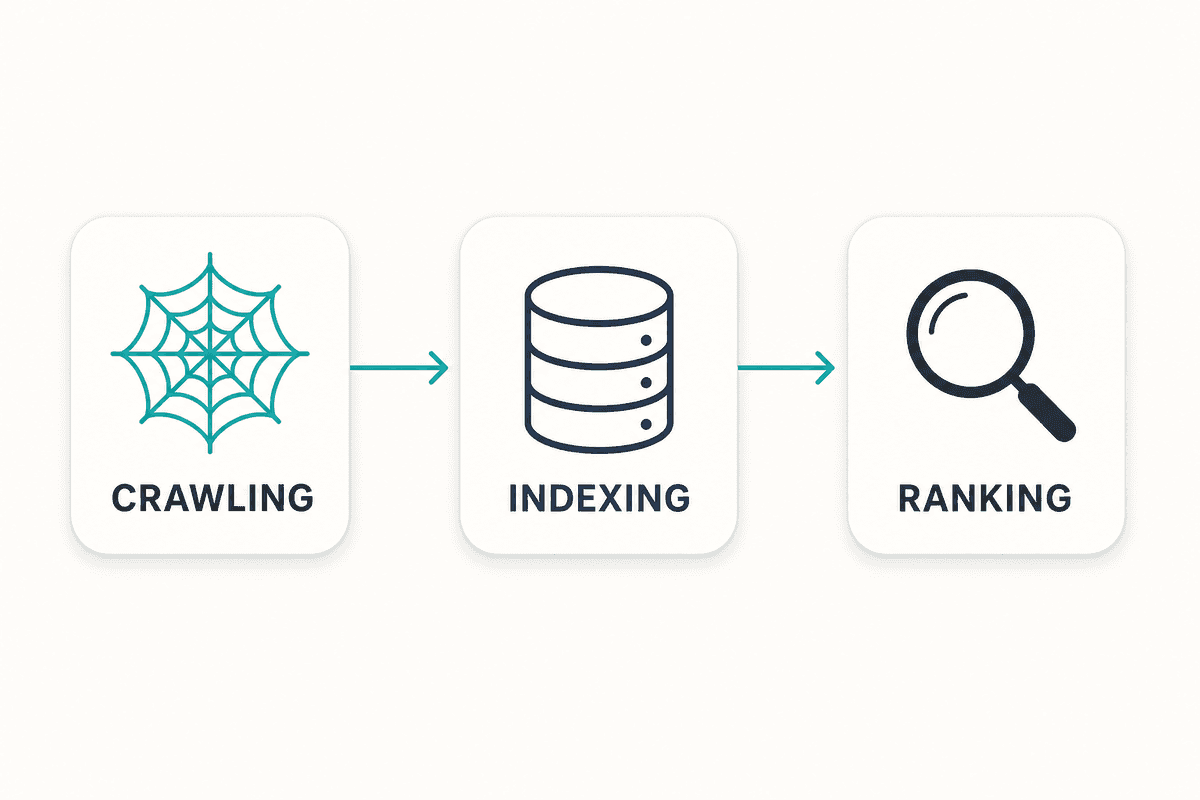
Before investing resources into content creation, you need a fundamental understanding of how search engines process your website. According to the Search Engine Optimization (SEO) Starter Guide, Google discovers pages through a three-step process:
- Crawling: Googlebot constantly explores the web looking for new or updated pages. It follows links from known pages to new ones.
- Indexing: Google tries to understand what the page is about by analyzing the text, images, and video files. This information is stored in the Google index.
- Serving Results: When a user searches, Google returns the highest quality, most relevant results from its index.
For SaaS applications—especially those built on modern frameworks—rendering can be a major hurdle during the indexing phase. If your product heavily relies on client-side JavaScript, Googlebot might see a blank page instead of your optimized content. This is why mastering Single-Page Application SEO: What Works in 2026? is a critical prerequisite for technical founders.
How Long Until I See Impact in Search Results?
Managing expectations is critical for SaaS teams. A common mistake is abandoning an SEO strategy after 45 days. In reality, most newly published pages take between 3 to 6 months to mature in search engine rankings. It takes time for search engines to crawl your new content, evaluate your site's authority, and test your pages against user behavior signals in the SERP (Search Engine Results Page).
If you want a steady stream of organic trials by Q4, your production pipeline needs to be fully operational by Q2.
The 7 SEO Content Pages Your SaaS Should Build Now
Not all web pages are created equal. When determining which pages to optimize for SEO, you must prioritize assets that bridge the gap between informational search intent and product-led growth (PLG). Here are the seven pages you need to build.
1. The "Alternative To" Competitor Comparison (Bottom-Funnel)
When a user searches for "[Giant Competitor] alternative," they have their credit card in hand. They already understand the software category; they are just frustrated by the market leader's pricing, bloated features, or poor customer support.
Implementation details:
- Do not bash the competitor: Maintain your E-E-A-T (Experience, Expertise, Authoritativeness, Trustworthiness). Objectively list what the competitor does well, then pivot to where they fall short.
- Use Comparison Tables: Search engines love structured data. Build a side-by-side feature matrix that highlights your specific advantages.
- Targeting: Create a dedicated page for every major competitor in your space.
2. The Step-by-Step Use Case Guide (Mid-Funnel)
Instead of pitching your software directly, pitch the solution to a workflow problem. If you sell scheduling software, a "How to Automate Client Onboarding Interviews" guide naturally leads into your product.
Implementation details:
- Write these guides as numbered steps. Google frequently extracts numbered lists for Featured Snippets.
- Embed your software naturally into the workflow. Use screenshots of your UI as the visual solution to the problem.
- For a blueprint on structuring these effectively, read SEO for Single Page Applications: A 5-Step Guide (2026).
3. The Vertical-Specific Landing Page (Mid-Funnel)
Your core product might be universally applicable, but buyers want software built for them. A general CRM is hard to sell, but a "CRM for Real Estate Brokerages" feels tailor-made.
Implementation details:
- Create a distinct landing page for every industry you serve (e.g., /solutions/real-estate, /solutions/agencies).
- Change the copy, case studies, and imagery to match the specific vertical.
- Ensure the technical architecture supports these pages properly. Learn How to Build an SEO Landing Page (7-Step Guide) to avoid duplicate content penalties.
4. The Integration Ecosystem Directory (Top to Mid-Funnel)
SaaS companies often sit on a goldmine of search volume tied to the tools they integrate with. If your product connects to Slack, Shopify, and Webflow, you should have dedicated SEO pages for each connection.
Implementation details:
- Target keywords like "Slack integration for [Your Category]".
- Explain the technical setup process, the data that syncs between the two platforms, and the specific workflow benefits.
5. The Free Tool or Calculator Page (Top-Funnel Link Magnet)
Engineering-as-marketing is one of the most effective SEO strategies for SaaS. Building a lightweight, free version of a core feature (like an ROI calculator, a privacy policy generator, or a website speed tester) attracts massive top-of-funnel traffic and natural backlinks.
Implementation details:
- The tool must provide instant value without a mandatory email gate.
- Include 1,000+ words of supporting text below the tool explaining the methodology, formulas, or related industry standards so search engines have text to crawl.
6. The Original Data and Statistics Report (Link Earning)
Earning backlinks is notoriously difficult. One of the few scalable ways to acquire them without aggressive outreach is by publishing original data. Journalists and bloggers constantly search for statistics to cite in their own content.
Implementation details:
- Anonymize and aggregate your platform's user data to reveal an industry trend (e.g., "The State of Email Open Rates in 2026").
- Create easily shareable, embeddable charts.
- This strategy is foundational to a robust SEO content strategy.
7. The Glossary and Terms Wiki (Top-Funnel Discovery)
Every industry has a unique vocabulary. Building a structured glossary captures users who are just beginning their educational journey in your space.
Implementation details:
- Don't just provide a two-sentence dictionary definition. Expand each term to include "Why it matters," "Examples," and "How [Your Brand] handles it."
- Cross-link these definitions internally whenever you use industry jargon on your main blog.
Organize Your Site: The Architecture of Traffic
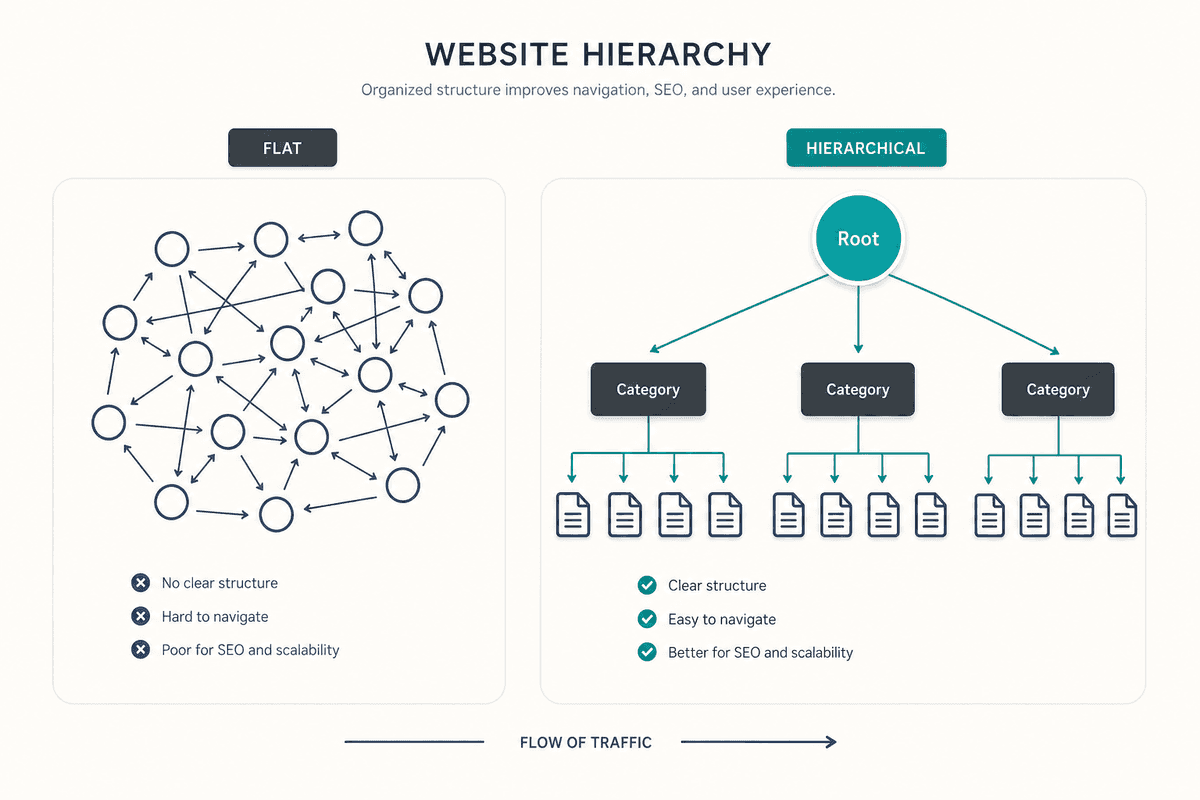
Google needs to understand the hierarchy of your website. If you dump all 500 of your articles into a single /blog/ folder with no categorization, you are severely limiting your organic potential. You must help search engines understand the relationships between your content pages.
Group Topically Similar Pages in Directories
Use descriptive URLs and logical folder structures. If you are building a cluster of pages around integrations, structure them logically:
bevisible.app/integrations/(Main hub)bevisible.app/integrations/wordpress(Spoke)bevisible.app/integrations/webflow(Spoke)
This hub-and-spoke model distributes page authority effectively. The main hub ranks for broad terms, while the specific spokes capture long-tail intent.
Internal Page Linking with Anchor Text
Your SEO content pages should not exist in isolation. Link them together using descriptive anchor text. Instead of writing "Click here to read our guide," write "Check out our guide to 11 Best SEO Blogs Every SaaS Founder Needs (2026)." This provides context to both the user and the search crawler.
On-Page SEO Checklist: Make Your Site Interesting and Useful
A technically perfect page that bores the reader will not rank long-term. Google's algorithms increasingly rely on user interaction signals. If visitors bounce immediately, your rankings will plummet. Merging technical requirements with user experience is a cornerstone of modern SEO best practices.
Influence How Your Site Looks in Google Search
The first interaction a user has with your brand is on the search results page. You control this through metadata.
- Title Tags: Keep them under 60 characters. Place your primary keyword near the front, and include a modifier like "(2026)" or "Guide" to increase click-through rates.
- Meta Descriptions: Write 150-character descriptions that act as ad copy. While they don't directly impact rankings, they heavily influence whether a user clicks your link over a competitor's.
Add Images to Your Site, and Optimize Them
Visual SEO is frequently ignored by SaaS companies.
- Add descriptive alt text to the image: Screen readers rely on alt text for accessibility, and Google relies on it to understand the image context. Never leave alt tags blank. Describe the image specifically.
- Add high-quality images near relevant text: Don't cluster all your screenshots at the bottom of the page. Place visual aids exactly where the corresponding text explains them.
- Format and Size: Compress images before uploading to ensure fast page load speeds, a critical ranking factor.
Write with Structure
Avoid massive walls of text. Use H2 and H3 subheadings to break up concepts. Employ bulleted lists for feature sets and bold text for key takeaways. A reader should be able to scroll your page in three seconds and understand the entire premise.
Common SEO Strategy Pitfalls (Things We Believe You Shouldn't Focus On)
As you map out your content, avoid these resource-wasting traps:
- Keyword Stuffing: Artificially injecting your target phrase 40 times into an article does not work and actively harms your readability. Write for humans first.
- Chasing Irrelevant High-Volume Terms: A keyword with 50,000 monthly searches but zero purchasing intent is useless to a SaaS company. Focus on "bottom of funnel" intent first, even if the search volume is only 100 queries a month.
- Ignoring the Mobile Experience: Google uses mobile-first indexing. If your complex comparison table breaks on an iPhone screen, your rankings will suffer.
Next Steps: Automating the Production Pipeline
Building out a library of integration pages, vertical landing pages, use-case guides, and competitor comparisons requires a massive amount of ongoing effort. Most SaaS founders, indie hackers, and lean marketing teams simply do not have the hours in the day to conduct SERP research, outline articles, write 2,000 words, generate schema markup, and publish consistently.
This is why content velocity usually stalls.
If you want to maintain a daily publishing cadence without hiring an expensive agency or a massive in-house team, automation is the most viable path forward. By connecting your site URL and niche to a platform like BeVisible, you can generate a complete 30-day content map. The platform automatically researches competitors, identifies keyword gaps, writes answer-first content, optimizes metadata and internal links, and publishes directly to your CMS (WordPress, Webflow, Notion, Ghost, or Shopify) via API every 24 hours.
At $199/month for 30 fully optimized articles, it transforms your website into a daily source of ranked answers for both traditional search engines and AI interfaces like ChatGPT and Perplexity.
Stop writing generic blog posts. Start building an automated ecosystem of high-ranking SEO content pages.