
There is a specific kind of regret reserved for SaaS founders locked into a 12-month SEO contract, paying $5,000 a month for "ongoing technical maintenance" and "proprietary link building," while organic traffic remains entirely flat.
When you hire an SEO agency or consultant, the relationship rarely breaks down over a lack of knowledge. It breaks down over a lack of clarity. Expectations misalign, deliverables become vague, and when you finally decide to pull the plug, you discover the contract leaves you empty-handed.
An SEO contract is not just a formality to establish payment terms. It is a risk mitigation tool. It defines exactly what you are buying, who owns the output, and how you measure failure. For early-stage startups and established e-commerce brands alike, signing the wrong agreement can stall your growth pipeline for a year and cost tens of thousands of dollars.
Before you onboard your next organic growth partner, you need to understand the mechanics of the agreement. Let's break down the essential components of an SEO contract and the five glaring red flags that should make you walk away.
The Anatomy of a Modern SEO Agreement
Most founders treat an SEO contract as a single monolithic document. In reality, a mature agency engagement usually consists of two distinct parts: the Master Services Agreement (MSA) and the Scope of Work (SOW).
The Master Services Agreement (MSA) governs the legal relationship. It covers confidentiality, dispute resolution, payment terms, and intellectual property ownership. This document rarely changes from client to client.
The Scope of Work (SOW) governs the operational reality. It lists the specific deliverables, timelines, key performance indicators (KPIs), and communication cadences. If you are going to dispute a deliverable six months from now, the SOW is the document you will point to.
 Many agencies blend these into a single two-page proposal, which is where the trouble starts. When the legal protections and the operational deliverables are blurred, neither is defined strictly enough to protect your business.
Let's look at the specific warning signs hidden in these documents.
Red Flag 1: The "Page One Ranking" Guarantee
It remains one of the most persistent myths in digital marketing: the guaranteed page-one ranking. If you see a contract promising to put your site on the first page of Google within three, six, or twelve months, do not sign it.
Why It's a Trap
Google's algorithm processes thousands of ranking signals, utilizes machine learning systems like RankBrain and AI Overviews, and frequently updates its core systems. No agency controls Google. Promising a specific ranking position is mathematically and technically impossible.
Agencies that offer these guarantees usually rely on one of two tactics to fulfill their contractual obligation:
- Zero-Volume Long-Tail Keywords: They will guarantee rankings for keywords that nobody searches for. Ranking #1 for "B2B predictive analytics software for midwest dental clinics" might fulfill the contract, but it will drive zero organic pipeline to your SaaS.
- Branded Keywords: They will claim victory for ranking your site for your own company name—something you were likely already ranking for or would achieve naturally with minimal effort.
What to Look for Instead: Deliverable-Based Guarantees
A legitimate SEO contract guarantees output, not algorithmic outcomes. You should look for performance commitments tied to the agency's actual labor:
- Content Volume: "Delivery of four 2,000-word, fully optimized bottom-of-funnel articles per month."
- Technical Benchmarks: "Resolution of all critical site speed issues identified in the initial audit, achieving a Core Web Vitals score of 90+ on mobile within 60 days."
- Link Acquisition: "Procurement of five high-authority (DA 50+) contextual backlinks per month, subject to client approval."
If you want more context on how bad service providers operate locally and internationally, our guide on Hiring SEO Services in Phoenix? 5 Red Flags (2026) details similar warning signs to avoid.
Red Flag 2: Vague Deliverables & "Proprietary" Tactics
SEO is not magic. It is a systematic process of technical optimization, content creation, and authority building. Yet, many contracts obscure these realities behind buzzwords and "proprietary methodologies."
If the SOW includes line items like "Ongoing algorithmic calibration" or "Monthly off-page optimization," you are stepping into a trap. Vague deliverables give the agency cover to do absolutely nothing while cashing your retainer check.
The Danger of "Maintenance"
One of the most common SOW line items is "Ongoing Technical Maintenance." For a robust, enterprise-level platform, technical maintenance is a real necessity. But for a standard SaaS marketing site built on Webflow or WordPress, your site does not need 15 hours of "technical maintenance" every month once the initial structural issues are fixed.
Agencies use vague maintenance clauses as a buffer. If they fail to acquire links or write content, they point to the invisible maintenance work to justify the invoice.
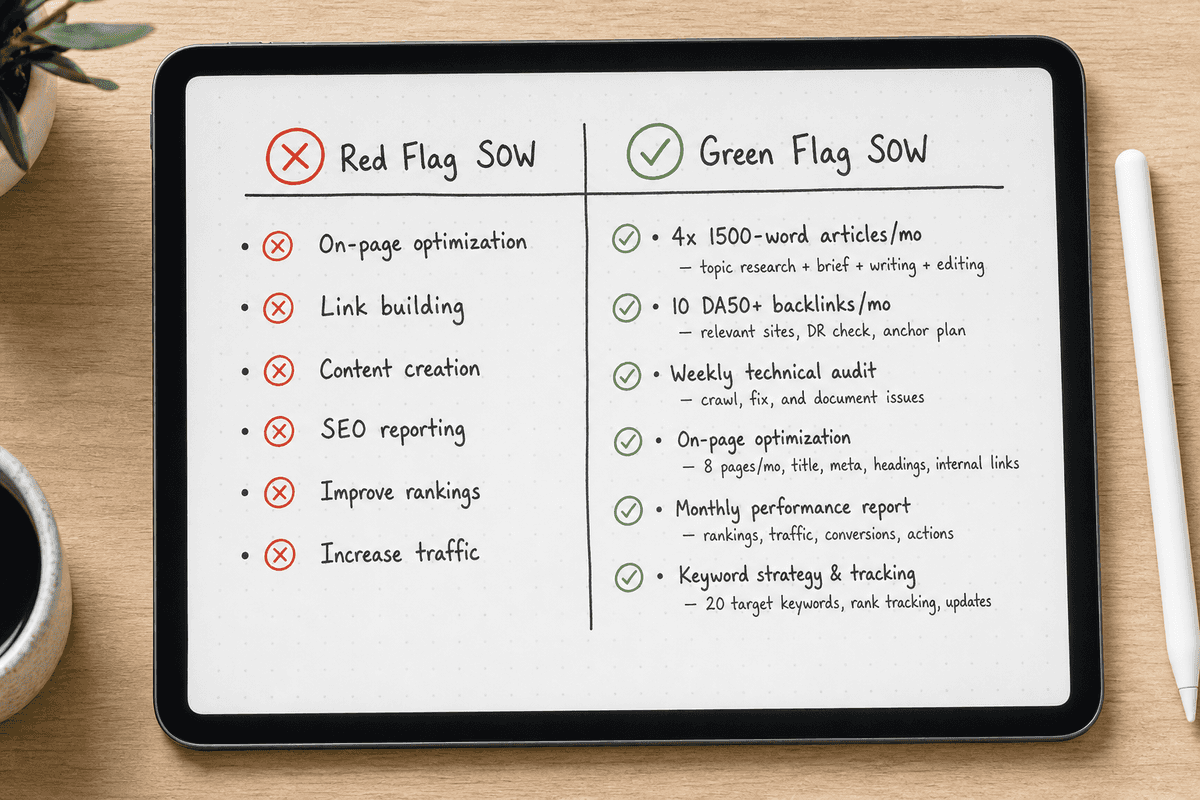
The Specificity Checklist
Every SOW must pass the specificity test. You should know exactly what is being delivered, down to the unit level. For example, if the agency is tasked with creating conversion-focused pages, the contract shouldn't say "optimize landing pages." It should specify deliverables similar to How to Build an SEO Landing Page (7-Step Guide), detailing the exact number of pages, wireframes, copy length, and schema markup implementation.
Compare these SOW entries:
If the contract cannot quantify the labor, you should not authorize the payment.
Red Flag 3: The Asset Hostage Crisis (IP & Ownership Clauses)
Perhaps the most damaging red flag in an SEO contract is the failure to clearly assign Intellectual Property (IP) ownership. What happens to the assets the agency built when you fire them?
In a fair engagement, you are paying for "work for hire." When the invoice is paid, you own the deliverables. However, predatory agencies use IP clauses to keep clients hostage.
Content Ownership
Read the fine print regarding content creation. Some contracts stipulate that the agency retains copyright over the articles they write, licensing them to you only while you remain a client. If you cancel the retainer, they demand you remove the content from your blog. This instantly destroys whatever organic traffic you built.
The Fix: Ensure the contract includes a clause stating: "Upon receipt of payment in full, all deliverables, including but not limited to written content, graphics, code, and strategy documents, become the exclusive property of the Client."
The Backlink Ransom
Off-page SEO (link building) is notorious for hostage tactics. Some agencies build networks of private blogs (PBNs) or pay for link placements where they control the relationship. The contract may include a hidden clause stating that links are "rented" or subject to removal upon termination.
If an agency removes backlinks when you leave, your domain authority will plummet, and your rankings will tank. Your contract must explicitly state that all acquired backlinks are permanent and the agency will take no action to remove, disavow, or alter them post-termination.
Account Access and Data Ownership
Never let an agency create your Google Analytics or Google Search Console accounts under their own master email. If they do, they own your historical data.
 Your contract should mandate that all external tools, tracking platforms, and CMS modifications are done within accounts owned by your company, with the agency granted temporary "Editor" or "Manager" access that can be revoked at any time.
Red Flag 4: Ironclad Lock-ins with No Deliverable Off-ramps
SEO takes time. It is perfectly reasonable for an agency to ask for a 6-month or 12-month commitment because they need runway to let Google index changes, establish content authority, and see ranking movement. You cannot judge an SEO campaign in 30 days.
However, there is a massive difference between a strategic commitment and a contractual prison.
The 90-Day Deliverable Clause
A standard red flag is a strict 12-month lock-in with a 100% payout penalty for early termination, regardless of agency performance. What happens if the agency simply stops responding to emails in month three? What if they deliver spun, unreadable AI content that you cannot publish?
You need an off-ramp based on deliverable failure. Your contract should include a Service Level Agreement (SLA) regarding communication and output.
For example:
- "Client may terminate this agreement with 30 days written notice without penalty if Agency fails to deliver the minimum monthly deliverables outlined in the SOW for two consecutive billing cycles."
This protects the agency from you canceling early just because you're impatient about rankings, while protecting you from paying for nine months of ghosting.
Red Flag 5: Misaligned KPIs and Weak Reporting Frameworks
How do you know if the SEO investment is working? If the contract doesn't define the reporting cadence and the primary metrics, the agency will simply report on whatever numbers look best that month.
Vanity Metrics vs. Pipeline Metrics
Many SEO contracts focus purely on "Traffic" or "Keyword Rankings." For a SaaS or e-commerce business, these are vanity metrics.
Imagine an agency ranks a top-of-funnel glossary term that brings in 10,000 visitors a month from regions where you cannot legally sell your software. Traffic is up 300%. The agency claims a massive victory. But your MRR hasn't moved a single dollar, and your customer acquisition cost (CAC) for organic just skyrocketed because you are paying a retainer for useless traffic.
A mature SEO contract aligns KPIs with your business model. The reporting framework outlined in the agreement should focus on:
- Non-Branded Organic Traffic: Filtering out the people who already knew your name.
- Conversions/Signups: How many organic visitors booked a demo, started a free trial, or purchased a product.
- High-Intent Keyword Movement: Tracking rankings for "bottom-of-funnel" terms with high purchase intent, rather than generic informational queries.
The Reporting Cadence
The contract must stipulate exactly how and when you will receive updates. "Monthly reporting" is too vague.
A solid contract specifies: "Agency will provide a live, dashboard-based report (e.g., Looker Studio) updating weekly, alongside a monthly recorded video walkthrough explaining pipeline impact, technical roadblocks, and the following month's strategic focus."
If you are trying to stay ahead of how top professionals track these metrics, we recommend reviewing the 11 Best SEO Blogs Every SaaS Founder Needs (2026) to understand what modern SEO reporting looks like.
Key Clauses Your SEO Agreement Must Include
To summarize the defensive posture you need to take during negotiations, ensure your contract contains these protective clauses:
- Strict Confidentiality / NDA: Ensure they cannot share your traffic data, conversion rates, or keyword strategy with your direct competitors.
- Non-Compete (Optional but Recommended): A clause stating the agency will not take on a direct, primary competitor in your exact niche while under active retainer with you.
- Approval Workflows: A stipulation that no content goes live on your domain and no irreversible technical changes are deployed without written sign-off from your team.
- Transition Support: A 30-day off-boarding clause dictating that the agency must hand over all strategy documents, asset lists, and credential access smoothly if the relationship ends.
The Cost of Traditional SEO vs. The Automation Alternative
Navigating MSA structures, SOW negotiations, and IP clauses takes time, legal fees, and operational bandwidth. This friction is why many SaaS founders and indie hackers are abandoning the traditional agency model entirely.
When you hire an agency, you are heavily subsidizing their account managers, sales commissions, and office overhead. This is why standard agency retainers range from $3,000 to $10,000+ per month for a handful of articles and some technical tweaks. You can see a full breakdown of these models in our analysis of SEO Charges UK: Agency Rates vs Automation (2026).
Why Founders Are Moving to Autonomous SEO
If the core problem with SEO contracts is the misalignment of cost vs. output, the modern solution is removing the human bottleneck for execution.
Platforms like BeVisible bypass the need for an agency contract entirely. Instead of arguing over who owns an article or paying $1,500 for an agency to perform keyword research, BeVisible automates the entire pipeline:
- No Long-Term Lock-ins: It operates on a SaaS subscription model. You cancel when you want, without penalty.
- Massive Output Scaling: Instead of fighting an agency for 4 articles a month, BeVisible automatically researches, writes, formats, and publishes 30 high-quality, answer-first articles every month.
- Full Asset Ownership: The content is published directly to your CMS (WordPress, Webflow, Notion, etc.). You own it forever.
- Fractional Cost: At $199/month, the investment is a fraction of a single agency deliverable, allowing startups to build massive organic authority without burning runway.
By fully automating competitor analysis, keyword mapping, content generation, schema markup, and internal linking, you eliminate the need for complex SOWs and deliverable tracking.
The Final Checklist: Before You Sign
If you decide your business requires the bespoke touch of a consultant or agency, use this rapid-fire checklist before signing the contract:
- Does the SOW quantify exact deliverables (word counts, link metrics, audit hours)?
- Does the contract explicitly grant me 100% ownership of all created content?
- Is there a clause confirming backlinks will not be removed upon termination?
- Is the guarantee tied to deliverable completion rather than page-one rankings?
- Is there an early termination off-ramp if the agency fails to meet output SLAs?
- Are KPIs tied to business metrics (signups, pipeline) rather than just traffic?
- Do I retain Master Admin rights to all my analytics and search console properties?
An SEO contract should feel like a roadmap, not a trap. By identifying these five red flags early, you can protect your marketing budget, secure your domain's authority, and build a search engine presence that genuinely drives revenue.