
A prospective buyer evaluating new CRM software no longer types "best CRM tools" into Google and clicks the first listicle. Instead, they open Perplexity, ChatGPT, or Gemini and type a highly constrained, multi-variable prompt: "Compare HubSpot and Salesforce for a 50-person B2B agency, focusing specifically on API rate limits, custom object flexibility, and total cost of ownership over two years."
Within seconds, the AI synthesizes an answer, complete with recommendations, pros, cons, and—crucially—citations.
If your SaaS product is not explicitly recommended and cited in that response, you effectively do not exist to that buyer. It doesn't matter how many backlinks you have or how well you rank for traditional keywords on the standard ten blue links. Search is transitioning from traffic capture to mindshare capture.
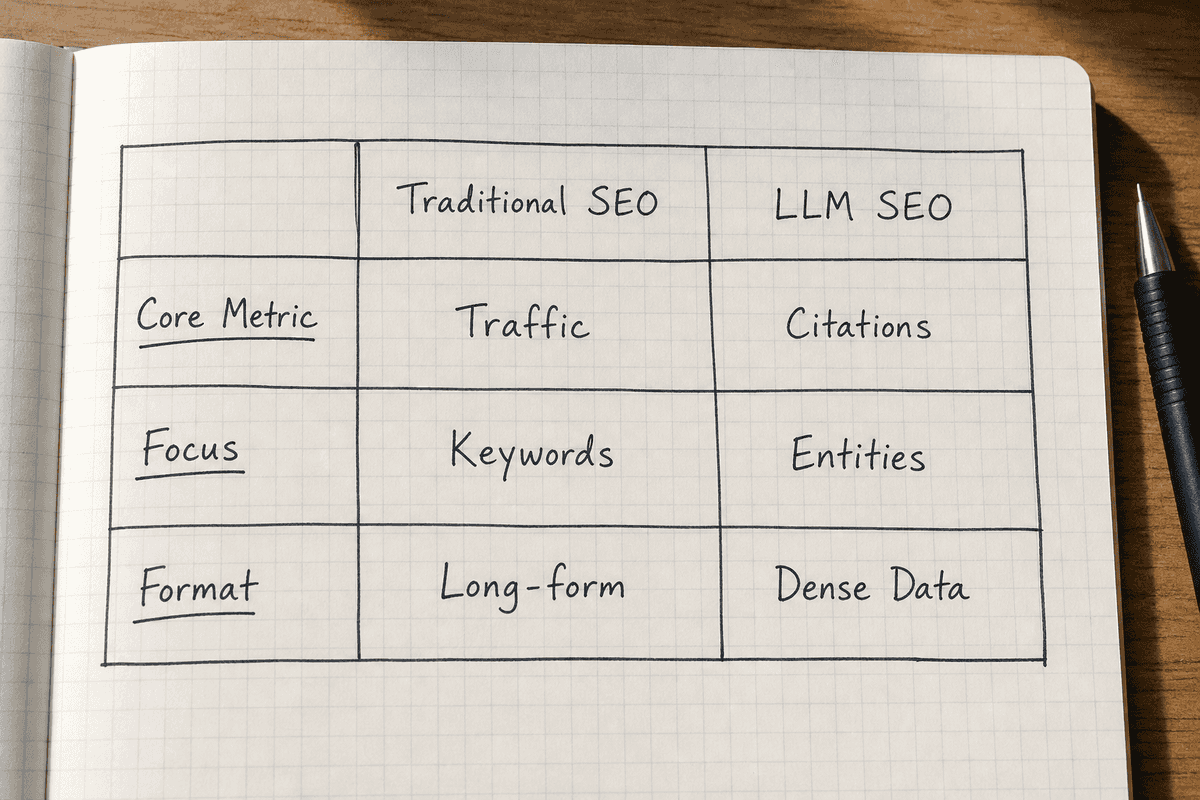
Optimizing for Large Language Models (LLMs)—often referred to as Generative Engine Optimization (GEO) or AI Search Optimization—requires a fundamental shift in how marketing teams approach discoverability. Traditional SEO relies on keyword density, internal linking structures, and click-through rates. SEO for LLMs relies on entity confidence, information density, machine readability, and third-party consensus.
In this guide, we will break down exactly how AI search engines retrieve information, how different models behave, and how growth teams can build a systemic engine to turn missing mentions and weak citations into visible market share.
The Paradigm Shift: Why Traditional SEO Fails in AI Search
For over two decades, search engines functioned as librarians. You asked a question, and the librarian pointed you to a shelf where a book might have the answer. You had to read the book, extract the information, and synthesize the conclusion yourself.
AI search engines act as subject matter experts. When asked a question, they do not point to the shelf. They read the books, synthesize the core arguments, and deliver a direct, customized answer, citing the sources they used to build that conclusion.
This shift fundamentally changes the metrics of success:
- From Clicks to Citations: In traditional SEO, success is a click. In LLM SEO, success is being cited as the authoritative source or recommended as the ideal solution directly within the chat interface.
- From Keywords to Entities: Traditional search connects strings of text. AI search connects concepts. The LLM needs to understand your brand as a distinct entity with specific attributes, integrations, and capabilities.
- From Fluff to Density: Human readers might skim through a 2,000-word "Ultimate Guide" padded with generic introductions. AI models look for "Information Gain"—net-new data, hard statistics, expert quotes, and structured tables that answer the query efficiently.
If your current strategy relies heavily on generic top-of-funnel content that simply rephrases what is already on page one of Google, your visibility in AI search will rapidly approach zero. LLMs have already digested the consensus; they are looking for unique, authoritative data to augment their generated responses.
How LLMs Retrieve Information: The Mechanics of RAG
To optimize for an AI search engine, you must understand how it builds its answers. Modern AI search tools do not simply regurgitate data from their initial training runs. Training data cuts off at a specific date, and LLMs are prone to hallucination if forced to guess facts outside their training window.
Instead, platforms like ChatGPT, Perplexity, and Google's AI Overviews rely on a framework called Retrieval-Augmented Generation (RAG).
When a user enters a prompt, the system does not immediately generate text. It executes a multi-step process:
- Intent Parsing & Query Expansion: The LLM reads the user's prompt and breaks it down into search parameters. It translates complex natural language into backend search queries.
- Live Web Retrieval: The system pings a traditional index (like Bing Search for ChatGPT, or Google's index for Gemini and AI Overviews) to find the most relevant, up-to-date web pages related to the query.
- Vector Search & Semantic Matching: The retrieved documents are converted into embeddings (mathematical representations of text). The AI compares the "semantic distance" between the user's query and the retrieved documents to filter out irrelevant noise.
- Extraction & Synthesis: The LLM scans the top-scoring pages, extracts the specific sentences or data points that answer the prompt, and writes a cohesive summary.
- Citation Linking: Finally, the model attaches citation numbers to the claims it extracted, linking back to the source URLs.
 If your website fails at any point in this chain—if it isn't indexed by Bing/Google, if its semantic relevance is poor, or if the text is too unstructured for the AI to extract data cleanly—you will not be cited.
Model-Specific Visibility: Understanding the Big Players
Not all AI assistants fetch information the same way. A comprehensive AI visibility strategy requires understanding the nuanced differences between the major conversational models.
ChatGPT (OpenAI + Bing)
ChatGPT relies on OpenAI's proprietary models (like GPT-4o) and uses Bing's search index to perform RAG. When a user asks a commercial question, ChatGPT queries Bing, reads the top results, and synthesizes an answer.
- What this means for you: Your performance in Bing Search matters significantly more than it did a few years ago. If you ignore Bing Webmaster Tools, you are ignoring the data source that feeds ChatGPT. Furthermore, ChatGPT favors sites with high technical performance and low latency. If your site blocks the
OAI-SearchBotcrawler, your live data will not appear in ChatGPT's responses.
Perplexity AI
Perplexity positions itself as an "Answer Engine" rather than a conversational chatbot. It is highly aggressive in its retrieval, often scanning dozens of sources for a single prompt. It heavily favors journalistic sources, academic papers, rigorous documentation, and detailed review platforms.
- What this means for you: Perplexity prioritizes source diversity. If your brand is only mentioned on your own homepage, Perplexity will likely ignore you. It looks for validation across Reddit, G2, Capterra, and independent blogs. Building a presence across the web is critical for Perplexity visibility.
Google Gemini & AI Overviews (AIO)
Gemini and Google's AI Overviews are deeply integrated with Google's massive Knowledge Graph and traditional search index. AIOs appear directly at the top of Google search results, acting as an automated aggregator.
- What this means for you: Google's AI models are obsessed with E-E-A-T (Experience, Expertise, Authoritativeness, Trustworthiness). To trigger citations in AI Overviews, your content must satisfy Google's traditional quality guidelines while also providing highly structured, easy-to-parse data. Google frequently pulls bulleted lists and table data directly into the AI Overview interface.
The 5 Pillars of SEO for LLMs
Traditional SEO focuses on optimizing for the algorithm. LLM SEO focuses on optimizing for the extraction engine. To ensure your SaaS is consistently cited and recommended, you must build your strategy around these five pillars.
Pillar 1: Transitioning from Keywords to Entities
LLMs do not think in keywords; they think in nodes and relationships—a concept known as a Knowledge Graph.
When an AI encounters the string of text "Acme CRM," it needs to map that text to a specific entity. What is Acme CRM? Who is it for? What does it integrate with? How much does it cost?
To optimize for entities, you must explicitly define your brand's relationships across the web:
- Consistent Digital Footprint: Ensure your brand's core attributes (features, pricing, target audience) are described identically on your website, your social profiles, your G2 page, and your press releases.
- Wikipedia and Wikidata: While notoriously difficult to acquire, a Wikipedia page or a Wikidata entry acts as a master anchor for an entity in an AI's brain. If your SaaS qualifies for a Wikidata entry, secure it.
- Association via Content: Write content that explicitly compares your tool to known entities. If you are a new email marketing SaaS, explicitly referencing how your tool differs from established entities like Mailchimp or Klaviyo helps the LLM place your brand in the correct semantic cluster.
Pillar 2: Maximizing Information Gain and Density
When a RAG system retrieves five articles about a topic, the LLM evaluates them for unique value. If your article says the exact same thing as the other four articles, the LLM has no reason to cite you.
Information Gain refers to the amount of net-new information a document provides compared to the existing baseline. To increase your information density:
- Publish Proprietary Data: Aggregate anonymized data from your SaaS platform to publish industry benchmarks. If you run a sales automation tool, publish a report on "Average Cold Email Open Rates by Industry in 2026." LLMs actively hunt for statistics to validate their answers.
- Cut the Fluff: Eliminate 500-word anecdotal introductions. AI crawlers have limited token windows (the amount of text they can process at once). If the first 2,000 tokens of your article are generic filler, the AI might stop reading before it reaches your core insights.
- Use Subject Matter Experts (SMEs): Embed direct, attributed quotes from recognized industry experts. AI models weight authoritative quotes heavily during the synthesis phase.
Pillar 3: Formatting for Machine Readability
An LLM is a text prediction engine, not a human reader. It struggles with implied context, complex metaphors, and unstructured data blobs. If you want the AI to extract your product's pricing tiers, you must format that data logically.
- Semantic HTML: Use proper hierarchy (H1, H2, H3, H4). An AI parses an H2 as a core topic and the following H3s as sub-topics. If you use bold text instead of proper heading tags to style your pages, the AI loses that structural context.
- Tables over Text: If you are comparing your product to a competitor, do not just write a paragraph. Create an explicit HTML table comparing feature availability, pricing, and API limits. LLMs can perfectly parse table rows and columns, making them highly likely to extract and cite that exact data in a comparative prompt.
- Schema Markup (JSON-LD): Implement robust structured data on your site. Use
SoftwareApplicationschema to define your tool's category, pricing, and operating systems. UseFAQPageschema to answer common buyer objections. UseOrganizationschema to tie your leadership team and social profiles to your brand entity. Building an effective seo landing page requires embedding this machine-readable context directly into the code.
Pillar 4: Dominating the Third-Party Ecosystem
A critical mistake SaaS marketers make is assuming that optimizing their own website is enough. It is not.
When a buyer prompts an AI with, "What is the best project management tool for creative agencies?", the AI does not just read your homepage. It cross-references your claims against third-party validation. If your homepage says you are the best, but Reddit users say your software is slow, and G2 reviews complain about customer support, the AI will synthesize a balanced response: "While Brand X claims to be built for agencies, user reviews note significant performance issues."
To control the narrative, you must influence the sources the AI trusts:
- Review Platforms: Aggressively manage G2, Capterra, and Trustpilot. The AI models index these sites deeply. A robust volume of detailed, keyword-rich reviews provides excellent training data for the LLM.
- Digital PR and Roundups: Ensure you are featured in industry listicles and roundups. If an AI reads ten articles about "top software tools" and your brand is in eight of them, the LLM will confidently recommend you based on consensus.
- Community Forums: Monitor Reddit, Quora, and niche communities. Search engines (especially Google) are heavily indexing user-generated content (UGC) to provide authentic, human-tested answers. If your brand is highly recommended in these spaces, AI models will pick up on that positive sentiment.
- Industry Blogs: Cultivate relationships with high-authority publications. Reading the best seo blogs can help you stay ahead of algorithm changes, but getting featured on them establishes your entity authority.
Pillar 5: Solving Technical Rendering Blocks
All the content strategy in the world is useless if the AI cannot read your website.
Many modern SaaS websites are built as Single Page Applications (SPAs) using JavaScript frameworks like React, Vue, or Angular. While traditional Googlebot has gotten better at rendering JavaScript over the years, many AI-specific crawlers (like OpenAI's bot or Perplexity's bot) operate as headless browsers with aggressive timeout thresholds.
If your page takes four seconds to execute JavaScript and render the text, the AI crawler may simply see a blank <div id="root"></div> and move on. The RAG system will conclude that your page has no relevant information.
To ensure visibility, you must implement technical safeguards:
- Server-Side Rendering (SSR) or Static Site Generation (SSG): Pre-render your content on the server so that when the AI crawler requests the page, it immediately receives fully populated HTML. If you rely on complex JavaScript, review a technical checklist on seo for single page application architectures to ensure you aren't blocking bot access.
- Dynamic Rendering: If SSR is not feasible, implement dynamic rendering to serve a static HTML snapshot specifically to known bot user agents, while serving the dynamic JavaScript experience to human users.
- Optimize Crawler Budgets: Ensure your
robots.txtfile is not accidentally blocking AI search bots. Note: There is a difference between blocking a bot from training on your data (e.g., blockingCCBot) and blocking a bot from searching your data (e.g., blockingOAI-SearchBotorGoogle-Extended). If you block the search bots, you opt out of RAG visibility entirely.
How to Measure and Track Your AI Search Visibility
In traditional SEO, you track keywords and monitor your ranking position from 1 to 100. In LLM SEO, tracking is vastly more complex. Answers are highly personalized, conversational, and dynamic.
How do you actually know if ChatGPT is recommending your SaaS? How do you know what Perplexity says about your pricing?
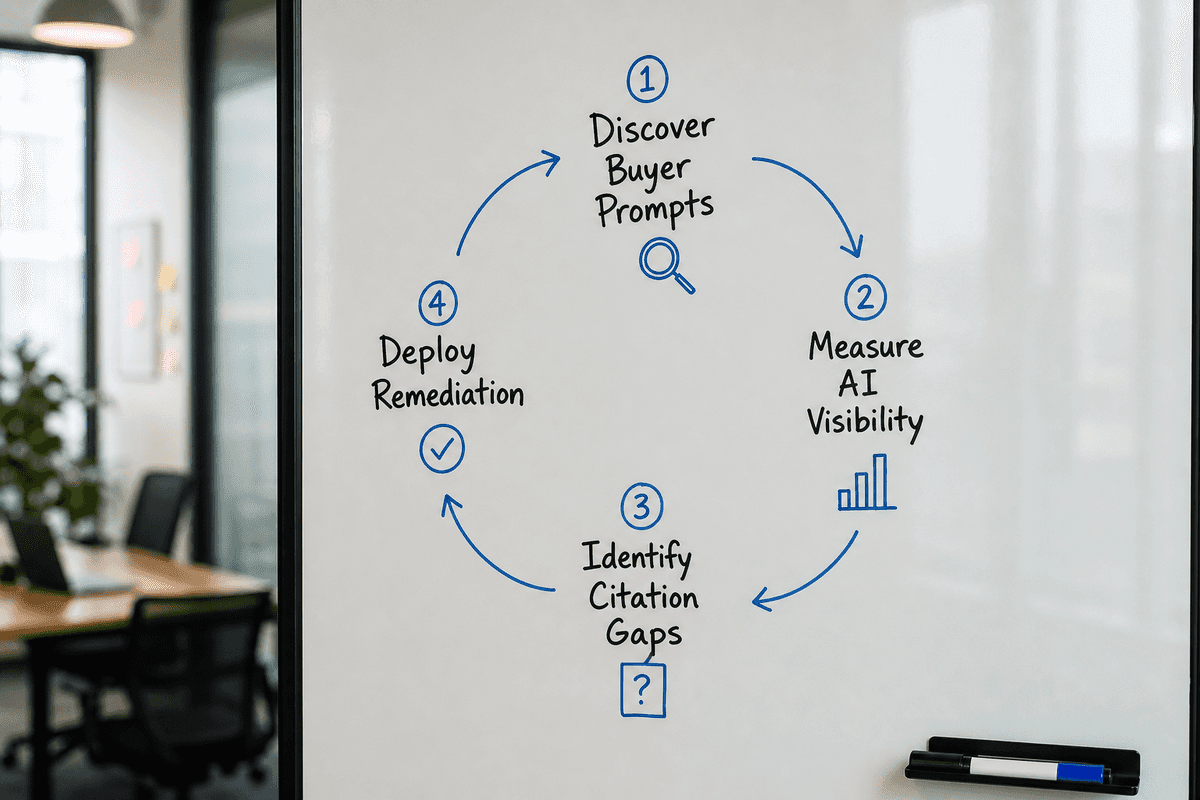
This is where a systemic visibility monitoring program is required. You cannot rely on manual, ad-hoc prompting. You need an automated workflow to measure share of voice across the models your buyers actually use.
Step 1: Define Your Buyer Prompt Universe
Stop thinking in short-tail keywords (e.g., "payroll software") and start thinking in complex buyer prompts. Buyers use AI at every stage of the funnel:
- Discovery Prompts: "What are the most popular tools for automating b2b sales tax compliance for a SaaS company scaling in Europe?"
- Comparative Prompts: "Compare Tool A and Tool B for an enterprise team. Focus on SOC2 compliance and native Salesforce integrations."
- Diagnostic Prompts: "Why is my current reporting software failing to sync data in real-time, and what alternatives exist that handle stream-processing better?"
- Navigational/Branded Prompts: "What are the hidden fees in [Your Brand]'s enterprise tier?"
Map out a universe of 100-500 prompts that your ideal buyers are asking.
Step 2: Automated Visibility Monitoring
Manually typing 500 prompts into four different AI engines every week is impossible. Teams must leverage dedicated AI visibility platforms to automate this process.
This is the core infrastructure BeVisible provides. BeVisible helps teams monitor how AI assistants answer buyer questions, which brands they recommend, and which sources they cite. It systematically tracks ChatGPT, Gemini, Perplexity, AI Mode, and AI Overviews across your buyer prompts.
By running these prompts at scale, you can establish a baseline metric: Out of your 500 buyer prompts, what percentage of the time is your brand mentioned? What percentage of the time is a competitor mentioned?
Step 3: Analyze Citations and Sentiment
Being mentioned is not enough; context matters. A tracking system must evaluate:
- Recommendation Status: Did the AI explicitly recommend you, or simply list you as a fallback option?
- Sentiment: Did the AI mention your "great UI" or your "terrible customer support"?
- Citation Source: When the AI recommended you, where did it get that information? Did it cite your own blog, a G2 review, or a competitor's biased comparison page?
Understanding the source of the citation is the key to fixing visibility gaps.
The Remediation Workflow: Turning Visibility Gaps into Strategy
Once you have measured your baseline visibility across the major LLMs, you will inevitably find gaps. Perhaps Perplexity hallucinates your pricing, or ChatGPT consistently recommends your biggest competitor for enterprise use cases.
The final step in LLM SEO is the remediation workflow. This is where you turn missing mentions and weak citations into evidence-backed opportunities, articles, review scheduling, and publishing work.
Scenario 1: Addressing Missing Mentions
The Gap: You run a prompt for "best automated accounting tools for freelancers," and the AI lists five competitors, completely ignoring your SaaS.
The Fix: Look at the sources the AI did cite to build that list. It likely pulled from 3 or 4 specific listicles on high-authority blogs or financial websites. Your remediation task is not to write another blog post on your own site. Your task is to conduct digital PR and outreach to get your brand added to those specific source URLs. By injecting your brand into the trusted source material, you force the AI to recognize you the next time it runs its RAG retrieval.
Scenario 2: Fixing Weak Citations and Hallucinations
The Gap: The AI recommends your software but states that you do not have a mobile app (even though you launched one six months ago).
The Fix: LLMs hallucinate when the correct data is either unavailable, contradictory, or hidden behind poor site architecture.
- Audit your website to ensure the mobile app is prominently featured in text, not just in an image or a buried footer link.
- Update your
SoftwareApplicationschema to explicitly list iOS and Android compatibility. - Update your profiles on G2, Capterra, and LinkedIn to mention the new app.
- Publish a highly structured, machine-readable feature log or release note detailing the mobile app capabilities. Once the AI search bots re-crawl these explicit nodes of information, the hallucination will resolve.
Scenario 3: Capitalizing on Competitor Blind Spots
The Gap: You monitor prompts related to a competitor and notice the AI consistently mentions that their platform "struggles with large dataset exports" because it is pulling negative sentiment from Reddit.
The Fix: You have discovered an evidence-backed opportunity. You can confidently build an editorial campaign, a comparison landing page, or targeted social content explicitly highlighting your platform's ability to handle massive dataset exports. You align your content strategy directly with the exact weaknesses the AI has already identified in the market.
This level of strategic execution requires resources, and many companies debate whether to build this capability internally or hire an agency. Budgeting for advanced AI technical fixes and digital PR can be complex—reviewing data on seo charges uk or looking into agency vs automation costs can help clarify the investment needed to scale this workflow.
Frequently Asked Questions about SEO for LLMs
Is traditional SEO completely dead? No. Traditional search and AI search are deeply intertwined. LLMs rely on traditional search indices (like Google and Bing) to retrieve live web data. If your site has terrible traditional SEO (poor backlinks, awful load times, zero domain authority), the RAG systems will never retrieve your content in the first place. Traditional SEO is the foundation; LLM SEO is the specialized layer built on top of it. You cannot ignore traditional best practices, such as ensuring your frontend handles single-page application seo correctly.
Can you pay for placement in AI search engines? Currently, direct "pay-for-placement" inside the organic generative text is rare, though platforms are experimenting with sponsored citations and featured ads alongside the chat interface (e.g., Perplexity's upcoming ad units). However, the core generative response is driven by algorithmic consensus. You cannot buy your way into being the "truth" of the model; you have to earn it through data density and third-party authority.
How long does it take for an LLM to update its knowledge of my brand? It depends on the system. For conversational models relying solely on training data, it can take months or years (whenever the next model training cutoff occurs). However, for RAG-based systems like Perplexity, ChatGPT (with web access), and AI Overviews, updates can happen in a matter of days or weeks. As soon as the underlying index (Google/Bing) recrawls your updated pages or the newly published third-party reviews, the AI can pull that fresh data into its next generated response.
Conclusion
The era of writing generic content to hack a ten-blue-link algorithm is ending. The buyers of 2026 and beyond are relying on AI assistants to cut through the noise, synthesize complex data, and deliver tailored recommendations.
To win in this new environment, SaaS brands must treat AI visibility not as an afterthought, but as a core pillar of their growth strategy. By optimizing for entities rather than keywords, structuring data for machine readability, dominating the third-party ecosystem, and implementing a rigorous monitoring and remediation loop, you can ensure that when a buyer asks an AI for the best solution on the market, the AI cites you.