
Many SaaS founders hit a wall when trying to scale organic traffic. They produce decent content, but operational friction grinds their velocity to a halt. Managing freelance writers, formatting posts in a content management system, and fighting with bloated SEO plugins creates a massive bottleneck. True organic growth requires a system that is fast, automated, and effortless.
When technical marketers talk about an SEO framework, they are typically referring to two distinct concepts. Sometimes they mean a strategic operating system for organic SaaS growth. Other times, they are searching for lightweight, anti-bloat software, such as the popular WordPress plugin specifically named The SEO Framework. Both interpretations share the exact same underlying philosophy. True organic success relies on an invisible technical foundation and intelligent automation. You do not need to spend hours manually configuring meta tags or chasing arbitrary keyword density scores.
In 2026, the most effective SaaS SEO framework integrates autonomous gap analysis, answer-first content structures, and end-to-end CMS publishing. This guide breaks down exactly how to build a lean, high-velocity growth engine that replaces manual labor with intelligent software.
Built on Core Principles That Matter: The Anti-Bloat Philosophy
Traditional search marketing setups are unnecessarily heavy. A standard SaaS marketing team might use one expensive tool for keyword research, another application for topic clustering, a third platform for outlining, a generic word processor for drafting, and a massive WordPress plugin to grade the final output. This fragmented approach destroys momentum and introduces countless points of failure.
 The modern alternative is an anti-bloat framework. This methodology strips away superficial metrics and focuses strictly on the mechanics that drive compounding demand. Building a lean framework relies on three fundamental shifts in how you operate.
First, you must move toward critically automated workflows. Software should handle repetitive tasks like competitor gap analysis, internal link mapping, and outline generation. Human resources should be reserved for high-level strategy and technical product alignment.
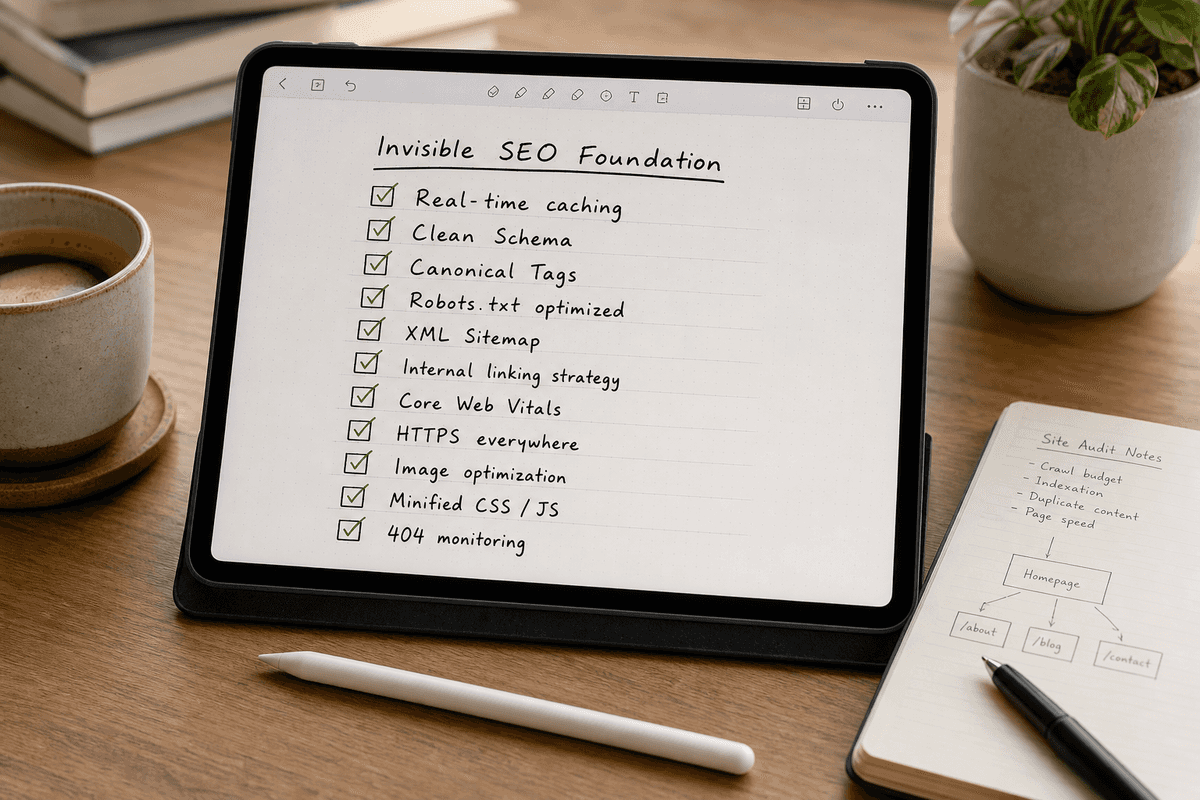
Second, you must demand impenetrable technical SEO from your infrastructure. Your website should generate clean code, proper structured data, and real-time caching without constant manual intervention. If you are constantly fixing broken canonical tags, your framework is failing.
Third, you must adopt an answer-first formatting standard. Content must be engineered simultaneously for traditional web crawlers and modern AI search engines like Perplexity and Claude.
By adopting these principles, SaaS operators can publish consistently without continuously increasing headcount or agency retainers.
Phase 1: The Invisible Technical Foundation
The foundation of any robust SEO framework is an emphasis on what you cannot see. Google and AI crawlers do not care how visually stunning your frontend design is if the underlying code is broken. You need an architecture that delivers results through sheer technical precision.
Automated Meta Optimization and Clean Code
Bloated legacy plugins often inject unnecessary scripts and advertising trackers directly into your site dashboard. A lean framework auto-configures your global settings based on modern search best practices. Your system should dynamically generate canonical URLs to prevent duplicate content issues. It should manage pagination limits automatically to preserve crawl budget. It should output clean, concise title tags without requiring you to fill out a redundant box for every single post.
Whether you use a minimalist plugin or a headless CMS setup, the goal is invisible efficiency. The software should read your content environment and generate the required markup invisibly in the background.
The Role of Application/LD+JSON Scripts
Structured data is strictly non-negotiable for SaaS companies in 2026. If you are wondering what application/ld+json scripts actually do, they act as a direct data translator for search engines. This specific JavaScript format feeds Google explicit, categorized details about your software product, your corporate entity, and your editorial content.
A proper framework handles this schema generation autonomously. When your platform publishes a new feature guide, the engine should immediately inject the correct Article or TechArticle schema. When you publish a product page, it should output SoftwareApplication schema. This distinct categorization helps AI search engines parse your exact value proposition without guessing.
Handling Single-Page Applications
Many modern SaaS products are built on JavaScript frameworks like React, Angular, or Vue. These single-page applications present highly unique crawling challenges. Traditional search engine bots often struggle to render JavaScript dynamically, which can result in completely blank pages being indexed.
Your SEO framework must account for dynamic rendering or static site generation methodologies. For a detailed breakdown of configuring these specific environments, review this guide on Single-Page Application SEO: What Works in 2026?. Maintaining a strict deployment protocol is critical. You must ensure your JavaScript environment actively serves fully rendered HTML to bots upon request.
Phase 2: Intelligent Automation and Gap Analysis
Once the invisible technical foundation is secure, the framework moves entirely to strategy. Manual keyword research is a relic of the past. SaaS founders do not have the time to export massive spreadsheets, cross-reference search volumes, and manually group keywords by user intent.
Autonomous Competitor Analysis
A high-velocity framework uses intelligent automation to find immediate ranking opportunities. Platforms like BeVisible autonomously analyze competitor domains every 24 hours. You simply input the URLs of your top three direct software competitors. The engine then identifies exact semantic topics where your competitors currently rank, but your site is entirely missing from the results.
This continuous gap analysis ensures your editorial calendar is constantly populated with high-intent, low-competition targets. You never have to guess what to write about next. The software dictates the strategy based on real-time SERP deficiencies.
Moving Past "Green Light" Scare Tactics
Legacy SEO tools trained an entire generation of content marketers to chase colored lights on a screen. Writers would unnaturally stuff a primary keyword into an introductory paragraph just to turn a red indicator dot green. These arbitrary scores are essentially scare tactics designed to keep users dependent on the plugin.
These gamified metrics do not correlate with actual ranking performance in 2026. A modern automated framework ignores arbitrary density scores. Instead, it relies on semantic relevance, comprehensive topical coverage, and the natural inclusion of related entities. If you write a comprehensive guide about automated billing software, the framework ensures you naturally cover topics like payment gateways, dunning management, and API webhooks, rather than just repeating the phrase "automated billing software" twelve times.
If you want to stay updated on how these semantic strategies are evolving, you can bookmark these 11 Best SEO Blogs Every SaaS Founder Needs (2026).
Phase 3: The Answer-First Content Architecture
Generative AI has fundamentally changed how users consume technical information. People no longer want to scroll through a lengthy personal anecdote or a generic history lesson to find a simple software configuration step.
Structuring for AI Search Engines
Your content pipeline must prioritize an answer-first structural framework. This means placing the most critical, direct answer at the very top of the page, or directly beneath a specific heading. Platforms like ChatGPT, Perplexity, and Claude prioritize and cite content that is concise, factual, and clearly formatted.
 If you are writing a guide on optimizing landing pages, you should immediately present the core methodology in the first two paragraphs. Do not bury the solution below three sections of generic context. You can see a structural example of this exact methodology in How to Build an SEO Landing Page (7-Step Guide).
The best automated frameworks enforce this fluff-free, crawler-friendly paragraph structure autonomously. They generate long-form drafts that prioritize numbered lists, clear comparison tables, and distinct H2 and H3 subheadings. This makes it effortless for both human readers to skim and AI bots to parse.
Phase 4: Continuous Distribution and CMS Sync
The single largest failure point in SaaS content marketing is the operational transition from a finalized draft to a published post. An incredible article sitting untouched in a Google Doc generates absolutely zero organic revenue.
End-to-End Publishing Hands-Free
A true SEO framework requires effortless distribution. Uploading a post manually requires copying text, reformatting headings, downloading and compressing images, writing alt text, configuring URL slugs, and fighting with CMS formatting quirks. This takes an average of 45 minutes per article.
Software like BeVisible resolves this exact operational bottleneck by pushing optimized, long-form drafts straight to your CMS. Whether your marketing site runs on WordPress, Webflow, Notion, or Ghost CMS, the synchronization should be immediate and autonomous. This zero-friction publishing model allows a small two-person team to easily maintain the output velocity of a massive corporate editorial department.
Evaluating Agency Rates vs. Automation
Founders often assume that building this kind of high-velocity framework requires hiring an expensive external agency. That assumption is financially dangerous in 2026. Software now capably handles the heavy lifting of gap analysis, outline structuring, drafting, and publishing. For a detailed breakdown of the massive financial differences, you can review the current data on SEO Charges UK: Agency Rates vs Automation (2026).
If you do decide to explore external consulting help, you must be extremely careful during the vetting process. Many legacy agencies still sell bloated, highly manual processes disguised as proprietary frameworks. Be sure to study Hiring SEO Services in Phoenix? 5 Red Flags (2026) to clearly understand the warning signs of outdated, labor-intensive agency methodologies.
A Case Study in Framework Migration: The Zero-Data-Loss Transition
Consider the real-world scenario of a mid-sized B2B logistics software company. They managed their company blog through a notoriously slow, plugin-heavy WordPress installation. Their lone marketing manager spent over 40 hours a month just manually formatting blog posts, updating legacy meta tags, and checking for broken links. Their organic traffic had completely plateaued because the manager had zero time left for actual strategy.
They made the decision to migrate to a fully automated framework. First, they audited their site and stripped out the heavy legacy SEO plugins. They replaced them with lean infrastructure focused purely on clean canonical generation and fast server-side caching.
Next, they connected BeVisible directly to their CMS. The platform immediately ran an autonomous gap analysis against their top three direct software competitors. Within a single week, the automated engine was autonomously generating and publishing highly relevant, answer-first content regarding logistics routing algorithms and supply chain compliance.
The marketing manager transitioned instantly from being a formatting bottleneck to an editorial director. They scaled their output from two posts a month to twenty posts a month, completely hands-free. Their organic demand curve steepened dramatically within ninety days.
The 30-Day Framework Implementation Roadmap
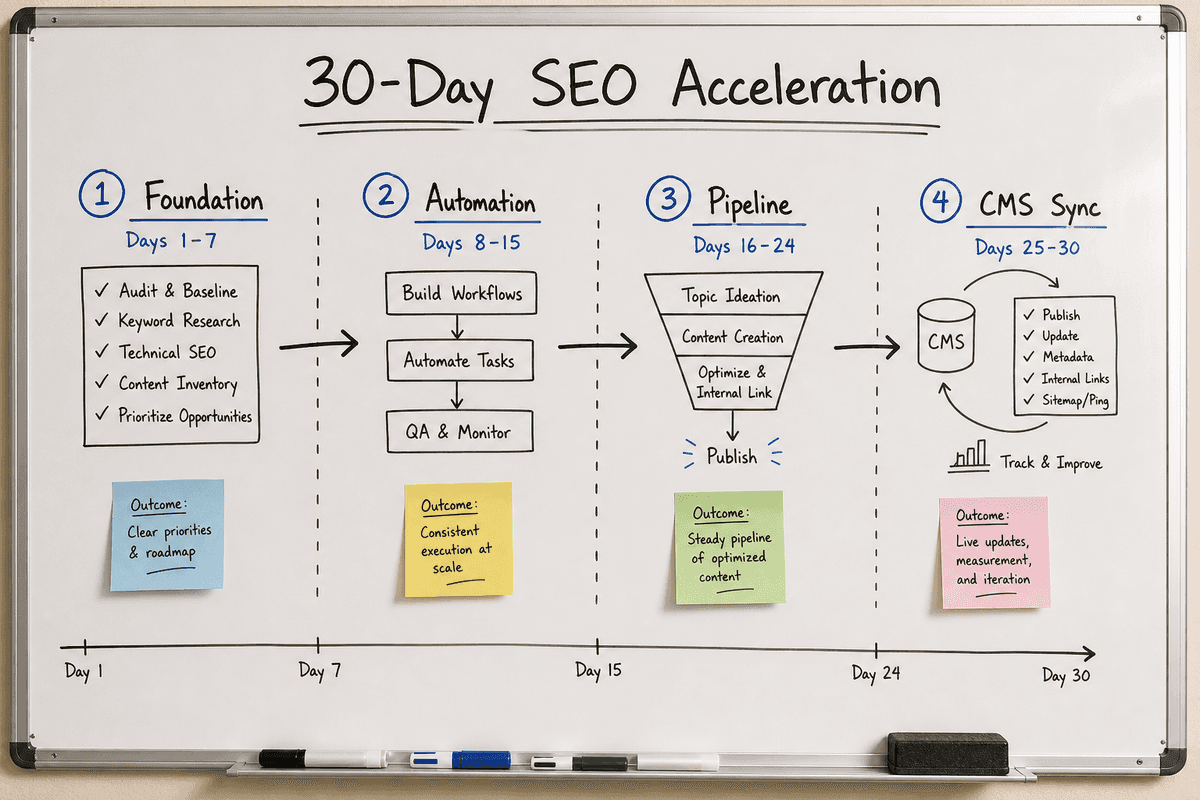
Getting started quickly is a core tenet of this methodology. You can completely transition your SaaS company to an automated SEO framework in exactly one month by following a strict operational roadmap.
Week 1: Clean the Technical Foundation
- Conduct a full audit of your current CMS environment.
- Ruthlessly remove bloated SEO plugins that rely on arbitrary keyword scores or inject heavy advertisements into your admin dashboard.
- Implement lean, invisible technical SEO focusing strictly on automated schema generation and flawless canonical tags.
Week 2: Define the Competitor Landscape
- Identify your top three direct software competitors based on actual product feature overlap.
- Input these specific domains into your automated gap analysis engine.
- Establish your target content clusters and allow the software to build the initial keyword roadmap autonomously.
Week 3: Dial in the Content Architecture
- Configure your brand voice, terminology, and instructional parameters within your automated blog engine.
- Ensure the output settings strictly enforce an answer-first, fluff-free format.
- Generate the very first batch of structured content outlines to review for topical accuracy.
Week 4: Activate Continuous Publishing
- Connect your AI generation platform directly to your WordPress, Webflow, Ghost, or Notion environment via native integrations.
- Publish the initial batch of content.
- Configure the engine to autonomously run new gap analyses and draft fresh posts every 24 hours without manual prompting.
Frequently Asked Questions About Modern SEO Frameworks
Why aren't focus keywords included in a modern automated setup?
Legacy software systems required you to manually input a single "focus keyword" to generate a density score. Modern search algorithms are entirely semantic. Google and AI search engines understand synonyms, entity relationships, and topical breadth. A modern framework focuses on covering the entire subject naturally through related entities rather than grading the repetitive use of a single isolated phrase.
The sitemap contains unwanted links. How does a framework fix this automatically?
A critically automated system dynamically manages your XML sitemap in real-time. It automatically excludes noindex pages, author archives, and thin taxonomy pages without requiring tedious manual configuration. This precise control ensures search engines only spend their valuable crawl budget on your highest-converting SaaS landing pages and comprehensive blog posts.
How does an automated framework handle content quality at scale?
An automated framework ensures quality by rigidly enforcing structure. It prevents writers or junior marketers from straying off-topic. By utilizing autonomous outlining based on active SERP data, the framework guarantees that every article directly addresses the exact questions users are currently asking. The resulting content is consistently highly structured, factual, and free of unnecessary introductory fluff.