
You’ve just hit early traction with your SaaS or e-commerce store, and organic search is finally on your radar as an acquisition channel. Naturally, you start looking for help. Within ten minutes, you’re staring at a pricing page from an agency offering a "Silver SEO Package" for $2,500 a month. It promises to optimize exactly 10 keywords, fix up to 15 meta tags, write two 800-word blog posts, and build three backlinks.
This is the exact moment where startups and indie hackers burn their runway.
In 2026, buying a task-based SEO package is like buying a car one bolt at a time. The deliverables are arbitrary, the volume is too low to move the needle against established competitors, and crucially, it treats search optimization as a manual checklist rather than a systemic growth engine. You don't need to pay an agency to spend six hours formatting a blog post in WordPress. You need a pipeline that captures demand and turns your website into a daily source of ranked answers.
Before you sign a six-month retainer or purchase a tiered bundle, you need to reframe how you evaluate organic search investments. Here is a breakdown of why traditional packages fail modern businesses, and the five ROI-focused features you should demand instead.
The Bronze-Silver-Gold Trap: Why Traditional Packages Fail SaaS
The standard SEO package model—usually divided into Bronze, Silver, and Gold tiers—was built for a different era of the internet. It was designed around billable hours and manual labor, limiting your growth to exactly what a junior account manager can accomplish in ten hours a month.
The Illusion of Deliverables
Most traditional packages sell you inputs, not outcomes. They package up technical audits, keyword tracking, and slight metadata tweaks. But tweaking the title tag on a page that has no topical authority will not suddenly drive hundreds of qualified sign-ups. When you read through the fine print of Hiring SEO Services in Phoenix? 5 Red Flags, you quickly realize that limits on "keywords tracked" or "pages optimized" are entirely artificial constraints designed to force you into a higher pricing tier.
The Output Bottleneck
The biggest failure mode of traditional packages is the publishing bottleneck. Content is the vehicle for organic traffic. Yet, standard agency packages routinely cap content creation at two to four posts per month. At that velocity, it takes an entire year to build a cluster of 30 articles. In a highly competitive SaaS niche, a 30-article cluster is often the baseline requirement just to be taken seriously by search algorithms.
The Integration Gap
Many SEO providers deliver their work in Google Docs and spreadsheets. They run a crawler, find errors, and hand you a PDF. They write an article, send a document, and wait for your feedback. This means the actual implementation—the formatting, the CMS upload, the schema markup, the internal linking—still falls on your shoulders or requires your developers' time. You are paying thousands of dollars a month just to create more work for yourself.
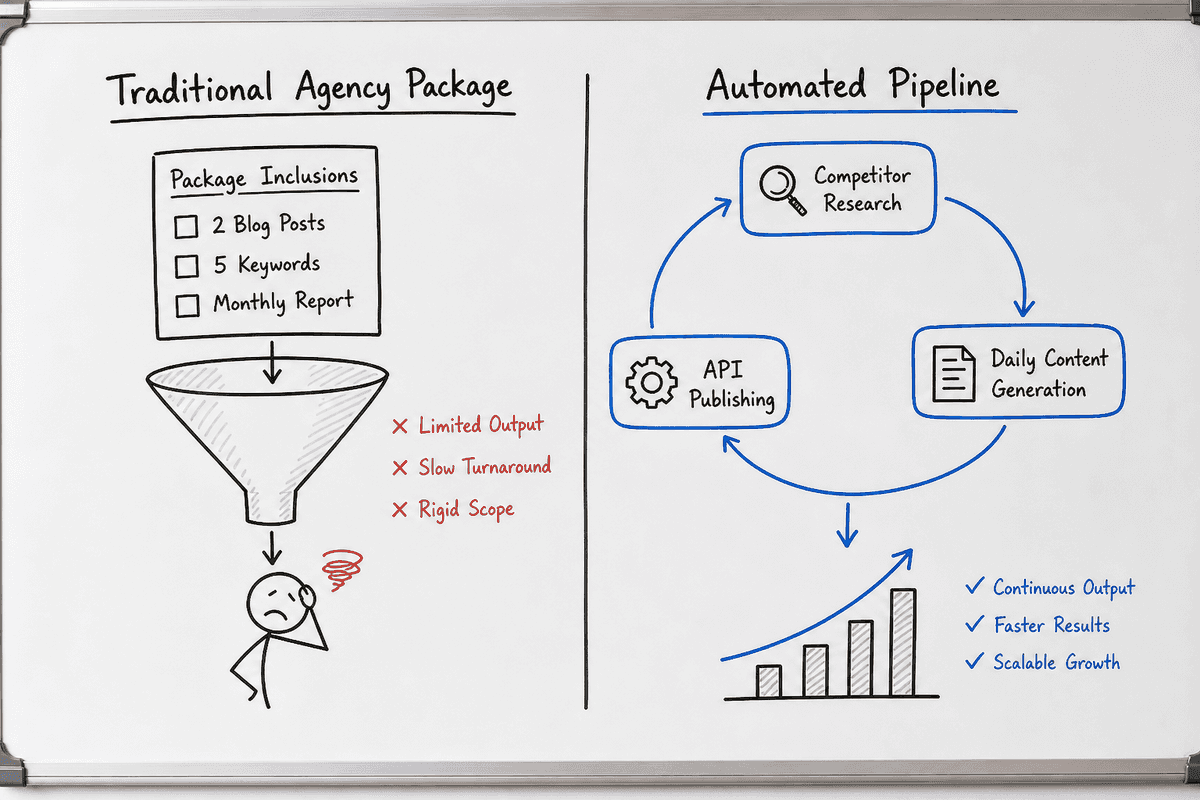
Feature 1: End-to-End Pipeline Autonomy (Zero-Management)
The highest-ROI feature of a modern SEO package is not a specific optimization tactic; it is the removal of the human bottleneck. You should not be buying a list of recommendations; you should be acquiring full pipeline autonomy.
What Autonomy Actually Looks Like
Partial execution is a hidden tax on your business. If an agency writes an article but leaves you to format it, source the featured image, add the meta description, and interlink it with your existing content, you have not actually outsourced your SEO. You have only outsourced the drafting phase.
An ROI-positive SEO solution handles the entire production pipeline automatically. It should be able to:
- Connect directly to your site URL and analyze your niche.
- Conduct competitor analysis to identify gaps.
- Build a cohesive 30-day content map.
- Write, polish, and optimize the content.
- Publish directly to your CMS without requiring a manual copy-paste.
When evaluating a provider or platform, look at their technical integrations. A capable system will connect via API to modern CMS platforms like WordPress, Webflow, Notion, Ghost, and Shopify. It will push the metadata, assign the correct tags and categories, and schedule the post.
Decision Criteria for Autonomy
- Do they deliver documents or live URLs? If the package results in a Google Doc, pass.
- Who handles the internal linking? A proper package automatically maps new articles to your existing content.
- Who sources the visual assets? The system should generate branded cover images automatically.
Feature 2: High-Velocity Publishing (Daily vs. Monthly)
There is a pervasive myth in content marketing that you must choose between quality and quantity. The argument is that writing one "masterpiece" a month is better than publishing frequently. In 2026, this is a false dichotomy. To capture market share, you need both high quality and high velocity.
The Math Behind Topical Authority
Search algorithms rank domains that demonstrate comprehensive expertise on a specific subject—known as topical authority. If you sell project management software, you need articles covering task delegation, sprint planning, remote team communication, Kanban methodology, and dozens of other subtopics.
If you buy a traditional package that delivers two articles a month, it will take you over a year to cover the basics. By the time you finish, your competitors have already mapped the entire topic. High velocity is an absolute requirement for aggressive organic growth.
The Daily Publishing Standard
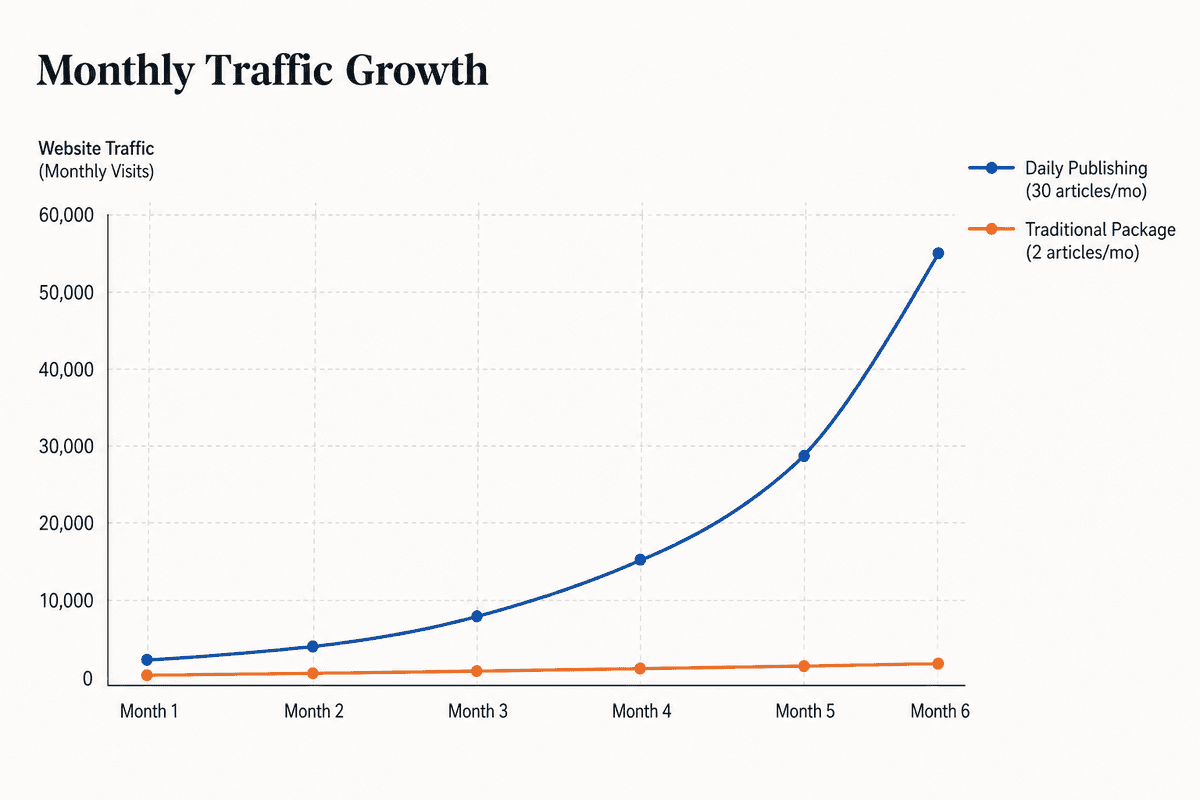
A modern SEO package should offer daily publishing. A platform like BeVisible operates on this exact premise: automatically writing, polishing, and publishing an article every 24 hours. This transforms your website into a compounding asset. Instead of waiting a year to see if your 24 articles gain traction, you drop 30 fully optimized, interlinked articles in a single month. This rapid injection of highly relevant, structured content forces search engines to crawl your site more frequently and recognize your topical depth much faster.
If an agency tells you that publishing 30 articles a month is "too fast" or "spammy," they are likely restricted by their own internal overhead, not by search engine guidelines. If the content answers the user's intent clearly and accurately, search engines want it as quickly as you can produce it.
Feature 3: AI-Search Native Structures (ChatGPT & Perplexity)
We are no longer optimizing solely for Google's ten blue links. A massive segment of your target audience—especially SaaS founders, developers, and marketers—are using AI search engines like ChatGPT, Perplexity, and Claude to find software solutions and operational guides.
An SEO package that only talks about "keyword density" and "backlinks" is functionally obsolete. The package must include AI-specific structural optimizations.
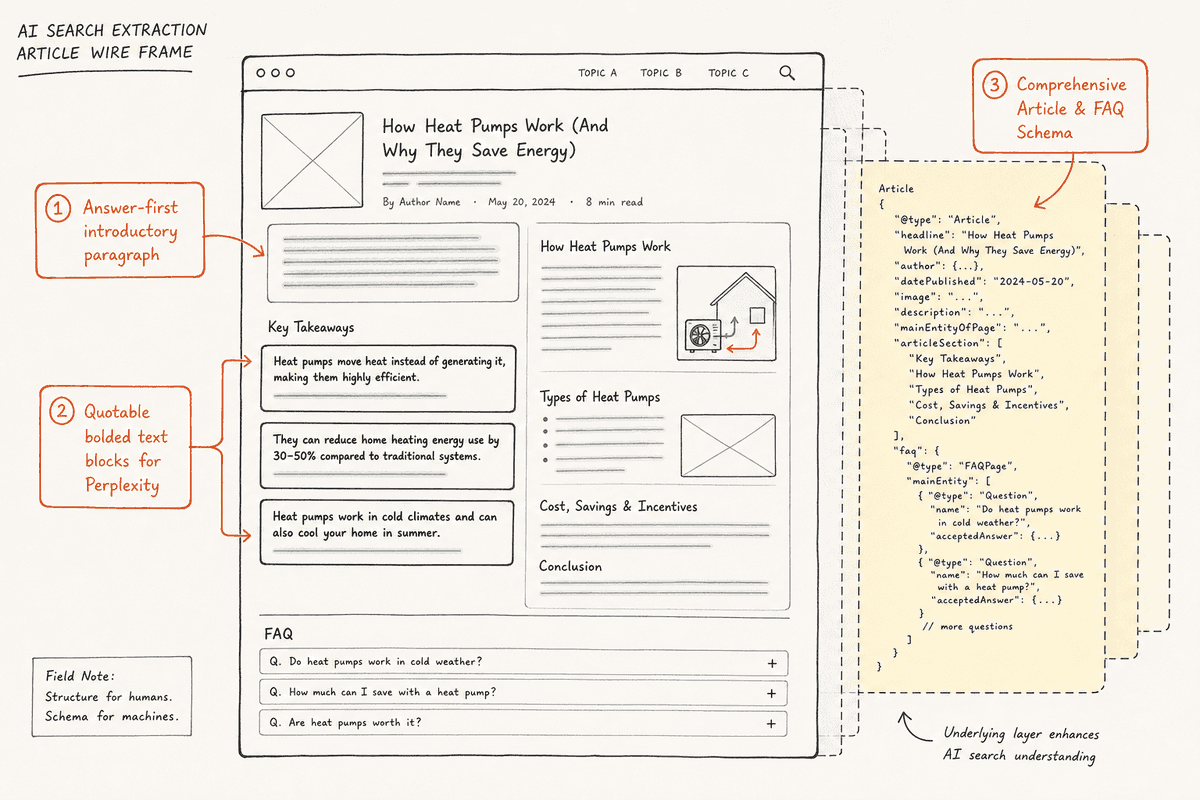
The Anatomy of an AI-Optimized Article
AI models do not read websites the way humans do. They parse semantic HTML, extract entities, and look for direct, definitive answers to surface in their chat interfaces. To capture this traffic, your content must be formatted for machine extraction.
- Answer-First Structures: The era of the 400-word rambling introduction is over. AI search engines want the direct answer immediately. If the query is "what is a headless CMS," the first paragraph under the H1 must define it concisely in under 50 words. The rest of the article can then expand on the nuance.
- Quotable Sections: LLMs look for high-information-density sentences to use as citations. An ROI-focused package will automatically identify and highlight key takeaways, formatting them as bolded standalone insights or blockquotes that are easy for Perplexity to scrape and cite.
- Comprehensive Schema Markup: Traditional packages might add basic Organization schema. Modern automation injects specific Article, FAQ, and HowTo schema into the page automatically. This structured data is the native language of search bots, explicitly telling them what the content is about without requiring them to guess based on text alone.
If your provider cannot explain their strategy for Perplexity visibility, they are selling you a legacy product.
Feature 4: Technical Agility for Modern Tech Stacks
The infrastructure of the web has changed. Many startups and indie hackers build their products as Single Page Applications (SPAs) using React, Angular, or Vue. While excellent for user experience, SPAs are notoriously difficult for search engines to render and index properly.
The Single Page Application Dilemma
Most traditional SEO packages are built for standard PHP-based WordPress sites. When an agency encounters a headless Webflow setup or a React-based SPA, their standard playbook breaks. They often recommend costly, months-long rebuilds or server-side rendering overhauls just to get a basic blog to index.
If you run an SPA, you need a solution that understands how to inject content and metadata so that crawlers can actually read it. Before you buy, review resources like SEO for Single Page Applications: The Technical Checklist to understand the rendering hurdles. Your SEO package provider must be able to deploy content via API into your specific tech stack seamlessly, ensuring that all metadata, canonical tags, and structured data render correctly on the first pass.
If you are a local brick-and-mortar business, standard agency setups might suffice—you can read about vetting those in guides like Top 7 Agencies for SEO in Durham—but if you run a modern SaaS, technical agility is non-negotiable.
Feature 5: Predictable, Flat-Rate Economics
The financial structure of traditional SEO is inherently hostile to early-stage businesses. Agencies rely on retainers, which means you pay a fixed, usually high, monthly fee regardless of the output. When costs scale with human hours, you end up paying for overhead, account management calls, and manual research rather than actual growth.
Retainers vs. Subscription Automation
When you examine global pricing models, as detailed in SEO Charges UK: Agency Rates vs Automation, the economic gap is staggering. A mid-tier agency might charge $2,000–$5,000.
This isn't just a cost-saving measure; it changes the unit economics of your marketing. When the cost of production drops to a flat, predictable software subscription, you can afford to target long-tail keywords that an agency would deem "too low volume" to justify their hourly rate.
Scaling Without Headcount
As your site grows, the complexity of managing it grows. You need landing pages for different features, use cases, and integrations. Understanding How to Build an SEO Landing Page (7-Step Guide) is great, but executing 50 of them manually is a nightmare. An automated package scales with your ambition, allowing you to generate and deploy dozens of pages without hiring a dedicated content manager or expanding an agency retainer.
Scenario: The $2,500 Agency Retainer vs. Platform Automation
To understand the practical difference, consider two indie hackers launching competing project management tools. They both decide to invest in SEO.
Founder A hires a traditional agency for $2,500/month.
- Month 1: The agency conducts a "discovery phase" and delivers a technical audit spreadsheet. Zero articles published.
- Month 2: The agency delivers two Google Docs. Founder A spends three hours uploading them, formatting them in WordPress, and searching for stock photos.
- Month 3: Two more articles are published. The agency sends a report showing that they tweaked 15 meta tags. Traffic remains flat.
- Total Cost: $7,500. Total Output: 4 articles.
Founder B uses an automated platform like BeVisible.
- Day 1: They connect their Webflow site via API, input their niche, and the platform generates a 30-day content map based on competitor analysis.
- Day 2 to 30: Every 24 hours, the platform automatically writes, polishes, and publishes a highly structured, answer-first article. It includes schema markup, internal links to their product pages, and a branded cover image. Founder B does not log into the CMS once.
- Month 2 and 3: The process repeats, compounding the site's topical authority.
- Total Cost: $79/mo). Total Output: 90 articles.
By Month 4, Founder B has built a massive footprint in the search results, capturing both traditional Google traffic and AI citations. Founder A is still waiting for their agency to send over the outline for article number five.
How to Evaluate Your Next SEO Investment
Transitioning from manual, agency-led SEO to an automated pipeline is a paradigm shift. If you are preparing to make an investment, use this checklist to interrogate the package you are buying:
- Is the output guaranteed? Refuse packages that sell "up to" a certain number of hours or deliverables. Demand a concrete publishing schedule.
- Does it require your labor? If you have to log into your CMS to upload their work, the package is incomplete.
- Is it optimized for AI? Ask the provider to show you how they structure content for Perplexity and ChatGPT. If they talk exclusively about backlinks and keyword density, walk away.
- Can it handle scale? A package that provides two articles a month will not help you catch up to competitors who have been publishing for five years.
- Are you learning? A good platform or provider is transparent. You should supplement your strategy by reading the 11 Best SEO Blogs Every SaaS Founder Needs to ensure you understand the engine you are building.
Frequently Asked Questions About SEO Packages
Are monthly SEO packages actually worth it?Task-based monthly packages from traditional agencies are rarely worth the investment for early-stage SaaS and e-commerce companies due to the low output volume and high cost. However, automated subscription packages that guarantee high-velocity, daily publishing are highly ROI-positive because they build topical authority rapidly at a fraction of the cost.
How long does it take to start seeing results with SEO?With a traditional package publishing two articles a month, it can take 6 to 12 months to see meaningful traction because it takes that long to cover a topic adequately. With automated daily publishing (30+ articles a month), you condense a year's worth of content creation into 30 days. Sites often begin seeing indexation and impression spikes within the first 6 to 8 weeks due to the rapid injection of relevant, structured data.
I have lots of links to my website. Why am I not ranking well?Backlinks act as an amplifier, but they cannot amplify a weak signal. If you have strong backlinks but thin, poorly structured, or infrequent content, search algorithms will not rank you for highly competitive queries. You need deep topical authority, which requires a high volume of comprehensive content that satisfies user intent.
What's the difference between local SEO and SaaS SEO packages?Local SEO focuses on proximity, Google Business Profiles, local citations, and geo-targeted keywords (e.g., "plumber in Austin"). SaaS SEO is usually global and heavily relies on massive informational content clusters, feature comparisons, and answering highly technical queries that developers or founders search for globally.
The days of buying arbitrary lists of optimizations are over. The most successful founders view SEO not as a consulting service, but as a software-driven publishing pipeline. By insisting on automation, high-velocity output, and AI-native structures, you can build a self-sustaining organic growth engine that outpaces competitors with a fraction of the budget.