
Most SaaS founders treat search engine optimization like a lottery ticket. They write a few blog posts about a new feature release, publish a generic "Ultimate Guide to [Industry]," and cross their fingers hoping Google will send them a flood of qualified leads. When the traffic doesn't arrive, they assume SEO simply doesn't work for their niche.
The reality is that organic growth doesn't come from random acts of content. It comes from a predictable, structured system. You need an SEO roadmap.
A SaaS SEO roadmap is more than just a list of target keywords. It is a comprehensive blueprint that bridges the gap between learning the fundamentals, securing your technical infrastructure, establishing a daily content production engine, and measuring the revenue impact. Whether you are a solo indie hacker forced to learn organic growth on the fly, or a marketing director trying to align your team, following a structured path is the only way to turn search engines into a reliable acquisition channel.
In this guide, we will walk through the exact 7 steps to build a SaaS SEO roadmap, taking you from beginner concepts to advanced execution.
Why Most SaaS Companies Fail at SEO
Before diving into the roadmap, it is critical to understand the common failure modes of SaaS organic strategy. Recognizing these pitfalls early will save you months of wasted effort.
- The Technical Blindspot: SaaS websites are frequently built using modern JavaScript frameworks (like React or Vue) to create seamless user experiences. However, these Single Page Applications (SPAs) are notoriously difficult for search engines to crawl if not configured correctly. You could write the best content in the world, but if Google's bots see a blank white screen, you will not rank.
- Inconsistent Publishing Velocity: The algorithm rewards domain freshness and topical authority. Publishing one high-quality article a month is no longer enough to compete with established brands or AI-powered competitors. Velocity matters.
- Top-of-Funnel Obsession: Startups often target massive, high-volume keywords (e.g., "project management software") out of the gate. These terms are highly competitive and convert poorly. A winning roadmap prioritizes low-volume, high-intent, bottom-of-funnel queries first.
With these traps in mind, let's build a roadmap that works.
Step 1: Understand Core Concepts and Build Strong Foundations
You cannot build an advanced organic acquisition engine without a firm grasp of the underlying mechanics of search. If you are learning on the job, your roadmap must begin with upskilling yourself or your foundational team.
SEO for software products is fundamentally different from other industries. For example, ecommerce SEO relies heavily on category pages, faceted navigation, and physical product reviews. SaaS SEO relies on feature landing pages, "alternative to" competitor comparisons, and deep educational content that solves user pain points.
Essential Concepts to Master
- Crawlability and Indexability: Understanding how search engines discover, render, and store your web pages.
- Search Intent Alignment: Recognizing whether a user searching a term wants to buy software (transactional), learn a concept (informational), or compare options (commercial investigation).
- Topical Authority: Realizing that Google ranks sites that exhaustively cover a specific niche, rather than sites that publish shallow content across many disparate topics.
 If you are looking for structured learning paths to build this foundation, there are excellent free resources available. Practitioners often recommend starting with a comprehensive curriculum like learningseo.io to understand core constructs and workflows. Additionally, exploring formal curriculums—like a Coursera roadmap—can help formalize your team's knowledge from beginner to expert.
Step 2: Audit Your Technical SaaS Infrastructure
Once the theoretical foundation is set, step two is strictly practical. You must ensure your software's website architecture allows search engines to read and categorize your content seamlessly.
As mentioned earlier, many SaaS platforms operate as Single Page Applications. When a user clicks a link in an SPA, the page doesn't actually reload; instead, JavaScript dynamically updates the content on the screen. While this creates a fast, app-like experience for humans, it can completely break your SEO roadmap before it even begins.
The SPA Technical SEO Checklist
To ensure your roadmap isn't derailed by technical debt, your engineering team needs to audit the following:
- Server-Side Rendering (SSR) or Static Site Generation (SSG): Search engine bots struggle to execute complex JavaScript. You must serve a fully rendered HTML version of your pages to the crawler. If you are struggling with this, refer to our SEO for Single Page Applications: The Technical Checklist.
- Dynamic Routing and Clean URLs: Ensure your application pushes clean URLs (e.g.,
yourdomain.com/features/automation) to the browser history, rather than using hash-based routing (yourdomain.com/#/automation). - Unique Metadata per View: Because the page doesn't reload, developers often forget to update the
<title>and<meta description>tags as the user navigates. These must update dynamically.
For a deeper dive into modern application architecture, our Single-Page Application SEO: What Works in 2026? guide provides a comprehensive overview of current best practices, and you can learn practical implementation tactics in Implementing SEO in Single Page Applications (3 Ways).
If your marketing site is decoupled from your actual web app (e.g., the marketing site is on WordPress or Webflow, and the app is on a subdomain like app.yoursite.com), you bypass many of these SPA issues. However, if they share an architecture, SEO for Single Page Applications: A 5-Step Guide (2026) is required reading.
Step 3: Practice with Interactive Tools and Define Your Keyword Strategy
A roadmap is useless without a destination. In step three, you will use SEO tools to map out exactly what your target customers are searching for, and organize those topics into a logical content architecture.
Must-Know SEO Tools and Frameworks
There are hundreds of tools on the market, ranging from enterprise suites to niche-specific scrapers (like the various 7 Best Etsy SEO Tools to Boost Sales in 2026 designed solely for marketplace sellers). For a SaaS company, you generally need three types of interactive tools:
- Keyword Research & Competitor Analysis: Tools like Ahrefs, Semrush, or BeVisible's built-in niche analysis engine to discover search volumes and competitor gaps.
- Technical Crawlers: Tools like Screaming Frog or Sitebulb to emulate Google's bots and catch technical errors.
- Analytics: Google Search Console (non-negotiable) and your product analytics (Amplitude, Mixpanel, or Google Analytics 4) to track conversions.
Mapping the Buyer's Journey
Do not start by targeting the biggest keywords in your industry. Instead, map your keywords to the three stages of the SaaS funnel:
Your roadmap should dictate that you build your BOFU content first. It takes less traffic to generate a paying SaaS customer from a "Competitor Alternative" page than it does from a generic glossary definition.
Step 4: Choose Your Execution Model
Once you have your technical foundation and your keyword map, you hit the most common roadblock: Production capacity.
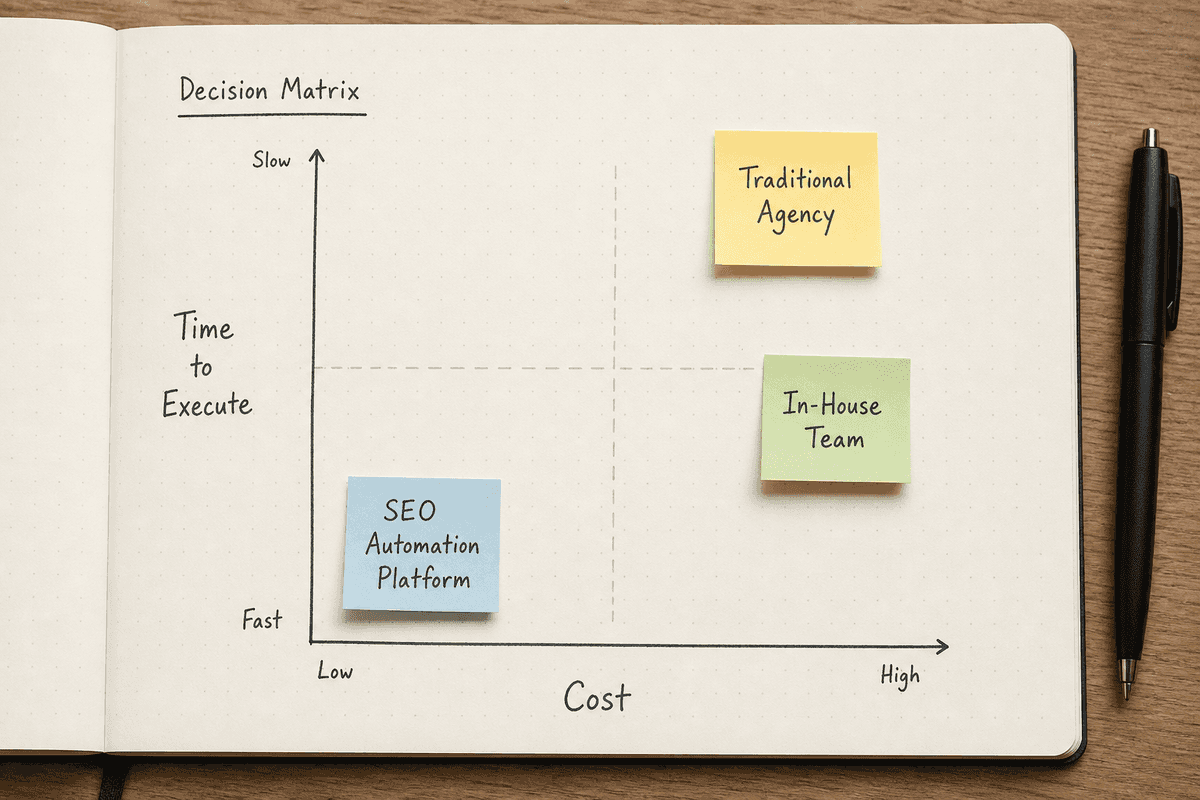
Creating high-quality, technically optimized content consistently is resource-intensive. According to discussions among practitioners on Reddit, maintaining the discipline of daily practice and consistent publishing is where most roadmaps fail. You have three primary paths to execute your content map.
Option A: The Traditional Agency Route
Hiring an agency offloads the work, but it comes with a steep price tag and varying degrees of quality. If you are exploring regional agencies, you might look at lists like the Top 7 Agencies for SEO in Durham (Ranked 2026). However, SaaS founders must be cautious.
Agencies often charge thousands of dollars a month for just 4 to 8 articles. Furthermore, you must heavily vet their processes to ensure they aren't using outdated tactics. If you are currently evaluating partners, review our guide on Hiring SEO Services in Phoenix? 5 Red Flags (2026) to know what warning signs to look for. You should also benchmark their pricing against national and international averages, such as SEO Charges UK: Agency Rates vs Automation (2026).
Option B: The In-House Team
Building an in-house team gives you total control over the brand voice. A dedicated Content SEO Strategist can interview your product team and write deeply nuanced articles. The downside is the overhead. Hiring a full-time SEO manager, a writer, and an editor will easily cost over $150,000 annually, not including software subscriptions. For early-stage startups and indie hackers, this is rarely viable.
Option C: The Automation Platform
In 2026, the landscape has shifted toward end-to-end automation platforms designed specifically for organic growth. For example, BeVisible transforms your website into a daily source of ranked answers for both traditional Google search and AI engines like ChatGPT and Perplexity.
Instead of managing a team of writers, an automation platform connects directly to your site URL, conducts the niche analysis, builds a 30-day content map, and automatically writes, polishes, and publishes an article every 24 hours. The articles feature answer-first structures, schema markup, automatic internal links, and branded cover images.
For SaaS founders operating lean, a professional automation plan (which often provides 30 fully optimized articles a month for a fraction of an agency's cost) provides the sheer velocity needed to build topical authority without the management overhead.
Step 5: Develop Independent Projects and Sprints
If you decide to execute your roadmap in-house, or if you are managing the strategy while an automation tool handles the writing, you must organize the work into manageable, independent projects or "sprints."
A 90-day sprint is the ideal timeframe for a SaaS SEO roadmap. It is long enough to see early indexing and impression data, but short enough to pivot if your strategy isn't aligning with your product goals.
The First 90-Day Sprint Schedule
- Days 1-15: The Audit and Setup. Resolve all SPA technical issues, configure Google Search Console, and connect your CMS (WordPress, Webflow, Ghost, etc.) to your automation tools via API.
- Days 16-30: The BOFU Build-Out. Map out your bottom-of-funnel keywords. Create dedicated landing pages for every major feature your SaaS offers, and build "Alternative to [Competitor]" pages for your top three rivals.
- Days 31-60: The Daily Content Engine. Begin executing your middle-of-funnel keyword strategy. This is where velocity is crucial. Aim to publish new, highly relevant articles daily. Ensure each article contains strong internal links back to your BOFU landing pages.
- Days 61-90: The Review and Refresh. Audit your early data. Which clusters are gaining impressions? Double down on those topics. If certain pages are ranking on page two of Google, manually update them with more actionable examples, proprietary data, or new schema markup to push them to page one.
 For inspiration on how top companies structure their content projects, studying successful industry publications is highly recommended. Check out the 11 Best SEO Blogs Every SaaS Founder Needs (2026) to see how market leaders run their content sprints.
Step 6: Build and Showcase a Strong Portfolio (Distribution and Links)
Creating great content on a technically sound website is only half the battle. To rank for competitive SaaS keywords, search engines need to trust your domain. Trust is built through backlinks—when other reputable websites link to yours.
For an individual learning SEO, "building a portfolio" means showcasing your personal success stories to get hired. For a SaaS business, building a portfolio means developing a robust profile of high-quality referring domains.
Tactical Distribution for SaaS
- Digital PR and Data Studies: Journalists are always looking for data. If your SaaS software processes unique industry data, aggregate it (anonymously) and publish original research reports. Reach out to industry newsletters and publications to share your findings. These naturally attract high-authority backlinks.
- Tool and Template Giveaways: Create free, lightweight versions of your software or downloadable templates (e.g., "Free Excel Project Management Template" if you sell PM software). Free tools are heavily linked to by resource pages.
- Community Engagement: Participate authentically in industry communities. Answer questions on Reddit, Quora, and niche Slack groups. While these links are often "nofollow" (meaning they don't pass direct SEO juice), they drive highly qualified referral traffic and brand awareness, which indirectly supports your organic growth.
Ensure that every major asset you build has a clear internal link pointing directly to your core product landing pages.
Step 7: Measure, Report, and Specialize
The final step in your roadmap is establishing a rigorous analytics routine. Without accurate reporting, you cannot iterate.
At a minimum, you should be tracking:
- Non-Branded Organic Impressions: Are more people seeing your site for generic industry terms? (Tracked in Google Search Console).
- Click-Through Rate (CTR): Are your meta titles and descriptions compelling enough to earn the click?
- Sign-ups from Organic Search: Use UTM parameters and your product analytics to track which blog posts actually result in free trials or booked demos.
For a deeper understanding of how to structure your reporting, you can explore external frameworks like the free strategy templates offered by SEOClarity, which help formalize your reporting cadences.
Expanding into SEO Specializations
As your SaaS scales, your roadmap will naturally evolve from generalist tactics to deep specializations. You may eventually need to explore:
- International SEO: Localizing your software and content into Spanish, German, or French using
hreflangtags to capture global markets. - Programmatic SEO: Using databases to automatically generate thousands of location-specific or integration-specific landing pages at scale.
- Technical SEO Specialists: Dedicating resources purely to optimizing Core Web Vitals, server response times, and complex log file analysis as your site grows into the tens of thousands of pages.
By following this 7-step roadmap, you transition your SaaS company from hoping for organic traffic to engineering it systematically.
Frequently Asked Questions
How do I choose which SEO tools to learn first?
Start with the foundation: Google Search Console (GSC). It is free, provides exact data directly from Google, and is essential for understanding your technical health and baseline performance. Once you master GSC, invest in one premium all-in-one suite (like Ahrefs or Semrush) for keyword research and competitor analysis, or leverage an end-to-end automation platform that handles the tooling for you.
Do I need coding experience for SEO?
No, you do not need to be a software engineer to succeed at SEO. However, for a SaaS founder, having a basic understanding of HTML, CSS, and how JavaScript frameworks operate is highly beneficial. It allows you to communicate effectively with your development team regarding technical requirements, meta tags, and site architecture.
How can I practice SEO if I don’t have a website?
You cannot truly learn SEO in a vacuum. If you do not have a SaaS product yet, start a free blog on WordPress or Ghost. Write about a hobby or niche interest, practice doing keyword research, optimize the pages, and watch how search engines react over 3 to 6 months. Practical, hands-on experimentation is the fastest way to learn.
Can I showcase SEO skills without formal job experience?
Yes. In the world of organic search, results speak louder than a resume. If you can build a personal website from zero to 10,000 organic visitors a month, that serves as a stronger portfolio than years of theoretical job experience. Document your strategies, your failures, and your traffic graphs, and present them as case studies.
What’s the best way to stay updated on SEO trends?
The search landscape changes rapidly, especially with the integration of AI search engines. To stay current, follow reputable industry blogs, participate in active community forums, and consistently test new theories on your own website rather than relying solely on secondhand advice.