
You have a beautifully designed SaaS website. Your product solves a genuine problem. Your team has spent weeks refining the messaging to sound professional, clever, and brand-aligned. Yet, when you look at Google Search Console, your organic traffic is a flatline.
Alternatively, maybe you do have traffic. You hired an agency to pump out optimized content, and now your site ranks for decent keywords. The problem? The copy reads like a robot wrote it. It’s stuffed with awkward keyword phrases, lacks your brand’s voice, and worst of all, it isn't converting visitors into trial users.
This is the classic divide in digital marketing. Writers who understand human psychology often ignore search algorithms, and technical SEOs who understand algorithms often ignore human psychology.
An SEO website copywriter exists to bridge this exact gap.
In 2026, where AI search engines like ChatGPT and Perplexity are changing how users find information, and traditional Google real estate is dominated by featured snippets, the role of an SEO copywriter has never been more critical. They don't just “sprinkle keywords” into existing text. They engineer content from the ground up to satisfy search intent, rank at the top of results, and persuade the reader to take action.
Whether you are a SaaS founder trying to bootstrap your organic growth or a marketing director auditing your current content strategy, understanding what an SEO website copywriter does—and how to deploy one effectively—is foundational to building a scalable acquisition channel.
What Does an SEO Website Copywriter Actually Do?
If you search online for explanations of this role, you’ll find plenty of confusion. As one user noted in a popular Reddit thread on digital marketing, the line between SEO writing, content writing, and copywriting is often blurred by marketers themselves.
To be precise: An SEO website copywriter writes text that is explicitly designed to rank in search engine results pages (SERPs) while simultaneously driving a specific conversion metric (like a newsletter signup, a software demo, or a direct sale).
Their day-to-day responsibilities go far beyond writing paragraphs. A professional SEO copywriter handles:
- Search Intent Analysis: Before writing a single word, they analyze the top-ranking pages for a target keyword to understand exactly what the user is trying to achieve. Are they looking for a definition (informational)? Are they comparing software tools (commercial)? Are they ready to buy (transactional)?
- Structural Outlining: They build an architecture for the page. This involves strategic use of H1, H2, and H3 tags, optimizing for "People Also Ask" questions, and formatting text into lists or tables to capture featured snippets.
- Entity Optimization: Modern SEO isn't about keyword density; it's about entities. A copywriter ensures the text naturally includes the semantically related concepts Google expects to see for a given topic.
- Conversion Rate Optimization (CRO): They weave persuasive elements, clear value propositions, and compelling calls-to-action (CTAs) into the text without disrupting the educational flow of the article.
- Technical Formatting: They write meta titles, meta descriptions, alt text for images, and often structure the content so it pairs seamlessly with schema markup.
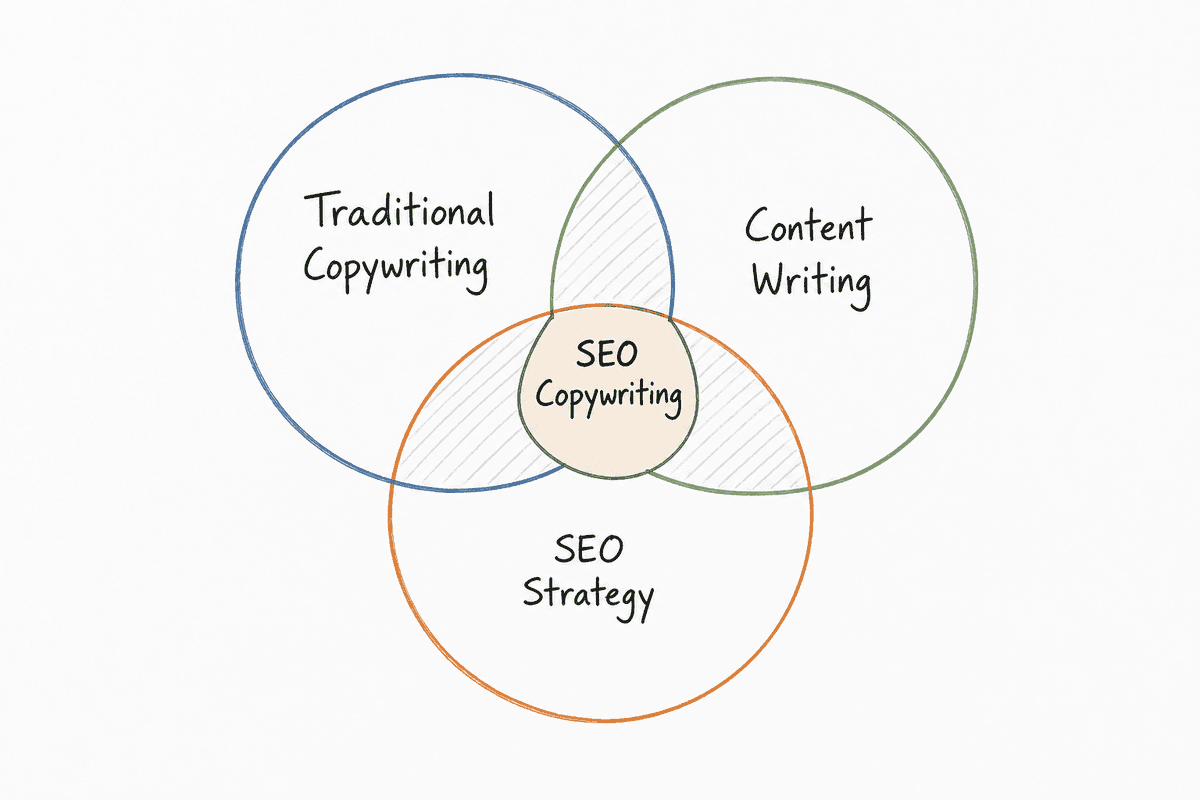
SEO Copywriting vs. Regular Copywriting vs. Content Writing
To fully grasp the value of an SEO copywriter, it helps to isolate the discipline from its closest relatives. While a single person might possess all three skill sets, the goals and constraints of each discipline are entirely different.
Traditional Copywriting
Traditional copywriting is purely about persuasion and direct response. Think of a Facebook ad, a sales email, or a billboard. The copywriter doesn't care about search engines because the traffic is being driven via paid channels or direct distribution.
- Primary Goal: Conversions, sales, clicks.
- Constraints: Character limits, attention spans, brand voice.
- Success Metric: Cost Per Acquisition (CPA), Click-Through Rate (CTR).
Content Writing
Content writing focuses on education, brand building, and engagement. Think of an opinion piece, a founders' story, or a social media thought leadership post. It exists to nurture an audience that is already aware of the brand.
- Primary Goal: Engagement, trust, authority.
- Constraints: Originality, narrative flow, industry expertise.
- Success Metric: Time on page, social shares, return visits.
SEO Copywriting
SEO copywriting is the intersection of the two, heavily layered with algorithmic strategy. It requires educating the reader (content writing), persuading them to act (copywriting), and structuring the data for machines (SEO).
- Primary Goal: Organic rankings and conversions.
- Constraints: Search intent, competitor word counts, entity inclusion, technical rendering constraints (especially if you are dealing with Single-Page Application SEO: What Works in 2026?).
- Success Metric: Organic traffic growth, keyword ranking positions, organic conversion rate.
As Boardfy notes in their breakdown of copywriting intricacies, integrating SEO strategy directly into the copywriting process is what allows organic traffic to translate into measurable business value, rather than just vanity metrics.
Why SaaS Brands Need Specialized SEO Copywriting
For B2B SaaS companies, indie hackers, and software startups, organic search is often the holy grail of acquisition. Paid advertising (PPC) is notoriously expensive in software niches, with Cost Per Click (CPC) for terms like "project management software" or "cloud ERP" regularly exceeding $20 to $50.
Building a moat of organic content is the only way to sustainably lower Customer Acquisition Cost (CAC) over time. But SaaS SEO presents unique challenges that require a specialized approach to copywriting.
The Dual Audience Problem
SaaS copywriters must write for two completely different audiences simultaneously. First, they must write for the algorithm (Google, Bing, ChatGPT) so the page is actually discovered. Second, they must write for a sophisticated human buyer—often a skeptical developer, a busy founder, or a cautious enterprise procurement manager.
If the copy leans too heavily toward SEO, the human buyer bounces immediately because the text feels amateurish. If the copy leans too heavily toward high-level brand messaging, the search engine can't parse what the page is actually about, and it never ranks.
Complex Buying Journeys
SaaS purchases are rarely impulse buys. The SEO copywriter must understand where a specific piece of content fits within the marketing funnel:
- Top of Funnel (ToFu): "What is workflow automation?"
- Middle of Funnel (MoFu): "Best workflow automation tools for agencies"
- Bottom of Funnel (BoFu): "Zapier vs Make comparison"
A specialized SEO copywriter adjusts the tone, depth, and CTA based on the exact intent behind the query.
For more insight into how top software companies manage these funnels, you can review the strategies discussed in the 11 Best SEO Blogs Every SaaS Founder Needs (2026).
The 6-Step SEO Website Copywriting Framework for 2026
Great SEO copywriting isn't about staring at a blank page waiting for inspiration. It is a highly repeatable, analytical process. According to leading practitioners like Jacob McMillen, treating SEO copywriting as a structured framework is the only way to consistently hit #1 rankings.
Here is the exact workflow a professional SEO website copywriter uses to build pages that rank and convert.
Step 1: Analyze Search Intent and Existing Rankings
The foundation of any SEO piece is understanding why the user typed a phrase into the search bar. The copywriter begins by searching the target keyword and analyzing the top 5 ranking pages.
They look for patterns:
- Format: Are the top results listicles, ultimate guides, or landing pages?
- Angle: Are they aimed at beginners or advanced users? Are they focused on saving money, saving time, or reducing risk?
- Freshness: Are the top results newly updated, or are they stale articles from three years ago?
If the search engine has decided that users searching for "best CRM for real estate" want a listicle comparing features and pricing, writing a 5,000-word philosophical essay on the history of real estate sales will not rank, no matter how beautifully it is written. The copywriter must match the format the algorithm is rewarding.
Step 2: Identify Content Gaps and Build a Better Resource
Once the baseline intent is understood, the copywriter looks for weaknesses in the competition.
Perhaps the top-ranking articles are long and thorough, but they lack practical examples. Maybe they provide pricing, but they don't explain the hidden fees. Maybe they are walls of text without any visual diagrams.
The goal is not just to match the competitors, but to build what SEOs call "10x content"—a resource so vastly superior that it naturally attracts links and engagement.
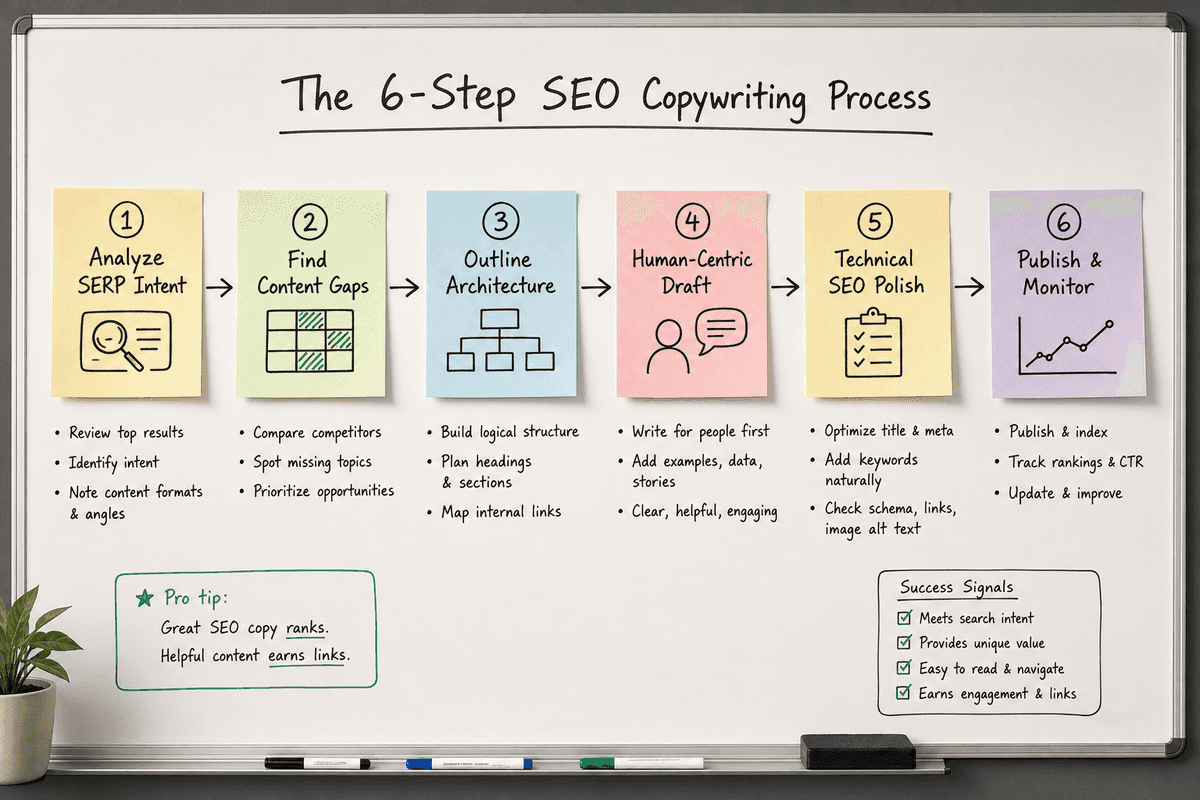
Step 3: Outline the Architecture (The "Answer-First" Structure)
Modern SEO copywriting relies heavily on an "Answer-First" structure. Because Google rewards featured snippets, and AI engines like Perplexity extract direct answers, the copywriter structures the page to deliver the most important information immediately.
Instead of starting an article with five paragraphs of filler about "In today's fast-paced digital world...", an SEO copywriter places a direct, bolded answer to the primary query in the very first section.
They then map out the H2s and H3s based on related keywords and questions scraped from Google's "People Also Ask" boxes.
Step 4: Write the Human-Centric Draft
With the architecture in place, the copywriter fills in the content. This is where traditional copywriting skills shine. They use:
- Short, punchy paragraphs: To keep mobile readers engaged.
- Active voice: To make the writing authoritative and energetic.
- Specific examples: Trading vague claims ("our software makes you faster") for concrete numbers ("our software reduces reporting time by 4 hours per week").
- Strategic formatting: Using bolding, bullet points, and blockquotes to make the text scannable for busy readers.
Step 5: Apply On-Page Technical SEO
Once the human draft is complete, the copywriter puts their SEO hat back on. They review the text to ensure:
- The exact target keyword appears in the H1, the first 100 words, and at least one H2.
- Secondary keywords and semantic entities are naturally woven into the text.
- Internal links are added pointing to other relevant pages on the website (passing link equity and keeping users on the site).
- External citations are linked to high-authority, trustworthy sources.
- The meta title and meta description are written to maximize Click-Through Rate (CTR) from the search results.
This step is particularly crucial if you are writing copy for JavaScript-heavy applications, where rendering issues can hide text from search engine bots. A technical SEO copywriter will understand these limitations. For a deeper dive into this specific challenge, review the SEO for Single Page Applications: The Technical Checklist.
Step 6: Publish, Monitor, and Iterate
An SEO copywriter's job doesn't end when they hit publish. They monitor how the page performs in Google Search Console over the next 3 to 6 months.
If the page ranks well for the target keyword but has a high bounce rate, the introduction might need to be rewritten. If the page is ranking on page 2, it might need more comprehensive H2 sections or better internal linking. SEO copywriting is an iterative process of continuous optimization.
Types of SEO Copywriting
The broad title of "SEO Website Copywriter" encompasses several distinct types of writing. Depending on your business model, you may need a specialist in one of the following areas.
1. SEO Landing Page Copywriting
Landing pages require a highly specialized blend of SEO and direct-response copywriting. These pages target high-intent, commercial queries (e.g., "inventory management software for Shopify").
The copywriter must balance technical on-page SEO with aggressive Conversion Rate Optimization. The page needs enough text to satisfy Google's desire for context, but the text cannot bury the pricing plans, feature matrices, or the "Start Free Trial" button. If you are struggling with this balance, the methodology in How to Build an SEO Landing Page (7-Step Guide) provides a technical blueprint.
2. B2B SaaS Blog Copywriting
This is long-form, educational content designed to capture informational and comparative search intent. The copywriter writes ultimate guides, "How-To" articles, and "Alternative to X" competitor teardowns.
B2B SaaS blog copywriting requires a deep understanding of the industry's jargon, pain points, and specific buyer personas. A copywriter who writes excellently about consumer fitness will likely fail at writing an authoritative guide on Kubernetes deployment.
3. eCommerce Product Page Copywriting
For eCommerce brands, SEO copywriters optimize category pages and individual product descriptions. They focus heavily on targeting long-tail, transactional keywords (e.g., "men's waterproof hiking boots size 11") and writing persuasive product descriptions that overcome buyer objections.
4. Local SEO Copywriting
Service businesses and agencies rely on local SEO copywriters to optimize pages for geographic modifiers (e.g., "plumber in Austin" or "SEO agency London"). This involves creating location-specific landing pages and ensuring local citations are consistent throughout the copy.
How Much Does an SEO Copywriter Cost?
If you've realized your SaaS needs an SEO copywriter, the next logical question is budgeting. The market for SEO writing is vast, and pricing varies wildly based on experience, niche expertise, and the operational model you choose.
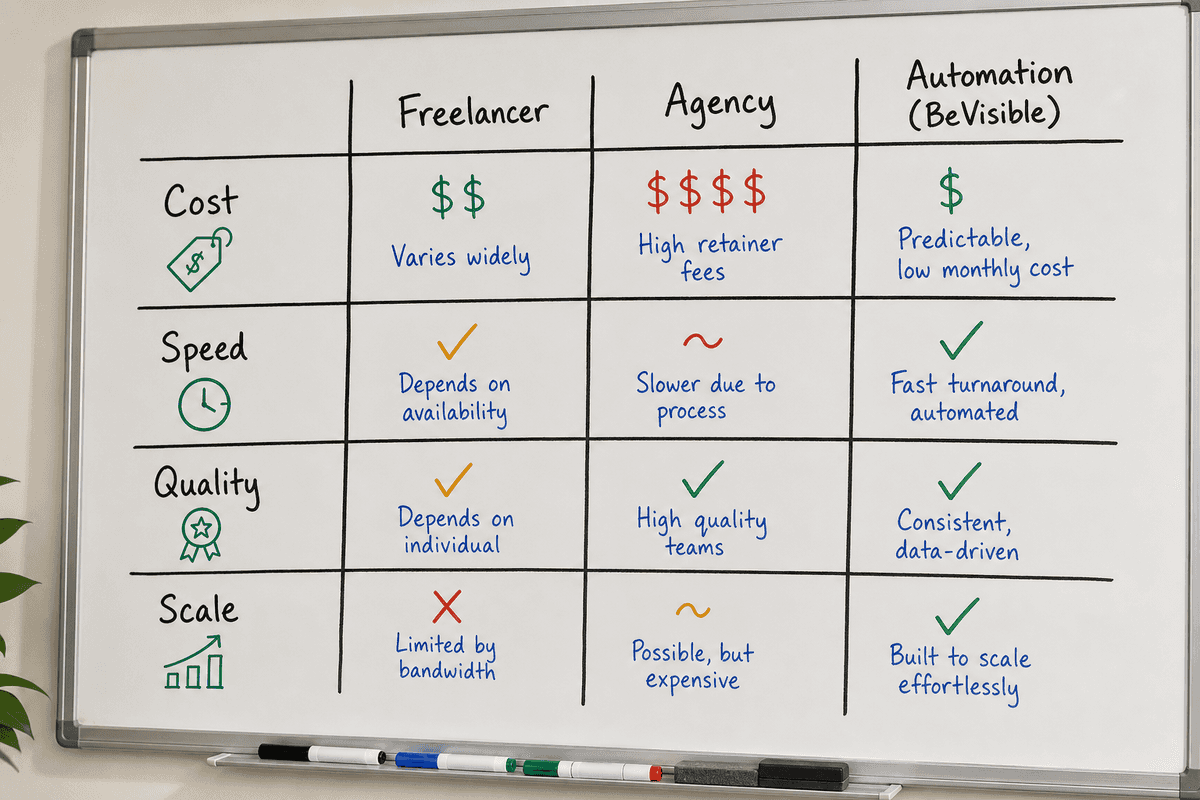
As outlined in SEO Charges UK: Agency Rates vs Automation (2026), you generally have three paths to acquiring SEO copy.
Path 1: Freelance SEO Copywriters
Hiring a freelancer provides flexibility. According to freelance SEO copywriter Tyler Tafelsky, a competent independent writer will handle keyword research, outlining, and drafting on a per-project basis.
- Cost: Quality freelance SEO copywriters specializing in B2B SaaS typically charge between $300 to $1,000+ per article, or $50 to $150+ per hour.
- Pros: High quality, specialized expertise, direct communication.
- Cons: Expensive at scale, you still have to manage them, and you are responsible for publishing and tracking the content.
Path 2: SEO and Content Agencies
Agencies provide a done-for-you service. They provide the strategists, the writers, and the editors.
- Cost: Monthly retainers typically range from $3,000 to $10,000+, depending on the volume of content.
- Pros: Hands-off, comprehensive strategy, multi-disciplinary teams.
- Cons: High barrier to entry for early-stage startups, slow turnaround times, and varying quality depending on which junior writer is assigned to your account.
Path 3: Automated SEO Content Platforms
For SaaS founders, indie hackers, and content marketers seeking aggressive organic growth without the budget for large teams or premium freelancers, specialized automation platforms are the modern solution.
Platforms like BeVisible represent a paradigm shift in how SEO copy is produced. Instead of hiring a writer to manually research keywords, analyze SERPs, write drafts, format schema, and publish via WordPress, BeVisible automates the entire end-to-end pipeline.
- Cost: The BeVisible Professional plan offers 30 fully optimized articles per month for $79 (launch discount).
- How it Works: The platform connects directly to your site URL and niche. It conducts competitor analysis and keyword research to build a 30-day content map. Every 24 hours, it automatically writes, polishes, and publishes a deeply researched article featuring answer-first structures, quotable sections, schema markup, internal links, and branded cover images.
- Pros: Daily publishing consistency, massive cost savings, built-in optimization for both traditional Google algorithms and AI search engines.
- Cons: Less manual oversight per article compared to an in-house hire, though platforms like BeVisible offer unlimited revisions.
How to Find and Hire a Good SEO Copywriter
If you decide to go the manual route and hire an in-house employee or a freelancer, the vetting process is critical. The SEO industry is rife with writers who claim to be experts but only deliver thin, AI-spun garbage that harms your domain authority.
When evaluating a candidate's portfolio, look for these specific green flags:
- They ask about your business goals, not just your keywords. A professional copywriter wants to know who your customer is, what their pain points are, and what action you want them to take after reading the page.
- They provide live URLs, not just Google Docs. Anyone can write a pleasant-sounding draft. You want to see pages that are currently live on the internet and ranking in the top 5 for competitive terms.
- They understand technical constraints. Ask them how they handle internal linking strategies or how they format headers for featured snippets.
Conversely, be extremely wary of copywriters who promise guaranteed #1 rankings overnight, or who talk extensively about "keyword density" (a metric that has been obsolete for a decade). For a deeper look at what to avoid, check out Hiring SEO Services in Phoenix? 5 Red Flags (2026).
Essential Skills Every Modern SEO Copywriter Needs
According to the job aggregator Indeed's breakdown of SEO copywriter duties, the role requires a unique hybrid skill set. If you are looking to become an SEO copywriter yourself, or trying to train a junior team member, these are the core competencies to develop:
- Research & Analytical Skills: The ability to dissect a SERP, use tools like Ahrefs or Semrush, and find content gaps.
- Empathy and Buyer Psychology: Understanding what motivates a reader to trust a brand and ultimately make a purchase.
- Adaptability to AI: The modern copywriter must know how to use AI tools for outlining and research without letting AI dictate the final voice and tone of the piece.
- Formatting Expertise: Knowing how to use white space, bulleted lists, and HTML structure to make content digestible.
- Basic Data Analysis: The ability to read Google Analytics and Google Search Console to determine if published content is actually performing.
The Shift: Is SEO Copywriting Still Important with AI?
This is the most common question founders ask in 2026. If ChatGPT can write a 2,000-word article in 30 seconds, do I still need SEO copywriting?
The answer is an emphatic yes, but the definition of the work has changed entirely.
AI language models are incredible predictive text engines. They are phenomenal at synthesizing information. However, they lack strategic intent. Out-of-the-box AI doesn't know your brand's unique value proposition. It doesn't inherently understand how to structure a landing page to capture a specific featured snippet, nor does it know how to weave a persuasive narrative that drives a SaaS signup.
The role of the SEO website copywriter has evolved from "typist" to "strategic editor and architect."
Whether that architect is a senior human freelancer charging $1,000 a post, or an advanced end-to-end automation platform like BeVisible that explicitly engineers content for both Google and AI search engines, the fundamental requirement remains the same: Content must be structured to be found by algorithms, and written to be trusted by humans.
Next Steps: Applying SEO Copywriting to Your SaaS
The cost of ignoring SEO copywriting is high. Every day your website sits with unoptimized, poorly structured copy is a day you bleed potential customers to competitors who are playing the search game correctly.
If you have a large budget and a complex enterprise product, begin the search for a specialized freelance SEO copywriter or a high-end agency. Audit their portfolios, check their live rankings, and start them on a trial project, like rewriting your highest-converting landing page.
If you are a SaaS founder, indie hacker, or agency looking to scale organic traffic aggressively without expanding payroll, leverage automation. Platforms like BeVisible provide the daily publishing cadence and deep technical SEO optimization required to build a commanding organic presence, allowing you to focus on building your product rather than managing a freelance writing team.
Whichever path you choose, treat your website's copy as the critical infrastructure it is. It is the only salesperson on your team that works 24/7, never asks for a raise, and speaks to thousands of prospects simultaneously. Make sure it knows exactly what to say.
Frequently Asked Questions About SEO Copywriters
Can SEO copywriting improve my website’s ranking on Google?
Yes. In fact, alongside technical SEO and backlink building, high-quality SEO copywriting is the primary driver of organic rankings. By aligning your content with user search intent and structuring the data so Google can easily read it, an SEO copywriter ensures your site is viewed as a relevant authority.
What are the best practices for SEO copywriting in 2026?
Best practices have shifted away from word count and keyword stuffing toward "Information Gain" and "Answer-First" structures. The focus is on providing unique insights not found elsewhere on the SERP, structuring articles with clear H2/H3 hierarchies, optimizing for AI-driven search engines (like Perplexity), and ensuring deep internal linking.
Do I need a niche specialist (e.g., a B2B SaaS SEO Copywriter)?
It depends on the complexity of your product. If you sell simple consumer goods (e.g., coffee mugs), a generalist SEO copywriter is perfectly fine. If you sell complex B2B software, legal services, or medical devices, hiring a niche specialist—or using an AI platform tuned strictly to your niche's technical parameters—is essential. Generalists often struggle to write authoritatively about highly technical subjects, leading to high bounce rates from expert readers.