
Traffic means nothing if your website copy reads like it was stitched together by an algorithm trying to hit a word count. For years, SaaS founders and content marketers treated SEO and website copywriting as two entirely separate disciplines. You optimized a page for Google, and you wrote a different page for humans to read and buy from.
In 2026, that division is obsolete. Search engines like Google, alongside AI-driven discovery engines like ChatGPT and Perplexity, no longer reward keyword-stuffed text. They reward "holistic SEO"—content that directly answers a user's intent, offers genuine expertise, and provides an excellent user experience.
If you want your website to operate as a daily source of ranked answers that actually convert, you need to master modern SEO website copywriting. Here is the framework for writing copy that algorithms extract and humans trust.
SEO Copywriting and Holistic SEO
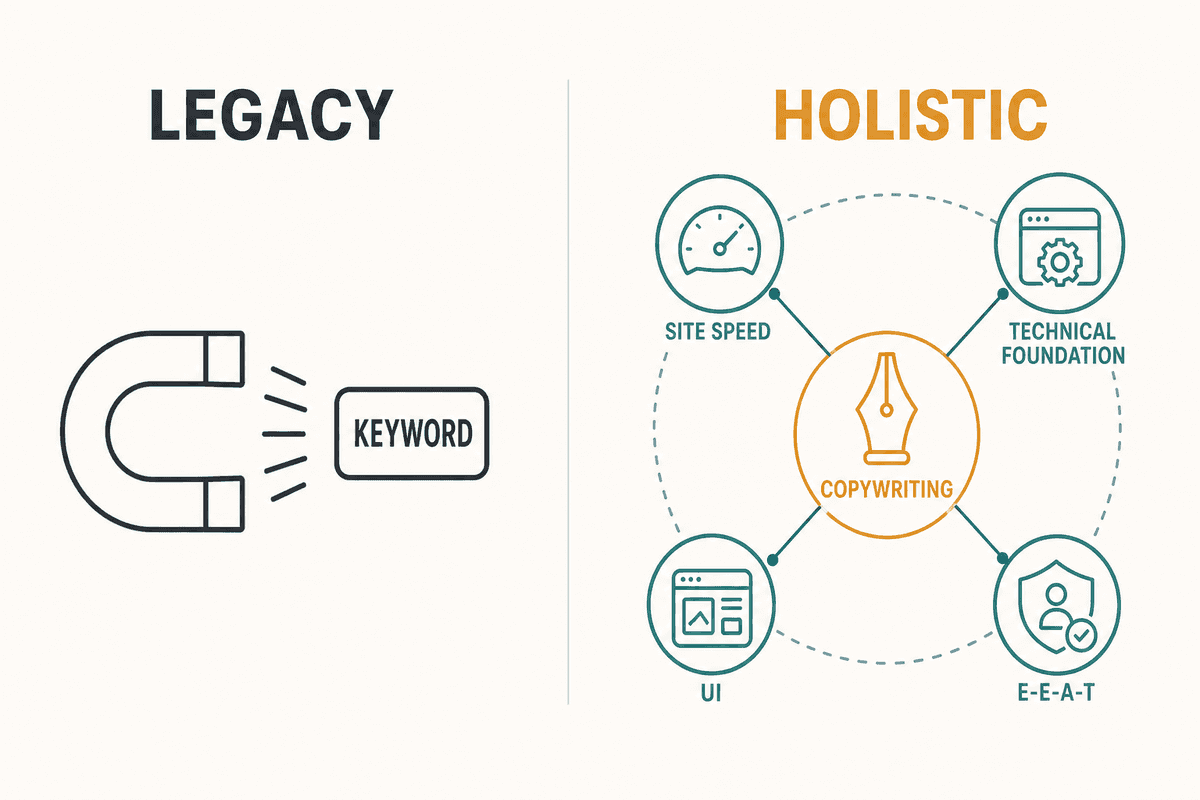
Legacy SEO was about tricking a search engine into thinking your page was relevant. Holistic SEO is about proving to both the search engine and the user that your page is the best possible resource on the internet for their specific query.
Google's Helpful Content guidelines and focus on E-E-A-T (Experience, Expertise, Authoritativeness, and Trustworthiness) mean your content must demonstrate firsthand knowledge. When you practice holistic SEO, your technical foundation, site speed, user interface, and copywriting all work together to satisfy the user's journey.
As Yoast notes in their definitive guide, writing the best copy is the core of this strategy. Good copy keeps people on the page longer, lowers bounce rates, and signals to search engines that your content successfully answers the query.
The Three Phases of Writing an SEO Article
The most consistent way to rank is by treating copywriting as a system rather than an art project. The process breaks down into three distinct phases: preparation, writing, and editing.
Phase 1: Preparing Your Text
Before writing: always start with keyword research and search intent analysis. If you skip this step, you risk writing a masterpiece for an audience of zero.
1. Formulate a Mission Statement What is the core purpose of your piece? Before looking at search volume, define exactly what you want the reader to learn or do by the time they reach the end of the page.
2. Make a List of Relevant Keywords Find the primary keyword and the secondary entities associated with it. Look at the specific questions your target audience asks on forums or social media. If you are learning how to analyze existing SEO rankings for your target keyword, you will quickly see which secondary topics the top-ranking pages cover.
3. Look at Search Intent Every search query falls into one of four intent categories:
- Informational: "What is an API?"
- Navigational: "BeVisible login"
- Commercial Investigation: "Best automated SEO platforms"
- Transactional: "BeVisible pricing"
The purpose of your text and the search intent must align. If someone is looking for a definition, do not bury it under a long-winded personal story.
4. Create Landing Pages for Searchers If your intent is transactional, you need to know how to build an SEO landing page that balances persuasive copywriting with search visibility. The structure of a landing page is drastically different from a top-of-funnel blog post.
Phase 2: Writing Your Text
Once the research is done, it is time to draft. The goal here is getting your ideas onto the page logically, without overthinking the technical SEO constraints.
Text Structure Outline the structure of your longform piece before drafting. Search engines rely on header tags (H1, H2, H3) to understand the hierarchy of your information. A clear structure also prevents the reader from feeling overwhelmed by a wall of text.
Just Write! Turn off your grammar checker and ignore your keyword list for a moment. Write the first draft focusing entirely on flow and value.
Stick to the Structure of Your Text As you write, refer back to your outline. If you find yourself going off on a tangent, cut that section and save it for a different article.
Phase 3: Editing Your Text
Editing is where standard writing transforms into SEO copywriting.
Make Sure Your Text is Readable Readability is a ranking factor because it directly impacts user experience. Use short paragraphs. Break up dense concepts with bulleted lists. Web copy must be easily scannable to attract clients and retain impatient readers.
A Few Ways to Improve Your Writing Style
- Step 1: Read slowly (and out loud). This is the fastest way to catch awkward phrasing and overly complex sentences.
- Step 2: Focus on sentences. Keep the majority of your sentences under 20 words. Mix short sentences with longer ones to create rhythm.
- Step 3: Focus on paragraphs. A good web paragraph is rarely longer than 3-4 sentences.
- Step 4: Check the text structure. Ensure your headings accurately describe the text beneath them.
- Step 5: Ask for feedback. Have someone unfamiliar with the topic read the draft to ensure your explanations are clear.
SEO Copywriting Examples: Before vs. After
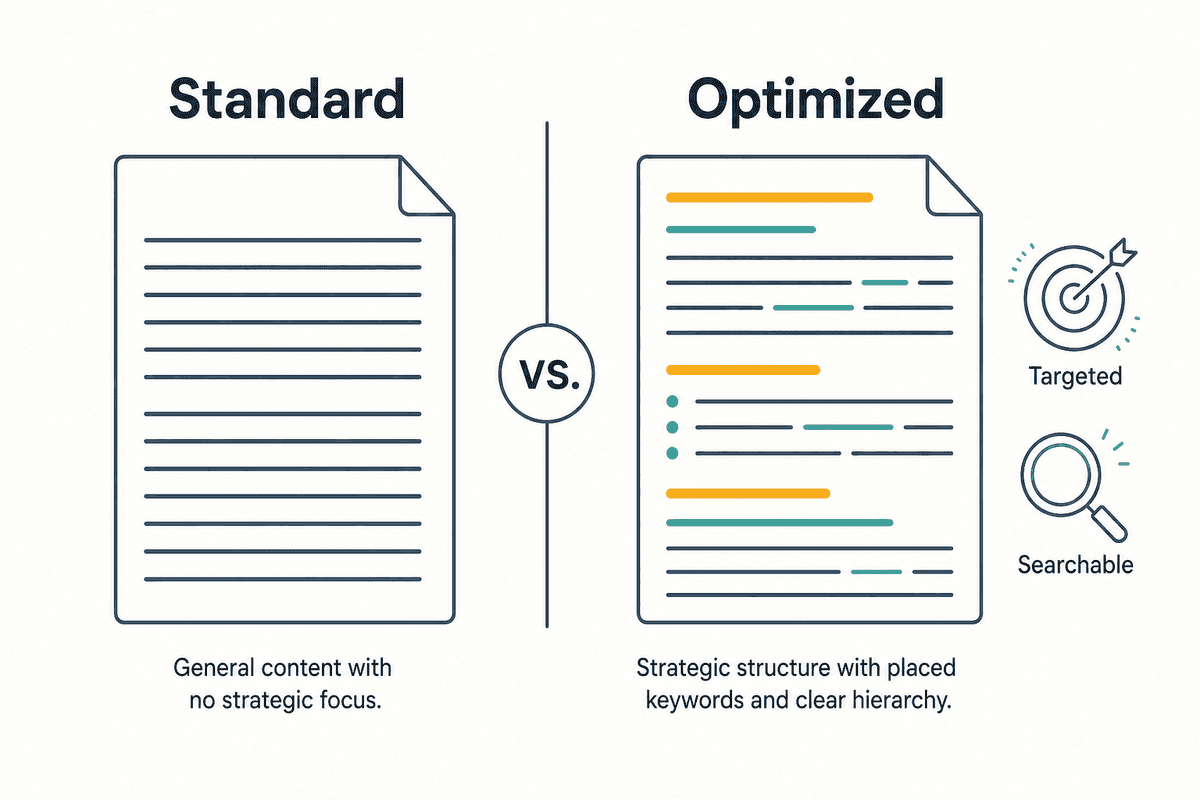
To understand the difference between standard writing and SEO-optimized web copy, look at how sentence structure and clarity impact both humans and algorithms.
SEO Copywriting in the Age of Generative AI
There is a pervasive myth among marketers that AI search engines and LLMs have made copywriting irrelevant. The reality is the exact opposite.
Because AI engines like Perplexity and ChatGPT synthesize answers from across the web, they heavily favor content with clear structure, authoritative "answer-first" formats, and quotable sections. If your article is a rambling mess, an AI crawler will simply ignore it in favor of a competitor's structured listicle.
If you want to survive the shift to AI search, your content must feature:
- Schema Markup: To explicitly tell crawlers what your data means.
- Entity Density: Using semantically related terms naturally, rather than repeating one target keyword.
- Quotable Summaries: Short, bolded answers immediately following a question heading.
Frequently Asked Questions About SEO Copywriters & SEO Copywriting
Real users consistently ask how SEO copywriting actually works behind the scenes. Here are the most common questions regarding the discipline.
1. What does an SEO copywriter do?
An SEO copywriter balances the technical requirements of search engine algorithms with the psychological requirements of human readers. They research search intent, structure content for maximum scannability, inject relevant entities seamlessly, and write persuasive copy designed to drive a specific action (like a newsletter signup or a software trial).
2. How is SEO copywriting different from regular copywriting?
Regular copywriting (like a billboard or a print ad) focuses purely on persuasion, brand awareness, and conversion. SEO copywriting must first win the battle for visibility. If a traditional sales letter is not optimized for search queries, no one will ever find it organically. SEO copy acts as both the distribution channel and the sales pitch.
3. Is SEO copywriting still important with AI-generated content?
Yes, but the required skill set has changed. Generating bulk, generic text is no longer a competitive advantage. Instead, the focus has shifted to strategy, structuring information for AI extraction, and ensuring the final output possesses the nuance, formatting, and branded context that raw LLM outputs lack.
Next Steps: Scaling Your SEO Content Strategy
Writing one perfectly optimized article using the three-phase framework is a great start. But organic growth requires consistency. You cannot publish once a month and expect to dominate search results.
The traditional route is hiring an agency, but understanding UK agency rates versus automation reveals a massive cost discrepancy for bootstrapped teams. Building a high-volume, high-quality content machine manually requires significant capital and management time.
This is why we built BeVisible.
Instead of managing a team of freelance writers or spending hours editing raw AI text, BeVisible automates the entire end-to-end production pipeline. You connect your site URL, and the platform conducts the keyword research, competitor analysis, and search intent mapping to build a 30-day content map.
Every 24 hours, BeVisible automatically writes, polishes, and publishes an article featuring the exact "answer-first" structures, internal links, and schema markup required to rank in both Google and AI engines.
Stop treating your content strategy as a series of manual tasks. Review the best SEO blogs to stay sharp on strategy, but automate the heavy lifting of execution. You can start building your 30-day content map with BeVisible's free 3-day trial today.