
Picture a two-person marketing team at a growing B2B SaaS company. On Monday morning, the founder hands down a new mandate: We need to publish twenty optimized blog posts a week to catch up with our competitors.
The immediate reaction is usually panic, followed by a frantic search for automated writing tools. For many lean teams, the default answer becomes firing up a one-click AI generator like Seowriting AI, pasting in a list of keywords, and scheduling the output directly to WordPress. It feels like a massive productivity win—until three months later when traffic remains flat, bounce rates sit at 90%, and AI assistants like ChatGPT and Perplexity completely ignore the brand when buyers ask questions about the niche.
When you publish thin, commodity content at scale, search engines and large language models (LLMs) filter it out as noise. Volume content marketing is a strategy that involves creating high-volume content for a brand's target audience, but it only works if that content actually serves the reader's intent and provides unique value.
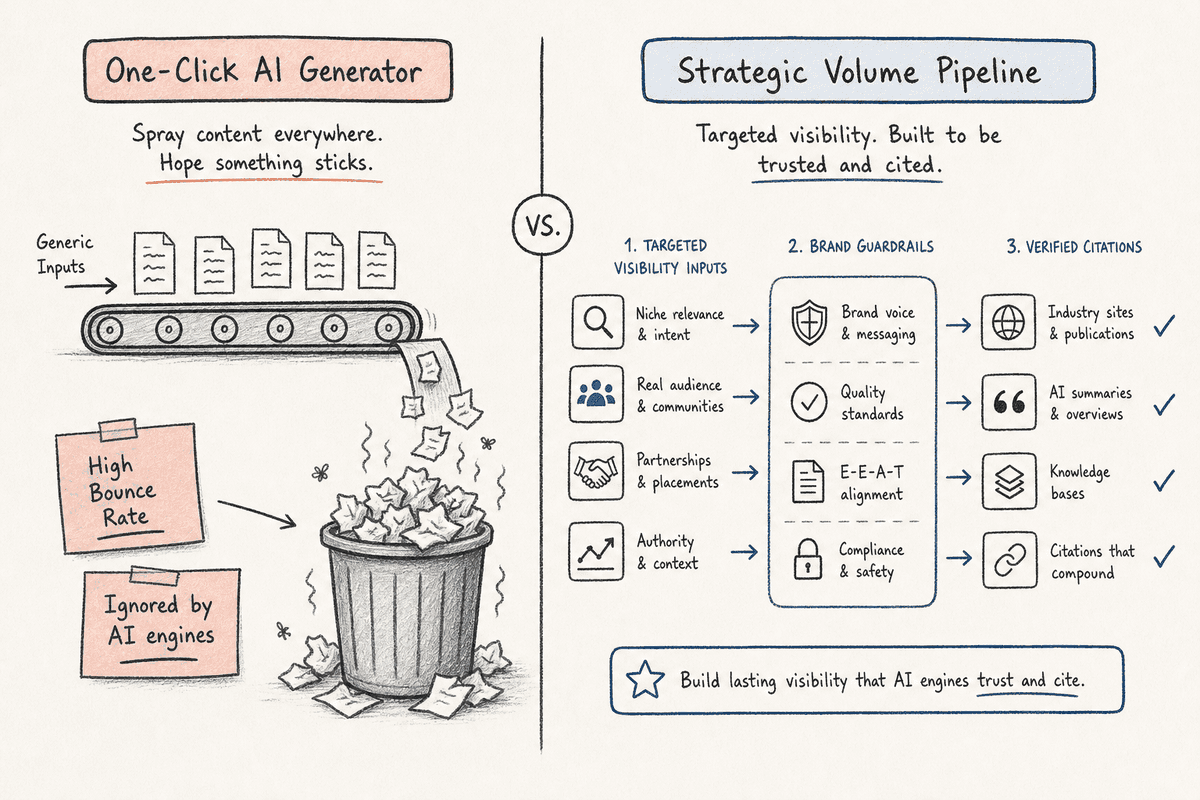
Small marketing teams absolutely can publish high-volume blogs. But to do it effectively, they need to abandon the spray-and-pray approach of basic one-click generators. They need intelligent workflows, strict brand alignment, and a strategy driven by actual visibility gaps rather than random keyword lists.
The Trap of One-Click Blog Generation
The allure of one-click AI writers is undeniable for an under-resourced team. The promise is that you can generate thousands of words with a single button press. However, scaling a bad process just gives you bad results faster.
While tools like Seowriting AI offer quick, one-click article generation and basic WordPress publishing integrations, users often run into operational friction. For example, some platforms rely on a pricing model that is credit-based which gets pretty confusing, and users occasionally report poor support especially around refunds when customers aren't very happy with the output quality](https://www.youtube.com/watch?v=Bra8oTYrTZE&t=386).
Beyond pricing and support, the fundamental flaw of relying solely on basic one-click generators includes:
- Zero Brand Nuance: One-click tools scrape existing top-ranking content and average it out. They do not know your company's contrarian takes, proprietary data, or unique product features.
- Weak Citations: LLMs like Perplexity and AI Overviews heavily weigh authoritative citations when formulating answers. Generic AI content rarely links out to credible primary sources, meaning your content is unlikely to be cited by AI engines answering buyer prompts.
- The Hallucination Risk: When you generate posts in bulk without human review, you inevitably publish inaccurate claims, broken links, or competitor recommendations on your own domain.
- Invisible to AI Engines: Producing 100 generic posts won't move the needle if they don't answer the specific questions buyers are typing into Gemini, ChatGPT, or AI Overviews.
To actually win, small teams need alternatives that blend the speed of AI with the strategic precision of targeted visibility monitoring.
Alternative 1: Workflow Integration Over One-Click Apps
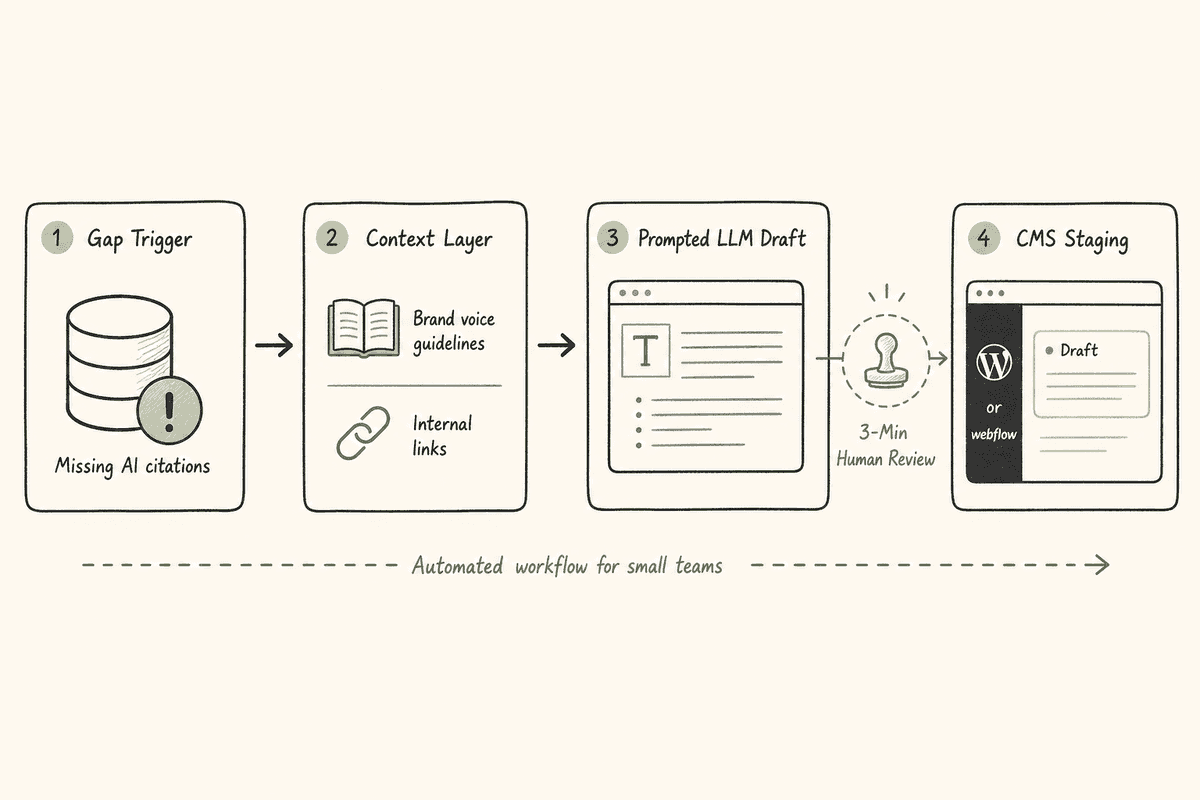
Instead of using an isolated tool that spits out raw text, high-functioning small teams are building automated content pipelines. This involves connecting prompt-driven AI models directly to their Content Management Systems (CMS) and editorial calendars.
By using workflow automation (via tools like Make or Zapier) combined with sophisticated APIs, teams can build a process where content is drafted, formatted, and staged without manual copy-pasting. For instance, an agency or small team can set up a system where approved topics are drafted and this post will just automatically be added now to my content planner, appearing right in the next slot for review](https://www.youtube.com/watch?v=esN40CErzbw&t=405).
This approach separates the drafting from the strategy.
The Automation Pipeline
- Ideation Trigger: A visibility gap is identified (e.g., your brand is missing from a ChatGPT response about your niche). This topic is added to a Notion or Airtable database.
- Context Assembly: The automation pulls in your brand guidelines, a specific writing framework, and 2-3 required internal links (like linking to a guide on How to Build an SEO Landing Page (7-Step Guide)).
- Prompt-Driven Drafting: The data is sent via API to an LLM, generating a structured draft based on strict instructions. As industry experts note, AI turns prompts into drafts in minutes, letting marketers focus on editing and strategy](https://gravitywrite.com/blog/future-of-content-creation).
- CMS Staging: The completed draft is automatically pushed to WordPress, Webflow, or Shopify as a "Draft," complete with formatted markdown and placeholder images.
This alternative removes the operational friction of copying, pasting, and formatting, saving a two-person team hours every week. The humans spend their limited time editing and injecting expertise rather than formatting H2 tags.
Alternative 2: Visibility-Led Content Generation
The biggest mistake small marketing teams make when attempting high-volume blogging is guessing what to write about based on generic keyword research tools. If you are a lean team, every single piece of content must have a specific job.
This is where AI visibility monitoring changes the volume equation. Rather than publishing 50 articles a month on broad industry terms that are already saturated, small teams can use platforms like BeVisible to track exactly how AI assistants are answering buyer questions today.
Turning Gaps Into High-Volume Sprints
BeVisible helps teams monitor ChatGPT, Gemini, Perplexity, and AI Overviews across targeted buyer prompts. When you track these conversations, you discover clear visibility gaps:
- Competitors being recommended instead of you.
- AI engines stating there is "no clear solution" for a specific pain point your software solves.
- Weak citations where the AI is sourcing a generic forum post because no brand has written a definitive guide on the topic.
These gaps become your high-volume editorial calendar.
Instead of opening a one-click writer and guessing, a small team can pull a report of 30 exact prompts where their brand is currently missing. Because these topics are highly specific and evidence-backed, the team can rapidly produce targeted blog posts designed to act as the perfect citation source for the AI engine. You aren't just writing for Google; you are publishing work designed to feed the LLMs exactly what they need to recommend you tomorrow.
Alternative 3: The Pillar-Based Repurposing Engine
Volume doesn't always mean starting from scratch 50 times a month. The most sustainable way for a small marketing team to publish high-volume blogs is through intelligent repurposing built around a pillar strategy.
HubSpot pioneered this method, proving that content performance over time and improvements compound into a consistent lead growth](https://www.youtube.com/watch?v=pdZ42GF9OVc&t=325).
The Hub and Spoke Atomization Process
To execute this without burning out, small teams should focus on creating one deeply researched, highly authoritative "Pillar" piece of content per month. This could be original research, a webinar transcript, or a comprehensive market report.
Once the pillar is created, the team uses AI tools to atomize it into dozens of high-volume supporting blogs.
- The Pillar: The 2026 State of B2B Marketing Automation (5,000 words, original data).
- Spoke 1: 5 Lead Scoring Mistakes (Extracted from Chapter 2).
- Spoke 2: Automated Email Benchmarks by Industry (Extracted from Chapter 4).
- Spoke 3: How to Build a Marketing Tech Stack (Extracted from Chapter 5).
Because the foundational research and brand voice are already established in the Pillar, AI tools can safely and accurately generate the supporting Spoke articles in minutes. The human editor simply ensures the AI hasn't hallucinated and that it correctly links back to the central Pillar. This ensures high volume without diluting the quality of the insights.
Structuring the Publishing Tech Stack
Small teams often wonder if they should just outsource the entire volume operation. But when you compare the economics, building an in-house automated tech stack is almost always more efficient. As detailed in our analysis of SEO Charges UK: Agency Rates vs Automation (2026), traditional agencies charging by the hour for volume content often rely on the same AI tools you can access, but they mark up the cost by 500%.
Furthermore, outsourcing volume without strict guidelines often leads to disaster. If you are Hiring SEO Services in Phoenix? 5 Red Flags (2026) to watch out for include agencies that promise hundreds of posts a month without asking for your brand voice guidelines, customer interviews, or visibility goals.
To keep this in-house and scalable, a lean team needs a streamlined stack:
Technical Note on Hosting: If your marketing site is built as a modern Single Page Application (SPA), pushing high-volume blog content requires specific technical handling to ensure search engines and AI crawlers can actually read the text. Bots often struggle to render heavy JavaScript on the fly. You can explore the technical requirements for this setup in our guide on Single-Page Application SEO: What Works in 2026?. Ensuring your infrastructure can handle the volume is just as important as writing the posts.
Managing Quality Control at Scale
The biggest risk of high-volume publishing is that nobody actually reads the content before it goes live. For a small team, reading 40 articles a week word-for-word is impossible. You need a scalable editing framework.
The "Human-in-the-Loop" (HITL) model is non-negotiable for brands that want to maintain trust. But the human shouldn't be fixing commas; they should be editing for strategy.
The 3-Minute Editorial Checklist for AI Content
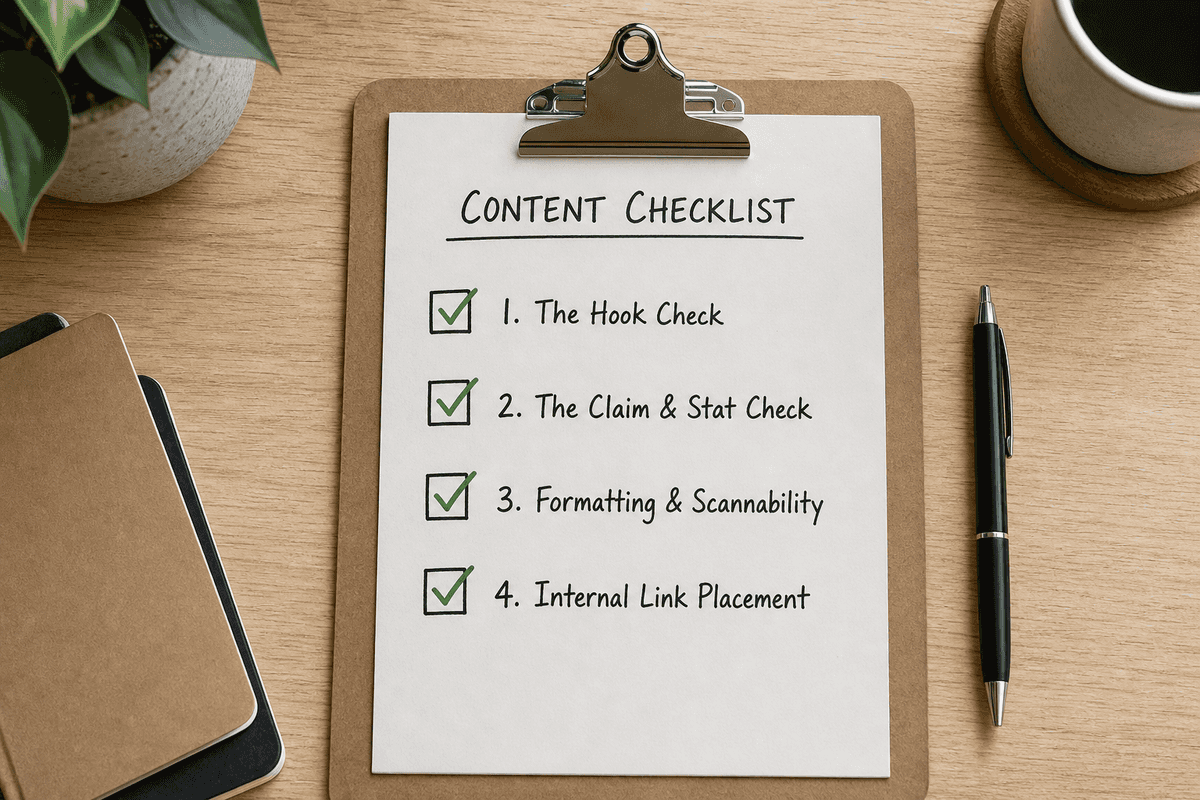
When an AI-generated draft hits the CMS, the human editor should spend exactly three minutes reviewing it against these four criteria:
- The Hook Check: Does the first paragraph actually address the buyer's pain point, or does it start with generic filler like "In today's fast-paced digital world"? (Always rewrite the first paragraph).
- The Claim Check: Are the statistics and factual claims verifiable? Did the AI invent a case study? Highlight claims and verify them against known sources.
- The Formatting Check: Are the H2 and H3 headings descriptive? Does the text break up long paragraphs with bullet points or standard markdown tables for readability?
- The Internal Link Check: Did the tool link to your product pages naturally? If you are writing about continuous learning, does it effectively point to resources like the 11 Best SEO Blogs Every SaaS Founder Needs (2026)?
If the draft fails more than two of these checks, do not waste time rewriting it manually. Adjust the prompt in your automation workflow and regenerate it. Your goal is to engineer a system that outputs 80% perfect drafts, leaving you to add the final 20% of brand voice and expertise.
Common Failure Modes of Lean Content Teams
Even with the best tools and alternatives to Seowriting AI, small teams often hit roadblocks when trying to scale. Recognizing these failure modes early can save months of wasted effort.
1. Treating AI as an Expert Rather Than an Intern
If you ask an AI to "write a comprehensive guide to enterprise cybersecurity protocols," it will give you a regurgitated Wikipedia summary. AI is a reasoning engine, not a subject matter expert. Fix: Provide the expertise in the prompt. Feed the AI transcripts of your sales calls, whitepapers, or rough voice memos from your founders. Treat the AI like a junior copywriter who needs strict source material to work from.
2. Ignoring Search Intent for Volume's Sake
Publishing 50 posts targeting high-volume keywords won't work if your content format doesn't match what the user (or the AI engine) expects. If a user is searching for a template, and your AI writes a 2,000-word philosophical essay, you lose. Fix: Ensure your workflow automation pulls in intent data. If the prompt requires a listicle, force the AI to output a structured list.
3. Neglecting Technical SEO on the Publishing Site
A massive influx of new URLs can strain your site's architecture if not managed properly. If your blog index becomes paginated to 400 pages with poor internal linking, crawlers will abandon the effort. Fix: Implement strict category silos. If you are using advanced front-end frameworks, double-check your rendering strategy (refer to our guide on Implementing SEO in Single Page Applications (3 Ways)).
Frequently Asked Questions
How many posts a month is considered "high volume" for a small team?
Volume is relative to your baseline. If you currently publish twice a month, scaling to 15 highly targeted, visibility-driven posts a month is high volume and will have a massive impact. True enterprise volume content marketing often exceeds 50-100 posts per month, but lean teams should aim for 15-20 high-quality, heavily automated pieces that directly address missing AI mentions.
Will search engines or AI assistants penalize purely automated content?
Search engines have publicly stated they do not penalize content simply because it is generated by AI. They penalize content that is unhelpful, spammy, or lacks human insight. Similarly, AI engines like Perplexity or ChatGPT do not "penalize" AI content, but they heavily favor content that contains unique facts, primary data, and strong brand authority. If you use one-click tools to generate generic fluff, you will be ignored. If you use AI to scale your unique insights, you will be cited.
How do we train an AI generator to sound exactly like our brand?
You cannot rely on simple adjectives like "write in a professional but approachable tone." Instead, build a "Brand Voice Blueprint" document. This should include 5-10 examples of your best-performing paragraphs, a list of industry buzzwords you explicitly refuse to use, and guidelines on how you structure arguments. Feed this document into your LLM (using Custom Instructions or the API system prompt) before generating any high-volume batches.
Transitioning to High Volume Execution
For a small marketing team, the mandate to publish high-volume blogs doesn't have to mean sacrificing quality, nor does it require settling for the lowest common denominator of one-click AI writers.
By stepping away from tools that generate isolated, generic text, and moving toward integrated workflows, prompt-driven drafting, and visibility-led content generation, a two-person team can output the volume of a 10-person agency.
The most critical shift is moving from guesswork to evidence. Stop writing what you hope buyers are searching for, and start monitoring how AI assistants are actually answering their prompts. Track the missing mentions, identify the weak citations, and let those visibility gaps dictate your publishing volume. When every piece of content is engineered to fill a specific void in an AI engine's response, high-volume publishing becomes the ultimate growth lever.