
Solo founders face a distinct content paradox. You know you need to publish consistently to capture organic traffic and train AI assistants on your brand. But when you try to automate this process, you usually end up in one of two failure modes.
Either you string together a fragile chain of Zapier integrations and AI wrappers that hallucinate wildly, or you invest in an enterprise-grade "content operating system" that takes longer to configure than simply writing the articles yourself.
For many, Sight AI falls into the latter category. It is a powerful platform featuring multiple AI agents capable of handling research, writing, SEO, and visibility tracking. But for a single-person startup, a multi-agent system often introduces unnecessary friction. The best automated content workflow tool for a solo operator is rarely a single, massive application. Instead, it is a curated stack that moves ideas to drafts to distribution, while deliberately keeping you in control of the final approval.
In this guide, we will break down the most effective alternatives to heavy multi-agent systems, evaluate the exact tools that fit a solo founder's constraints, and map out an automated pipeline that actually ships high-quality, AI-search-optimized content in 2026.
The Problem with Heavy Content Operating Systems
When you are the only person managing product, sales, and marketing, your software needs to reduce cognitive load.
Enterprise content systems are built on the premise of delegation. You configure a research agent to scrape the web, a writing agent to draft the piece, an SEO agent to optimize it, and an editing agent to check the tone. While this sounds appealing in theory, the reality for a solo founder is that you become the manager of a highly erratic, non-human editorial team. You spend your weekends tweaking agent prompts and fixing bizarre structural choices instead of hitting publish.
This is why many solo founders actively seek out Sight AI alternatives that strip away the complexity of multi-agent orchestration. The goal is not to remove human oversight entirely. The real bottleneck in content marketing is not the approval stage; it is the blank page, the initial research, and the tedious formatting.
 A highly effective solo workflow focuses on automation where it excels (ideation, structuring, drafting, and scheduling) and preserves human intervention where it matters most (brand voice, factual accuracy, and final strategic alignment).
Full Content Pipelines: The Closest to "All-in-One" Automation
If you want a system that mimics an end-to-end pipeline without the heavy configuration overhead of a multi-agent operating system, a few platforms stand out. These tools are designed to take a seed keyword or topic and produce a structured, ready-to-review draft.
ContentFlow
For solo founders who want to set up content streams and review the output on a weekly basis, ContentFlow offers a streamlined alternative to heavier platforms. It operates as an AI content pipeline that automatically researches topics and generates SEO-structured drafts complete with citations.
Unlike systems that require you to manage conversational agents, ContentFlow is built around a reliable input-output mechanism. You feed it a content strategy, and it populates a queue with scheduled drafts that sit waiting for your approval.
Where it excels for solo founders:
- Topic Ideation to Draft: The transition from a seed idea to a fully fleshed-out draft is seamless and requires minimal prompting.
- SEO Structuring: It natively understands how to structure headings and include relevant entities.
- Approval-Based Publishing: It does not force auto-publishing. The content queue allows you to batch-edit your weekly content on a Friday afternoon and schedule it out.
Where you need to step in:
- Brand Voice: While the structure is sound, the tone often requires a human editor to inject specific brand opinions and internal experiences.
TheStacc
Another strong contender in the automated pipeline space is theStacc. It bridges the gap between raw AI generation and structured content management.
While evaluating the 10 Best Automated Content Workflow Tools in 2026, it becomes clear that tools like theStacc are optimizing for the "managerial" aspect of content creation. It provides a visual interface for where a piece of content currently sits in the pipeline, which is incredibly useful when you are balancing content creation alongside product development and customer support.
MarketMuse (The SEO Heavyweight)
If your primary focus is capturing traditional search traffic and you need rigorous data behind your automated workflows, MarketMuse is a formidable, albeit complex, alternative.
Acquired by Siteimprove, MarketMuse relies on proprietary topic modeling algorithms rather than generic AI wrappers. It assesses your domain's authority on specific subjects and provides personalized insights into keyword difficulty and content gaps.
A recent MarketMuse review highlights its suite of applications—Optimize, Research, Compete, Questions, and Connect. The platform excels at content cluster analysis and generating highly technical content briefs that you can feed into a lighter AI writer.
Why solo founders use it:
- It removes the guesswork from content planning. You know exactly what subtopics need to be covered to achieve topical authority.
- The generative AI support for drafting is heavily constrained by actual SERP data, reducing fluff.
The tradeoff:
- MarketMuse has a steep learning curve and comes with an enterprise-leaning price tag. It requires a dedicated onboarding period to fully integrate into a fast-moving solo operation.
Editorial Workflow and Approval-First Systems
For many solo founders, the issue isn't generating text; it's organizing the chaos. You might already have a preferred AI model (like ChatGPT or Claude) that you use for writing, but you lack a system to manage briefs, revisions, and multi-channel distribution. This is where editorial workflow tools shine.
Narrato
Narrato approaches content automation from a workspace perspective. Rather than acting strictly as a generative pipeline, it is built around the concept of the "content brief."
For a single-person startup, this methodology is highly effective. You start by defining the parameters of the article—target audience, keywords, required citations, and brand guidelines. Narrato's AI then generates content against that specific brief.
Furthermore, Narrato excels at multi-channel reuse. A solo founder cannot afford to write a 3,000-word article and leave it to die on a blog. Narrato helps automatically parse that pillar content into LinkedIn posts, email newsletters, and X threads, all tied to the original brief and awaiting your final approval.
CoSchedule
If your primary struggle is consistency and distribution, CoSchedule remains a staple. While traditionally known as a marketing calendar, its modern iteration includes robust automation for scheduling and social sharing.
CoSchedule is the ultimate "control" tool. It allows a solo founder to visualize exactly what is going out and when. By integrating a lighter AI writing tool with CoSchedule, you create an automated workflow that guarantees your content actually reaches your audience, without surrendering the final say on when a piece goes live.
The BeVisible Layer: Automating Based on AI Search Visibility
The tools listed above solve the "how to write and publish" problem. But for a solo founder in 2026, a more pressing question is "what should I write about?"
Traditional keyword research tools tell you what people typed into Google three months ago. But B2B buyers, SaaS founders, and growth teams are increasingly asking AI assistants (like ChatGPT, Gemini, and Perplexity) for software recommendations and strategic advice.
If a potential customer asks ChatGPT for an "automated content workflow tool for single person startups," and the AI recommends your competitors because they have clearly structured pillar pages addressing that exact phrase, you have a visibility gap.
This is where BeVisible comes into the stack. BeVisible tracks how AI assistants answer specific buyer prompts, identifying which brands they recommend and which sources they cite. When BeVisible flags that your brand is missing from a high-intent AI response, it doesn't just give you a metric; it gives you the exact evidence-backed opportunity to create content.
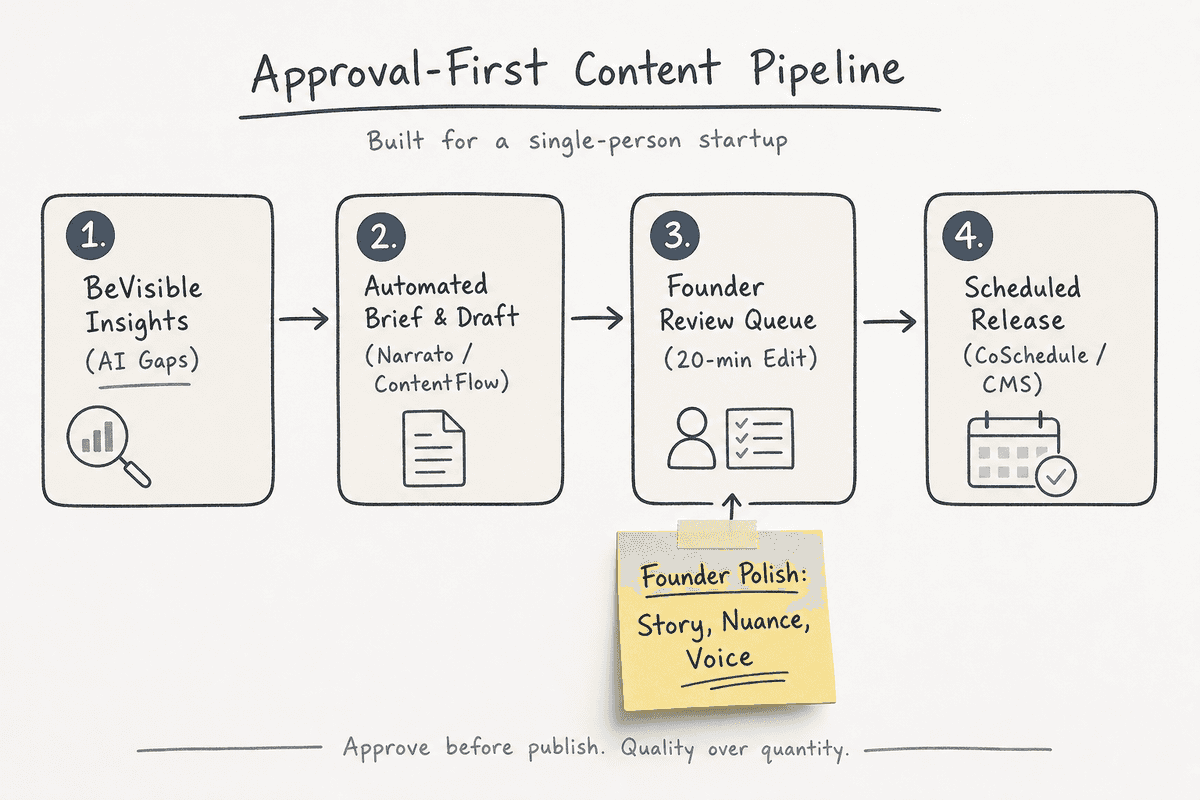
The highly leveraged solo workflow looks like this:
- Monitor: BeVisible flags that ChatGPT is recommending ContentFlow and CoSchedule for a specific buyer prompt, but omitting your SaaS.
- Brief: You export the missing citations and target questions from BeVisible directly into an automated brief.
- Draft: A tool like ContentFlow or Narrato processes the brief, researching the specific gaps your competitors missed.
- Review: You spend 20 minutes editing the draft, ensuring your product's unique point of view is front and center.
- Publish: The approved piece is pushed live, subsequently ingested by AI models, and closes your visibility gap.
You are no longer guessing what to write. Your automated content workflow is directly tied to capturing real-time AI-search recommendations.
Building the Solo Founder Content Architecture
To make this practical, let’s build a lightweight, high-output content architecture that avoids the bloated content creation autopilot software trap.
Step 1: Constraint-Based Ideation
Never let an AI tool brainstorm topics in a vacuum. It will default to generic, low-value concepts like "Top 10 Marketing Tips."
Instead, constrain your ideation phase. Use BeVisible to identify exactly what questions your target market is asking AI assistants. Cross-reference this with the top blogs in your space (for inspiration, review the 11 Best SEO Blogs Every SaaS Founder Needs (2026)). Feed these specific gaps and proven formats into your brief generator.
Step 2: The Brief is the Prompt
The quality of automated content is entirely dependent on the strictness of the brief. If you use a tool like Narrato or MarketMuse, ensure the brief includes:
- The exact H2 and H3 structures required.
- Mandatory internal links.
- Specific product features that must be mentioned.
- A list of clichés and buzzwords the AI is forbidden from using (e.g., "In today's fast-paced digital landscape").
Step 3: Generating and Formatting
Whether you use ContentFlow or a custom API connection to a frontier model, the output should arrive formatted in clean markdown.
If you are building programmatic pages or targeted conversion assets, this automated output needs to slot perfectly into your site structure. For instance, if you are utilizing this workflow to generate bottom-of-funnel pages, ensure your AI tool is trained on How to Build an SEO Landing Page (7-Step Guide) so it outputs the correct components (hero sections, social proof markers, and CTA placements).
Step 4: The 20-Minute Human Polish
This is the non-negotiable step for a solo founder. Automation gets you to 80%. The final 20% is where the value lives.
During your weekly review block, look for:
- The "Hook": AI struggles to write compelling introductions. Rewrite the first paragraph to include a specific, contrarian, or hyper-relevant observation from your own experience.
- The Nuance: Add edge cases. AI loves to speak in absolutes. Add the "however, this breaks when..." scenarios that prove human expertise.
- Formatting: Break up walls of text with bullet points and ensure inline visuals make sense.
Technical Considerations: Single Page Applications and SEO
Many single-person startups build their products and marketing sites as Single Page Applications (SPAs) using frameworks like React or Vue. SPAs offer incredible user experiences but introduce significant friction for automated content workflows and SEO.
If your automated workflow is pushing content to a headless CMS connected to an SPA, you must ensure that search engine crawlers and AI bots can actually read the content upon initial load.
A common failure mode is an automated tool successfully pushing a brilliant, 3,000-word article to a database, but the SPA requires client-side rendering to display it. If the crawler doesn't execute the JavaScript, the page appears blank, and your AI visibility remains at zero.
To prevent this, you must implement server-side rendering (SSR) or static site generation (SSG). Before scaling your automated content volume, verify your technical foundation against the SEO for Single Page Applications: The Technical Checklist. Automation only generates ROI if the output is indexable.
Cost Analysis: Automation vs. Agency Execution
Why build this stack at all? Why not just hire an agency?
For a single-person startup, cash is often tighter than time in the early days, but as the product scales, time becomes the absolute premium. Traditional SEO and content agencies charge substantial retainers for discovery, account management, and manual drafting.
When you look at current market rates (for an in-depth breakdown, see SEO Charges UK: Agency Rates vs Automation (2026)), a mid-tier agency might charge $3,000 to $5,000 a month for four high-quality articles.
Compare this to the automated stack:
- Visibility Tracking (BeVisible): ~$99 - $299/month
- Pipeline/Drafting (ContentFlow/Narrato): ~$50 - $150/month
- Your Time (Approval & Polish): 2 hours a week.
The financial leverage of a tightly constrained, approval-first automated workflow is undeniable. You achieve agency-level output volume while maintaining founder-level product knowledge and voice, all for a fraction of the cost.
Scenario: The "Weekly Review" Workflow in Action
Let’s look at how this plays out in reality. Meet David, a solo founder running a B2B SaaS tool for remote team scheduling.
Previously, David tried to write two blog posts a week manually. It took him 10 hours. He then tried an enterprise multi-agent system (like Sight AI), but spent 8 hours a week fixing the AI's tendency to invent fictional competitors and write in an overly formal, academic tone.
Here is his new, optimized workflow:
Monday (Automated): BeVisible scans AI search engines for prompts related to "remote team scheduling software." It flags that Perplexity is citing three competitors but missing David's brand. It exports these gaps as topics.
Tuesday (Automated): A webhook sends these topics to ContentFlow. The tool researches the specific parameters, pulls in real statistics, and generates two 2,500-word drafts. The drafts are placed in a "Pending Review" status in David's CMS.
Friday (Human Intervention): David blocks out two hours. He opens the first draft. The structure is excellent, the citations are accurate, but the intro is dry. He spends 15 minutes rewriting the intro to include a personal story about a disastrous remote meeting he had last month. He adds his specific product screenshots. He repeats this for the second draft.
He hits "Schedule."
David has reduced his content creation time from 10 hours to 2 hours, maintained complete control over his brand voice, and ensured every piece of content is directly targeting a known AI visibility gap.
FAQs About Automated Content Workflows for Solo Founders
Can one tool really do it all?
Technically, yes. Practically, no. Tools that claim to do everything from keyword research to automatic publishing usually perform at least one of those tasks poorly. For a solo founder, a modular stack (Insight tool -> Drafting tool -> CMS) is more reliable and easier to debug than a monolithic system.
How do I prevent AI content from sounding generic?
The secret is in the prompt constraints and the human editing layer. Never ask an AI to "write an article about X." Ask it to "write an article about X, targeting this specific buyer persona, strictly adhering to this outline, avoiding these ten buzzwords, and concluding with this specific methodology." Then, manually rewrite the first and last paragraphs.
Does automated publishing hurt SEO?
Search engines and AI assistants do not penalize content simply because it was generated by AI. They penalize content that is unhelpful, repetitive, or inaccurate. If your automated workflow produces highly structured, accurate, and deeply relevant answers to specific buyer questions, it will perform well. The risk lies in publishing unedited, hallucinated content at scale, which damages both your domain reputation and your brand trust.
The Path Forward for Solo Operators
Scaling a single-person startup requires ruthlessly optimizing your time. Content marketing is essential for growth, but manually writing every word or wrestling with overly complex multi-agent systems will burn you out.
By pivoting away from heavy operating systems and embracing Sight AI alternatives like ContentFlow or Narrato, you can build a pipeline that does the heavy lifting. Pair that drafting power with an approval-first mindset and precise AI visibility data from BeVisible, and you transform content creation from a chaotic chore into a predictable, highly leveraged growth engine.