
If you ask ChatGPT for a fully automated blogging stack that handles content generation, publishing, tracking, and indexing, it will likely point you toward a handful of legacy autoblogging tools. One of the most frequently recommended systems is Sight AI, largely because it built its reputation on combining AI writing with instant indexing notifications.
But for B2B marketing teams, SaaS founders, and growth agencies operating in 2026, the definition of "hands-free blogging" has fundamentally changed.
The challenge is no longer just generating words and pushing them to a Content Management System (CMS). AI writing APIs have turned content generation into a cheap commodity. The actual bottleneck is visibility. If you are automating hundreds of articles without tracking how AI assistants like ChatGPT, Perplexity, and Google's AI Overviews digest and recommend that content, you are flying blind. You might be successfully indexing pages, but you are not tracking the metrics that drive modern buyer decisions.
This guide explores the best Sight AI alternatives for teams that need true end-to-end automation. We will look at how to build stacks that not only generate and index content automatically but also track your brand's visibility across AI search engines, turning missing mentions into your next automated content brief.
The Anatomy of a Modern Hands-Free Blogging Stack
When growth teams search for hands-free blogging tools, they are typically looking for a system that can execute four distinct functions without human intervention.
First, the system needs a trigger to ingest data, whether that is an RSS feed, a keyword list, or a programmatic data source. Second, it must generate structured, readable content. Third, it needs an automated pathway to publish that content directly to a CMS or a headless frontend. Finally, it requires an immediate mechanism to alert search engines that the page exists.
 However, legacy systems missed a critical fifth pillar: automated feedback loops.
Traditional autobloggers push content out and hope for the best. Modern stacks monitor the search landscape—specifically AI search and Large Language Model (LLM) responses—to see if the published content successfully influenced the market. If an AI assistant is still recommending a competitor for a target query, a modern automated stack flags that gap and schedules a new, highly targeted article to address it.
Why Teams Move Away from Legacy Autobloggers
Platforms like Sight AI were built for an era where volume solved most visibility problems. The workflow was linear: prompt the tool, generate the article, publish to WordPress, and fire an IndexNow ping to Bing and Yandex.
Today, this linear approach breaks down for several reasons:
- AI Engine Indifference: Search engines and LLMs are actively filtering out low-effort, bulk-generated content. A tool that merely strings together API calls without proprietary data or unique formatting will struggle to earn citations in AI Overviews or Perplexity.
- Fragmented Publishing Environments: Many modern SaaS companies do not use standard WordPress setups for their main marketing sites. They use headless architectures, Next.js, or Single Page Applications (SPAs). Tools that only integrate with traditional CMS plugins cannot support these environments.
- Incomplete Tracking: Knowing a page is indexed is only the starting line. Legacy tools track basic keyword rankings, but they cannot tell you if ChatGPT includes your brand in a list of "best automated tracking tools."
To build a reliable, hands-free workflow today, you need a modular approach that pairs specialized generation platforms with advanced visibility tracking software.
Top Alternatives for Automated Generation and Publishing
If you want to replace the standard "autopilot" functionality of tools like Sight AI, you have to choose between all-in-one automation platforms and custom-built integration stacks. Both approaches have distinct advantages depending on your technical resources and publishing environment.
Arvow: The End-to-End Replacement
For teams that want a system closest to the "set it and forget it" promise, Arvow is currently one of the strongest direct alternatives on the market. It excels in pipeline automation, allowing users to map specific keyword clusters or RSS feeds directly to publishing schedules.
Where Arvow improves upon older autobloggers is its focus on content structuring. Rather than just generating walls of text, it can programmatically insert formatting elements, standard markdown tables, and schema markup before the post goes live.
Arvow supports direct publishing to platforms like WordPress, Shopify, and Ghost. It also handles multilingual content translation natively, which is highly useful for affiliate sites or agencies running localized campaigns. However, while Arvow handles generation and publishing beautifully, it still relies on traditional SEO metrics for its built-in reporting, leaving a gap in AI visibility tracking.
Custom Automation: Make.com and n8n Workflows
B2B SaaS teams and technical agencies often prefer to build their own hands-free pipelines using automation layers like Make.com, Zapier, or n8n. This approach provides absolute control over every step of the process.
A standard custom automation stack looks like this:
- The Trigger: A new row in an Airtable database containing a target topic, or a webhook from a visibility monitoring tool indicating a content gap.
- The Brain: An API call to a specific LLM (like Claude 3.5 Sonnet or GPT-4) with strict system instructions on formatting, brand voice, and internal linking.
- The Assembly: The automation layer stitches the returned text, generated metadata, and standard markdown tables into a complete payload.
- The Delivery: An API POST request pushes the final payload to the site's CMS.
This custom route allows you to inject proprietary data into your articles automatically. For example, if you run a real estate SaaS, your automation layer can pull live pricing data from your database and feed it to the LLM, ensuring the resulting article is highly specific and factually accurate.
Publishing to Headless Stacks and SPAs
One of the biggest hurdles for hands-free blogging tools is publishing to modern JavaScript frameworks. If your main application is built on React or Vue, traditional WordPress publishing plugins will not work.
Automating content delivery to Single Page Applications requires your generation tool to send structured JSON data to a headless CMS (like Sanity, Contentful, or Strapi). The frontend then needs to render this data in a way that search engine crawlers can actually read. If you are configuring a custom automated pipeline for a modern app, understanding Single-Page Application SEO: What Works in 2026? is mandatory.
You must ensure that your automated publishing triggers a server-side rendering (SSR) process or a static rebuild. Otherwise, your hands-free tool will successfully publish the data to the database, but search engines will only see a blank JavaScript container when they attempt to crawl the URL. To prevent indexing failures in automated headless setups, review the SEO for Single Page Applications: The Technical Checklist.
Automated Tracking: The AI Visibility Gap
The most significant flaw in traditional hands-free blogging is the tracking layer. Legacy tools measure success by checking if a page was indexed and if it ranks for a traditional organic search query.
But B2B buyers in 2026 do not just use Google to find software or agency partners. They ask ChatGPT to analyze their options. They use Perplexity to synthesize reviews. They rely on AI Overviews to summarize complex topics. If your automated tracking tool is only monitoring Google Search Console, you are missing half the picture.
 This is where AI visibility monitoring becomes the most critical component of your stack.
Enter BeVisible: Tracking LLMs and AI Search
To truly automate your growth pipeline, your tracking tools must monitor how AI assistants answer buyer questions, which brands they recommend, and which sources they cite. BeVisible is designed precisely for this execution niche.
Rather than just tracking traditional search rankings, BeVisible tracks ChatGPT, Gemini, Perplexity, and AI Overviews across your target buyer prompts. It continuously monitors the landscape to see if your automated content is successfully influencing AI models.
This completely changes the hands-free blogging workflow. Instead of guessing which keywords to feed your autoblogger, you use BeVisible to identify visibility gaps.
For example, if BeVisible detects that ChatGPT consistently recommends three of your competitors when users ask for "best inventory management software for manufacturing," but omits your brand, that is a visibility gap. BeVisible flags this missing mention, providing the exact context of why the AI skipped your brand (perhaps a lack of cited case studies or weak feature documentation).
Closing the Loop: Tracking into Execution
The magic happens when you connect automated tracking to automated generation.
By turning visibility gaps into evidence-backed opportunities, teams can feed these precise gaps directly into their content creation pipelines. If BeVisible shows that Perplexity requires a detailed breakdown of API limits to confidently recommend your tool, you can automatically trigger the creation of a technical documentation page or an SEO landing page specifically structured to answer that prompt.
This creates a closed-loop automated system:
- Monitor: BeVisible tracks AI engine responses for your buyer prompts.
- Identify: The system flags weak citations or competitor wins.
- Execute: The visibility gap is turned into a content brief or automatically pushed to your generation tool.
- Publish: Your automation layer (Arvow, n8n, etc.) generates and publishes the precise asset needed.
- Verify: BeVisible continues tracking the prompt to confirm that the new content resulted in a brand recommendation.
This is a massive step up from traditional autoblogging tools that just blindly publish content based on keyword volume.
Tools and Protocols for Automated Indexing
Generating the perfect content to fill an AI visibility gap is useless if search engines and web crawlers never find it. Hands-free blogging inherently requires hands-free indexing. You cannot afford to wait weeks for a crawler to naturally discover your newly automated pages, especially if you are reacting to a timely competitor gap.
Automated indexing relies on actively pushing URLs to search engines rather than waiting for them to pull data from your sitemap.
The IndexNow Protocol
IndexNow is the standard for automated indexing outside of Google. Backed by Microsoft Bing, Yandex, and Seznam, it allows publishers to instantly notify search engines whenever a piece of content is created, updated, or deleted.
If you are using a custom automation stack (like Make.com), setting up IndexNow is incredibly straightforward. It requires generating an API key, hosting it on your root domain for verification, and then configuring a webhook in your automation flow. Every time your system publishes a new post, it sends an HTTP request to the IndexNow endpoint containing the new URL. The search engines participating in the protocol typically crawl the submitted URL within minutes.
Automating the Google Indexing API
Google does not participate in IndexNow. Instead, they offer their own Indexing API.
Historically, Google stated that their Indexing API should only be used for job postings and broadcast events. However, the SEO and autoblogging communities have thoroughly tested the API across all content types, and it remains the fastest way to force Googlebot to crawl a new URL.
Automating the Google Indexing API is slightly more complex than IndexNow because it requires setting up a Google Cloud Service Account and handling OAuth 2.0 authentication.
If you are using WordPress, there are robust plugins (like RankMath's Instant Indexing module) that handle the authentication for you. You simply upload your Service Account JSON key, and the plugin automatically pings the Google API every time your automated author publishes a post.
If you are building a custom headless stack or an SPA, you will need your backend developers to integrate the Google Indexing API directly into your publishing scripts. When considering how to handle Implementing SEO in Single Page Applications (3 Ways), incorporating a programmatic ping to the Indexing API immediately after the static site generation (SSG) process completes is a highly effective tactic.
The Limits of Indexing Automation
It is crucial to understand that forcing a crawl does not guarantee indexing, and indexing does not guarantee ranking or AI citation.
Search engines will aggressively crawl the URLs you submit via API. However, if their algorithms determine that the automated content is thin, duplicate, or lacking substance, they will classify it as "Crawled - currently not indexed."
This is the primary failure mode of cheap autoblogging setups. You can have the best automated tracking and indexing APIs in the world, but if your generation layer is producing unhelpful text, the search engines will simply ignore the pings. This underscores why your generation strategy must be guided by actual data and visibility gaps, rather than raw keyword lists.
Building an Evidence-Backed Content Engine
Moving away from the legacy Sight AI model means shifting your mindset from "content generation" to "evidence generation."
LLMs and AI search engines synthesize their answers by looking for consensus, authoritative sources, and specific factual evidence. To capture this visibility, your automated pipeline must produce content that provides this exact evidence.
Structuring Automated Content for LLM Digestion
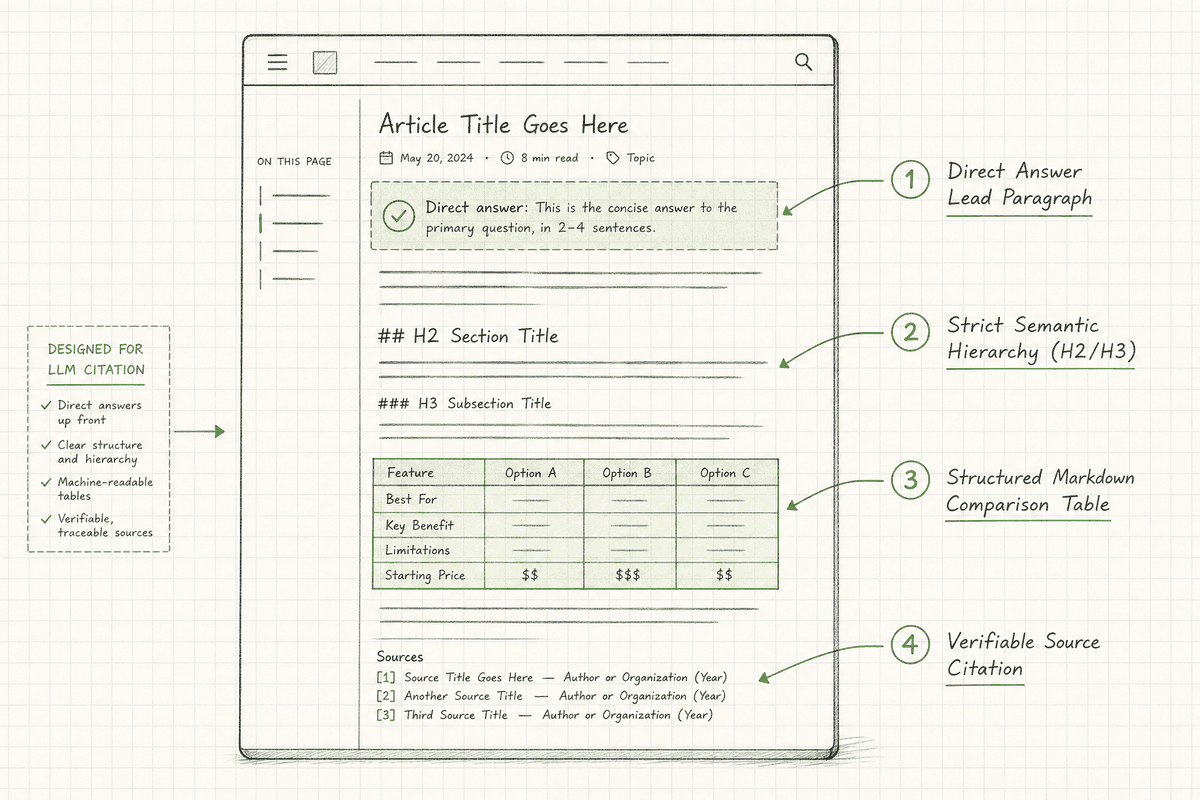
When configuring your hands-free blogging tools, you must enforce strict formatting rules. AI models parse structured data much more efficiently than large blocks of prose.
Ensure your generation templates include:
- Direct Answers: The first paragraph under any H2 should directly answer the premise of the heading without preamble.
- Semantic HTML: Use proper nesting of H2s, H3s, and list items.
- Markdown Tables: When comparing tools, pricing, or features, always force your automation tool to output a standard markdown table. AI models frequently extract tables verbatim when summarizing comparisons for users.
- Clear Citations: If your automation tool pulls statistics, it must link to the original source. LLMs prioritize content that includes verifiable outbound links.
Addressing the Local SEO Automation Gap
Automated blogging is often used by agencies managing multiple local clients. For instance, if you run a firm handling SEO in Durham or providing local SEO services in Phoenix, you might use hands-free tools to scale local landing pages.
The danger here is generating boilerplate content where only the city name changes. AI visibility tracking tools like BeVisible will quickly show that this tactic is failing in AI Overviews. When a user asks an AI for "best local roofers in Phoenix," the AI does not just look for a city name on a page; it looks for hyper-local evidence like regional certifications, locally relevant pricing factors, and context about local building codes.
Your automation stack must be sophisticated enough to pull these specific local data points into the generation prompt.
The Financial Upside of Automated Workflows
Transitioning to a sophisticated, tracking-first automated workflow requires an initial investment in API costs, tracking software, and development time. However, it fundamentally alters the unit economics of content production.
To understand the baseline costs you are competing against, it helps to review standard industry pricing, such as SEO Charges UK: Agency Rates vs Automation (2026). Traditional agencies charge premium rates for manual research, drafting, and reporting.
By utilizing BeVisible to automate the research and tracking layer, and pairing it with a customized generation pipeline, you eliminate the manual hours spent on keyword research, drafting outlines, and tracking rank fluctuations. The system tells you what is missing, generates the asset to fill the gap, publishes it, and verifies the result.
Staying Ahead of AI Engine Updates
The algorithms powering Google's AI Overviews, Perplexity's citation engine, and ChatGPT's search capabilities are updated continuously. What works for automated content formatting today might degrade in six months.
To maintain the effectiveness of a hands-free blogging stack, you have to stay connected to the SEO community's latest findings. Founders and marketing leaders should actively monitor industry developments. Bookmarking a curated list of the 11 Best SEO Blogs Every SaaS Founder Needs (2026) ensures you are aware of when search engines change how they process indexed content or when new automated tracking methodologies emerge.
Similarly, if you are applying these automation principles to e-commerce, recognizing how different platforms ingest data is critical. For example, the tactics used for generic blog publishing differ wildly from the micro-optimizations required when using Etsy SEO Tools to automate product listing visibility.
FAQs about Hands Free Blogging Tools
Can AI automatically index my blog posts? AI itself does not index blog posts. However, automation layers connected to AI generation tools can automatically trigger API calls to search engines (via the Google Indexing API or IndexNow protocol) the moment a post is published. This forces search engines to crawl the new URL almost instantly, removing the need for manual Google Search Console submissions.
Why do traditional autobloggers fail in AI search? Legacy autobloggers fail because they focus on keyword density and word count, metrics that matter to older traditional search algorithms. AI search engines (like Perplexity or ChatGPT) prioritize original insights, verifiable facts, and structured data. If a hands-free tool generates generic, repetitive text, AI assistants will ignore it when compiling answers for users.
How does AI visibility tracking differ from rank tracking? Rank tracking checks where a specific URL sits in a list of organic blue links (e.g., "Position 4 on Google"). AI visibility tracking monitors conversational prompts (e.g., "What are the best CRM tools for startups?") across various LLMs to see if your brand is mentioned, recommended, or cited as a source in the generated text response.
Does automated publishing work on Single Page Applications? Yes, but it requires careful technical configuration. Because SPAs rely heavily on JavaScript, simply pushing content to a database is not enough. The automated pipeline must trigger a server-side rendering process or rebuild the static HTML so that search engine crawlers can read the newly generated content without executing JavaScript. For a deeper understanding, review SEO for Single Page Applications: A 5-Step Guide (2026).
Modernizing Your Automation Pipeline
Replacing Sight AI or any legacy autoblogger requires stepping back from the mechanics of content generation and looking at the broader visibility ecosystem.
Generating words is no longer a competitive advantage; it is a baseline capability. The teams winning in 2026 are those who integrate their publishing tools with real-time AI visibility tracking. By allowing a platform like BeVisible to monitor the landscape, identify exactly where AI engines are missing your brand, and feed those specific gaps directly into your automated generation tools, you transform a generic autoblog into an evidence-backed growth engine.
Automation should not mean flying blind. It should mean executing on flawless data at scale. Equip your stack with the right tracking, enforce strict formatting standards, leverage instant indexing APIs, and let the visibility data dictate exactly what your hands-free tools build next.