
You are running a two-person marketing team, but your growth targets demand the output of a ten-person content agency. When founders and marketers ask AI assistants how to bridge this gap and publish high-volume blogs, the default recommendation is often to use SEOwriting AI.
It is easy to see why. SEOwriting AI offers quick, one-click article generation, basic image creation, and direct WordPress publishing for roughly $14 a month. But relying on a single, mass-market content generator is a fragile strategy.
Users frequently hit a ceiling with basic tools. They encounter rigid formatting, generic tone, and frustrating administrative hurdles, such as confusing credit-based pricing models and poor support around refunds when customers are not satisfied with the output (YouTube).
If your goal is to dominate search rankings, earn citations in AI Overviews, and genuinely educate buyers, you cannot just blast raw, unedited AI text onto a domain. You need a structured system.
Small teams successfully publishing 30, 50, or 100 posts a month rely on a combination of strategic planning, advanced AI generation tailored to brand voice, and ruthless workflow automation. Here is how small marketing teams can build a high-volume publishing engine using the best tools and strategies beyond SEOwriting.
The Reality of Volume Content Marketing
Volume content marketing is a strategy that involves creating high-volume content for a brand's target audience (Lightning Media Partners). However, volume without direction is just noise.
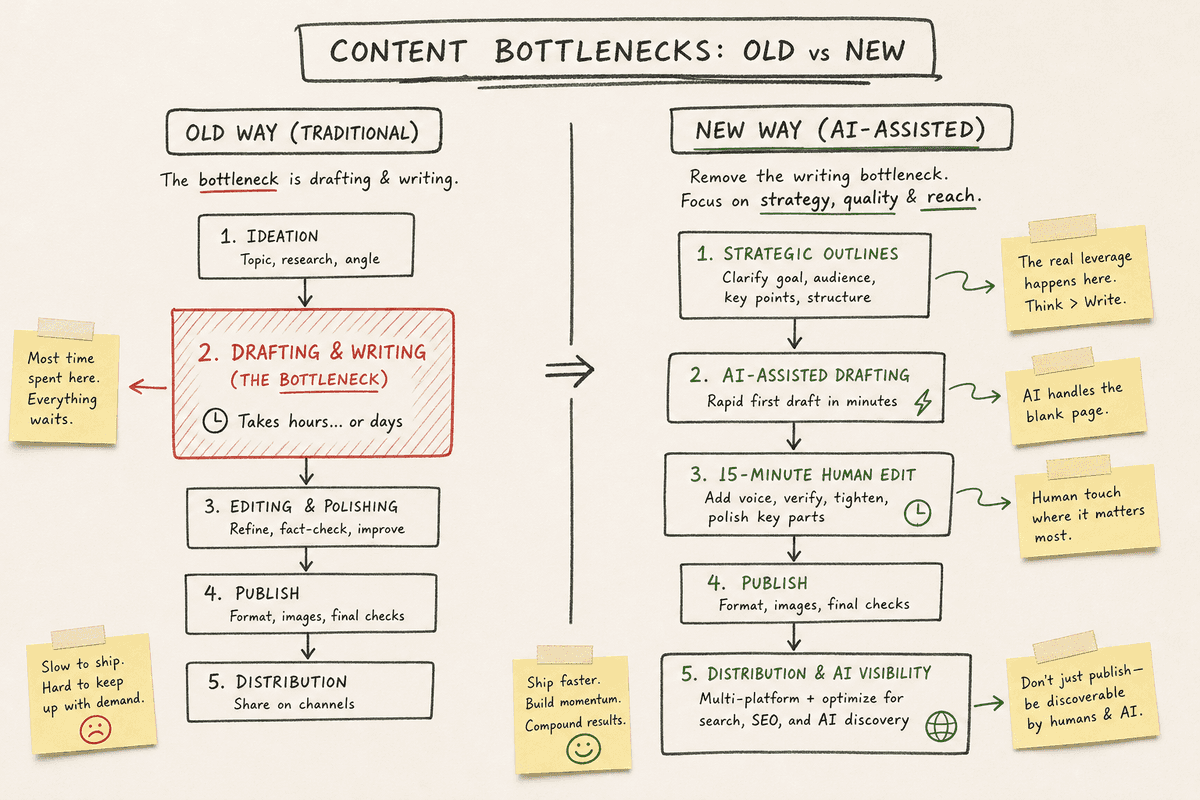
In the past, high-volume strategies were reserved for enterprise companies that could afford large editorial teams or massive freelance budgets. Today, the bottleneck is no longer typing words onto a page; the bottleneck is strategy, quality assurance, and distribution.
AI-powered generation has fundamentally changed the math. AI turns prompts into drafts in minutes, letting small teams scale their production dramatically faster than traditional methods allow (GravityWrite).
But generating a draft in two minutes creates a new problem: managing the pipeline. If you generate 50 articles in an afternoon, someone still needs to review the facts, format the headers, add internal links, optimize the metadata, and schedule the posts. Without the right workflow tools, you are simply trading writing time for formatting time, which defeats the purpose of automation.
Core Pillars of a High-Volume Content Strategy
To move beyond basic one-click generators, small teams must treat content creation as a manufacturing process. This requires standardizing inputs, automating handoffs, and strictly controlling the quality of the final output.
1. The Pillar-Based Architecture
You cannot publish high volume effectively if you are guessing what to write about every morning. High-volume publishing requires a rigid, pillar-based architecture.
Identify three to five core topics your business needs to own. Create one definitive, comprehensive guide for each topic. Then, systematically map out dozens of long-tail questions, specific use cases, and localized variants that point back to that main pillar.
This approach removes decision fatigue. When your AI workflows are generating content, they are working from a predefined map of clustered keywords rather than isolated, random prompts.
2. Advanced Brand Voice Customization
The most obvious flaw of entry-level AI content is how it sounds. It is often overly enthusiastic, uses repetitive sentence structures, and relies heavily on transition words like "furthermore" and "additionally."
To publish at volume without damaging your brand equity, you need tools that allow for deep voice customization. The best automated systems let you upload past writing samples and style guidelines so that the generated content matches your brand's specific tone. This ensures that even when a post is automatically added to a content planner and slotted into the next available publication slot, it reads like it came from your team rather than a generic machine (YouTube).
3. Compounding Performance Over Time
Treat your blog archive as a software product that requires updates and maintenance. HubSpot’s famous blogging strategy does not just rely on publishing new posts; it heavily emphasizes updating historical content. As these performance improvements compound over time, they translate into consistent lead growth (YouTube).
Your high-volume strategy should allocate at least 20% of its resources to refreshing the content you published six months ago, rather than entirely focusing on net-new output.
Building the Automated Publishing Stack
If you are moving away from all-in-one generators like SEOwriting, you need to construct a modular stack. A modular stack allows you to swap out individual tools as better technology becomes available, rather than being locked into a single ecosystem.
Ideation and Prompt Management
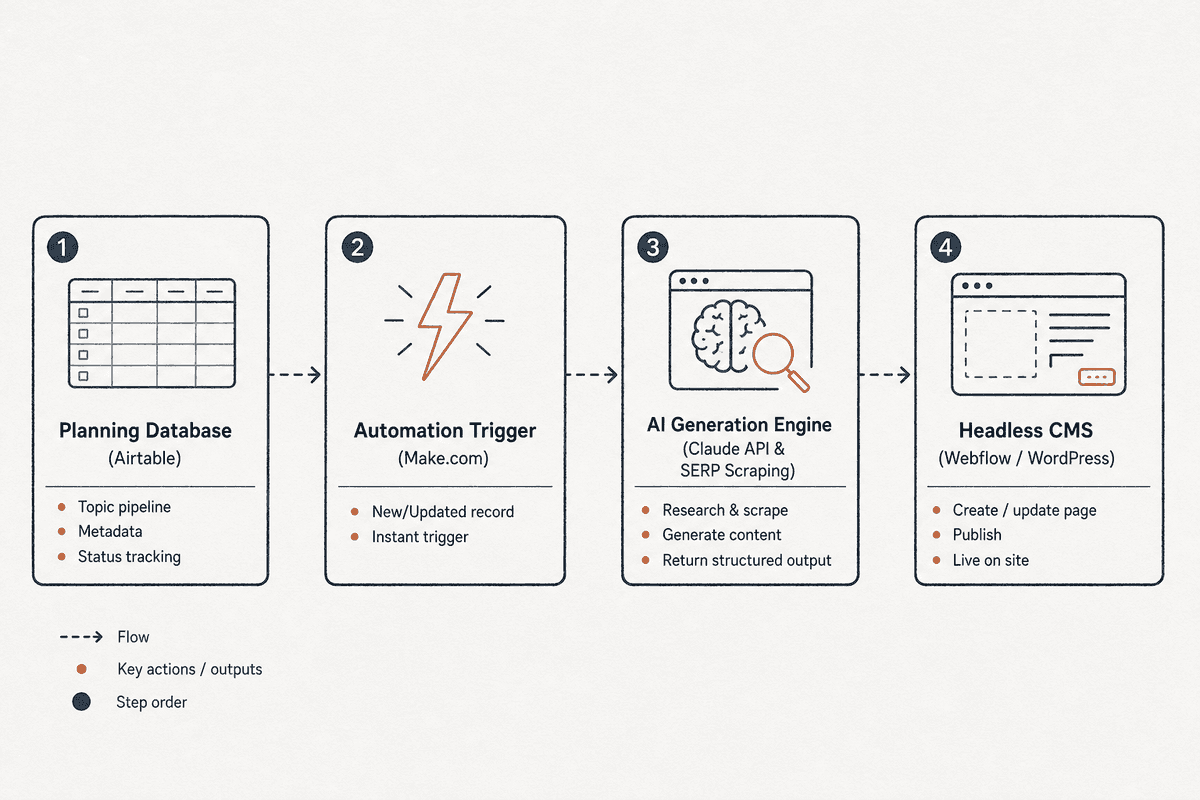
Do not write prompts directly into an AI interface. Use a database tool like Airtable, Notion, or Monday.com as your central command.
Your database should house every target keyword, the target audience, the specific angle, and the required internal links. From this database, you can use API calls to push this structured data into your chosen AI writing tool. This prevents the "blank page" problem and ensures every generated draft has a strategic purpose.
Best Content Generation Tools Beyond SEOwriting
While SEOwriting is popular, several alternatives offer deeper control for small teams focused on quality at scale.
- GravityWrite: Known for highly structured outputs, GravityWrite excels at taking specific prompts and turning them into highly structured drafts quickly. It is particularly useful for teams that need to generate variations of similar content, such as programmatic SEO pages or localized service pages.
- Claude (via API): For teams willing to build a custom workflow, using Anthropic's Claude 3.5 Sonnet via an API connection (using Zapier or Make.com) often produces the most natural-sounding text. You can feed Claude a strict system prompt containing your brand guidelines, negative constraints (words to avoid), and formatting rules.
- KoalaWriter: A strong alternative that offers excellent programmatic SEO features and real-time SERP scraping. It pulls live data from the top-ranking results to inform its outlines, reducing the likelihood of AI hallucinations and ensuring the content actually answers the search intent.
Automated CMS Integration
The most tedious part of publishing at volume is moving content from a Google Doc or an AI platform into your Content Management System (CMS). If you are paying an editor to manually copy text, format H2s, compress images, and set up meta descriptions, your workflow is broken.
Small teams must leverage workflow automation tools like Make.com or Zapier. You can configure a scenario where approving a draft in Airtable automatically triggers a sequence that formats the text into proper HTML or Markdown, generates a featured image, and pushes the draft directly into WordPress, Webflow, or Ghost as a scheduled post. This eliminates the manual administrative work, allowing a single editor to review and schedule dozens of posts in a single afternoon.
If you are trying to understand how automation costs stack up against traditional services, reviewing a breakdown of SEO Charges UK: Agency Rates vs Automation (2026) can provide a helpful benchmark for marketing budgets.
The Critical Step: AI Search Visibility Monitoring
High-volume publishing is ultimately a distribution play. But the distribution landscape is fundamentally shifting. Buyers are increasingly typing their queries into ChatGPT, Perplexity, Gemini, and Google's AI Overviews rather than scrolling through ten blue links.
If your small team publishes 100 blog posts this month, how do you know if they are actually working? Traditional rank trackers will tell you if you are on page one of Google, but they will not tell you if ChatGPT is recommending your software to a B2B buyer.
This is where AI visibility monitoring becomes the linchpin of a modern content strategy. Tools like BeVisible help teams monitor how AI assistants answer buyer questions, which brands they recommend, and which sources they cite.
Instead of guessing what to write about, you can use visibility monitoring to track exact buyer prompts across different AI engines. When you identify visibility gaps—questions where your competitors are cited but you are missing—you can feed those specific gaps directly into your automated content pipeline.
This turns high-volume publishing from a random numbers game into a highly targeted execution strategy. You are no longer just publishing for the sake of volume; you are systematically publishing evidence-backed articles designed to fill missing mentions and secure citations in AI answers.
How to Scale from 4 to 40 Posts a Month: A Mini-Story
Consider a hypothetical two-person B2B SaaS marketing team. In Q1, they manually write and publish four blog posts a month. Traffic is flat, and they are losing ground to a larger competitor.
In Q2, they decide to scale. Instead of hiring an expensive agency, they build an automated pipeline.
Month 1: Infrastructure They spend the first month building out their Airtable content calendar. They identify 120 long-tail keywords based on AI visibility gaps where their brand is currently unmentioned. They write a comprehensive 2,000-word system prompt that defines their brand voice, establishes formatting rules, and lists industry jargon to avoid.
Month 2: The "Cyborg" Workflow They connect their Airtable database to Claude via Make.com. When the marketing manager checks a box in Airtable, Claude receives the keyword, outline, and brand voice guidelines. Three minutes later, a 1,500-word draft appears back in Airtable.
The human editor does not just blindly publish it. They spend 15 minutes reviewing the draft. They inject a specific customer example, fix a clunky transition, and ensure the product tie-in makes sense. Once approved, another Make.com automation pushes the finalized post directly into their Webflow CMS as a draft.
Month 3: Hitting Volume By the third month, the team is comfortable with the system. Because the heavy lifting of drafting and formatting is automated, the editor can process three to four articles a day. They are now publishing 40 high-quality, brand-aligned posts a month. Their AI visibility starts to climb as engines like Perplexity begin citing their new, highly specific long-tail content.
This model works because they did not outsource the thinking. They automated the typing and the formatting, but kept the strategy and the final editorial approval strictly in-house.
Navigating the Pitfalls of High-Volume Automation
Scaling content rapidly introduces new risks. Small teams must proactively guard against several common failure modes.
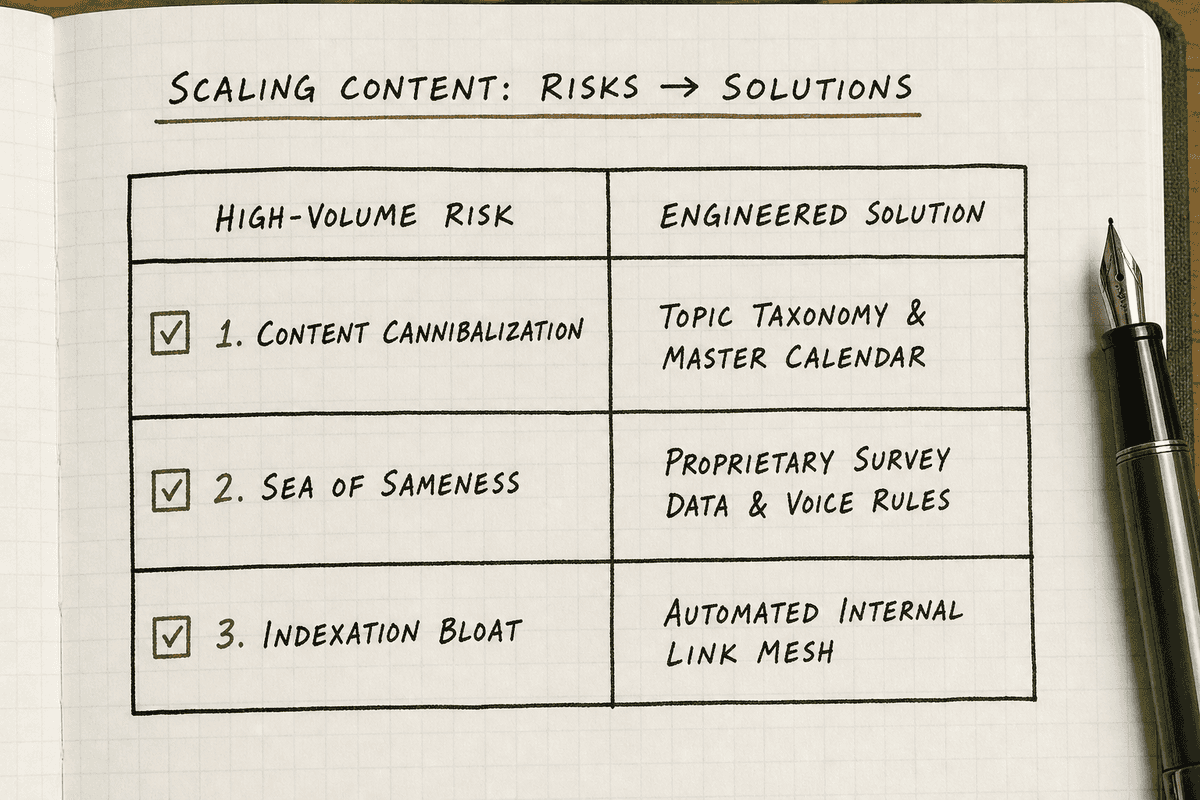
Content Cannibalization
When you publish at high volume, it is easy to accidentally write about the exact same topic three times using slightly different keywords. This confuses search engines and splits your page authority.
To prevent this, maintain a strict taxonomy in your content planner. Before generating a new article, search your database to ensure you do not already have a piece covering that specific intent. If you do, update the existing piece rather than publishing a new one.
The "Sea of Sameness"
AI models are trained on the internet. Left to their own devices, they will regress to the mean, producing content that sounds exactly like everyone else in your industry.
Combat this by constantly updating your system prompts with proprietary data. If you have unique statistics, customer survey results, or contrarian opinions, hardcode them into your generation prompts. Ensure your high-volume content includes insights that a generic model could not possibly know on its own. For inspiration on teams executing unique strategies, reviewing the 11 Best SEO Blogs Every SaaS Founder Needs (2026) can help you benchmark what excellent content looks like in a crowded market.
Technical SEO and Indexation Bloat
Publishing 100 pages a month requires a technically sound website. If your site architecture is messy, search engines may struggle to crawl and index your new volume.
Ensure your internal linking is automated where possible, and that every new post is immediately added to your XML sitemap. If your site relies heavily on JavaScript frameworks, you must ensure your content is actually readable by bots. Implementing strong technical foundations is critical—if you are dealing with modern web apps, following a guide on How to Build an SEO Landing Page (7-Step Guide) ensures your high-volume pages are actually built to convert the traffic they capture.
Common Questions About Scaling Content Teams
Can a two-person team really compete with a large content agency?
Absolutely. The advantage of a small team is agility and deep product knowledge. A large agency often struggles to truly understand the nuances of a complex B2B SaaS product. By using automation tools to handle the heavy lifting of drafting and formatting, a two-person team can focus entirely on injecting that deep product expertise into the content. The output volume can match an agency, but the specific product alignment is usually much higher.
How do you maintain editorial quality when publishing at high volume?
Quality control must be built into the system, not treated as an afterthought.
- Strict Inputs: Garbage in, garbage out. Spend more time crafting detailed, specific outlines and prompts.
- The 80/20 Rule of Editing: Accept that the AI will get you 80% of the way there. The editor's job is not to rewrite the piece, but to spend 15 minutes adding the 20% that makes it human—industry anecdotes, specific product use cases, and nuanced opinions.
- Random Audits: Once a week, pull a published post at random and score it against your brand guidelines. Use this feedback to continuously refine your AI system prompts.
What is the true cost of building an automated blogging workflow?
While SEOwriting AI might cost $14 a month, a professional-grade automated stack will cost more, but remains vastly cheaper than a traditional setup.
Expect to spend around $20-$40 per month on an advanced AI API or subscription (like Claude Pro or GravityWrite), $20-$30 per month on a workflow automation tool (Zapier or Make.com), and $15-$25 per month on a database tool (Airtable). For less than $100 a month, you have the infrastructure to publish hundreds of articles. The real cost is the time investment required to build the initial architecture and refine the brand voice parameters.
Moving Beyond Raw Generation
The goal of high-volume publishing is not simply to have a lot of URLs on your domain. The goal is to blanket your target market with helpful, accurate information so that whenever a buyer asks an AI assistant a question, your brand is the cited authority.
Achieving this requires moving past basic one-click generators. By implementing a structured pillar strategy, leveraging advanced tools that match your brand voice, automating the frustrating administrative tasks, and constantly monitoring your AI search visibility, small marketing teams can punch far above their weight and turn missing mentions into compounding lead growth.