
You open ChatGPT, type in the exact query your highest-converting buyers use, and hit enter. The AI generates a structured, confident list of the top five solutions in your market. Your biggest competitor is listed first, complete with bullet points praising their ease of use. Your brand is entirely missing.
For B2B growth teams and SaaS founders, this scenario is no longer an edge case. It is a daily revenue leak.
Search behavior has fractured. Buyers are bypassing traditional search engine results pages (SERPs) and asking AI assistants for direct recommendations. If you cannot measure how ChatGPT, Gemini, Perplexity, and Google's AI Overviews perceive your brand, you are flying blind in the fastest-growing acquisition channel of the decade.
Software to monitor AI recommendations has emerged to solve this exact problem. While early tools like Otterly.ai brought much-needed visibility to the space, passive monitoring is no longer enough. Knowing you are losing to a competitor is only half the battle. The real objective is turning those missing mentions and weak citations into published work that forces the AI algorithms to reconsider.
This guide explores the current landscape of AI recommendation monitoring software. We will examine the limitations of passive tracking, break down the strongest tools available in 2026, and show you how to transition from simply observing AI answers to actively shaping them.
The Two Distinct Worlds of AI Monitoring
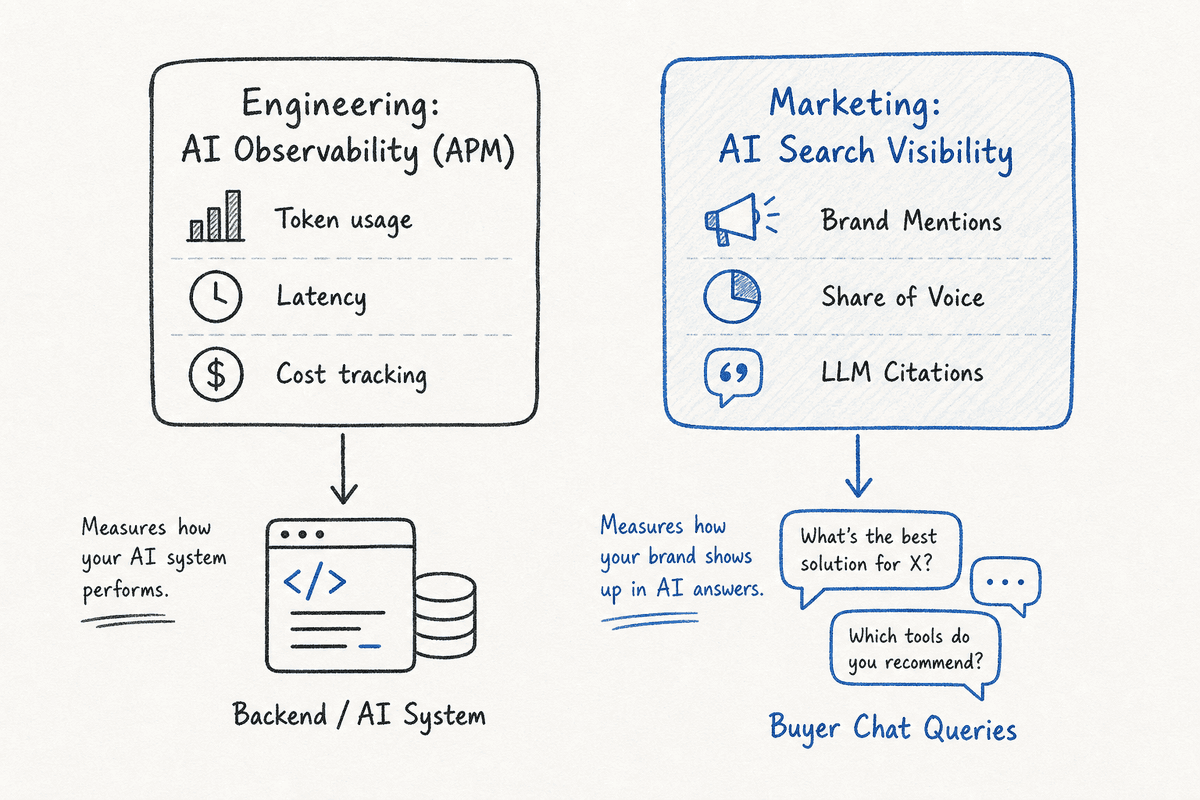
Before evaluating software, you must define what you are actually trying to monitor. The term "AI monitoring" frequently causes confusion because it applies to two completely different disciplines: system observability and brand visibility.
1. Application Performance Monitoring (APM) for AI
If you are building an AI product, you need software to monitor how your AI agents perform in production. This involves tracking token usage, latency, hallucination rates, and API costs. Developers rely on specialized platforms like New Relic to scale AI with visibility into backend performance. They might also attend technical deep dives on how to monitor AI agents in production to refine their retrieval pipelines. This category is strictly for engineering and product teams.
2. AI Brand and Search Visibility Monitoring
If you are a marketer, founder, or agency, you do not care about API latency. You care about whether ChatGPT recommends your product when a user asks for "best inventory management software for Shopify." You want to know which sources Perplexity cites when comparing your brand to a competitor.
This second category is what we are covering today. AI visibility software tracks the outputs of commercial Large Language Models (LLMs) and AI search engines to measure your brand's share of voice, sentiment, and citation frequency.
Where Passive Trackers Like Otterly.ai Succeed (and Stop)
When marketing teams first realize they need to track AI recommendations, they often evaluate Otterly.ai. It has built a reputation as a reliable baseline tool for tracking share of voice across generative engines.
As a monitoring tool for agencies, Otterly excels at data aggregation. It tracks major platforms including ChatGPT, Perplexity, Google AI Overviews, Google AI Mode, Gemini, and Microsoft Copilot. You can feed it a list of keywords, and it will return a dashboard showing your brand's visibility score compared to your competitors.
The software provides a clear snapshot of reality. You can log in on a Monday morning and see that your software is recommended in 12% of ChatGPT conversations regarding your category, while your main rival is recommended in 45%.
But this is precisely where passive monitoring tools hit a wall.
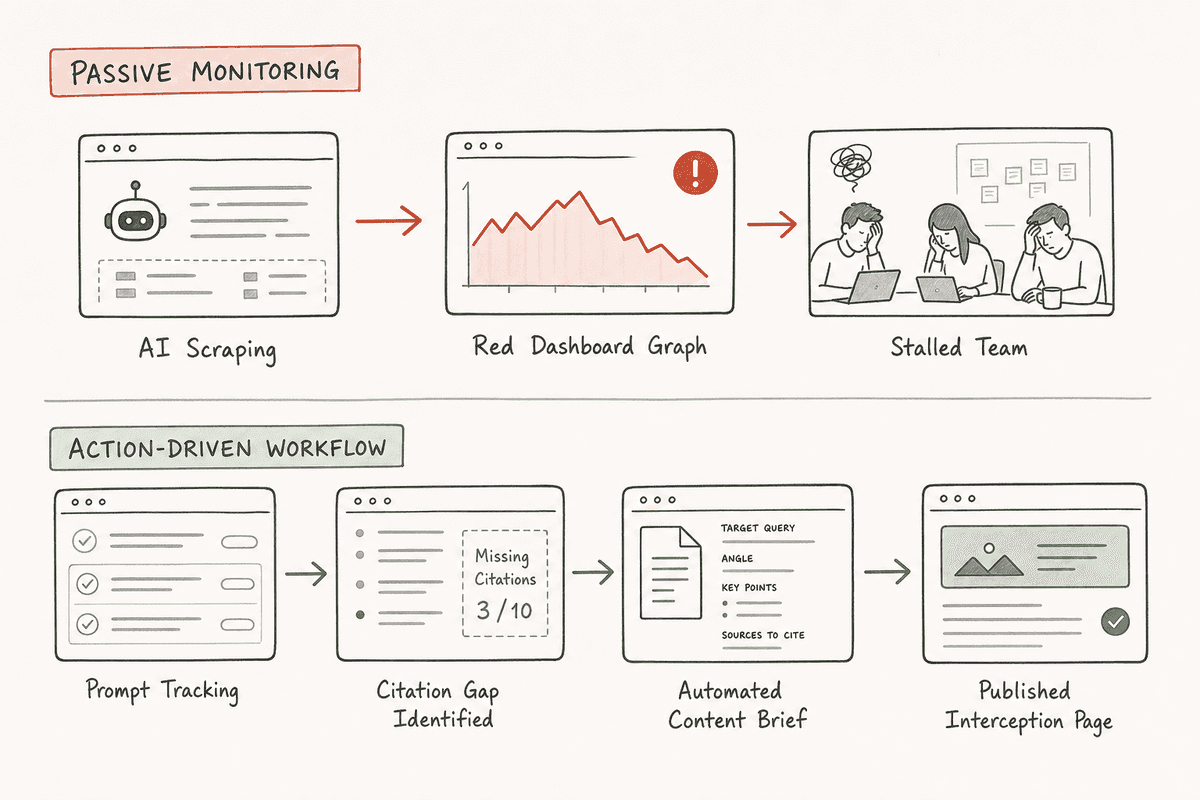
Dashboards create awareness, not pipeline. When a monitoring tool tells you that Perplexity prefers your competitor, the immediate question is: Why? And more importantly: What do we do about it right now?
Traditional rank trackers suffered from this same limitation. They told you your landing page dropped to page two of Google, but left you to figure out the technical fixes, content gaps, or backlink deficits on your own. AI recommendation engines are exponentially more complex than traditional search algorithms. Knowing you are missing from an AI answer does not explain whether the LLM is ignoring you because of poor technical crawlability, a lack of trusted third-party reviews, or a deficit in unlinked brand mentions.
Passive tracking leads to dashboard fatigue. Teams stare at red lines on a graph, unsure of the operational steps required to turn things green.
BeVisible: The Action-Driven Alternative
The evolution of AI visibility requires moving from observation to execution. BeVisible was built specifically for teams that need to measure AI-search visibility and immediately turn those insights into published work.
Rather than stopping at a visibility score, BeVisible acts as an end-to-end AI workflow platform for SaaS founders, B2B marketing teams, and content agencies.
Multi-Engine Buyer Prompt Tracking
BeVisible tracks the exact prompts your buyers use across the most critical engines: ChatGPT, Gemini, Perplexity, AI Mode, and Google AI Overviews. By analyzing how these assistants answer questions, BeVisible identifies precisely which brands are being recommended and, crucially, which sources the AI relies on to make those recommendations.
Reversing the Citation Engineering Process
AI assistants do not form opinions in a vacuum. Platforms like Perplexity and Google AI Overviews rely on Retrieval-Augmented Generation (RAG). They scrape the web in real-time, find trusted sources discussing the user's prompt, and synthesize that information into a cohesive answer.
If your brand is missing from the recommendation, it is usually because you are missing from the underlying sources the AI trusts. BeVisible highlights these citation gaps. It shows you exactly which Reddit threads, G2 review pages, or niche industry blogs the AI is reading to form its answers.
Turning Gaps Into Published Work
This is the core distinction between BeVisible and passive trackers. BeVisible takes your missing mentions and competitor wins, and translates them into evidence-backed opportunities.
If the software detects that ChatGPT consistently recommends a competitor because of a specific feature gap mentioned in a high-ranking blog post, BeVisible queues that insight into your scheduling and publishing workflow. It creates a concrete action plan to intercept the AI's data diet. You are no longer guessing what content to write. You are publishing the exact articles, comparisons, and feature pages the AI engines are looking for.
The 2026 Landscape: 3 Other Software Options for AI Monitoring
Beyond BeVisible and Otterly.ai, several other platforms have entered the AI monitoring space. These tools generally approach the problem from the perspective of traditional enterprise SEO or specialized LLM analytics.
1. Amplitude (via Ahrefs Brand Radar integration)
Traditional SEO giants are scrambling to adapt to the AI era. Ahrefs has expanded its traditional keyword tracking to include brand monitoring capabilities that touch on AI visibility. Amplitude highlights that platforms extending into AI mention monitoring provide a bridge for teams already deeply entrenched in traditional search metrics.
If your team relies heavily on traditional backlink analysis and technical site audits, these extended modules offer a familiar interface. However, because they are built on legacy SEO infrastructure, they often treat AI prompts like traditional keywords, which fails to account for the conversational, multi-turn nature of AI chat interfaces.
2. Authoritas / Evertune
Evertune operates as a specialized analytics platform focused on how AI systems represent your brand. Evertune aims to measure how AI represents your brand and provides analytics on your positioning in generative AI recommendations.
This software is particularly useful for enterprise brands managing complex public relations and brand sentiment. If you are a multinational corporation worried about how an LLM summarizes a recent product recall, these specialized sentiment analysis tools provide granular data on LLM positioning. For growth-focused SaaS teams trying to capture high-intent buyer queries, the enterprise-heavy feature set can sometimes feel bloated.
3. Nightwatch
Nightwatch built its reputation on highly accurate local rank tracking for traditional SEO. They have recently integrated LLM monitoring and citation-level sentiment analysis into their platform. Nightwatch bridges the gap between tracking a localized traditional search (e.g., "best plumbers in Chicago") and monitoring how Google AI Overviews handle that same query.
This makes Nightwatch a strong contender for local businesses or agencies managing brick-and-mortar clients. If your AI strategy relies heavily on localized queries, their hybrid approach provides solid baseline data.
The Core Mechanics of AI Recommendations: What Are You Actually Tracking?
To choose the right software, you must understand how AI assistants generate their recommendations. AI answers are not monolithic. Different engines use entirely different mechanisms to decide which brand deserves the top spot. Your monitoring software must account for these mechanical differences.
Parameterized Knowledge vs. RAG
Generative engines rely on two primary methods to retrieve information:
Parameterized Knowledge: This is the information baked directly into the model's neural network during its initial training phase. When you ask a base model (without internet access) a general question, it relies on this internal weighting. Changing parameterized knowledge is incredibly difficult because you have to wait for the AI company to release a new training run, and your brand must be prominently featured in their training data.
Retrieval-Augmented Generation (RAG): This is how modern, connected AI assistants work. When a user asks Perplexity for "the best CRM for manufacturing," Perplexity searches the live internet, reads the top-ranking articles, extracts the relevant facts, and synthesizes an answer.
Monitoring software must distinguish between these two outputs. If an AI recommends a competitor based on parameterized knowledge, your strategy requires massive digital PR and long-term brand building. If the AI recommends a competitor based on RAG, you can intercept that recommendation quickly by publishing targeted content that outranks the AI's current sources.
The Engine Nuances
A prompt entered into Gemini will often yield a completely different recommendation than the exact same prompt entered into ChatGPT.
- Google AI Overviews heavily prioritize traditional SEO signals. They pull from sites with high domain authority, strong internal linking, and excellent technical foundations. For instance, how you build an SEO landing page directly impacts whether Google's AI will cite you.
- Perplexity operates like a hyper-efficient research assistant. It loves dense, factual content, comprehensive comparison tables, and primary sources. It frequently cites Reddit threads and specialized industry forums to capture raw user sentiment.
- ChatGPT (Search enabled) relies heavily on Bing's search index to pull real-time data, but often defaults to high-authority media publications and aggregate review sites like G2 or Capterra for software recommendations.
Effective monitoring software must split its data by engine. A blended "overall AI visibility score" is mathematically useless because the execution strategy for winning Perplexity is vastly different from the strategy for winning Google AI Overviews.

5 Features You Must Demand From AI Recommendation Software
If you are evaluating tools to track your share of AI search, treat the procurement process exactly as you would when buying mission-critical revenue software. Look past the marketing copy and demand proof of these five capabilities.
1. Citation Source Extraction
Knowing you were mentioned is baseline data. Knowing why you were mentioned is actionable intelligence. The software must show you the exact URLs the AI scraped to form its answer. If ChatGPT recommends your SaaS product and cites a specific G2 review and a blog post from a partner integration, you need to know that. This allows you to double down on the channels that are actually influencing the algorithms.
2. Prompt Flexibility
Buyers do not talk to AI the way they talk to Google. Traditional search queries are short and fragmented ("SEO charges UK"). AI prompts are conversational, highly specific, and contextual ("What are the standard SEO charges in the UK for a B2B SaaS company transitioning from an agency to an automated in-house model?").
Your software must allow you to track long-form, multi-variable prompts. If the tool forces you to track single keywords, it is just a legacy rank tracker wearing an AI mask.
3. Share of Voice (SOV) by Competitor
You cannot measure success in a vacuum. The software must allow you to input your top five competitors and track your visibility against theirs across specific topics. If your visibility drops by 10%, you need to know instantly which competitor captured that lost ground and which new sources the AI is citing to justify their rise.
4. Hallucination Filtering
AI models hallucinate. They invent features, fabricate pricing, and create non-existent integrations. Your monitoring software needs a mechanism to detect when an AI recommendation is based on a hallucination versus actual web data. If an AI assistant tells buyers your product costs $5,000 per month when it actually costs $500, your marketing team needs to know immediately so they can publish aggressive, indexable pricing corrections to retrain the RAG pipeline.
5. Execution Workflows
The data must flow into a work queue. BeVisible pioneered this approach by ensuring that visibility gaps directly inform content scheduling. If the software requires you to manually export a CSV, interpret the data, hold a meeting, and then manually create a brief in a separate project management tool, the insight will rot before you execute on it.
The Execution Playbook: Turning AI Gaps into Pipeline
Assume you have implemented a platform like BeVisible. The dashboard reveals that across 50 high-intent buyer prompts, your brand has a 5% share of voice. Your competitor sits at 60%.
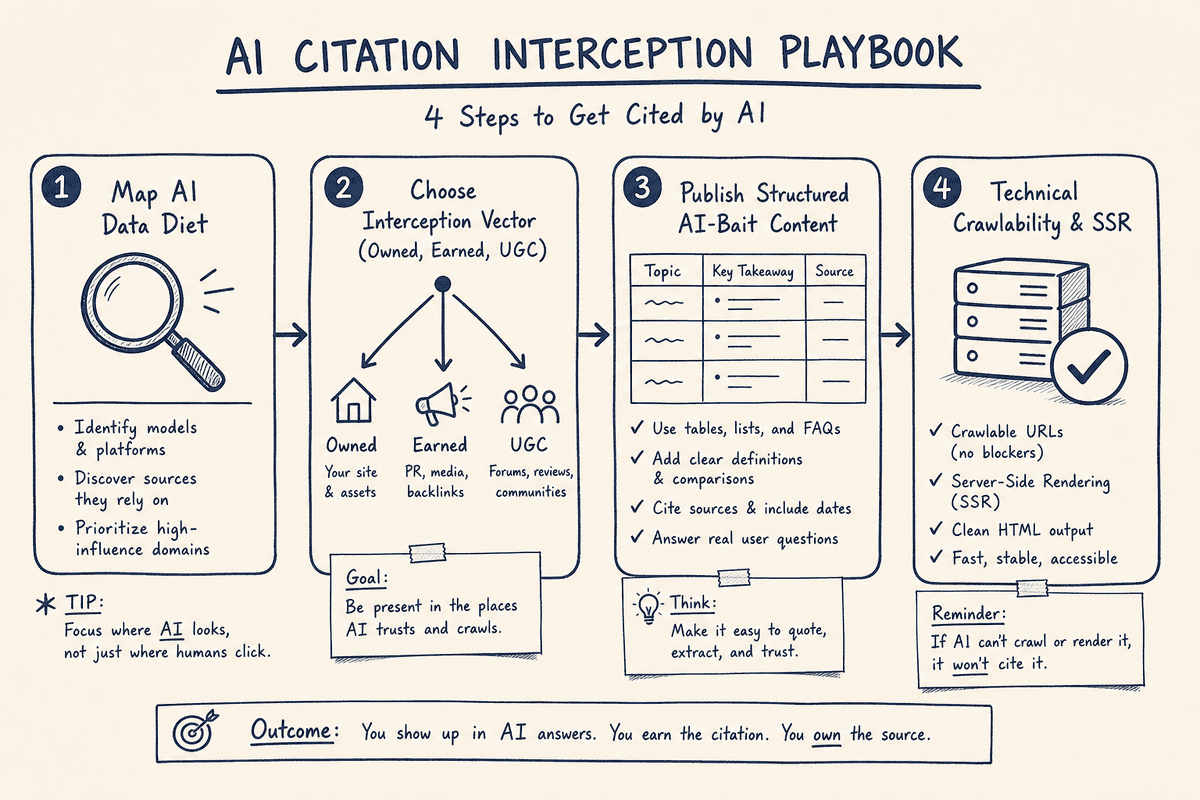
How do you close the gap? You execute the following playbook.
Step 1: Map the AI's Data Diet
Look at the citations the AI is using to recommend your competitor. You will usually find a pattern. The AI might be leaning heavily on a specific "Top 10" listicle published by an industry publication. It might be pulling from a massive Reddit thread where users are complaining about your lack of a specific feature. Or it might be reading your competitor's highly optimized comparison pages.
Step 2: Determine the Interception Vector
Once you know what the AI is reading, you must decide how to intercept that information. You have three primary vectors:
- Owned Media: Publish content on your own domain to directly answer the prompt better than the current sources.
- Earned Media: Reach out to the third-party sites the AI is already citing and pitch them on including your brand.
- User-Generated Content (UGC): Encourage your happy customers to leave detailed, feature-specific reviews on the platforms the AI trusts (G2, TrustRadius, Reddit).
Step 3: Publish "AI-Bait" Content
AI crawlers want structure, factual density, and clear semantic relationships. When publishing content designed to influence AI recommendations, avoid fluff.
Use standard markdown tables to compare features. Use numbered lists to explain workflows. Define acronyms clearly. If you are a specialized agency, reading top SEO blogs will reveal that AI models prefer entities mapped to clear definitions. State your facts plainly: "Product X integrates with Y via a native API." Do not write: "Our revolutionary synergy seamlessly unlocks integration potential." AI algorithms discard marketing speak; they index facts.
Step 4: Ensure Technical Crawlability
The most profound AI content strategy will fail if the AI's web crawlers cannot render your site. This is especially true for modern web frameworks. If your application relies heavily on client-side rendering, you must ensure you have implemented proper SEO for single-page applications.
AI bots like ChatGPT-User or Googlebot need to access your text efficiently. If they hit a blank JavaScript shell, they will leave, and your competitor will win the recommendation. Server-side rendering (SSR) or dynamic rendering is non-negotiable if you want your content fed into RAG pipelines.
The Financial Argument: In-House Automation vs. Agency Retainers
Adopting AI recommendation monitoring software requires budget allocation. Many SaaS founders debate whether to purchase software like BeVisible for their internal growth team or outsource the entire AI visibility problem to an agency.
The traditional agency model is struggling to adapt to the velocity of AI search. Agencies are accustomed to a monthly cadence: auditing keywords, writing blog posts, and building backlinks. AI search moves dynamically. A single viral Reddit thread can alter Perplexity's recommendation engine overnight.
Relying on an agency to manually check ChatGPT prompts once a month guarantees you will always be reacting weeks late.
Automated software brings the intelligence in-house. A robust tool continuously scans the engines, identifies the shifts, and cues up the necessary publishing tasks. Even if you ultimately use freelance writers or a content agency to execute the writing, the strategic intelligence—knowing exactly what the AI engines want to read today—must be owned internally through automated monitoring.
This approach significantly reduces bloated retainer costs while increasing execution speed. When you control the visibility data, you control the strategy.
Advanced Tactics: Managing Sentiment and Context in AI Recommendations
Getting mentioned by an AI assistant is only the first step. The context of that mention dictates whether the user actually clicks through to your site.
AI models are highly sensitive to semantic proximity. If your brand name frequently appears near words like "expensive," "difficult," or "outdated" across the web, the AI will internalize that sentiment and reflect it in its summaries.
Tracking Feature-Specific Sentiment
Advanced monitoring involves tracking specific feature queries. Do not just track "best accounting software." Track "which accounting software is easiest for non-accountants to use."
If you discover that AI engines consistently label your product as "powerful but steep learning curve," you have a sentiment problem. To fix this, you must flood the AI's data sources with counter-narratives. You would schedule articles detailing your new onboarding flow, create comparison charts highlighting your intuitive UI, and ask customers to specifically mention "ease of use" in their public reviews.
Leveraging Competitor Weaknesses
Monitoring software will also reveal your competitors' weaknesses. When you track a competitor's brand name in AI engines, look for the caveats the AI includes.
An AI might say: "Competitor X is an excellent choice for enterprise teams, though it lacks robust mobile capabilities."
This is an immediate execution opportunity. You now know the AI recognizes a gap in the market regarding mobile capabilities. Your team should immediately publish targeted content emphasizing your platform's superior mobile experience, specifically comparing it to the broader enterprise solutions. When the AI model next crawls the web to update its knowledge base, it will find your content waiting, perfectly positioned to capture that specific weakness.
Frequently Asked Questions About AI Recommendation Software
Can AI monitoring tools track personalized results? No tool can track a perfectly personalized session, as AI chat interfaces adapt to the user's specific conversational history. However, platforms like BeVisible track the "clean room" baseline response. By running prompts through fresh, unbiased sessions across multiple geographies, the software establishes the standard recommendation the AI defaults to before heavy personalization takes over.
Is traditional SEO obsolete now that AI assistants provide direct answers? Absolutely not. Traditional SEO is the foundation of AI visibility. Engines like Google AI Overviews and Perplexity rely entirely on traditional search indexes to find the information they synthesize. If your site has poor technical architecture, slow load times, or a lack of authoritative backlinks, it will not rank in traditional search, which means the AI bots will never find it to cite it. Traditional SEO is now the mechanism for feeding the AI.
How long does it take to change an AI's recommendation? If you are dealing with parameterized knowledge (a base model like ChatGPT-4o without web search), it can take months until the next training update. If you are dealing with RAG-based engines like Perplexity or Google AI Overviews, you can alter recommendations in a matter of days or weeks. Once you publish the right content and force a crawl via Google Search Console or Bing Webmaster Tools, the AI will pull the new data during its next real-time retrieval phase.
Should I optimize for ChatGPT or Perplexity? You must optimize for both, but the methods differ. Perplexity captures a highly technical, research-heavy audience that values primary sources and detailed comparisons. ChatGPT commands massive volume and tends to favor authoritative mainstream publications and established brand entities. Your monitoring software should tell you where your specific buyers are active, allowing you to prioritize the right engine.
The Execution Imperative
Observing your brand lose market share in real-time is not a strategy. The first wave of AI search tools proved that we can track generative engines. The current wave proves that tracking is only valuable if it leads directly to production.
When buyers ask an AI assistant to solve their problem, they receive a definitive answer. They do not scroll through ten pages of blue links; they trust the synthesis provided. If your brand is not part of that synthesis, you do not exist in that buyer's journey.
Software to monitor AI recommendations must do more than print a dashboard. It must identify the missing mentions, reveal the weak citations, expose competitor wins, and hand your team the exact blueprint required to publish the assets the algorithms crave.
Stop watching the AI recommend your competitors. Start publishing the evidence it needs to recommend you.