
You spent hours tweaking a draft to hit a score of 90 in Surfer SEO. You carefully injected every NLP entity, matching the exact word count, heading ratio, and keyword density recommended by the tool. A few weeks later, you check your analytics. Not only is traditional organic traffic flat, but when you prompt ChatGPT, Gemini, or Google's AI Overviews with buyer questions, your highly optimized page is nowhere to be found.
Instead, the AI assistants are citing a competitor's article that completely ignores traditional keyword metrics.
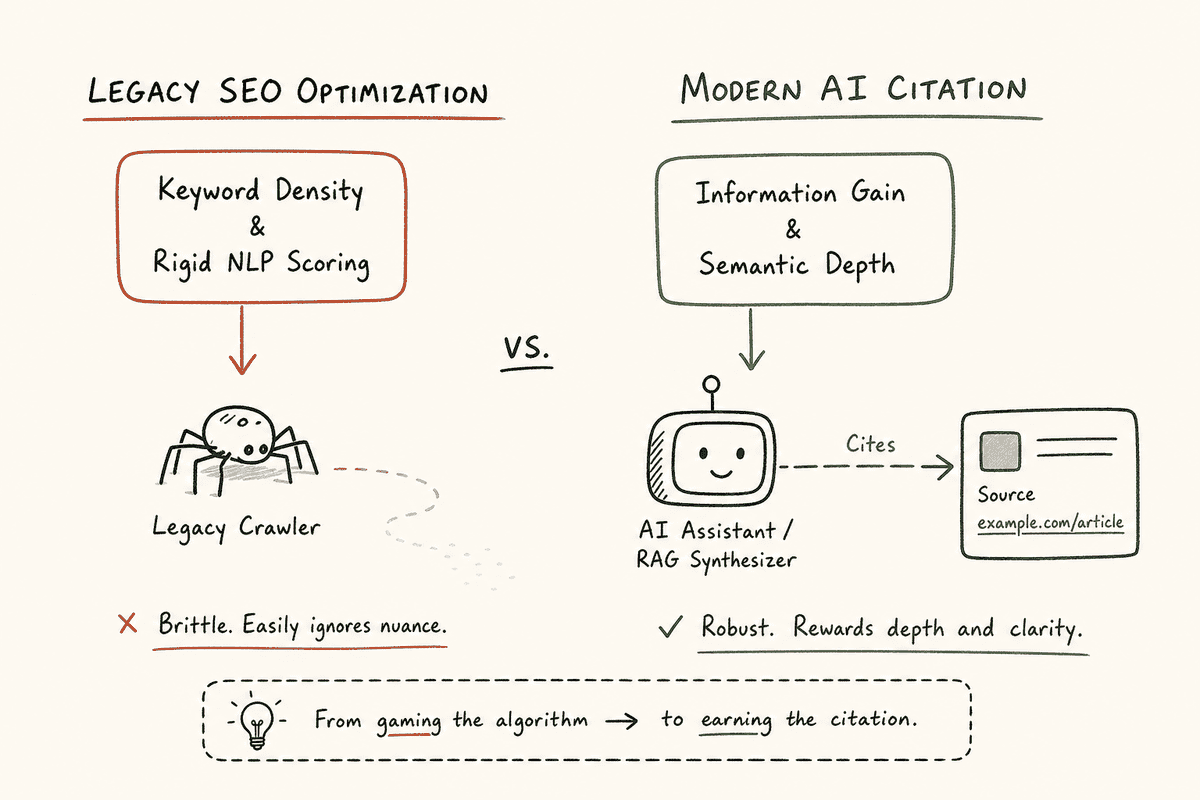
Why? Because traditional content optimization tools were built for a fundamentally different era of search. They train writers and AI generators to produce dense, repetitive, entity-stuffed paragraphs. While that approach historically satisfied legacy web crawlers, modern Retrieval-Augmented Generation (RAG) systems operate differently. AI models evaluating sources for their own answers prioritize semantic depth, readability, and natural cadence. When content reads like a robot trying to game a scoring algorithm, modern models often pass it over.
Passing human tone standards requires bypassing predictable AI patterns like monotonous sentence lengths, frequent transition words, and robotic phrasing. To maintain visibility in a world where AI assistants answer buyer questions directly, content teams are shifting away from traditional entity-stuffing. They are moving toward a new stack of AI content generators, advanced base models, and dedicated humanizers designed to produce nuanced, conversational, and context-aware writing.
The Shift: Why Legacy Optimization Fails Modern AI Search
Traditional SEO optimization tools rely heavily on correlational data. They analyze the top ten search results, extract the most common terms, and tell you exactly how many times to use them. For years, this was highly effective.
But this methodology creates a structural problem when paired with AI content generators.
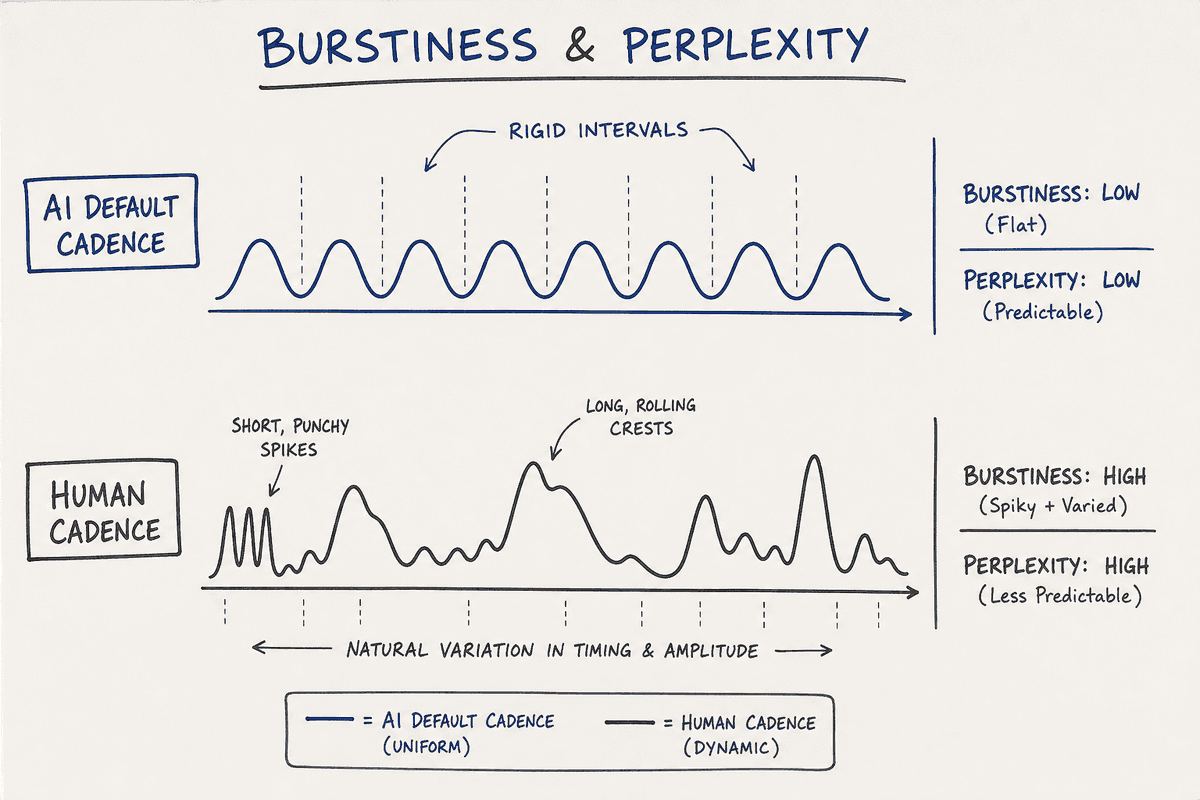
If you feed an AI generator a strict list of 50 mandatory keywords and phrase match requirements, the LLM is forced to contort its sentences to accommodate them. The resulting text suffers from low "burstiness" (variation in sentence length and structure) and low "perplexity" (the unpredictability of word choices).
The Anatomy of Robotic Content
When AI generators attempt to satisfy aggressive SEO scoring tools, they fall into predictable failure modes:
- The Transition Trap: Forced to connect unrelated entities, the AI leans on words like "moreover," "furthermore," "crucially," and "additionally."
- The Symmetrical Paragraph: Every paragraph ends up being exactly three to four sentences long, containing a topic sentence, a supporting sentence, and a concluding thought.
- The Definition Reflex: Instead of speaking to an expert audience, the AI stops to define basic industry terms simply because those terms were on the required entity list.
- The Summary Habit: Articles repeatedly summarize themselves at the end of every H2 section, padding the word count without adding information gain.
AI assistants like Perplexity and ChatGPT are designed to synthesize the most helpful, authoritative information available. When their internal algorithms parse content riddled with these robotic patterns, the text often triggers internal quality filters. It reads as low-effort or spam, reducing the likelihood of your brand being cited in the AI's final answer.
What Defines "Human Tone Standards" in 2026?
To replace the old scoring metrics, content teams need a new set of standards focused on human readability and AI detector avoidance. Passing human tone standards isn't just about tricking a scanner; it is about creating content that actually engages the reader and signals authority to an AI evaluating the text for citation.
Burstiness and Perplexity
These two terms are the foundation of how AI detection works, and consequently, how you bypass it.
Perplexity measures how predictable a sequence of words is to a machine learning model. If a sentence uses the exact sequence of words a model would naturally predict, its perplexity is low. Human writers naturally use idioms, unexpected synonyms, and varied sentence structures, resulting in high perplexity.
Burstiness refers to the structural variation in the text. AI generators default to a steady, monotonous rhythm. Human writers are inherently bursty. We write a long, flowing sentence that spans three lines and contains multiple clauses. Then we write a short one. Like this.
Making ChatGPT sound human requires deliberately breaking its default rhythm. By default, its writing is imperfect, and the tone can sometimes feel stiff, formal, and a little bit robotic. Teaching your content generator to embrace high burstiness and high perplexity is the first step away from traditional SEO scoring.
Nuance Over Density
Human tone standards prioritize nuance. A human expert discussing a complex B2B software integration will acknowledge edge cases, point out common mistakes, and use real-world analogies. A legacy SEO tool simply wants the phrase "B2B software integration API" used three times in the text.
Modern AI content generators that pass human tone standards are prompted to focus on the narrative and the edge cases, allowing the necessary entities to occur naturally rather than forcing them into the structure.
Base LLMs That Natively Sound Human
Before reaching for third-party optimization tools or complex prompt chains, it is critical to select the right base model. If you are generating content directly, the underlying Large Language Model dictates the baseline tone. Instead of needing heavy post-editing, certain models natively excel at nuanced, conversational writing.
Claude (by Anthropic)
In 2026, Claude remains the gold standard for natural, human-like writing out of the box. Unlike other models that default to overly enthusiastic or formal tones, Claude excels at matching specific voice guidelines.
When you provide Claude with a few examples of your brand's writing style, it can mimic the cadence, formatting preferences, and vocabulary constraints with remarkable accuracy. It naturally avoids the repetitive transitions and forced summaries that plague other generators. For content teams looking to build How to Build an SEO Landing Page (7-Step Guide), Claude can generate the persuasive, user-centric copy required for conversions without sounding like an infomercial.
Grok
Grok has carved out a unique space for content that requires a casual, witty, or opinionated tone. For brands that lean into a conversational, slightly irreverent voice, Grok often reads like a clever human colleague rather than a sanitized corporate bot.
While Grok might not be the right fit for a highly technical whitepaper, it shines in newsletter generation, opinion-led blog posts, and social media commentary. Its training leans heavily on real-time human interactions, giving it a natural defense against the stiff, academic tone common in older LLMs.
OpenAI o3-mini
For deep, context-rich content, OpenAI's o3-mini is highly capable of producing detailed outputs that score well on human tone checks. The "mini" designation belies its reasoning capabilities. Because it processes context more efficiently, it can take in a massive amount of source material—like transcripts from Subject Matter Expert (SME) interviews—and synthesize it without losing the human voice of the original speaker.
When you need to turn a recorded webinar into an authoritative article, feeding the transcript to o3-mini and prompting it to retain the speaker's exact colloquialisms results in highly detailed, context-rich outputs that easily pass as human writing.
Dedicated AI Humanizers to Bypass Detectors
Even with the best base models, there are times when generated text still triggers AI detectors or feels slightly off. This is especially true if you are scaling content production or if you inherited a batch of heavily SEO-optimized content that needs to be refreshed for modern AI visibility.
When base LLMs aren't enough, dedicated AI humanizer tools offer a distinct alternative to traditional SEO scoring tools. Instead of optimizing for keywords, these tools optimize for burstiness, perplexity, and natural flow.
With so much AI content flooding the internet, standing out with real human-sounding writing has never been more important. Dedicated humanizers restructure the text specifically to strip away the tell-tale signs of machine generation.
WriteHuman
WriteHuman is built explicitly for bypassing AI detectors. Its core value proposition is taking raw, detectable AI output and restructuring the syntax and vocabulary so that it is indistinguishable from human writing.
For agencies scaling content, tools like WriteHuman serve as a final polishing step. Instead of running a draft through Surfer SEO to check keyword density, editors run it through WriteHuman to ensure the rhythm and vocabulary read naturally. The tool effectively breaks up the monotonous sentence lengths and replaces predictable word choices with more varied language.
Grammarly's AI Humanizer
Grammarly has evolved far beyond basic spell-checking. Grammarly's AI humanizer is designed to refine text so that it sounds clear, genuine, and expressive.
What makes Grammarly's approach unique is its focus on expression rather than just detector evasion. It highlights sections of text that sound overly formal, passive, or disconnected, offering rewrite suggestions that inject active voice and natural pacing. This is particularly useful for in-house content teams who want to maintain editorial control rather than trusting a black-box rewriter to change their entire draft.
The Broader Humanizer Landscape
The market for these tools is expanding rapidly. When evaluating the 5 best AI humanizer tools to beat AI detectors in 2026, the primary differentiator is often how much control the user retains over the final tone. Some tools allow you to specify the target audience (e.g., academic, casual, professional), while others apply a universal "human" algorithm that may strip away necessary technical jargon in an attempt to sound more conversational.
Selecting the right tool depends heavily on your niche. A highly technical B2B SaaS brand will need a humanizer that understands how to vary sentence structure without dumbing down the industry-specific vocabulary.
Building the Human-Tone Workflow (Replacing Surfer)
If you are abandoning the legacy workflow of generating content and then stuffing it with keywords via a scoring tool, what do you replace it with? You need a reliable, repeatable workflow that consistently produces high-quality, human-sounding content.
Step 1: The Information Gain Brief
Traditional SEO briefs focus on target keywords, LSI terms, and word counts. A human-tone brief focuses on information gain.
Information gain is the unique value, data, or perspective your article provides that cannot be found in the current top-ranking results. When AI models like Perplexity evaluate sources, they look for unique data points and original synthesis.
Your brief should include:
- The Target Question: What specific buyer question are you answering?
- The Original Insight: What proprietary data, customer story, or contrarian opinion are you including?
- The Voice Guidelines: Specific examples of how your brand sounds (e.g., "authoritative but conversational, like a senior engineer mentoring a junior developer").
Step 2: Prompting for Tone, Not Just Output
The most common mistake when using AI content generators is asking for the final output in a single prompt. If you ask a model to "Write a 2000-word blog post about AI visibility," it will rely on its most predictable, average training data, resulting in highly detectable, robotic text.
Instead, use a chained prompting approach:
- Context Setting: Provide the model with your original insights, data points, and the target audience.
- Voice Training: Feed the model 3-4 examples of your previous, high-performing human-written content. Ask it to analyze the tone, sentence structure, and pacing.
- Outlining: Have the model generate an outline based only on the provided context, preventing it from hallucinating generic filler.
- Drafting in Chunks: Generate the content section by section. This prevents the model's tone from degrading over a long output window.
Step 3: Deliberate Formatting and Structure
Human writers use formatting to make complex topics digestible. They use bullet points, bold text for emphasis, and short paragraphs to break up large walls of text.
AI generators often default to massive, dense paragraphs. When reviewing your AI-generated draft, aggressively break up the text. If you are writing about SEO for Single Page Applications: The Technical Checklist, the reader needs clear, actionable steps, not dense theoretical paragraphs. Formatting the output into a clear checklist inherently makes the content feel more human-crafted and user-centric.
Step 4: The Humanization Pass
Once the draft is complete, apply your chosen humanizer tool or human editor. The goal here is not to change the meaning, but to adjust the rhythm. Look for repetitive sentence structures and transition words.
If you are using a tool like Grammarly, accept the suggestions that increase clarity and active voice. If you are using a tool like WriteHuman, review the output to ensure that no critical technical terms were altered in the process.
AI Visibility Monitoring: Why Tone Matters to BeVisible
At BeVisible, we help teams monitor how AI assistants answer buyer questions, which brands they recommend, and which sources they cite. We track visibility across ChatGPT, Gemini, Perplexity, AI Mode, and AI Overviews.
The data consistently shows a stark reality: content that fails human tone standards is rapidly losing visibility.
How AI Assistants Choose Sources
When a buyer prompts ChatGPT with a query like, "What is the best software for managing remote teams?", the model's RAG system retrieves a selection of web pages. It doesn't just look for the page with the highest keyword density. It evaluates the retrieved documents for semantic relevance, depth of information, and coherence.
If your page reads like a spun article stuffed with LSI keywords, the model is less likely to synthesize your content into its final answer. The AI is programmed to provide a helpful, natural-sounding response to the user. If it cites robotic, low-quality sources, its own output suffers.
Turning Visibility Gaps into Execution
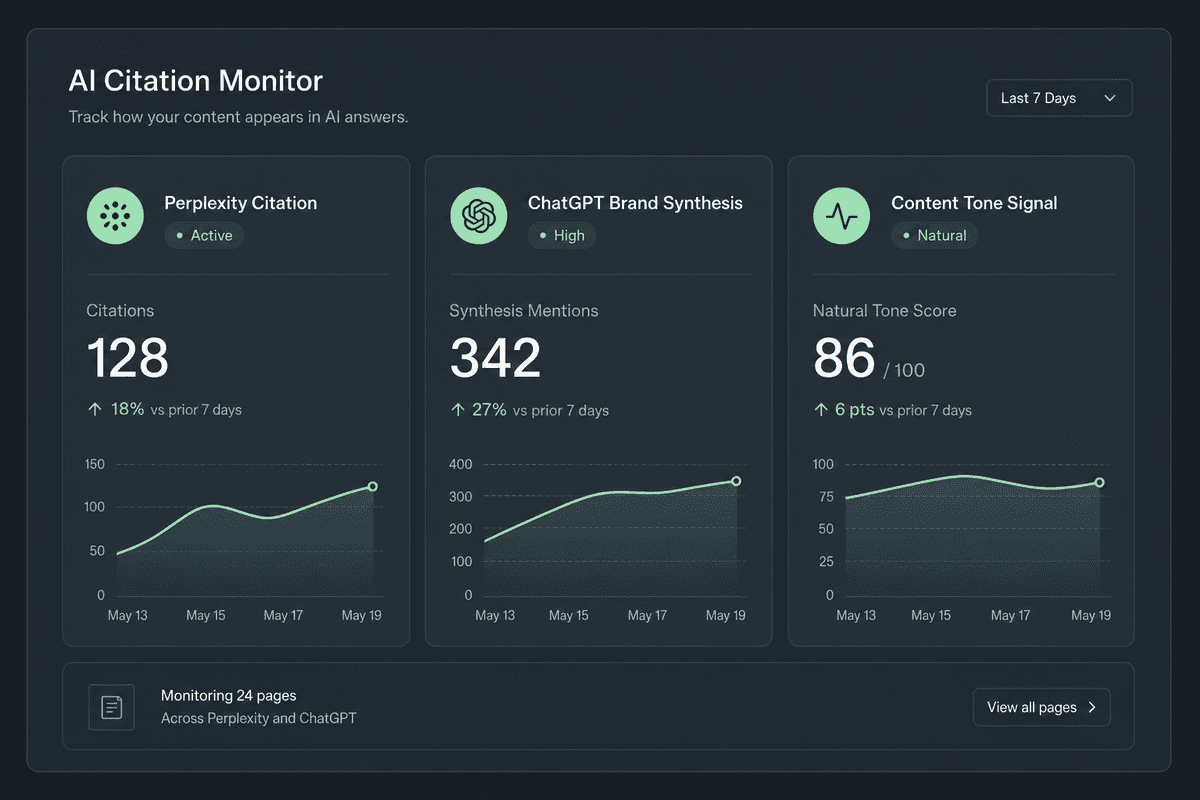
Monitoring AI visibility allows you to see exactly where your current content strategy is failing. If BeVisible shows that your brand is completely missing from Perplexity's answers regarding your core product category, you have a visibility gap.
Traditionally, an SEO agency might suggest running your existing page through Surfer SEO to add more keywords. In 2026, the correct execution is to rewrite that content to pass human tone standards, ensuring it contains unique information gain that the AI models actually want to cite. You take those missing mentions and competitor wins, and turn them into evidence-backed, human-sounding published work.
Evaluating the Cost: Automation vs. Agencies
Shifting from legacy SEO optimization to a human-tone AI workflow requires a reassessment of resource allocation. Do you rely entirely on automated humanizer tools, or do you hire human editors to polish the AI output?
When evaluating SEO Charges UK: Agency Rates vs Automation (2026), the financial dynamics are shifting. Historically, agencies charged premium retainers to manually optimize content for scoring tools. Today, many of those same agencies are quietly using AI generators to produce the content.
This introduces a significant risk. If you are Hiring SEO Services in Phoenix? 5 Red Flags (2026) to watch out for include agencies that deliver content that feels stiff, predictable, and heavily reliant on repetitive transitions. If an agency is just feeding a keyword list into a basic LLM and returning the raw output, you are paying agency rates for content that will actively harm your AI search visibility.
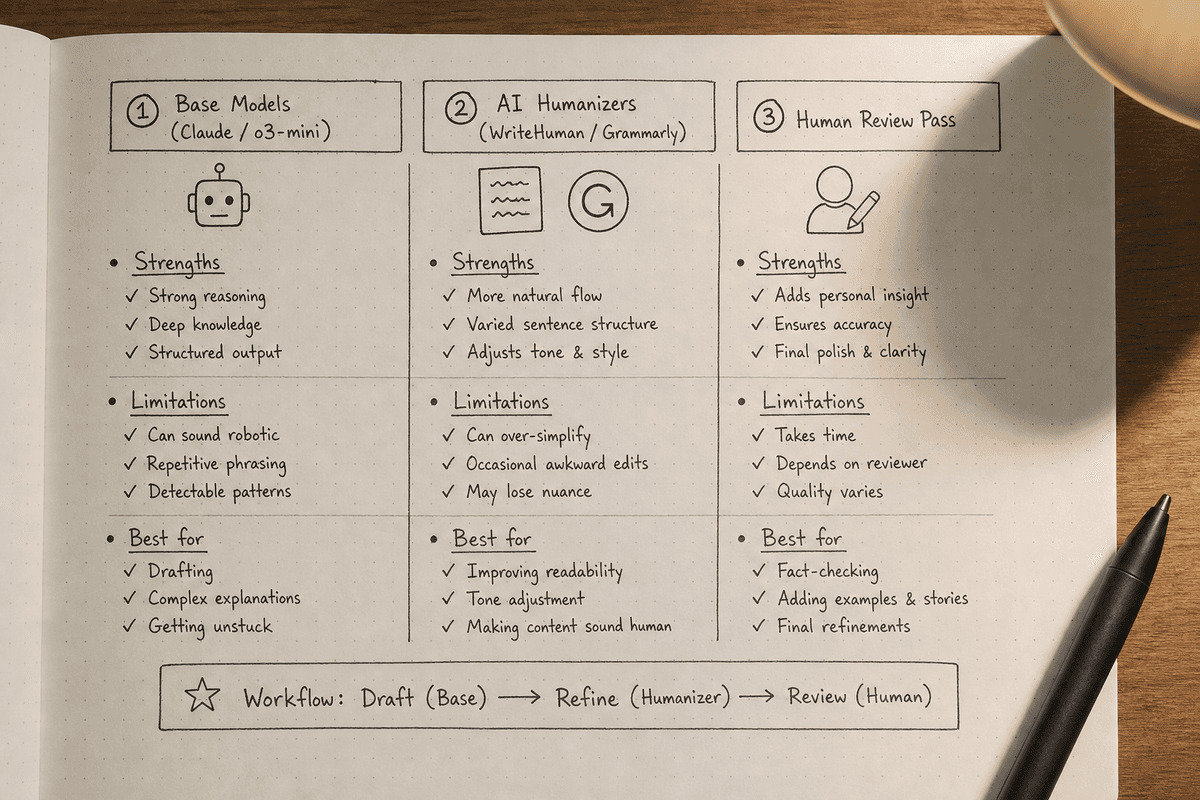
The most effective teams blend automation with targeted human oversight. They use advanced models like Claude for the heavy lifting, run the draft through a humanizer like WriteHuman or Grammarly to break up the AI rhythm, and then have a human Subject Matter Expert review the piece for factual accuracy and brand voice alignment.
Content Formatting: Avoiding the Predictable Layouts
Passing human tone standards isn't just about the words; it is also about the visual presentation of the information. AI generators often default to highly predictable structural layouts. They love to output information in long, uninspired bulleted lists or unnecessary summary paragraphs.
The Problem with Forced Structure
If you ask an AI to compare two software tools, it will almost always generate a rigid point-by-point comparison that feels deeply unnatural. A human writer would synthesize the comparison, highlighting the key tradeoffs and weaving the features into a narrative about use cases.
Using Tables Effectively
When comparing data, features, or specifications, standard markdown tables are highly effective. They organize information cleanly without requiring the AI to write forced transitional prose.
Using simple, clear structures like the table above helps break up the text naturally. It provides high information density without triggering the structural flags that AI detectors look for.
Advanced Strategies for Technical Content
Applying human tone standards becomes significantly more difficult when writing highly technical content. When discussing complex architectural topics, the vocabulary is inherently restricted. You cannot easily swap out technical terms for casual synonyms without losing accuracy.
The Technical Content Dilemma
Consider writing about Single-Page Application SEO: What Works in 2026?. The article requires precise terminology regarding client-side rendering, dynamic routing, and DOM manipulation.
If you run this type of technical content through an aggressive AI humanizer, the tool might attempt to increase the "perplexity" of the text by replacing "DOM manipulation" with "altering the document framework." This ruins the accuracy of the piece.
Technical Prompting Best Practices
To maintain human tone in technical content without sacrificing accuracy, you must restrict the AI's ability to alter core entities while demanding structural variation.
- Lock the Entities: In your prompt, explicitly list the technical terms that must not be altered or swapped for synonyms.
- Demand Structural Variety: Prompt the model specifically to vary sentence length. For example: "Explain client-side rendering. Use a mix of short, punchy sentences and longer explanatory sentences. Do not use words like 'furthermore' or 'moreover'."
- Use Analogies: Human experts explain complex topics by bridging the gap with analogies. Prompting the AI to include a real-world analogy for a technical concept naturally injects high-perplexity, human-sounding text into the middle of a technical explanation.
This approach ensures that a piece like Implementing SEO in Single Page Applications (3 Ways) remains technically flawless while still reading like it was written by a senior developer rather than a machine learning model.
Building a Culture of Continuous Learning
The landscape of AI content generation and AI search visibility is moving incredibly fast. The models that sound human today will be the detectable baselines of tomorrow. The humanizer tools that effectively bypass detectors this month will need to update their algorithms next month.
For SaaS founders and growth teams, staying ahead requires continuous monitoring and education. Following the 11 Best SEO Blogs Every SaaS Founder Needs (2026) is a good starting point, but practical execution requires internal testing.
You must continuously monitor your own content against the actual outputs of AI assistants. If ChatGPT starts dropping your brand from its recommendations, you need to investigate whether your latest batch of content triggered its internal quality filters due to robotic tone.

Frequently Asked Questions (FAQ)
Does humanizing AI content guarantee indexing in Google and AI Overviews?
No tool can guarantee indexing or placement. However, humanizing your content removes the primary roadblocks that prevent modern search engines and RAG models from trusting your content. AI models prioritize natural, authoritative, and unique information. Bypassing predictable AI patterns ensures your content is evaluated on its actual merits rather than being filtered out as low-effort spam.
Can I still use traditional SEO scoring tools alongside AI humanizers?
Yes, but the relationship must change. You can use traditional tools to identify missing topics or important sub-themes, but you should not obsess over hitting a specific score or exact keyword density. Use the SEO tool for research, build the content using a human-tone workflow, and prioritize the natural flow of the text over the tool's arbitrary score.
Which AI model currently sounds the most human by default?
As of 2026, Claude (by Anthropic) consistently scores the highest for natural, nuanced, and human-like writing out of the box. It is highly adept at following brand voice guidelines and naturally avoids the repetitive structures common in other base models. OpenAI's o3-mini is also exceptionally strong for highly detailed, context-rich outputs that require deep reasoning without sounding robotic.
How do I know if my content sounds too robotic?
The most practical test is to read it aloud. If you find yourself stumbling over unnatural transitions, or if every paragraph feels exactly the same length and rhythm, the content is likely suffering from low burstiness. Additionally, using BeVisible to monitor how AI assistants summarize or ignore your content provides empirical data on whether your tone is successfully signaling authority to the models.
The Future of Content Execution
The era of writing for the algorithm is over, primarily because the algorithm now reads like a human.
Relying on traditional SEO scoring tools to guide your content generation ensures that your output will sound predictable, dense, and monotonous. In a landscape where visibility is dictated by AI assistants summarizing the best available information, content that reads like it was written by a machine will simply be ignored.
By transitioning to a workflow that utilizes advanced base models like Claude or o3-mini, and employing dedicated humanizers like WriteHuman or Grammarly, content teams can break free from the constraints of legacy SEO. It allows you to focus on what actually matters: providing deep, context-rich, and uniquely valuable information that AI models actively want to cite.
Monitor your visibility gaps, understand how the models are responding to your tone, and turn those insights into published work that resonates with both the machine learning algorithms and the human buyers reading the final output.