
Most marketing teams think they have an automated SEO pipeline because they connected a keyword research tool to an AI writer. For years, platforms like Surfer SEO dominated this workflow, popularizing the idea that you could simply drop a keyword into a text box, let the software generate a brief, and push a button to get a fully optimized draft.
That is not a pipeline. That is an assembly line for average content.
If you are trying to build an automated B2B SEO pipeline in 2026, you are looking for an orchestration system that handles much more than just content scoring. A true pipeline requires a stack that covers five distinct layers: keyword and intent intelligence, technical site health, content optimization, automated publishing, and AI visibility reporting.
No single software tool fully owns all five layers. Replacing Surfer SEO in an enterprise context means abandoning the "all-in-one" content writer and instead assembling a stack of specialized orchestration and SEO platforms.
Here is how modern B2B growth teams are architecting their automated pipelines, the software they use to do it, and why the traditional approach to content scoring is no longer enough.
The 5-Layer Architecture of a B2B SEO Pipeline
To understand why a single tool falls short, you have to look at the anatomy of an automated search operation. When you attempt to force all of these functions into a single interface, you end up with bottlenecks.
 A functional pipeline moves data sequentially through these stages:
- Intelligence: Mining competitor gaps, search volume, and search engine results page (SERP) features.
- Technical Health: Ensuring the target environment is actually crawlable and indexable before deploying content.
- Generation & Optimization: The actual creation of the asset, aligned with semantic entities and brand voice.
- Publishing: Routing the approved asset to the CMS and updating internal link graphs.
- Iteration: Monitoring how the published asset performs across both traditional search and AI assistants, then feeding that data back into layer one.
Layer 1: Core SEO Intelligence Engines
Data is the foundation of any serious B2B SEO automation setup. You cannot automate content creation if your inputs are based on flawed assumptions about search intent or ranking difficulty. The tools in this layer do not "automate SEO" on their own; rather, they serve as the data feed for your downstream workflows.
Semrush
Semrush operates as the intelligence backbone for pipelines that rely heavily on third-party integrations. Rather than just using its web interface, B2B teams use its API to automatically pull keyword variations, search volume, and keyword difficulty scores into centralized databases like Airtable or Google Sheets.
Why it fits the pipeline:
- It offers a robust API that integrates natively with orchestration platforms like Make and Zapier.
- The keyword database is expansive enough to support programmatic SEO campaigns targeting thousands of long-tail B2B variations.
- You can automate competitor gap analysis, triggering an alert to your content team whenever a primary competitor ranks for a new high-value term.
Ahrefs
For pipelines built around backlink velocity and competitor movement, Ahrefs is the standard. While Semrush excels in broad keyword intelligence, Ahrefs provides highly granular data on how pages are acquiring links and changing SERP positions over time.
Why it fits the pipeline:
- You can build automated workflows that detect when a competitor loses a high-quality backlink, automatically generating an outreach task for your team.
- The data extraction API allows developers to pull massive datasets into business intelligence tools for custom dashboarding.
- It is particularly effective for identifying low-competition, high-intent topics in niche B2B software categories.
Moz Pro
Moz Pro serves as a reliable data layer for lighter pipelines. Teams that do not need the heavy API capabilities of Semrush or Ahrefs often lean on Moz for its straightforward Domain Authority metrics and keyword tracking. It works well for mid-market setups where the volume of automated content is lower, but the need for accurate local or regional data remains high.
Layer 2: Technical SEO Automation
A common failure mode in automated SEO is publishing hundreds of pages to an architecture that search engines cannot parse. This is especially true for modern B2B SaaS websites built on JavaScript frameworks.
You need a technical safety net that runs continuously, catching rendering issues or broken links before they degrade your organic performance.
Screaming Frog SEO Spider
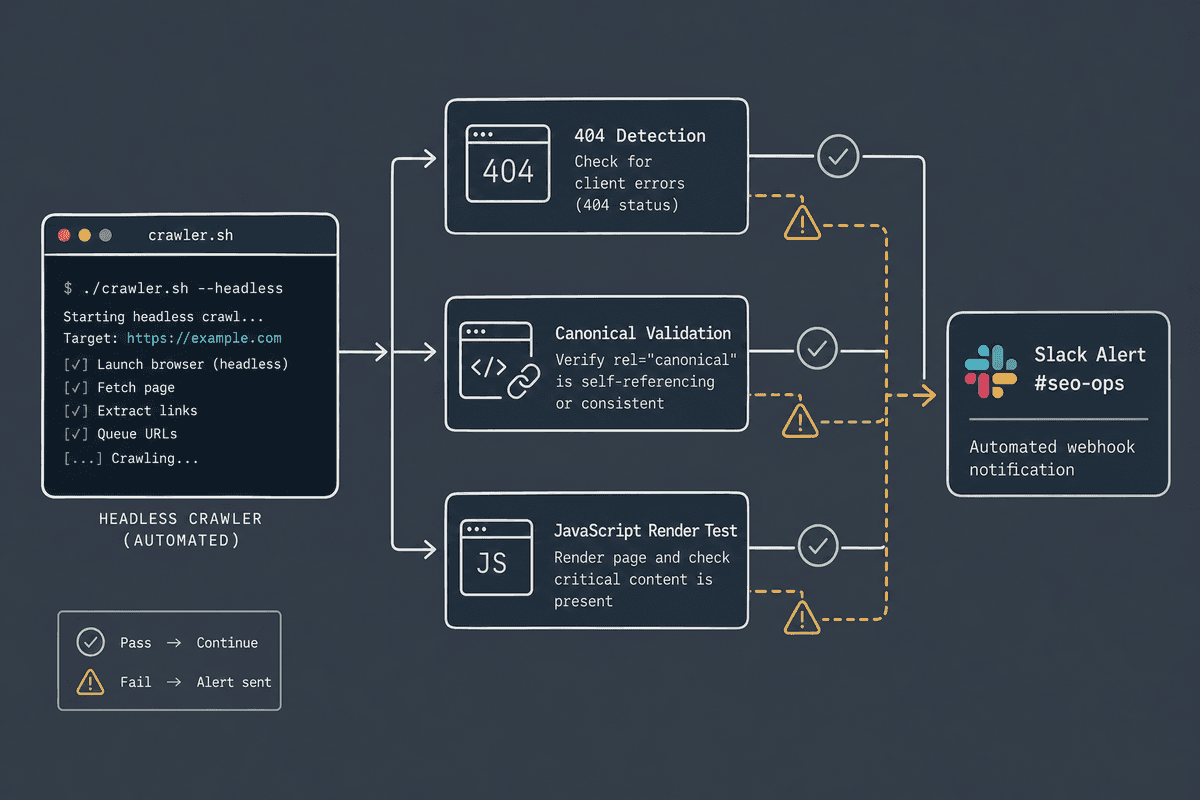
Screaming Frog is traditionally viewed as a manual desktop crawler, but its command-line interface makes it a powerful automation engine.
Implementation details: You can script Screaming Frog to run headless on a virtual machine, crawling your site every night. It can automatically export the crawl data into Google Sheets, cross-reference it with Google Analytics data via API, and ping a Slack channel if it detects an anomalous spike in 404 errors or missing canonical tags.
Lumar (formerly DeepCrawl)
Lumar is built for continuous crawling and alerting at an enterprise scale. If you are operating a massive B2B site with thousands of programmatic landing pages, running desktop crawlers becomes inefficient. Lumar monitors site health from the cloud, making it highly effective for automated issue-detection pipelines.
The JavaScript Rendering Challenge
Technical automation gets complicated when dealing with client-side rendering. If your marketing site shares a codebase with your web application, standard crawlers might just see a blank page. Implementing technical safeguards here is non-negotiable. If you are dealing with these environments, setting up a pipeline requires specific rendering rules. You can review the exact requirements in SEO for Single Page Applications: The Technical Checklist, which outlines how to configure your automated tools to handle dynamic content. Failing to account for this will render your entire content pipeline invisible to Google.
Layer 3: Content Optimization (The Direct Surfer Alternatives)
This is the layer where Surfer SEO traditionally sits. Surfer automates briefs, provides content scoring, and suggests NLP (Natural Language Processing) terms. However, B2B pipelines often outgrow Surfer because its scoring system can incentivize keyword stuffing, and its bulk generation features sometimes struggle with highly technical SaaS topics.
When replacing Surfer, teams usually take one of two paths: adopting a more nuanced semantic optimization tool, or building a custom agentic AI pipeline.
Alternative 1: Clearscope
Clearscope is widely considered the premium alternative to Surfer SEO for B2B content. It focuses less on arbitrary scoring thresholds and more on comprehensive semantic relevance.
Decision criteria:
- Strengths: Clearscope's Google Docs and WordPress integrations fit seamlessly into existing editorial workflows. Its grading algorithm tends to produce more natural-sounding text than Surfer.
- Weaknesses: It is significantly more expensive, making it cost-prohibitive for massive programmatic SEO campaigns. It is best used for high-value pillar pages rather than automated bulk landing pages.
Alternative 2: Dashword or Frase
For teams looking for a middle ground, Frase and Dashword provide strong brief-building automation and content scoring at a more accessible price point. Frase, in particular, has strong features for analyzing the exact headings and questions used by competitors, allowing you to automate the initial structuring of a B2B blog post.
Alternative 3: Agentic AI Pipelines (The Custom Build)
The most advanced B2B marketing teams are abandoning off-the-shelf scoring tools entirely. Instead, they are building their own content generation engines using orchestration platforms like Make.com paired with Large Language Models (LLMs) like Claude 3.5 Sonnet or OpenAI's GPT-4.
How a custom pipeline works:
- Make.com receives a web-hook containing a target keyword from Semrush.
- Make triggers an API call to scrape the top 10 ranking pages for that keyword.
- The text from those pages is fed into Claude via API, alongside a strict custom prompt containing your specific brand voice guidelines, product features, and formatting rules.
- Claude generates a highly technical, formatted draft that actually sounds like your company, bypassing the generic output typical of out-of-the-box SEO writers.
This approach gives you total control over the output quality while maintaining the speed of automation.
Layer 4: Automated Publishing and Internal Linking
Generating content is only half the battle. If an editor has to spend 45 minutes manually uploading a post to WordPress, formatting headings, adding alt text, and finding relevant internal links, your pipeline is broken.
Headless CMS Integrations
Modern pipelines use headless CMS platforms (like Contentful, Sanity, or Ghost) combined with API endpoints to handle publishing automatically. Once a draft is approved in a system like Airtable, a webhook fires, pushing the markdown text directly into the CMS.
For teams building high-volume campaigns, standardizing the page structure is a prerequisite for automation. The data fields in your database must map perfectly to the components on your site. For a breakdown of how to structure these templates effectively, How to Build an SEO Landing Page (7-Step Guide) covers the exact layout requirements needed for a smooth automated deployment.
Programmatic Internal Linking
Internal linking is notoriously difficult to automate well. Automated plugins often match exact keywords and insert links blindly, resulting in unnatural phrasing and poor user experience.
A better automated pipeline handles internal linking during the generation phase. By feeding your existing sitemap and a list of priority URLs into your LLM prompt (Layer 3), the AI can weave relevant, context-rich internal links into the draft naturally before it ever reaches the CMS.
Layer 5: Reporting, Iteration, and AI Visibility
This is where legacy SEO pipelines fail completely.
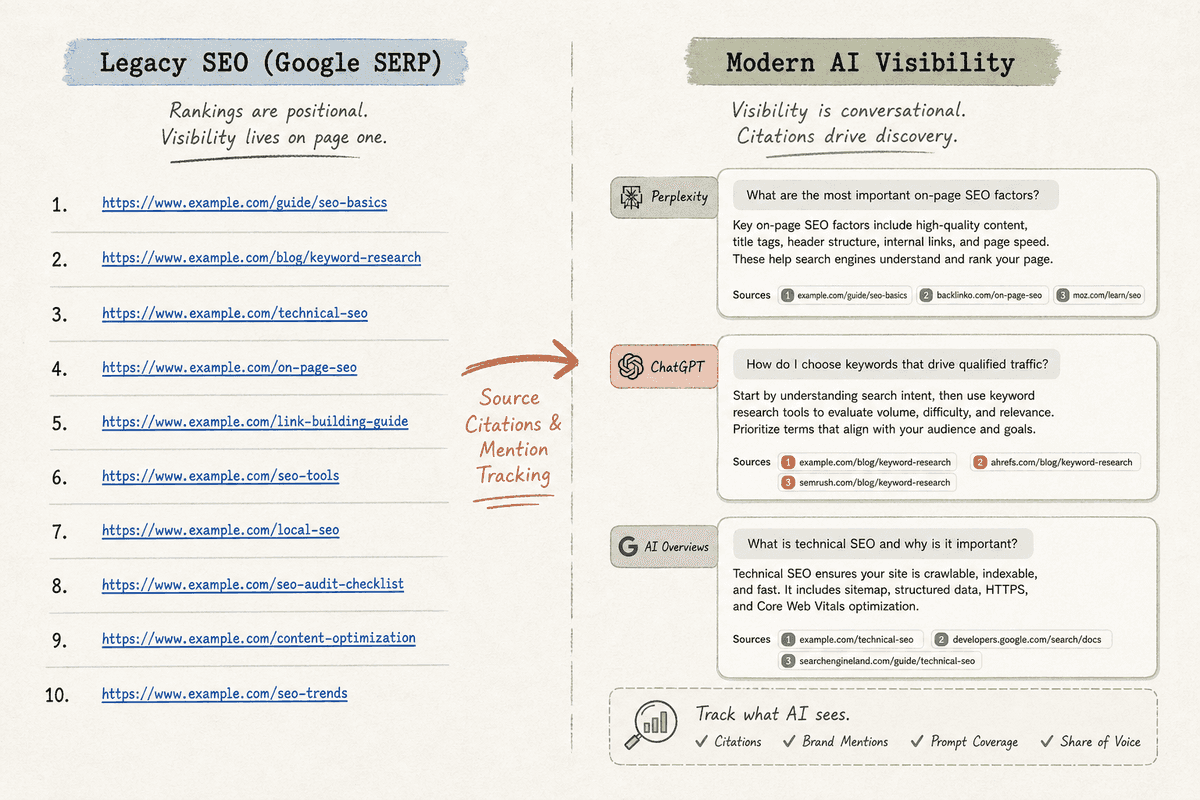
Traditional pipelines end by pushing data to a rank tracker. They monitor Google positions for ten blue links and report on organic traffic. In 2026, that is a massive blind spot. B2B software buyers are no longer just typing queries into Google; they are asking ChatGPT for software recommendations, researching features in Perplexity, and relying on AI Overviews for quick answers.
If your automated pipeline is entirely focused on optimizing for Google's traditional algorithm, you are missing the platforms where mid-market and enterprise buyers actually make decisions.
Enter BeVisible: Orchestrating AI Visibility
To close the loop on a modern pipeline, you need to track how AI assistants process and recommend your brand. BeVisible is designed precisely for this gap in the automation stack.
Instead of just tracking keyword rankings, BeVisible helps teams monitor how AI assistants answer specific buyer questions. It tracks platforms like ChatGPT, Gemini, Perplexity, and AI Overviews, providing clear data on which brands these tools recommend and which sources they cite.
Turning gaps into automated workflows: A robust pipeline does not just report data; it acts on it. When BeVisible identifies a visibility gap—perhaps ChatGPT is recommending a competitor because your site lacks clear feature documentation—it turns that missing mention into an evidence-backed opportunity. You can feed this gap directly back into Layer 1 of your pipeline, triggering the creation of new comparison pages or detailed technical documentation designed specifically to be ingested by LLM crawlers.
This creates a self-healing pipeline:
- BeVisible detects a missing recommendation in Gemini.
- The gap triggers a topic requirement in your orchestration tool.
- The custom AI pipeline generates the necessary technical content to address the gap.
- The content is published, giving Gemini the citations it needs to recommend you in the future.
Scenario: Building a Self-Sustaining Competitor Pipeline
To see this stack in action, consider a mid-market SaaS company that provides API monitoring tools. They want to capture traffic from users searching for alternatives to their largest competitor.
Instead of manually writing dozens of comparison pages, they orchestrate a pipeline.
First, they use Ahrefs (Layer 1) to identify every variation of "[Competitor] alternatives." They export this list into Airtable.
Next, they set up a Make.com scenario (Layer 3). For every row in Airtable, Make pulls the competitor's current pricing and feature set from a database. It feeds this structured data to Claude via API, applying a prompt that enforces the company's brand voice and strictly forbids generic marketing jargon. Claude writes a highly factual, markdown-formatted comparison page.
The drafted text is pushed to Webflow via API (Layer 4), where it sits in a staging environment for a quick 5-minute human review.
Once published, Lumar (Layer 2) ensures the new pages are rendering correctly for search bots. Finally, the team uses BeVisible (Layer 5) to monitor Perplexity. They track queries like "What is the best alternative to [Competitor]?" to ensure their new automated pages are actually being cited by AI engines as authoritative sources.
They successfully built a pipeline that scaled their content production without degrading quality, capturing both traditional search traffic and AI-driven buyer queries.
Budgeting for Automation vs. Outsourcing
Building an orchestration stack requires upfront investment. You have to pay for the API credits, the SaaS subscriptions, and the development time to wire the webhooks together.
Many B2B founders look at the complexity of Layer 3 and Layer 4 and decide to simply hire an agency instead. However, evaluating the total cost of ownership over a 12-month period usually favors the software stack. While an agency might charge premium retainers for manual execution, a well-built automated pipeline drastically reduces the marginal cost of each new published asset.
When comparing these options, you have to weigh the initial build cost against long-term scalability. You can find a detailed breakdown of these comparative costs in SEO Charges UK: Agency Rates vs Automation (2026). Furthermore, if you do choose to outsource, be highly critical of agencies claiming to offer "automated SEO." Many are simply running your target keywords through basic tools and charging a premium for the output. Knowing what to watch out for is critical; reviewing resources like Hiring SEO Services in Phoenix? 5 Red Flags (2026) can help you avoid predatory contracts that deliver low-value automated spam.
FAQ: B2B SEO Pipeline Automation
Can you fully automate a B2B SEO pipeline end-to-end?
Technically, yes. You can wire Semrush to Make, Make to Claude, and Claude to WordPress, allowing content to publish without human intervention. Strategically, this is a terrible idea for B2B. Fully autonomous pipelines inevitably hallucinate product features or misrepresent complex industry nuances. The most effective pipelines automate the heavy lifting—data gathering, brief creation, initial drafting, and CMS routing—but always include a manual approval gate before publishing.
Does AI-generated content rank without human editing?
It can rank temporarily if the domain authority is exceptionally high, but it rarely sustains those rankings or converts B2B buyers. Search engines, and more importantly, human readers, are highly attuned to the predictable cadence of unedited AI text. The goal of an automated pipeline is not zero human involvement; the goal is leverage. The software stack should do 80% of the work so your subject matter experts can spend 100% of their time on the final 20% of refinement.
How do you track SEO pipeline ROI in AI search?
You track it by monitoring citation frequency and recommendation share on the platforms buyers actually use. If your automated pipeline is churning out hundreds of pages, but tools like Perplexity and ChatGPT refuse to cite them as authoritative sources, your content lacks unique value. Tracking these metrics requires specialized software that parses AI outputs, shifting the focus from simple Google rank tracking to comprehensive AI visibility monitoring.
The Future of B2B Pipeline Orchestration
Relying on a single piece of software to manage your entire organic search strategy is a fragile approach. Tools that attempt to do everything—keyword research, content generation, and auditing—rarely excel at any of them.
The strongest B2B marketing teams treat SEO like a software engineering challenge. They build modular pipelines. They use distinct data providers for intelligence, dedicated technical monitors for site health, highly customized LLM prompts for content generation, and sophisticated tracking systems for AI visibility.
By replacing the traditional all-in-one content spinner with a deeply integrated stack, you can scale your search presence faster, maintain strict editorial standards, and ensure your brand actually shows up when buyers ask AI for a recommendation.